Skip to content

What does a student learn in ?

This is the year social studies opens up to the whole country. Students step beyond their own community and start learning about the people, places, and ideas that built the United States, from Indigenous nations and early explorers to the founders who signed the Declaration of Independence. They locate states, oceans, and landmarks on a map, and they learn why citizens vote, follow laws, and respect each other. By spring, students can name a few American changemakers, point to Washington, D.C. on a map, and explain why people use money instead of trading one item for another.

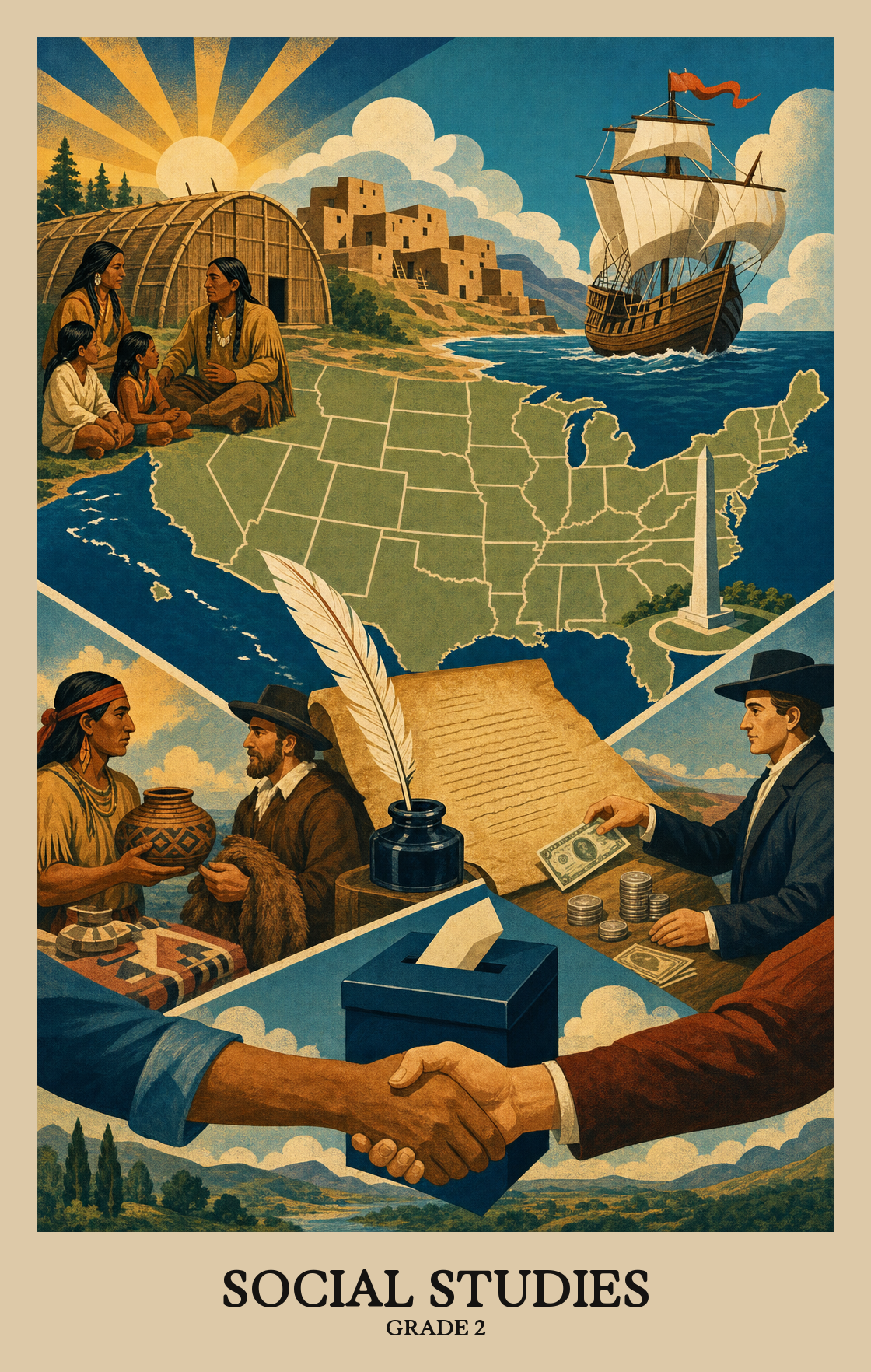
Illustration of what students learn in Grade 2 Social Studies
  • American history
  • Founders
  • Indigenous nations
  • Citizenship
  • Maps and landmarks
  • National symbols
  • Needs and wants
Source: Virginia Virginia Standards of Learning
Year at a glance
How the year usually goes. Every school and district set their own curriculum, so treat this as a guide, not official pacing.
  1. 1

    Citizens, symbols, and shared holidays

    Students start the year learning what it means to be a citizen of the United States. They look at the flag, the bald eagle, and the Statue of Liberty, and talk about why we mark days like Veterans Day and Thanksgiving.

  2. 2

    Indigenous peoples and early explorers

    Students learn about the first peoples of North America, including nations of the Eastern Woodlands, Plains, and Southwest. They then meet English, French, and Spanish explorers who came later and changed life on the continent.

  3. 3

    Founding the United States

    Students hear the story of the thirteen colonies and the people who pushed for independence, like George Washington, Thomas Jefferson, and Benjamin Franklin. They look at why the Declaration of Independence was written and what it asked for.

  4. 4

    Changemakers and growing nation

    Students meet inventors, explorers, and reformers who shaped the country, from the Wright brothers to Rosa Parks. They also see how the country grew west after the Louisiana Purchase and why Washington, D.C. became the capital.

  5. 5

    Maps, landmarks, and places

    Students practice using maps and globes to find countries, oceans, rivers, and mountains. They connect places to stories they have learned, like Valley Forge, the Lincoln Memorial, and Yellowstone National Park.

  6. 6

    Money, resources, and choices

    Students wrap up the year by looking at how people get the things they need. They sort needs from wants, compare trading with using money, and notice that resources are limited, so people have to make choices.

Mastery Learning Standards
The required skills a student should display by the end of Grade 2.
Skills
  • The student will apply history and social science skills to the content by

    S.2

    Reading maps, timelines, and graphs to answer questions about people, places, and events. Students practice these tools across history, geography, and civics all year.

  • viewing and exploring information sources, including

    S.2.a

    Students look at real objects, old photographs, charts, and other sources to find information about a topic. They practice deciding where information comes from and what it shows.

  • applying geographic skills to identify and understand geographic features and…

    S.2.b

    Students read maps and globes to find geographic features like rivers, mountains, and cities, then explain how those features connect to the way people live and move around.

  • demonstrating curiosity and critical thinking through questioning and drawing…

    S.2.c

    Students ask questions about what they're learning and use what they find to draw a conclusion. It's the habit of not just accepting an answer but thinking through why something is true.

  • sequencing and organizing information

    S.2.d

    Students put events or facts in order, from first to last, and group related information so it's easier to understand and remember.

  • identifying similarities and differences to clarify and explain content

    S.2.e

    Students look at two things side by side and explain what matches and what doesn't. This skill helps them make sense of what they're learning in history and social studies.

  • recognizing cause-and-effect relationships

    S.2.f

    Reading a story or looking at a picture, students figure out why something happened and what came next because of it.

  • using economic decision-making models to make informed economic decisions

    S.2.g

    Students practice a simple yes-or-no thinking process for spending choices: what do I want, what does it cost, and what do I give up to get it?

  • practicing civility, respect, hard work, honesty, trustworthiness

    S.2.h

    Students practice the habits that make a classroom and community work: being honest, treating others with respect, and following through on responsibilities.

  • using content vocabulary to demonstrate comprehension

    S.2.i

    Students practice using the key words from their social studies lessons, not just recognizing them, to show they actually understand what those words mean.

Civics
  • The student will apply history and social science skills to distinguish between…

    2.1

    Rights are things students are free to do or have, like speaking up or going to school. Responsibilities are the duties that come with those rights, like following rules and treating others fairly.

  • exercising freedom of expression

    2.1.a

    Freedom of expression means students can share their thoughts and opinions without being punished for it. They practice this right when they speak up in class, write what they think, or peacefully protest something they believe is unfair.

  • exercising freedom of religion

    2.1.b

    Students learn that people in the United States can choose their own religion, or no religion, without the government telling them what to believe or how to worship.

  • understanding equal protection

    2.1.c

    Equal protection means every person is treated fairly under the law, no matter what they look like or where they come from. Students learn that rules and laws in the United States are supposed to apply to everyone the same way.

  • voting for local, state

    2.1.d

    Voting is how people choose the leaders who make decisions for their community, state, and country. Students learn that casting a vote is both a right citizens hold and a responsibility that shapes who leads them.

  • respecting and following laws

    2.1.e

    Laws are rules that everyone in a community must follow. Students learn why respecting laws keeps people safe and why following them is part of being a member of a community.

  • practicing honesty and trustworthiness

    2.1.f

    Honesty means telling the truth even when it is hard. Students learn that being trustworthy, doing what you say you will do, helps their classroom and community work better for everyone.

  • respecting the rights, beliefs

    2.1.g

    Students practice treating classmates fairly even when they disagree, by listening without interrupting and accepting that others may hold different beliefs or ideas.

  • The student will apply history and social science skills to understand…

    2.2

    Citizenship means being a responsible member of a community. Students learn what citizens do, what rights they have, and how they contribute to school, neighborhood, and country.

  • identifying the benefits of being an American citizen

    2.2.a

    Being a U.S. citizen comes with real protections and freedoms. Students learn what those are, like the right to vote, go to public school, and be treated fairly under the law.

  • identifying the responsibilities of being an American citizen

    2.2.b

    Responsibilities are the things citizens are expected to do, like following laws, voting when they grow up, and helping their community. Students learn what makes someone a good citizen in their country.

  • The student will apply history and social science skills to explain how…

    2.3

    Communities mark certain days to remember people and events that matter. Students learn why Virginia and the country set aside specific holidays and how neighborhoods and towns celebrate them.

  • Labor Day

    2.3.a

    Labor Day is a holiday in September that honors workers across the country. Students learn why communities set aside a day to recognize the people whose work keeps everyday life running.

  • Columbus Day (Yorktown Victory Day)

    2.3.b

    Students learn why Columbus Day is observed in Virginia as Yorktown Victory Day, marking the 1781 battle that helped end the American Revolution.

  • Election Day

    2.3.c

    Election Day is the day communities vote to choose their leaders. Students learn why voting matters and how elections let people have a say in who makes decisions for their town, state, or country.

  • Veterans Day

    2.3.d

    Students learn why Veterans Day is observed each November and what it honors. The holiday recognizes the men and women who have served in the U.S. military.

  • Thanksgiving Day

    2.3.e

    Thanksgiving Day is a national holiday in November. Students learn why Americans have celebrated it since colonial times, including the shared meal between the Pilgrims and the Wampanoag people.

  • Christmas Day

    2.3.f

    Christmas Day (December 25) is a federal holiday when government offices, schools, and many businesses close. Students learn it as one of the official days the United States sets aside each year.

  • New Year’s Day

    2.3.g

    New Year's Day (January 1) marks the start of a new calendar year. Students learn why communities in Virginia and across the country celebrate this holiday as a shared American tradition.

  • Martin Luther King, Jr

    2.3.h

    Students learn why the country observes a federal holiday honoring Martin Luther King, Jr. and what he did to advance equal rights for all Americans.

  • George Washington Day

    2.3.i

    Students learn why Virginia sets aside a day to honor George Washington, the first U.S. president, who was born in Virginia and helped shape how the country is governed.

  • Memorial Day

    2.3.j

    Memorial Day is a national holiday when Americans honor military members who died serving the country. Students learn why communities hold parades and ceremonies each May to remember those who gave their lives.

  • Juneteenth

    2.3.k

    Students learn what Juneteenth is and why it matters. It marks June 19, 1865, the day enslaved people in Texas learned they were free, and it is now a Virginia and national holiday.

  • Independence Day

    2.3.l

    Independence Day is a federal holiday on July 4th marking the day in 1776 when American colonists declared independence from Britain. Students learn why communities celebrate with fireworks, parades, and flags each summer.

  • The student will apply history and social science skills to recognize state and…

    2.4

    State and national symbols like the flag, the bald eagle, and the state seal stand for shared values and history. Students learn to recognize these symbols and explain what they mean.

  • locating the Virginia and United States capitals and Capitol buildings

    2.4.a

    Students find Richmond and Washington, D.C. on a map and learn what happens inside the Capitol buildings where Virginia's state government and the U.S. government meet and make laws.

  • explaining the meaning behind symbols, including

    2.4.b

    Students explain what symbols like the American flag, the bald eagle, and the Statue of Liberty stand for and why the country uses them.

  • learning about the meaning of the American flag and the words chosen in the…

    2.4.c

    Students learn what the American flag stands for and why specific words were chosen for the Pledge of Allegiance and the National Anthem.

History
  • The student will use history and social science skills to identify the…

    2.5

    Students learn where Indigenous peoples have lived across North America, how they used the land and its resources, and what they contributed to their communities then and now.

  • Indigenous nations and tribes of the Eastern Woodlands

    2.5.a

    Students learn about the Native nations who lived in the forests and river valleys of the eastern part of North America, studying where they settled, how they used the land, and what they contributed to the region.

  • Indigenous nations and tribes of the Plains

    2.5.b

    Students learn about the Native nations who lived on the vast grasslands of the interior of North America, including how they hunted, traveled, and built communities on the open plains.

  • Indigenous nations and tribes of the Southwest

    2.5.c

    Students learn about Native nations like the Navajo and Pueblo peoples who have lived in the desert Southwest for thousands of years, and how their farming, building, and cultural traditions continue today.

  • understanding Tribal Sovereignty, including but not limited to the importance…

    2.5.d

    Tribal Sovereignty means Native nations have the right to govern themselves and make decisions for their own communities. Students learn why land, history, and culture matter to Indigenous peoples today, not just in the past.

  • The student will use history and social science skills to identify the…

    2.6

    Students learn where European explorers came from, why they traveled to North America, and what they found and took from the land. They look at how English, French, and Spanish explorers shaped the early history of the continent.

  • The student will apply history and social science skills to describe the…

    2.7

    Students learn about the real people who pushed back against British rule and helped start the United States. They look at what these individuals did, why it mattered, and how their choices shaped the country.

  • John Adams

    2.7.a

    Students learn who John Adams was and why he mattered during the American Revolution. He was a Massachusetts lawyer who pushed hard for independence and later became one of the country's first leaders.

  • Benjamin Franklin

    2.7.b

    Students learn who Benjamin Franklin was and why he mattered during the American Revolution. They study how he helped convince France to support the colonies and how his work as a writer, inventor, and diplomat shaped the fight for independence.

  • Alexander Hamilton

    2.7.c

    Students learn who Alexander Hamilton was and why he matters to American history. He helped lead the fight for independence, later shaped how the new government ran, and appears on the ten-dollar bill.

  • Patrick Henry

    2.7.d

    Patrick Henry was a Virginia leader who gave fiery speeches urging colonists to fight for independence from Britain. Students learn why his words mattered and how public argument helped spark the Revolution.

  • Thomas Jefferson

    2.7.e

    Students learn who Thomas Jefferson was and why he matters: the Virginia leader who wrote most of the Declaration of Independence, explaining to the world why the colonies were breaking free from British rule.

  • James Madison (“Father of the Constitution”)

    2.7.f

    Students learn who James Madison was and why he earned the nickname "Father of the Constitution." They study his role in shaping the rules and structure that still govern the United States today.

  • Paul Revere

    2.7.g

    Students learn who Paul Revere was and why he matters to the American Revolution. He is best known for his midnight ride in 1775, warning colonists that British soldiers were on their way.

  • George Washington (“Father of our Country”)

    2.7.h

    Students learn who George Washington was and why Americans called him the "Father of our Country." They study his role leading the army during the Revolution and how he helped shape the new nation.

  • The student will apply history and social science skills to understand the…

    2.8

    Students learn why the American colonies broke from Britain and what ideas the Founders used to build a new country. They connect those founding principles to how the United States still works today.

  • identifying reasons for the settlement of the thirteen colonies

    2.8.a

    Students learn why people left Europe to start new lives in the thirteen original colonies, including the search for religious freedom, better land, and economic opportunity.

  • explaining the relationships between the colonies and Great Britain

    2.8.b

    Students learn why the American colonies and Britain went from close partners to bitter rivals. They practice explaining how British rules and taxes pushed colonists toward independence.

  • identifying key components of the Declaration of Independence

    2.8.c

    Students read the Declaration of Independence and pick out its main ideas, including why the colonists broke from Britain and what rights they believed every person deserved.

  • The student will apply history and social science skills to understand key…

    2.9

    Students learn about turning points in U.S. history by studying real events, reading maps and timelines, and practicing the same skills historians use to figure out what happened and why it mattered.

  • recognizing the reasons for moving the nation’s capital from Philadelphia to…

    2.9.a

    Students learn why the U.S. capital moved from Philadelphia to Washington, D.C., and why having a capital city matters for the country.

  • describing the impact of the Louisiana Purchase on the westward expansion of…

    2.9.b

    Students learn how buying a huge piece of land from France in 1803 opened a path for Americans to settle farther west. They describe how that purchase nearly doubled the size of the country.

  • The student will describe the contributions and roles of changemakers in United…

    2.10

    Students learn about real people who worked to change or improve life in the United States. They describe what those people did and why it mattered.

  • Scholars and Inventors

    2.10.a

    Students learn who these historical figures were and what they created or discovered, and how those inventions and ideas changed everyday life in America.

  • Explorers and Adventurers

    2.10.b

    Students learn who Lewis, Clark, Sacagawea, Amelia Earhart, and Neil Armstrong were and what each one discovered or accomplished by going somewhere no one had gone before.

  • Reformers and Champions

    2.10.c

    Students learn who these historical figures were and what they fought to change. Each person on this list worked to make life fairer for a group of Americans who had been treated unjustly.

Geography
  • The student will apply history and social science skills to develop geographic…

    2.11

    Reading a world map or globe, students practice finding continents, oceans, and other places. They learn to use directions, symbols, and map keys to make sense of what they see.

  • locating the countries of North America and the bordering oceans

    2.11.a

    Students find and name the countries of North America on a map or globe, along with the oceans that border the continent on each side.

  • identifying major rivers, mountain ranges, lakes

    2.11.b

    Students locate and name major physical features of the United States on a map, such as large rivers, mountain ranges, and lakes.

  • The student will apply history and social science skills to connect geography…

    2.12

    Students match real places to the events that happened there, like connecting a battlefield to a battle or a monument to the person it honors.

  • Jefferson Memorial and Lincoln Memorial

    2.12.a

    Students learn what the Jefferson Memorial and Lincoln Memorial are, where they stand in Washington, D.C., and why the country built them to honor two presidents who shaped American history.

  • Valley Forge and George Washington’s crossing of the Delaware River

    2.12.b

    Students learn how the geography of rivers and cold valleys shaped key moments in the American Revolution, including why Washington crossed the Delaware River and what soldiers endured at Valley Forge.

  • Yellowstone National Park

    2.12.c

    Students learn what Yellowstone National Park is, where it sits in the western United States, and why the country set it aside as protected land. It connects geography to the idea that some places are preserved because of what makes them rare or significant.

Economics
  • The student will apply history and social science skills to understand basic…

    2.13

    Reading a price tag, choosing between two items with limited money, or recognizing that jobs earn income are the starting points here. Students learn that people make choices about spending and saving because no one can have everything they want.

  • identifying natural resources

    2.13.a

    Resources are the things used to make goods or provide services. Students sort them into three groups: things found in nature like water or wood, people doing the work, and tools or machines that help get the job done.

  • distinguishing between needs and wants

    2.13.b

    Needs are things people must have to survive, like food and shelter. Wants are things people would like but can live without. Students practice telling the difference between the two.

  • distinguishing between the use of barter and the use of money in the exchange…

    2.13.c

    Barter means trading one thing directly for another, like swapping apples for bread. Money makes trading easier because both people agree it has value, so you can buy or sell anything without needing something the other person wants.

  • explaining that scarcity

    2.13.d

    Scarcity means there isn't enough of something for everyone. Students learn why limited resources force people to decide what to make, buy, or use, and what to give up instead.

No state assessments at this grade
Students take their next one in Grade 3.
Alternate assessment

Virginia Alternate Assessment Program

Alternate assessment program for eligible students with significant cognitive disabilities, covering state-tested grades and subjects.

When given:
state testing window
Frequency:
annual
Official source
Common Questions
  • What does social studies look like this year?

    Students learn about American citizenship, holidays, and symbols like the flag and the Statue of Liberty. They study Indigenous nations, early explorers, the people who founded the country, and changemakers like Rosa Parks and Jackie Robinson. They also start using maps, globes, and basic ideas about money and resources.

  • How can a parent help with social studies at home?

    Talk about holidays as they come up and what each one honors. Pull up a map when a place comes up in conversation or on TV. Ask questions like why people moved somewhere or how a rule got made, and let students share what they think.

  • Which people and events should students know by name?

    Students should recognize George Washington, Thomas Jefferson, Benjamin Franklin, Abraham Lincoln, Rosa Parks, Martin Luther King Jr., and Sacagawea, among others. They should also know the Declaration of Independence, the Louisiana Purchase, and why the capital moved to Washington, D.C.

  • How should the year be sequenced?

    A common path starts with citizenship, symbols, and holidays in the fall, since holidays land naturally across the calendar. Indigenous nations, explorers, and the founding of the country fit well in winter. Geography, changemakers, and basic economics round out the spring.

  • What does a parent do when a child gets confused about history dates?

    Skip the dates and focus on the order of events. A simple timeline on the fridge with three or four sticky notes works well. Students at this age remember stories and people, so retell what happened and why it mattered before worrying about the year.

  • What economics ideas do students need to grasp?

    Students learn the difference between needs and wants, and between natural, human, and capital resources. They also learn that money makes trading easier than barter, and that limited resources mean people have to choose. A trip to the grocery store is a good place to practice these ideas.

  • Which skills usually need the most reteaching?

    Cause and effect tends to be the hardest, especially when events feel far away. Map reading also takes repeated practice, since students confuse states, countries, and continents. Build both into short warm-ups across the year instead of saving them for one unit.

  • How does a teacher know students are ready for next year?

    Students should be able to name a few founding figures and changemakers, explain what a citizen does, and point to the United States on a map. They should also sort needs from wants and give a simple reason for an event, such as why colonists wanted independence.

  • Does a child need to memorize the Pledge of Allegiance and the National Anthem?

    Students hear both often and pick up the words over time. What matters more is understanding what the words mean, such as what a pledge is and why people stand for the flag. Talk through a line or two at home if questions come up.