Westward expansion and Reconstruction
Students start the year after the Civil War. They look at why settlers moved west, what happened to Indigenous peoples already living there, and how the country tried to rebuild itself once the war ended.
This is the year the story of the United States moves from the Civil War to today. Students trace how the country grew west, rebuilt after slavery, filled with factories and immigrants, and fought two world wars. They learn how the Cold War, the Civil Rights movement, and September 11 shaped the country families live in now. By spring, students can place big events on a timeline and explain what caused them.
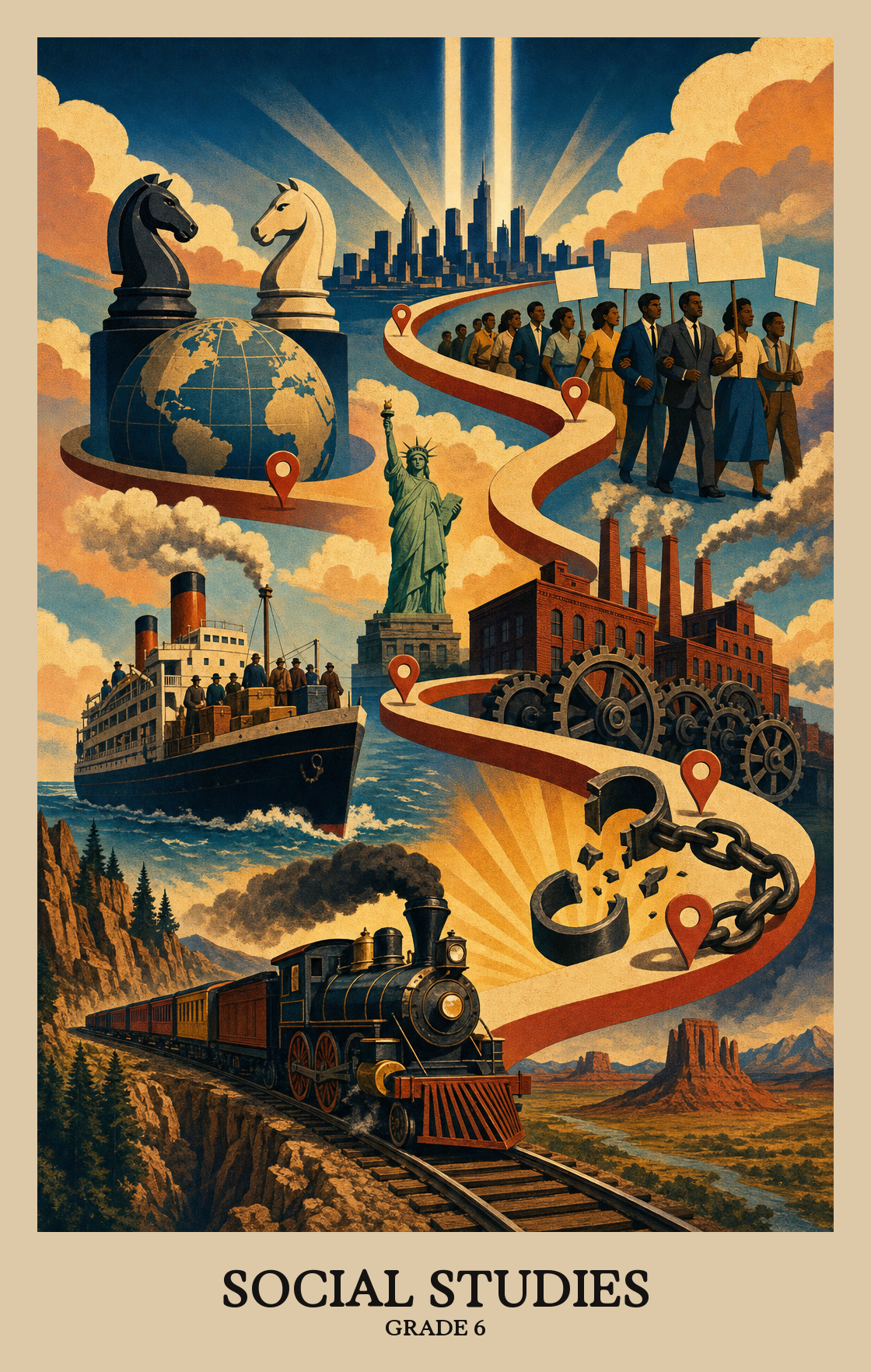
Students start the year after the Civil War. They look at why settlers moved west, what happened to Indigenous peoples already living there, and how the country tried to rebuild itself once the war ended.
Students study the rise of factories, railroads, and big cities. They learn why millions of immigrants came to the United States, what life was like for workers and children, and how reformers pushed for safer jobs and the right to vote.
Students follow the country into its first world war and through the years that came after. They look at the Roaring Twenties, the Harlem Renaissance, the stock market crash, the Dust Bowl, and the New Deal programs that tried to help people recover.
Students examine the causes of World War II, the major battles in Europe and the Pacific, and the Holocaust. They also look at what life was like back home, including women in factories and the incarceration of Japanese Americans.
Students follow the long standoff between the United States and the Soviet Union. They also study the leaders, marches, and laws of the Civil Rights Era and how everyday people pushed the country to change.
Students close the year by looking at recent decades. They study September 11, the Americans with Disabilities Act, and the way new technology and media have shaped how people work, learn, and talk to each other.
Reading maps, analyzing sources, and comparing different perspectives to make sense of U.S. history. Students practice the thinking skills historians use, not just the facts.
Students pull together clues from multiple sources, such as old letters, photos, charts, and graphs, to piece together what actually happened in U.S. history.
Students use maps and geographic data to spot patterns, like where populations cluster or why certain events happen in certain places, and then predict how those patterns might shift over time.
Students write questions about a topic before diving in, then look closely at sources to figure out what they mean and whether they can be trusted.
Students build timelines by pulling dates and events from sources, then sort those events into categories and decide which claims are facts and which are someone's opinion.
Students look at two historical events, people, or viewpoints side by side to find what they have in common and where they differ.
Students trace why a historical event happened and what it set in motion. They explain the connection in their own words, not just name the event.
Students look at a real decision from U.S. history and weigh what it cost against what it gained. They explain what pushed people toward that choice and what happened as a result.
Students practice disagreeing respectfully and listening to people who see an issue differently. The goal is to exchange ideas clearly, not to win.
Students turn what they've learned into a finished product, like a map, poster, or written piece, that shows how well they understand the topic.
| Standard | Definition | Code |
|---|---|---|
| The student will apply history and social science skills to the content by | Reading maps, analyzing sources, and comparing different perspectives to make sense of U.S. history. Students practice the thinking skills historians use, not just the facts. | S.USII |
| synthesizing evidence from information sources, including | Students pull together clues from multiple sources, such as old letters, photos, charts, and graphs, to piece together what actually happened in U.S. history. | S.USII.a |
| applying geographic skills to determine and predict patterns and trends of… | Students use maps and geographic data to spot patterns, like where populations cluster or why certain events happen in certain places, and then predict how those patterns might shift over time. | S.USII.b |
| developing questions, enhancing curiosity | Students write questions about a topic before diving in, then look closely at sources to figure out what they mean and whether they can be trusted. | S.USII.c |
| integrating evidence to construct and analyze timelines, classify events | Students build timelines by pulling dates and events from sources, then sort those events into categories and decide which claims are facts and which are someone's opinion. | S.USII.d |
| comparing and contrasting people, places, events | Students look at two historical events, people, or viewpoints side by side to find what they have in common and where they differ. | S.USII.e |
| determining and explaining cause-and-effect relationships | Students trace why a historical event happened and what it set in motion. They explain the connection in their own words, not just name the event. | S.USII.f |
| using an economic decision-making model to analyze the costs and benefits and… | Students look at a real decision from U.S. history and weigh what it cost against what it gained. They explain what pushed people toward that choice and what happened as a result. | S.USII.g |
| engaging and communicating as a civil and informed individual with persons with… | Students practice disagreeing respectfully and listening to people who see an issue differently. The goal is to exchange ideas clearly, not to win. | S.USII.h |
| developing products that reflect an understanding of content | Students turn what they've learned into a finished product, like a map, poster, or written piece, that shows how well they understand the topic. | S.USII.i |
Westward expansion describes how the United States pushed its borders to the Pacific after the 1850s. Students examine what drove settlers west, how the federal government backed that movement, and what it cost the Indigenous peoples already living on that land.
Students learn how tools like the railroad, the steel plow, and barbed wire let settlers move into and farm the Great Plains despite the harsh terrain and weather.
Students identify what drew settlers westward: land, gold, trade routes, and the promise of a fresh start. They look at who made those journeys and why, including the government policies that pushed expansion forward.
Students look at how government decisions, laws, and agreements with Native nations shaped who controlled land and resources as the United States expanded west.
Students examine how U.S. expansion pushed Indigenous peoples off their lands, disrupted their ways of life, and forced relocation through treaties that were often broken.
| Standard | Definition | Code |
|---|---|---|
| The student will apply history and social science skills to examine westward… | Westward expansion describes how the United States pushed its borders to the Pacific after the 1850s. Students examine what drove settlers west, how the federal government backed that movement, and what it cost the Indigenous peoples already living on that land. | USII.1 |
| explaining how technology allowed settlers to adapt to the physical features… | Students learn how tools like the railroad, the steel plow, and barbed wire let settlers move into and farm the Great Plains despite the harsh terrain and weather. | USII.1.a |
| identifying the motivations for westward expansion | Students identify what drew settlers westward: land, gold, trade routes, and the promise of a fresh start. They look at who made those journeys and why, including the government policies that pushed expansion forward. | USII.1.b |
| examining the impact of policies, legislation | Students look at how government decisions, laws, and agreements with Native nations shaped who controlled land and resources as the United States expanded west. | USII.1.c |
| explaining the effect that the growth of the United States had on Indigenous… | Students examine how U.S. expansion pushed Indigenous peoples off their lands, disrupted their ways of life, and forced relocation through treaties that were often broken. | USII.1.d |
Reconstruction reshaped the country after the Civil War. Students study how the laws, conflicts, and compromises of that era still show up in American politics, race relations, and daily life today.
Students learn what changed in the country after Lincoln was killed and the Civil War ended. They look at how his death shifted who held power and what decisions got made about rebuilding the nation.
Students examine what the 13th, 14th, and 15th Amendments, the Freedmen's Bureau, and early civil rights laws actually did. The focus is on how those policies changed who counted as a citizen and what rights that carried.
Students describe what each of these figures left behind after the Civil War and Reconstruction: Lincoln's words at Gettysburg, Grant and Lee's roles in the war's outcome, and the push by Revels and Douglass for Black civil rights.
Congress and the Supreme Court shaped how the South rejoined the Union after the Civil War. Students learn how competing plans, including Lincoln's Ten Percent Plan, set the terms for rebuilding the country and what that meant for formerly enslaved people.
Formerly enslaved people and others ran for office and won seats in state and federal government during Reconstruction. Students examine who those individuals were, what motivated them, and what changed because they held power.
Students trace how the disputed 1876 presidential election ended with a political deal that pulled federal troops out of the South, finishing Reconstruction and leaving formerly enslaved people without government protection.
| Standard | Definition | Code |
|---|---|---|
| The student will apply history and social science skills to understand the… | Reconstruction reshaped the country after the Civil War. Students study how the laws, conflicts, and compromises of that era still show up in American politics, race relations, and daily life today. | USII.2 |
| describing the impact of the assassination of Abraham Lincoln and the political… | Students learn what changed in the country after Lincoln was killed and the Civil War ended. They look at how his death shifted who held power and what decisions got made about rebuilding the nation. | USII.2.a |
| analyzing the goals and effects of the Reconstruction Amendments, the… | Students examine what the 13th, 14th, and 15th Amendments, the Freedmen's Bureau, and early civil rights laws actually did. The focus is on how those policies changed who counted as a citizen and what rights that carried. | USII.2.b |
| describing the legacies of Abraham Lincoln and the Gettysburg Address, Ulysses S | Students describe what each of these figures left behind after the Civil War and Reconstruction: Lincoln's words at Gettysburg, Grant and Lee's roles in the war's outcome, and the push by Revels and Douglass for Black civil rights. | USII.2.c |
| describing the role of Congress and the Supreme Court in Reconstruction plans… | Congress and the Supreme Court shaped how the South rejoined the Union after the Civil War. Students learn how competing plans, including Lincoln's Ten Percent Plan, set the terms for rebuilding the country and what that meant for formerly enslaved people. | USII.2.d |
| describing the role and motivations of individuals who sought to gain from… | Formerly enslaved people and others ran for office and won seats in state and federal government during Reconstruction. Students examine who those individuals were, what motivated them, and what changed because they held power. | USII.2.e |
| explaining how the 1876 presidential election led to the end of Reconstruction | Students trace how the disputed 1876 presidential election ended with a political deal that pulled federal troops out of the South, finishing Reconstruction and leaving formerly enslaved people without government protection. | USII.2.f |
Industrialization reshaped where Americans lived and how they worked. Students examine how factories, railroads, and growing cities changed daily life for farmers, immigrants, and workers in the decades after the Civil War.
After the Civil War, students explain how raw materials like coal and iron ore moved along railroads and rivers to factories, and how that flow of resources shaped where industries grew across the country.
New machines, massive companies, and factory growth reshaped American life after the Civil War. Students explain how those changes affected workers, farmers, and everyday routines across the country.
The Progressive Movement pushed for real changes in American life around 1900. Students study how reformers fought to end child labor, improve factory conditions, win women the right to vote, and shape immigration laws, then weigh which changes helped people and which caused harm.
Students explain why millions of people left their home countries and moved to the United States in the late 1800s, covering the hardships they fled and the opportunities they hoped to find.
As U.S. cities filled with people in the late 1800s, governments had to build or expand water systems, sewers, and public transit to keep up. Students study why that growth happened and what it forced city leaders to do.
Students learn how specific U.S. laws, like the Chinese Exclusion Act of 1882, targeted and harmed Chinese immigrants and other newcomers by limiting their rights and opportunities.
Students learn how reform groups and settlement houses tried to help newcomers adjust to life in America, and how immigrants organized, protested, and spoke up to improve their own conditions.
The 1893 Chicago World's Fair put American inventions and industry on display for the world. Students explain what was showcased there and how the fair helped establish the United States as a leader in global business and technology.
Students trace how the U.S. shifted from staying out of world affairs to becoming a major player on the global stage, covering the decades from the 1880s through World War I.
Students study what Theodore Roosevelt actually did as president: protecting forests and parks, pushing for fairer business rules, overseeing the Panama Canal's construction, and fighting in the Spanish-American War.
Students learn why the U.S. went to war with Spain in 1898, what the country gained from winning, and how the Roosevelt Corollary declared America's right to police Latin American nations.
Students trace how a single assassination sparked a world war, then examine what the fighting cost in lives and political change. Key leaders and alliances show up throughout.
Students learn how fighting changed during modern wars, from soldiers on horseback to airplanes, submarines, and chemical weapons. Trench warfare and new technology reshaped how armies attacked and defended.
Students explain how World War I turned the United States into a major world power. They look at how the war shifted American influence far beyond its own borders.
After World War I, harsh penalties on Germany and a weak international peacekeeping body left tensions unresolved. Students examine how those failures made a second world war more likely.
Between roughly 1900 and 1930, the United States changed fast. Students study how new factories, cities, and inventions reshaped daily life, how the government responded to those changes, and how different groups of Americans gained or lost power during that period.
Students learn how free markets and private business pushed factories to produce more, made transportation faster, and spread electricity to farms and small towns, changing how ordinary Americans worked and lived.
After World War I, Americans feared that communist ideas spreading from Russia would take hold in the United States. Students study how that fear shaped government actions and public life during the first Red Scare.
Students learn why millions of Black Americans left the rural South for Northern cities between the 1910s and 1940s, and what changed for those families and communities when they arrived.
Students study how women in the early 1900s organized, marched, and lobbied Congress until they won the right to vote in 1920. They learn the names and roles of key leaders who made that happen, plus how Prohibition became law around the same time.
Students look at paintings, stories, and songs from the 1920s and 1930s to understand how American culture shifted during the Roaring Twenties and how Black artists and writers shaped a new movement during the Harlem Renaissance.
Students examine what caused the economy to collapse in the late 1920s and how the Great Depression hit American families. They also look at how years of drought and dust storms drove thousands of farming families off their land.
Students study Franklin Roosevelt's New Deal: what programs it created, what problems it tried to solve during the Great Depression, and which agencies or policies still shape American life today.
Students learn how African Americans were systematically blocked from voting, owning homes, and participating in public life after Reconstruction, through laws, racial violence, and policies that enforced separation by race.
Students study how Black leaders in the early 1900s pushed back against racial segregation laws by forming organizations like the NAACP, leading protests, and building colleges. They look at figures like Booker T. Washington, W.E.B. Du Bois, and Ida B. Wells-Barnett.
| Standard | Definition | Code |
|---|---|---|
| The student will apply history and social science skills to understand how… | Industrialization reshaped where Americans lived and how they worked. Students examine how factories, railroads, and growing cities changed daily life for farmers, immigrants, and workers in the decades after the Civil War. | USII.3 |
| explaining relationships among natural resources, transportation | After the Civil War, students explain how raw materials like coal and iron ore moved along railroads and rivers to factories, and how that flow of resources shaped where industries grew across the country. | USII.3.a |
| explaining the impact of new inventions, the rise of big business, the growth… | New machines, massive companies, and factory growth reshaped American life after the Civil War. Students explain how those changes affected workers, farmers, and everyday routines across the country. | USII.3.b |
| evaluating and explaining the impact of the Progressive Movement on child… | The Progressive Movement pushed for real changes in American life around 1900. Students study how reformers fought to end child labor, improve factory conditions, win women the right to vote, and shape immigration laws, then weigh which changes helped people and which caused harm. | USII.3.c |
| explaining the events, factors | Students explain why millions of people left their home countries and moved to the United States in the late 1800s, covering the hardships they fled and the opportunities they hoped to find. | USII.3.d |
| examining the cause-and-effect relationship between rapid population growth and… | As U.S. cities filled with people in the late 1800s, governments had to build or expand water systems, sewers, and public transit to keep up. Students study why that growth happened and what it forced city leaders to do. | USII.3.e |
| explaining how governmental actions, including | Students learn how specific U.S. laws, like the Chinese Exclusion Act of 1882, targeted and harmed Chinese immigrants and other newcomers by limiting their rights and opportunities. | USII.3.f |
| explaining how various groups worked to alleviate the issues facing new… | Students learn how reform groups and settlement houses tried to help newcomers adjust to life in America, and how immigrants organized, protested, and spoke up to improve their own conditions. | USII.3.g |
| describing the technological advances and the broader impact of the 1893… | The 1893 Chicago World's Fair put American inventions and industry on display for the world. Students explain what was showcased there and how the fair helped establish the United States as a leader in global business and technology. | USII.3.h |
| The student will apply history and social science skills to explain the… | Students trace how the U.S. shifted from staying out of world affairs to becoming a major player on the global stage, covering the decades from the 1880s through World War I. | USII.4 |
| explaining the legacy of Theodore Roosevelt, including | Students study what Theodore Roosevelt actually did as president: protecting forests and parks, pushing for fairer business rules, overseeing the Panama Canal's construction, and fighting in the Spanish-American War. | USII.4.a |
| explaining the reasons for and results of the Spanish-American War, including… | Students learn why the U.S. went to war with Spain in 1898, what the country gained from winning, and how the Roosevelt Corollary declared America's right to police Latin American nations. | USII.4.b |
| analyzing the major causes and consequences of World War I and examining the… | Students trace how a single assassination sparked a world war, then examine what the fighting cost in lives and political change. Key leaders and alliances show up throughout. | USII.4.c |
| examining the evolution of warfare tactics and technology, including | Students learn how fighting changed during modern wars, from soldiers on horseback to airplanes, submarines, and chemical weapons. Trench warfare and new technology reshaped how armies attacked and defended. | USII.4.d |
| explaining how the war was a catalyst for the United States gaining… | Students explain how World War I turned the United States into a major world power. They look at how the war shifted American influence far beyond its own borders. | USII.4.e |
| examining how post-war sanctions and the failure of the League of Nations set… | After World War I, harsh penalties on Germany and a weak international peacekeeping body left tensions unresolved. Students examine how those failures made a second world war more likely. | USII.4.f |
| The student will apply history and social science skills to understand the… | Between roughly 1900 and 1930, the United States changed fast. Students study how new factories, cities, and inventions reshaped daily life, how the government responded to those changes, and how different groups of Americans gained or lost power during that period. | USII.5 |
| explaining how capitalism and free markets helped foster developments in… | Students learn how free markets and private business pushed factories to produce more, made transportation faster, and spread electricity to farms and small towns, changing how ordinary Americans worked and lived. | USII.5.a |
| examining how the rise of communism affected America, including | After World War I, Americans feared that communist ideas spreading from Russia would take hold in the United States. Students study how that fear shaped government actions and public life during the first Red Scare. | USII.5.b |
| describing the reasons for and impact of the Great Migration | Students learn why millions of Black Americans left the rural South for Northern cities between the 1910s and 1940s, and what changed for those families and communities when they arrived. | USII.5.c |
| describing the events and leaders that lead to prohibition, the Women’s… | Students study how women in the early 1900s organized, marched, and lobbied Congress until they won the right to vote in 1920. They learn the names and roles of key leaders who made that happen, plus how Prohibition became law around the same time. | USII.5.d |
| examining the art, literature | Students look at paintings, stories, and songs from the 1920s and 1930s to understand how American culture shifted during the Roaring Twenties and how Black artists and writers shaped a new movement during the Harlem Renaissance. | USII.5.e |
| analyzing the causes of the Great Depression and the impact of the Dust Bowl on… | Students examine what caused the economy to collapse in the late 1920s and how the Great Depression hit American families. They also look at how years of drought and dust storms drove thousands of farming families off their land. | USII.5.f |
| describing the features, effects, programs | Students study Franklin Roosevelt's New Deal: what programs it created, what problems it tried to solve during the Great Depression, and which agencies or policies still shape American life today. | USII.5.g |
| describing racial segregation, housing discrimination via redlining, the rise… | Students learn how African Americans were systematically blocked from voting, owning homes, and participating in public life after Reconstruction, through laws, racial violence, and policies that enforced separation by race. | USII.5.h |
| analyzing events and impacts of African American leaders in response to “Jim… | Students study how Black leaders in the early 1900s pushed back against racial segregation laws by forming organizations like the NAACP, leading protests, and building colleges. They look at figures like Booker T. Washington, W.E.B. Du Bois, and Ida B. Wells-Barnett. | USII.5.i |
World War II reshaped the United States and the world. Students study what caused the war, what happened during it, and how America's involvement changed the country and its place in global affairs.
Students learn why fascist and totalitarian governments gained power across Europe and Asia in the 1930s, and why democratic nations gave in to Hitler's demands instead of stopping him early.
Students explain why the United States entered World War II, focusing on the Japanese attack on the Pearl Harbor naval base in Hawaii in 1941 and the events that pulled America into the fight.
Students learn the key battles that decided the war in Europe, from the Allied push into Italy through D-Day and the German counterattack at the Bulge to the final fight for Berlin.
Students locate and describe the turning points of the war in the Pacific, from early battles like Midway to the brutal island fighting at Iwo Jima and Okinawa that brought the war toward its end.
Students study leaders like Churchill, Hitler, Roosevelt, and Stalin to understand how individual decisions shaped the course of World War II. They weigh which leaders helped turn the tide of the war and why.
Students learn who actually fought in World War II, including Black pilots, Japanese American soldiers, Native American code breakers, and women in uniform. They study the real people and units whose service shaped the war, including those held as prisoners.
Students look at how World War II changed daily life at home. That includes women taking factory jobs, the forced imprisonment of Japanese Americans, and families rationing food and buying war bonds to support the war effort.
Students study how and why the Holocaust happened: Jewish life before the Nazi rise to power, the laws and violence used to persecute Jews and others, how people resisted, and how the world responded after the war ended.
Students trace how the Allied powers won World War II, from key battles and the atomic bomb to the treaties and decisions that shaped the world after the fighting stopped.
| Standard | Definition | Code |
|---|---|---|
| The student will apply history and social science skills to understand the… | World War II reshaped the United States and the world. Students study what caused the war, what happened during it, and how America's involvement changed the country and its place in global affairs. | USII.6 |
| explaining the rise and spread of fascism and totalitarianism internationally… | Students learn why fascist and totalitarian governments gained power across Europe and Asia in the 1930s, and why democratic nations gave in to Hitler's demands instead of stopping him early. | USII.6.a |
| explaining the causes and events that led to American involvement in the war… | Students explain why the United States entered World War II, focusing on the Japanese attack on the Pearl Harbor naval base in Hawaii in 1941 and the events that pulled America into the fight. | USII.6.b |
| locating and describing the major events and turning points of the war in… | Students learn the key battles that decided the war in Europe, from the Allied push into Italy through D-Day and the German counterattack at the Bulge to the final fight for Berlin. | USII.6.c |
| locating and describing the major events and turning points of the war in the… | Students locate and describe the turning points of the war in the Pacific, from early battles like Midway to the brutal island fighting at Iwo Jima and Okinawa that brought the war toward its end. | USII.6.d |
| explaining and evaluating the role of key political and military leaders of the… | Students study leaders like Churchill, Hitler, Roosevelt, and Stalin to understand how individual decisions shaped the course of World War II. They weigh which leaders helped turn the tide of the war and why. | USII.6.e |
| identifying the roles and sacrifices of American armed forces, including… | Students learn who actually fought in World War II, including Black pilots, Japanese American soldiers, Native American code breakers, and women in uniform. They study the real people and units whose service shaped the war, including those held as prisoners. | USII.6.f |
| evaluating the effects of the war on the home front, including | Students look at how World War II changed daily life at home. That includes women taking factory jobs, the forced imprisonment of Japanese Americans, and families rationing food and buying war bonds to support the war effort. | USII.6.g |
| examining the causes and consequences of the Holocaust, including | Students study how and why the Holocaust happened: Jewish life before the Nazi rise to power, the laws and violence used to persecute Jews and others, how people resisted, and how the world responded after the war ended. | USII.6.h |
| describing the events that led to the surrender of the Axis Powers and… | Students trace how the Allied powers won World War II, from key battles and the atomic bomb to the treaties and decisions that shaped the world after the fighting stopped. | USII.6.i |
After World War II, the U.S. shifted from staying out of other countries' conflicts to actively competing with the Soviet Union for global influence. Students study how that rivalry shaped American decisions in war, diplomacy, and daily life for the next fifty years.
Students learn how World War II's aftermath shaped the world map of alliances. They study specific agreements, like the United Nations and NATO, that brought countries together to prevent another global war.
Students learn why the U.S. spent billions to rebuild Western Europe and Japan after World War II, and how that effort helped turn the U.S. and Soviet Union into the world's two dominant powers.
Students explain what made the U.S. and Soviet Union so different: one let citizens vote and run businesses, the other gave the government control over elections and the economy.
Students study how the U.S. tried to stop the spread of communism after World War II. That includes the Berlin Airlift, the wars in Korea and Vietnam, the Cuban Missile Crisis, and the fall of the Berlin Wall.
Students learn why the Soviet Union fell apart in the late 1980s and how the Cold War ended. The focus is on decisions made by Ronald Reagan and Mikhail Gorbachev that pushed communist governments in the Soviet Union and Eastern Europe toward collapse.
| Standard | Definition | Code |
|---|---|---|
| The student will apply history and social science skills to understand the… | After World War II, the U.S. shifted from staying out of other countries' conflicts to actively competing with the Soviet Union for global influence. Students study how that rivalry shaped American decisions in war, diplomacy, and daily life for the next fifty years. | USII.7 |
| explaining how key decisions and agreements, including | Students learn how World War II's aftermath shaped the world map of alliances. They study specific agreements, like the United Nations and NATO, that brought countries together to prevent another global war. | USII.7.a |
| describing the Marshall Plan’s objectives for rebuilding Europe, the occupation… | Students learn why the U.S. spent billions to rebuild Western Europe and Japan after World War II, and how that effort helped turn the U.S. and Soviet Union into the world's two dominant powers. | USII.7.b |
| describing the differences between communism and a democratic nation, including | Students explain what made the U.S. and Soviet Union so different: one let citizens vote and run businesses, the other gave the government control over elections and the economy. | USII.7.c |
| examining the role of the United States in fighting communism and defending… | Students study how the U.S. tried to stop the spread of communism after World War II. That includes the Berlin Airlift, the wars in Korea and Vietnam, the Cuban Missile Crisis, and the fall of the Berlin Wall. | USII.7.d |
| explaining the collapse of communism in the Soviet Union and Eastern Europe and… | Students learn why the Soviet Union fell apart in the late 1980s and how the Cold War ended. The focus is on decisions made by Ronald Reagan and Mikhail Gorbachev that pushed communist governments in the Soviet Union and Eastern Europe toward collapse. | USII.7.e |
Students look at how American life shifted after 1950, from how people worked and where they lived to how technology changed daily routines. They connect those shifts to events still shaping the country today.
Students learn who led the Civil Rights movement and what they did, studying figures like Dr. Martin Luther King Jr., Rosa Parks, and John Lewis alongside events like the Selma march, sit-ins, and boycotts.
Students study how urban renewal projects in Virginia displaced established Black neighborhoods to make way for highways and new development. The cases of Jackson Ward in Richmond and Vinegar Hill in Charlottesville show both what was lost and why those decisions still matter.
Students study the major events that reshaped American life from the 1960s through the 1970s, from the moon landing and Watergate to the women's movement and landmark environmental laws.
The Baby Boom sent school enrollment and housing demand soaring after World War II. Students learn how that population surge, along with shifts in immigration and age, reshaped American life, and why the U.S. ended mandatory military service in 1973.
The Americans with Disabilities Act, passed in 1990, forbids discrimination against people with disabilities in jobs, schools, and public places. Students learn what specific protections the law provides and how it changed daily life for millions of Americans.
Students compare what women fought for in the early 1900s with what the women's movement pushed for by the 1960s and 70s. The goals overlapped in some ways and diverged in others.
After World War II and through recent decades, more doors opened for veterans, women, and minorities to attend college, get better jobs, and build financial security. Students trace how laws and policies made those opportunities real.
Students study the September 11 attacks and trace how that day changed airport security, U.S. foreign policy, and how Americans and the rest of the world thought about terrorism. The story of Flight 93 passengers is part of that picture.
| Standard | Definition | Code |
|---|---|---|
| The student will apply history and social science skills to analyze the key… | Students look at how American life shifted after 1950, from how people worked and where they lived to how technology changed daily routines. They connect those shifts to events still shaping the country today. | USII.8 |
| examining the contributions of key leaders and events during the Civil Rights… | Students learn who led the Civil Rights movement and what they did, studying figures like Dr. Martin Luther King Jr., Rosa Parks, and John Lewis alongside events like the Selma march, sit-ins, and boycotts. | USII.8.a |
| explaining the significance of urban renewal plans, including | Students study how urban renewal projects in Virginia displaced established Black neighborhoods to make way for highways and new development. The cases of Jackson Ward in Richmond and Vinegar Hill in Charlottesville show both what was lost and why those decisions still matter. | USII.8.b |
| examining key events of the 1960s and 1970s, including | Students study the major events that reshaped American life from the 1960s through the 1970s, from the moon landing and Watergate to the women's movement and landmark environmental laws. | USII.8.c |
| describing the impact of the Baby Boom, the changing demographics of the United… | The Baby Boom sent school enrollment and housing demand soaring after World War II. Students learn how that population surge, along with shifts in immigration and age, reshaped American life, and why the U.S. ended mandatory military service in 1973. | USII.8.d |
| describing the protections and provisions of the Americans with Disabilities Act | The Americans with Disabilities Act, passed in 1990, forbids discrimination against people with disabilities in jobs, schools, and public places. Students learn what specific protections the law provides and how it changed daily life for millions of Americans. | USII.8.e |
| describing the similarities and differences between the objectives of the… | Students compare what women fought for in the early 1900s with what the women's movement pushed for by the 1960s and 70s. The goals overlapped in some ways and diverged in others. | USII.8.f |
| describing expanded educational and economic opportunities for military… | After World War II and through recent decades, more doors opened for veterans, women, and minorities to attend college, get better jobs, and build financial security. Students trace how laws and policies made those opportunities real. | USII.8.g |
| describing how the terrorist attacks of September 11, 2001, including the… | Students study the September 11 attacks and trace how that day changed airport security, U.S. foreign policy, and how Americans and the rest of the world thought about terrorism. The story of Flight 93 passengers is part of that picture. | USII.8.h |
Reading charts, maps, and primary sources to piece together how the modern world developed. Students practice the research and analysis skills historians use to explain change over time.
Students trace how science and technology kept building on each other through the 1900s and into today, looking at how each new discovery or invention opened the door to the next one.
Students learn how life in America changed after 1900, from new music and art to shifts in banking and business. The focus is on how those changes shaped everyday American culture and the economy.
| Standard | Definition | Code |
|---|---|---|
| The student will apply history and social science skills by | Reading charts, maps, and primary sources to piece together how the modern world developed. Students practice the research and analysis skills historians use to explain change over time. | USII.9 |
| studying the iterative and ongoing advancements in science and technology | Students trace how science and technology kept building on each other through the 1900s and into today, looking at how each new discovery or invention opened the door to the next one. | USII.9.a |
| describing the changes in American culture related to music, art, media | Students learn how life in America changed after 1900, from new music and art to shifts in banking and business. The focus is on how those changes shaped everyday American culture and the economy. | USII.9.b |
Alternate assessment program for eligible students with significant cognitive disabilities, covering state-tested grades and subjects.
Students study United States history from the mid-1800s through today. That includes westward expansion, Reconstruction after the Civil War, the rise of factories and cities, both World Wars, the Cold War, the Civil Rights era, and recent events like September 11.
Ask students to tell the story of what they learned that day in their own words. Use a paper map or pull up an online one and find the places they mention. Five minutes of conversation at dinner does more than flashcards.
No. Students are expected to explain why events happened and what came after, not just list dates. When students get stuck, ask questions like what caused this and what changed because of it.
Most teachers move in order from the late 1800s forward, since cause and effect drive the content. Westward expansion and Reconstruction set up industrialization, which sets up the World Wars and the Cold War. Saving the last few weeks for the Civil Rights era through today works well.
Look at one photograph, letter, or short speech together and ask three questions: who made this, when, and what were they trying to say. The Library of Congress and the National Archives have free collections sorted by topic.
Reconstruction and the Cold War tend to need a second pass. Both involve shifting policies, multiple groups with different goals, and vocabulary that students confuse. Building a class timeline on the wall and adding to it each week helps students hold the sequence.
By spring, students should be able to read a short primary source, pull out evidence, and explain a cause-and-effect chain across decades. They should also be able to compare two perspectives on the same event and back up their thinking with specifics.
Be honest and calm. Ask what was discussed in class and what questions came up. It is fine to say a topic is heavy and to talk about why people study it: so the same harm is less likely to happen again.
Plan for short written responses most weeks and a few longer pieces each quarter. Students should practice making a claim, citing evidence from a source, and explaining how the evidence supports the claim. Short and frequent beats long and rare.