Reading deeply and building stamina
Students dig into challenging books and articles, including British literature and literary nonfiction. They learn to stick with hard texts, pull out evidence, and track how ideas develop across longer works.
This is the year students read like adults heading into college or a job. They work through challenging British and world literature, track how a theme shifts across centuries, and weigh whether an author's argument actually holds up. Writing turns practical too, with research papers, job applications, and business documents that have to land with a real audience. By spring, students can write a sourced essay with a clear thesis, cited evidence, and a thoughtful response to the other side.
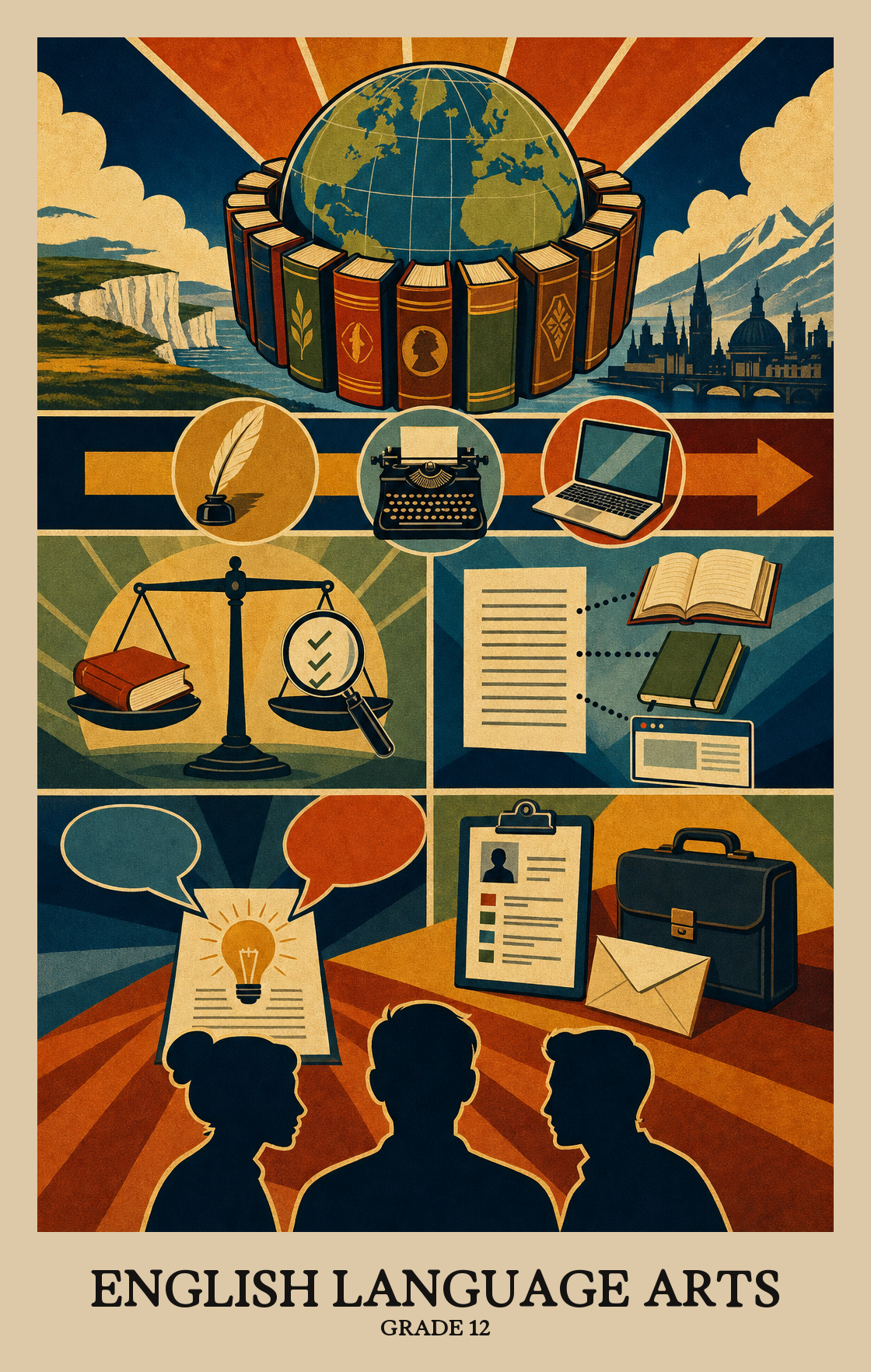
Students dig into challenging books and articles, including British literature and literary nonfiction. They learn to stick with hard texts, pull out evidence, and track how ideas develop across longer works.
Students read poetry, plays, and novels from different eras and cultures. They study how characters change, how authors use irony and figurative language, and how a writer's time and place shape their work.
Students weigh the arguments writers make in essays, news, and technical pieces. They check whether reasoning holds up, whether evidence is solid, and how word choice shapes the author's point of view.
Students run their own research projects, narrowing questions and pulling from several sources. They judge what is credible, cite work using MLA or APA, and learn the rules for honest use of sources, including AI tools.
Students write longer essays with a clear thesis and well-organized evidence. They also draft real-world pieces like job applications, business communication, and college admission writing, matching tone to audience.
Students lead discussions, give multimedia presentations, and recite a dramatic monologue. They also analyze how media uses imagery, bias, and framing to shape what audiences believe.
Students read difficult, grade-level texts closely, pulling evidence to support their thinking. When a passage stops making sense, they use specific strategies to work through it rather than skip past it.
Students read challenging texts aloud with steady pace and expression, then check their own understanding as they go. When something sounds off or stops making sense, they stop and correct themselves before moving on.
Students read long, challenging texts at a college-prep level and answer questions that go beyond basic recall, drawing conclusions, weighing the author's choices, and connecting ideas across a passage.
When reading or discussing a text, students pull multiple quotes or paraphrases to back up their conclusions, and they note exactly where in the text each piece of evidence comes from.
Students read several texts on the same topic to build real knowledge and useful vocabulary. That background knowledge then helps them understand harder texts and new ideas they encounter later.
When a difficult passage stops making sense, students slow down and use a deliberate strategy to get back on track. That might mean mapping how the text is organized, writing a quick summary, or asking a question about what they just read.
| Standard | Definition | Code |
|---|---|---|
| The student will build knowledge and comprehension skills from reading a range… | Students read difficult, grade-level texts closely, pulling evidence to support their thinking. When a passage stops making sense, they use specific strategies to work through it rather than skip past it. | 12.DSR.1 |
| Read a variety of grade-level complex text with accuracy, automaticity… | Students read challenging texts aloud with steady pace and expression, then check their own understanding as they go. When something sounds off or stops making sense, they stop and correct themselves before moving on. | 12.DSR.1.A |
| Proficiently read and comprehend a variety of literary and informational texts… | Students read long, challenging texts at a college-prep level and answer questions that go beyond basic recall, drawing conclusions, weighing the author's choices, and connecting ideas across a passage. | 12.DSR.1.B |
| When responding to text through discussions and/or writing, draw several pieces… | When reading or discussing a text, students pull multiple quotes or paraphrases to back up their conclusions, and they note exactly where in the text each piece of evidence comes from. | 12.DSR.1.C |
| Regularly engage in reading a series of conceptually related texts organized… | Students read several texts on the same topic to build real knowledge and useful vocabulary. That background knowledge then helps them understand harder texts and new ideas they encounter later. | 12.DSR.1.D |
| Use reading strategies as needed to aid and monitor comprehension when… | When a difficult passage stops making sense, students slow down and use a deliberate strategy to get back on track. That might mean mapping how the text is organized, writing a quick summary, or asking a question about what they just read. | 12.DSR.1.E |
Students work with challenging words they encounter in grade-level reading, building a working vocabulary that carries across subjects and into college or a job.
Students read and figure out the meaning of unfamiliar words, using context clues, word roots, and other strategies to understand what they read across subjects.
Students build and practice precise vocabulary by reading closely, talking through ideas, and writing about complex texts. The goal is accurate, confident use of both everyday academic words and subject-specific terms.
Reading around an unfamiliar word to figure out what it means. Students use the surrounding sentences and how a word fits into the sentence to work out its meaning without stopping to look it up.
Students break apart unfamiliar words by examining their roots, prefixes, and suffixes to figure out meaning. Knowing that "rupt" means break, for example, helps them decode "disruption," "rupture," and "corrupt" without a dictionary.
Words like "assertive," "aggressive," and "domineering" can all mean pushy, but each carries a different shade of judgment. Students read those shades carefully and explain how the choice of one word over another shifts meaning.
Students read a phrase like "burning the midnight oil" and explain what it actually means in that sentence. They go further by analyzing why the writer chose that expression and what effect it creates.
Students read sentences where figurative language or a reference to a classic story, myth, or historical figure appears, then explain what the phrase means and why the writer used it there.
Students practice using new vocabulary words in more than one place: in class discussions, in writing, and in conversation. The goal is to make unfamiliar words feel natural through repeated use.
| Standard | Definition | Code |
|---|---|---|
| The student will systematically build vocabulary and word knowledge based on… | Students work with challenging words they encounter in grade-level reading, building a working vocabulary that carries across subjects and into college or a job. | 12.RV |
| Vocabulary Development and Word Analysis | Students read and figure out the meaning of unfamiliar words, using context clues, word roots, and other strategies to understand what they read across subjects. | 12.RV.1 |
| Develop and accurately use general academic and content-specific vocabulary… | Students build and practice precise vocabulary by reading closely, talking through ideas, and writing about complex texts. The goal is accurate, confident use of both everyday academic words and subject-specific terms. | 12.RV.1.A |
| Use context and sentence structure to clarify the meanings of words and phrases | Reading around an unfamiliar word to figure out what it means. Students use the surrounding sentences and how a word fits into the sentence to work out its meaning without stopping to look it up. | 12.RV.1.B |
| Use structural analysis of roots, affixes | Students break apart unfamiliar words by examining their roots, prefixes, and suffixes to figure out meaning. Knowing that "rupt" means break, for example, helps them decode "disruption," "rupture," and "corrupt" without a dictionary. | 12.RV.1.C |
| Analyze the nuances in the meaning of words with similar denotations | Words like "assertive," "aggressive," and "domineering" can all mean pushy, but each carries a different shade of judgment. Students read those shades carefully and explain how the choice of one word over another shifts meaning. | 12.RV.1.D |
| Explain and analyze idiomatic language in context | Students read a phrase like "burning the midnight oil" and explain what it actually means in that sentence. They go further by analyzing why the writer chose that expression and what effect it creates. | 12.RV.1.E |
| Interpret the meaning of figurative language and literary and classical… | Students read sentences where figurative language or a reference to a classic story, myth, or historical figure appears, then explain what the phrase means and why the writer used it there. | 12.RV.1.F |
| Use newly learned words and phrases in multiple contexts, including in… | Students practice using new vocabulary words in more than one place: in class discussions, in writing, and in conversation. The goal is to make unfamiliar words feel natural through repeated use. | 12.RV.1.G |
Students read challenging poems, plays, stories, and nonfiction from British and world literature, then back up their thinking with specific lines or passages from the text.
Students read closely to find what the text says directly and what it implies. They use specific passages to support their ideas about the story or poem.
Students trace how a big idea, like lost innocence or growing up, runs through British poems, plays, and novels from different time periods, and explain how each era shapes that idea differently.
Authors build suspense and surprise by layering storylines, repeating parallel scenes, and timing when secrets come out. Students analyze how those structural choices shape what readers feel and when they feel it.
Students pick a character whose wants or beliefs pull in opposite directions, then trace how those inner conflicts shape what the character does, how they treat others, and where the story ends up.
Plays use techniques like soliloquies and asides to pull audiences inside a character's mind. Students analyze how those choices shape what a play means and the effect it has on the audience.
Reading closely for how an author's word choices, structure, and point of view shape the meaning and tone of a literary work.
Readers look closely at metaphors, similes, and other figurative language to explain how a writer's word choices shape the mood and meaning of a poem or story. The goal is to say why those choices matter, not just spot them.
Students look at specific word choices in a novel, play, or poem and explain how those words shape the feeling a piece creates. The focus is on why the author picked those words and what emotional effect they produce.
Students read passages where the author says one thing but means another, then explain how techniques like irony or understatement create that gap between the words on the page and the actual point being made.
Students trace how characters, ideas, or story elements connect and build across the whole text. They explain how those relationships shape the plot or central meaning of a work.
Students read older and newer poems from different cultures, then compare how they handle the same theme or character type. The focus is on what changed across time and place, and what stayed the same.
Students read two or more works and trace how each one builds the same big idea differently. They look at specific moments in the text to explain why the theme takes a different shape in each work.
Students read a poem, story, or essay and explain what it reveals about the era or society the author lived in. The goal is to connect the author's choices on the page to the world that shaped them.
| Standard | Definition | Code |
|---|---|---|
| The student will use textual evidence to demonstrate comprehension and… | Students read challenging poems, plays, stories, and nonfiction from British and world literature, then back up their thinking with specific lines or passages from the text. | 12.RL |
| Key Ideas and Plot Details | Students read closely to find what the text says directly and what it implies. They use specific passages to support their ideas about the story or poem. | 12.RL.1 |
| Analyze the development of universal themes | Students trace how a big idea, like lost innocence or growing up, runs through British poems, plays, and novels from different time periods, and explain how each era shapes that idea differently. | 12.RL.1.A |
| Examine how authors structure a text and order events within it through… | Authors build suspense and surprise by layering storylines, repeating parallel scenes, and timing when secrets come out. Students analyze how those structural choices shape what readers feel and when they feel it. | 12.RL.1.B |
| Analyze how complex characters-those with multiple or conflicting… | Students pick a character whose wants or beliefs pull in opposite directions, then trace how those inner conflicts shape what the character does, how they treat others, and where the story ends up. | 12.RL.1.C |
| Analyze and evaluate how dramatic conventions | Plays use techniques like soliloquies and asides to pull audiences inside a character's mind. Students analyze how those choices shape what a play means and the effect it has on the audience. | 12.RL.1.D |
| Craft and Style | Reading closely for how an author's word choices, structure, and point of view shape the meaning and tone of a literary work. | 12.RL.2 |
| Evaluate how the use of figurative language in poetry and prose contributes to… | Readers look closely at metaphors, similes, and other figurative language to explain how a writer's word choices shape the mood and meaning of a poem or story. The goal is to say why those choices matter, not just spot them. | 12.RL.2.A |
| Interpret and analyze how authors create intended effects using diction and… | Students look at specific word choices in a novel, play, or poem and explain how those words shape the feeling a piece creates. The focus is on why the author picked those words and what emotional effect they produce. | 12.RL.2.B |
| Evaluate the use of satire, sarcasm, irony | Students read passages where the author says one thing but means another, then explain how techniques like irony or understatement create that gap between the words on the page and the actual point being made. | 12.RL.2.C |
| Integration of Concepts | Students trace how characters, ideas, or story elements connect and build across the whole text. They explain how those relationships shape the plot or central meaning of a work. | 12.RL.3 |
| Compare and contrast traditional and contemporary texts that draw on similar… | Students read older and newer poems from different cultures, then compare how they handle the same theme or character type. The focus is on what changed across time and place, and what stayed the same. | 12.RL.3.A |
| Compare and contrast the development of a universal theme over the course of… | Students read two or more works and trace how each one builds the same big idea differently. They look at specific moments in the text to explain why the theme takes a different shape in each work. | 12.RL.3.B |
| Analyze how authors’ attitudes, viewpoints | Students read a poem, story, or essay and explain what it reveals about the era or society the author lived in. The goal is to connect the author's choices on the page to the world that shaped them. | 12.RL.3.C |
Students read complex articles, essays, and other real-world texts, then pull specific details from the writing to show they understood it and to support what they think it means.
Students read a complex article or speech and point to specific lines that prove their interpretation is accurate, not just plausible.
Students read job applications, college forms, and workplace documents, then fill them out correctly and explain what the document is asking for and why.
Students judge whether the way a piece of writing is organized and the persuasive techniques the author uses actually make the argument stronger. They explain how those choices push the author's point of view forward.
Students read a nonfiction passage and decide whether the author's argument actually holds up. They check if the reasons make sense, if the facts back the claim, and if anything is missing or misleading.
Students read a nonfiction article or speech and explain both the central idea and the author's specific word choices or structural decisions that shaped it.
Students examine how a news article, research report, or technical manual is organized, and explain how that structure shapes the writer's message. They also compare that structure to how a story is organized.
Students examine how an author's word choices build up over the course of a piece to reveal attitude toward the subject and set the overall mood. A single word rarely does this alone; the pattern across the whole text is what matters.
Students trace how two or more central ideas in a complex text shape and refine each other across paragraphs. They explain how those connections build the author's overall argument or analysis.
Two articles can cover the same event and reach opposite conclusions. Students read both, then judge which claims hold up, which reasoning falls apart, and how each piece connects to what they already know.
Students examine how a writer arranges ideas in a nonfiction piece: which points come first, how each one builds on the last, and what links the writer draws between them.
| Standard | Definition | Code |
|---|---|---|
| The student will use textual evidence to demonstrate comprehension and… | Students read complex articles, essays, and other real-world texts, then pull specific details from the writing to show they understood it and to support what they think it means. | 12.RI |
| Key Ideas and Confirming Details | Students read a complex article or speech and point to specific lines that prove their interpretation is accurate, not just plausible. | 12.RI.1 |
| Interpret and complete an application for employment or college admission | Students read job applications, college forms, and workplace documents, then fill them out correctly and explain what the document is asking for and why. | 12.RI.1.A |
| Evaluate the effectiveness of the structure | Students judge whether the way a piece of writing is organized and the persuasive techniques the author uses actually make the argument stronger. They explain how those choices push the author's point of view forward. | 12.RI.1.B |
| Analyze the argument and specific claims in texts, examining whether the… | Students read a nonfiction passage and decide whether the author's argument actually holds up. They check if the reasons make sense, if the facts back the claim, and if anything is missing or misleading. | 12.RI.1.C |
| Craft and Style | Students read a nonfiction article or speech and explain both the central idea and the author's specific word choices or structural decisions that shaped it. | 12.RI.2 |
| Analyze text structures to discern how they affect the meaning and message… | Students examine how a news article, research report, or technical manual is organized, and explain how that structure shapes the writer's message. They also compare that structure to how a story is organized. | 12.RI.2.A |
| Analyze the cumulative impact of specific word choices on meaning, author’s… | Students examine how an author's word choices build up over the course of a piece to reveal attitude toward the subject and set the overall mood. A single word rarely does this alone; the pattern across the whole text is what matters. | 12.RI.2.B |
| Integration of Concepts | Students trace how two or more central ideas in a complex text shape and refine each other across paragraphs. They explain how those connections build the author's overall argument or analysis. | 12.RI.3 |
| Evaluate texts with differing points of view on the same or similar events or… | Two articles can cover the same event and reach opposite conclusions. Students read both, then judge which claims hold up, which reasoning falls apart, and how each piece connects to what they already know. | 12.RI.3.A |
| Analyze how the author organizes an analysis or series of ideas or events… | Students examine how a writer arranges ideas in a nonfiction piece: which points come first, how each one builds on the last, and what links the writer draws between them. | 12.RI.3.B |
Students write for real audiences and purposes, with a focus on technical writing tied to what they're reading and studying. The goal is clarity and precision: explaining, instructing, or informing in writing that works in the real world.
Students practice different kinds of writing for different reasons: making an argument, explaining how something works, or telling a story. Each mode asks for a different structure and a different goal.
Extended pieces are multi-paragraph writings that develop an idea across several pages. Students learn to sustain a clear focus, build an argument or narrative over many paragraphs, and bring the piece to a deliberate close.
Students open an argument essay with enough background that a reader knows what's at stake, then state a clear position before laying out what the rest of the essay will cover.
Students arrange their argument so each idea leads logically to the next. The structure itself makes the reasoning easier to follow.
Students pick the most useful facts, quotes, and details from credible sources to back up their argument, cutting anything that doesn't add to what the reader needs to know.
Students write a closing paragraph that wraps up what the piece explained, not just a restatement of the opening. The ending should feel like a natural stop, not a sentence that drops off.
Technical writing explains how something works or how to do it. Students write step-by-step instructions, manuals, or reports where precision and clarity matter more than style.
Students write about their own skills, experiences, and goals to explain why they are a good fit for a job or college program. Think resume summary, cover letter, or personal statement.
Students write for real situations, like a job application, a college essay, or a workplace email, adjusting their tone and structure to fit who will read it and why.
Students write workplace documents like job applications, questionnaires, or business emails, keeping the format and tone matched to who will read them and why.
Students write short and long pieces across many formats, adjusting word choice and tone to fit different readers and goals. A summary sounds different from a poem, and a personal reflection sounds different from a critique.
Students arrange ideas clearly, choose words that fit the purpose, and structure paragraphs so a reader can follow the argument from start to finish.
Before writing, students decide who they're writing for and what they want that reader to take away. Then they plan, draft, revise, and edit with that goal in mind.
Students write a single sentence that states their main argument clearly enough that a reader knows exactly where the essay stands before reading further.
Students arrange their main argument, opposing views, and supporting evidence in a logical order that holds together from start to finish. Every paragraph connects to the central point.
Students choose quotes and details from several sources to back up a main argument or address an opposing view. The evidence has to fit the point, not just fill space.
Students learn to weave outside sources into their writing so each quote or fact gets introduced, explained in their own words, and properly credited. The evidence supports the argument instead of just sitting there.
Students use storytelling moves inside essays and arguments, weaving in transitions that pull readers from one idea to the next without losing the thread.
Students choose words and sentence structures on purpose to make their ideas land. A complex idea gets its own clause; a detail becomes vivid through specific, concrete language rather than vague description.
Students write with correct grammar, punctuation, and sentence structure. This standard covers the mechanical habits that make writing clear and credible to any reader.
Students reread their own writing and sharpen it: cutting vague words, fixing facts, and adding detail where the reader needs more to follow the argument.
Students read their own writing and a classmate's, then note what works and suggest specific changes. The goal is cleaner sentences and clearer ideas before the final draft.
Editing means fixing more than just spelling. Students adjust word choice, tone, and sentence structure to match the situation, whether the writing is a casual email or a formal research paper.
Students write and revise sentences, paragraphs, and documents to meet the grammar and style standards expected in a job or college course. The goal is writing that holds up outside the classroom.
| Standard | Definition | Code |
|---|---|---|
| The student will write in a variety of forms for diverse audiences and purposes… | Students write for real audiences and purposes, with a focus on technical writing tied to what they're reading and studying. The goal is clarity and precision: explaining, instructing, or informing in writing that works in the real world. | 12.W |
| Modes and Purposes for Writing | Students practice different kinds of writing for different reasons: making an argument, explaining how something works, or telling a story. Each mode asks for a different structure and a different goal. | 12.W.1 |
| Write extended pieces that | Extended pieces are multi-paragraph writings that develop an idea across several pages. Students learn to sustain a clear focus, build an argument or narrative over many paragraphs, and bring the piece to a deliberate close. | 12.W.1.A |
| Introduce a topic clearly by providing context, presenting well-defined theses | Students open an argument essay with enough background that a reader knows what's at stake, then state a clear position before laying out what the rest of the essay will cover. | 12.W.1.A.i |
| Adopt an organizational structure that clarifies relationships among ideas and… | Students arrange their argument so each idea leads logically to the next. The structure itself makes the reasoning easier to follow. | 12.W.1.A.ii |
| Develop the topic through sustained use of the most significant and relevant… | Students pick the most useful facts, quotes, and details from credible sources to back up their argument, cutting anything that doesn't add to what the reader needs to know. | 12.W.1.A.iii |
| Provide a concluding section that follows from the information or… | Students write a closing paragraph that wraps up what the piece explained, not just a restatement of the opening. The ending should feel like a natural stop, not a sentence that drops off. | 12.W.1.A.iv |
| Write technical pieces that | Technical writing explains how something works or how to do it. Students write step-by-step instructions, manuals, or reports where precision and clarity matter more than style. | 12.W.1.B |
| Describe personal qualifications for potential occupational or educational… | Students write about their own skills, experiences, and goals to explain why they are a good fit for a job or college program. Think resume summary, cover letter, or personal statement. | 12.W.1.B.i |
| Create clear and coherent writing in which the development, organization | Students write for real situations, like a job application, a college essay, or a workplace email, adjusting their tone and structure to fit who will read it and why. | 12.W.1.B.ii |
| Generate technical writing | Students write workplace documents like job applications, questionnaires, or business emails, keeping the format and tone matched to who will read them and why. | 12.W.1.B.iii |
| Blend multiple modes of writing, by routinely engaging in the production of… | Students write short and long pieces across many formats, adjusting word choice and tone to fit different readers and goals. A summary sounds different from a poem, and a personal reflection sounds different from a critique. | 12.W.1.C |
| Organization and Composition | Students arrange ideas clearly, choose words that fit the purpose, and structure paragraphs so a reader can follow the argument from start to finish. | 12.W.2 |
| Plan and organize writing to address a specific audience and purpose using the… | Before writing, students decide who they're writing for and what they want that reader to take away. Then they plan, draft, revise, and edit with that goal in mind. | 12.W.2.A |
| Composing a thesis statement that clearly communicates the writer’s position… | Students write a single sentence that states their main argument clearly enough that a reader knows exactly where the essay stands before reading further. | 12.W.2.A.i |
| Organizing claims, counterclaims | Students arrange their main argument, opposing views, and supporting evidence in a logical order that holds together from start to finish. Every paragraph connects to the central point. | 12.W.2.A.ii |
| Selecting appropriate evidence from multiple texts to clarify ideas, illustrate… | Students choose quotes and details from several sources to back up a main argument or address an opposing view. The evidence has to fit the point, not just fill space. | 12.W.2.A.iii |
| Contextualizing evidence from sources effectively with proper introduction… | Students learn to weave outside sources into their writing so each quote or fact gets introduced, explained in their own words, and properly credited. The evidence supports the argument instead of just sitting there. | 12.W.2.A.iv |
| Embedding narrative techniques and organizing information logically and… | Students use storytelling moves inside essays and arguments, weaving in transitions that pull readers from one idea to the next without losing the thread. | 12.W.2.A.v |
| Elaborating ideas clearly and effectively through syntactic structure… | Students choose words and sentence structures on purpose to make their ideas land. A complex idea gets its own clause; a detail becomes vivid through specific, concrete language rather than vague description. | 12.W.2.A.vi |
| Usage and Mechanics | Students write with correct grammar, punctuation, and sentence structure. This standard covers the mechanical habits that make writing clear and credible to any reader. | 12.W.3 |
| Revise writing for clarity of content, accuracy | Students reread their own writing and sharpen it: cutting vague words, fixing facts, and adding detail where the reader needs more to follow the argument. | 12.W.3.A |
| Use peer- and self-evaluation to edit writing for clarity and quality of… | Students read their own writing and a classmate's, then note what works and suggest specific changes. The goal is cleaner sentences and clearer ideas before the final draft. | 12.W.3.B |
| Edit writing for appropriate conventions, style | Editing means fixing more than just spelling. Students adjust word choice, tone, and sentence structure to match the situation, whether the writing is a casual email or a formal research paper. | 12.W.3.C |
| Write and revise to a standard acceptable both in the workplace and in… | Students write and revise sentences, paragraphs, and documents to meet the grammar and style standards expected in a job or college course. The goal is writing that holds up outside the classroom. | 12.W.3.D |
Students learn when to use formal English and when casual language fits better. They apply that choice in their writing and speaking, matching the tone to the situation.
Students revise real sentences for grammar, catching errors in structure, agreement, and punctuation that would undermine the writing in college or a job application.
Students combine different clause types, like relative or adverbial clauses, to write sentences that vary in length and rhythm. The goal is to make the meaning clearer and the writing more engaging.
Students edit their writing for correct punctuation, capitalization, and spelling. This is the technical side of writing, making sure the sentences on the page follow the rules readers expect.
Students pick one citation style, like MLA or APA, and follow its exact rules for punctuating and formatting any quoted text they borrow from a source. The format has to match that style guide throughout the paper.
Students spell words correctly in their writing and look up any word they're unsure about. At this level, that habit matters as much as the rule itself.
| Standard | Definition | Code |
|---|---|---|
| The student will use the conventions of Standard English when speaking and… | Students learn when to use formal English and when casual language fits better. They apply that choice in their writing and speaking, matching the tone to the situation. | 12.LU |
| Grammar | Students revise real sentences for grammar, catching errors in structure, agreement, and punctuation that would undermine the writing in college or a job application. | 12.LU.1 |
| Use various clauses | Students combine different clause types, like relative or adverbial clauses, to write sentences that vary in length and rhythm. The goal is to make the meaning clearer and the writing more engaging. | 12.LU.1.A |
| Mechanics | Students edit their writing for correct punctuation, capitalization, and spelling. This is the technical side of writing, making sure the sentences on the page follow the rules readers expect. | 12.LU.2 |
| Apply a style manual, such as that of the Modern Language Association | Students pick one citation style, like MLA or APA, and follow its exact rules for punctuating and formatting any quoted text they borrow from a source. The format has to match that style guide throughout the paper. | 12.LU.2.A |
| Spell correctly, consulting reference materials to check as needed | Students spell words correctly in their writing and look up any word they're unsure about. At this level, that habit matters as much as the rule itself. | 12.LU.2.B |
Oral communication and collaboration at this level means students practice speaking clearly, listening closely, and building on each other's ideas in discussion. The goal is a classroom where everyone helps make sense of difficult material together.
Students listen carefully, speak clearly, and work with others to share and build on ideas. This standard covers the habits that make real conversation useful, from following a discussion to contributing something worth hearing.
Students lead and take part in group discussions on complex topics and texts, building on others' ideas, asking good questions, and keeping the conversation focused and moving forward.
Students practice real listening habits: tracking the speaker's key points, holding back interruptions, and responding in a way that moves the conversation forward rather than just waiting for a turn to talk.
Students listen to viewpoints they may disagree with and respond using specific evidence from the text or discussion, keeping the exchange respectful even when opinions differ.
In a group discussion, students track where people agree and where they differ, then sum up both sides clearly. This keeps conversations productive and shows students can follow complex exchanges.
Students choose the right mix of visuals, audio, or slides to match what they're presenting and why. The tools serve the message, not the other way around.
Students listen to a presentation and judge how well it's built: whether the opening draws you in, the evidence holds up, and the ending lands. They look for what works and what doesn't.
Students look back on how they contributed to a small group discussion and honestly assess what helped the group and what they would do differently next time.
Students prepare and deliver spoken presentations to a real audience, supporting their main idea with organized detail and adapting how they speak to fit the situation.
Students stand up and deliver a spoken report or argument on a topic they've researched or read about. The focus is on organizing ideas clearly and speaking with enough confidence that an audience can follow along.
Students choose the right format for a presentation (speech, slides, video) and weave together information from more than one source into a single, clear message.
Students select words and tone to match who they're speaking to and why. A presentation to classmates sounds different from one to a panel of adults, and students learn to make that shift on purpose.
Students choose rhetorical tools like repetition, analogy, or direct address to sharpen the point they're making. The goal is a speech or presentation where the audience follows the argument without effort.
When making an argument, students acknowledge views that disagree with their own and respond to those views directly. A strong rebuttal shows they understand the other side, not just their own position.
Students watch their audience while presenting and shift their pace, volume, or approach when listeners look confused or disengaged. Reading the room is part of the skill.
Students review their own finished presentations and judge what worked, what fell flat, and whether the evidence actually supported the argument. It builds the habit of honest self-assessment before the next presentation.
Students memorize a speech or monologue from a play and perform it aloud, using their voice and body to show what the character feels and why they act the way they do.
Students combine written, visual, and spoken elements to make a single, clear message. Think a speech paired with slides, or an essay that uses images to support the writing.
Students plan and deliver presentations that mix spoken words, visuals, and other media, both alone and with a group, for different audiences and goals.
Students look at sources like videos, podcasts, and websites and decide whether the information holds up. They check whether each source makes a fair, well-supported case or whether the author's own bias is shaping what gets said.
Students pull together information from several different sources on the same topic, then write a summary or build an argument that connects what they found.
Students plan and build a media message (a video, podcast, slideshow, or similar piece) that uses images, sound, and layout together to make the meaning clear, not just the words alone.
Students correctly credit any outside source they quote, paraphrase, or borrow an idea from, whether that source is an article, a book, a website, or a video.
Students analyze how photos, videos, ads, and news stories are built to shape what audiences think and feel. They look past the surface to question who made the message, why, and what it leaves out.
Students read closely enough to figure out what an author actually believes, then build a case for why the text proves it. They also consider how those beliefs quietly shaped what the author chose to include or leave out.
Students pick apart a media message, like a news clip, ad, or social post, and judge whether the evidence is solid and the message actually works for the audience it's aimed at.
Students look at news stories, ads, or social media posts and explain how the symbols, images, and word choices are shaping the message. They identify bias and judge whether it changes what the audience is meant to believe.
Students examine a news story, ad, or social media post to figure out whose perspective is missing and whose is centered. Then they explain how that choice shapes what the audience believes or does.
Students study news articles, social media posts, and broadcasts to figure out how media coverage shapes what the public thinks, and how public opinion can shape coverage in return.
| Standard | Definition | Code |
|---|---|---|
| The student will develop effective oral communication and collaboration skills… | Oral communication and collaboration at this level means students practice speaking clearly, listening closely, and building on each other's ideas in discussion. The goal is a classroom where everyone helps make sense of difficult material together. | 12.C |
| Communication, Listening | Students listen carefully, speak clearly, and work with others to share and build on ideas. This standard covers the habits that make real conversation useful, from following a discussion to contributing something worth hearing. | 12.C.1 |
| Facilitate and contribute to a range of sustained collaborative discussions… | Students lead and take part in group discussions on complex topics and texts, building on others' ideas, asking good questions, and keeping the conversation focused and moving forward. | 12.C.1.A |
| Applying a variety of strategies to listen actively and speak purposefully… | Students practice real listening habits: tracking the speaker's key points, holding back interruptions, and responding in a way that moves the conversation forward rather than just waiting for a turn to talk. | 12.C.1.A.i |
| Responding thoughtfully and tactfully with evidence to diverse perspectives | Students listen to viewpoints they may disagree with and respond using specific evidence from the text or discussion, keeping the exchange respectful even when opinions differ. | 12.C.1.A.ii |
| Summarizing points of agreement and disagreement | In a group discussion, students track where people agree and where they differ, then sum up both sides clearly. This keeps conversations productive and shows students can follow complex exchanges. | 12.C.1.A.iii |
| Selecting and applying multimodal tools to design and develop presentation… | Students choose the right mix of visuals, audio, or slides to match what they're presenting and why. The tools serve the message, not the other way around. | 12.C.1.A.iv |
| Evaluating the content of presentations, including introduction… | Students listen to a presentation and judge how well it's built: whether the opening draws you in, the evidence holds up, and the ending lands. They look for what works and what doesn't. | 12.C.1.A.v |
| Using reflection to evaluate one's own role in the group process in small… | Students look back on how they contributed to a small group discussion and honestly assess what helped the group and what they would do differently next time. | 12.C.1.A.vi |
| Speaking and Presentation of Ideas | Students prepare and deliver spoken presentations to a real audience, supporting their main idea with organized detail and adapting how they speak to fit the situation. | 12.C.2 |
| Report orally on a topic or text or present an opinion | Students stand up and deliver a spoken report or argument on a topic they've researched or read about. The focus is on organizing ideas clearly and speaking with enough confidence that an audience can follow along. | 12.C.2.A |
| Selecting the modes and purposes for presentations and synthesizing multiple… | Students choose the right format for a presentation (speech, slides, video) and weave together information from more than one source into a single, clear message. | 12.C.2.A.i |
| Choosing appropriate vocabulary, language | Students select words and tone to match who they're speaking to and why. A presentation to classmates sounds different from one to a panel of adults, and students learn to make that shift on purpose. | 12.C.2.A.ii |
| Incorporating various rhetorical devices to enhance purpose and strengthening… | Students choose rhetorical tools like repetition, analogy, or direct address to sharpen the point they're making. The goal is a speech or presentation where the audience follows the argument without effort. | 12.C.2.A.iii |
| Anticipating and addressing alternative or opposing perspectives and… | When making an argument, students acknowledge views that disagree with their own and respond to those views directly. A strong rebuttal shows they understand the other side, not just their own position. | 12.C.2.A.iv |
| Monitoring audience engagement effectively and adjusting delivery accordingly… | Students watch their audience while presenting and shift their pace, volume, or approach when listeners look confused or disengaged. Reading the room is part of the skill. | 12.C.2.A.v |
| Evaluating the content and effectiveness of one's presentations, including… | Students review their own finished presentations and judge what worked, what fell flat, and whether the evidence actually supported the argument. It builds the habit of honest self-assessment before the next presentation. | 12.C.2.A.vi |
| Memorize and recite an excerpt or monologue from a dramatic work portraying… | Students memorize a speech or monologue from a play and perform it aloud, using their voice and body to show what the character feels and why they act the way they do. | 12.C.2.B |
| Integrating Multimodal Literacies | Students combine written, visual, and spoken elements to make a single, clear message. Think a speech paired with slides, or an essay that uses images to support the writing. | 12.C.3 |
| Create and deliver planned, multimodal, interactive presentations… | Students plan and deliver presentations that mix spoken words, visuals, and other media, both alone and with a group, for different audiences and goals. | 12.C.3.A |
| Examine multimodal sources’ claims, arguments, ideas | Students look at sources like videos, podcasts, and websites and decide whether the information holds up. They check whether each source makes a fair, well-supported case or whether the author's own bias is shaping what gets said. | 12.C.3.B |
| Synthesize multiple streams of information on the same or similar topic to… | Students pull together information from several different sources on the same topic, then write a summary or build an argument that connects what they found. | 12.C.3.C |
| Organize information to create media messages with visual, audio | Students plan and build a media message (a video, podcast, slideshow, or similar piece) that uses images, sound, and layout together to make the meaning clear, not just the words alone. | 12.C.3.D |
| Provide appropriate citation of all content from external sources | Students correctly credit any outside source they quote, paraphrase, or borrow an idea from, whether that source is an article, a book, a website, or a video. | 12.C.3.E |
| Examining Media Messages | Students analyze how photos, videos, ads, and news stories are built to shape what audiences think and feel. They look past the surface to question who made the message, why, and what it leaves out. | 12.C.4 |
| Defend hypotheses about an author’s underlying values, viewpoints | Students read closely enough to figure out what an author actually believes, then build a case for why the text proves it. They also consider how those beliefs quietly shaped what the author chose to include or leave out. | 12.C.4.A |
| Analyze and critique the effectiveness of media messages by evaluating the… | Students pick apart a media message, like a news clip, ad, or social post, and judge whether the evidence is solid and the message actually works for the audience it's aimed at. | 12.C.4.B |
| Analyze and evaluate how the media's use of symbolism, imagery, metaphor | Students look at news stories, ads, or social media posts and explain how the symbols, images, and word choices are shaping the message. They identify bias and judge whether it changes what the audience is meant to believe. | 12.C.4.C |
| Explain and analyze how values and viewpoints are included or excluded and how… | Students examine a news story, ad, or social media post to figure out whose perspective is missing and whose is centered. Then they explain how that choice shapes what the audience believes or does. | 12.C.4.D |
| Analyze media to determine the cause-and-effect relationship | Students study news articles, social media posts, and broadcasts to figure out how media coverage shapes what the public thinks, and how public opinion can shape coverage in return. | 12.C.4.E |
Students pick a topic they care about, then read several related sources to build real knowledge about it. The research connects to grade-level ideas and texts, not just a one-time assignment.
Students find sources, weigh how reliable and useful each one is, then pull the best evidence together into a clear, well-supported argument or explanation.
Students start with a research question, then sharpen or widen it as they learn more. The goal is a question focused enough to answer well but broad enough to matter.
Students pull facts and details from multiple sources, then sort that information into a clear, logical order before writing. The goal is to have everything in place before drafting begins.
Students read primary and secondary sources and decide how trustworthy and useful each one is. That means spotting the author's point of view, finding where sources disagree, and flagging any bias or misleading information before using a source in research.
Students pull together research from several sources to build a single, well-supported argument, then address the strongest objection to it. The goal is a position that holds up even after someone pushes back.
Students produce a finished research piece, such as an essay or report, that meets the same reading and writing expectations they've worked on all year. The research doesn't live in a separate silo; it connects directly to how students read sources and construct arguments.
Students practice a standard system, like MLA or APA, to credit the sources behind quoted and paraphrased ideas in their writing. Getting citations right is a skill colleges and workplaces expect.
Plagiarism means passing off someone else's words or ideas as your own. Students learn what counts as plagiarism, why it matters legally and academically, and how to gather and cite sources honestly.
Students learn to use sources honestly, which means citing where information came from, thinking critically about AI-generated content, and not presenting borrowed ideas as their own.
| Standard | Definition | Code |
|---|---|---|
| The student will conduct research and read a series of conceptually related… | Students pick a topic they care about, then read several related sources to build real knowledge about it. The research connects to grade-level ideas and texts, not just a one-time assignment. | 12.R |
| Evaluation and Synthesis of Information | Students find sources, weigh how reliable and useful each one is, then pull the best evidence together into a clear, well-supported argument or explanation. | 12.R.1 |
| Formulate and revise questions about a research topic broadening or narrowing… | Students start with a research question, then sharpen or widen it as they learn more. The goal is a question focused enough to answer well but broad enough to matter. | 12.R.1.A |
| Gather and organize information from various sources | Students pull facts and details from multiple sources, then sort that information into a clear, logical order before writing. The goal is to have everything in place before drafting begins. | 12.R.1.B |
| Objectively evaluate primary and secondary sources for their credibility… | Students read primary and secondary sources and decide how trustworthy and useful each one is. That means spotting the author's point of view, finding where sources disagree, and flagging any bias or misleading information before using a source in research. | 12.R.1.C |
| Synthesize multiple streams of evidence to support claims and acknowledge… | Students pull together research from several sources to build a single, well-supported argument, then address the strongest objection to it. The goal is a position that holds up even after someone pushes back. | 12.R.1.D |
| Create research products aligned with the demands of the reading and writing… | Students produce a finished research piece, such as an essay or report, that meets the same reading and writing expectations they've worked on all year. The research doesn't live in a separate silo; it connects directly to how students read sources and construct arguments. | 12.R.1.E |
| Cite sources for quoted and paraphrased ideas using a standard method of… | Students practice a standard system, like MLA or APA, to credit the sources behind quoted and paraphrased ideas in their writing. Getting citations right is a skill colleges and workplaces expect. | 12.R.1.F |
| Define the meaning and consequences of plagiarism and follow ethical and legal… | Plagiarism means passing off someone else's words or ideas as your own. Students learn what counts as plagiarism, why it matters legally and academically, and how to gather and cite sources honestly. | 12.R.1.G |
| Demonstrate ethical and responsible use of all sources, including the Internet… | Students learn to use sources honestly, which means citing where information came from, thinking critically about AI-generated content, and not presenting borrowed ideas as their own. | 12.R.1.H |
Federally administered sample-based assessment in reading, mathematics, science, writing, and other subjects. NAEP results inform state-by-state comparisons rather than individual student or school accountability.
Students read challenging British literature alongside world and American texts, including Shakespeare, poetry, and longer novels. They write technical pieces like job applications and business letters, plus research papers that pull from several sources. The year is built to prepare students for college reading loads and workplace writing.
Ask students to summarize each chapter in a sentence or two before moving on. If a passage stops making sense, have them back up, reread, and look for unfamiliar words or long sentences that tripped them up. Talking through a confusing paragraph out loud often unlocks it.
Students should write a clear thesis, support it with evidence from several sources, and cite those sources using MLA or APA. They should also produce workplace writing such as resumes, cover letters, and business emails that match audience and purpose.
Many teachers move chronologically from Anglo-Saxon and medieval texts through Renaissance drama, Romantic and Victorian poetry, and modern fiction. Pairing each era with a contemporary text on the same theme keeps the universal ideas front and center and gives students something to compare in writing.
Integrating evidence smoothly into a paragraph and citing it correctly are the most common sticking points. Distinguishing a strong claim from a summary also needs steady practice. Short, frequent writing tasks tend to move these skills faster than long essays.
Read drafts of resumes, college essays, and cover letters out loud together. Ask whether each sentence sounds like a real person and whether the qualifications are specific. Generic phrases like "hard worker" should be replaced with concrete examples.
Students can read a complex text independently, build an argument from multiple sources, and revise their own writing for clarity and accuracy. They can also speak in a discussion or presentation, address a counterargument, and cite sources without prompting.
Students should treat AI as a starting point for ideas, not a source to quote. Any facts pulled from AI need to be verified in a credible source and cited properly. Submitting AI-generated writing as one's own counts as plagiarism.
A ready reader can finish a dense article or chapter, summarize the main argument, and point to evidence that supports it. They can also name where the author's reasoning is weak or where bias might be shaping the claims.