Skip to content

What does a student learn in ?

This is the year civics gets real. Students study how the Constitution and Bill of Rights actually shape daily life, from free speech to fair trials. They look closely at elections, campaign money, the three branches, and how state and local government work in Virginia. By spring, students can read a news story about a court case or a bill and explain what is happening and why it matters.

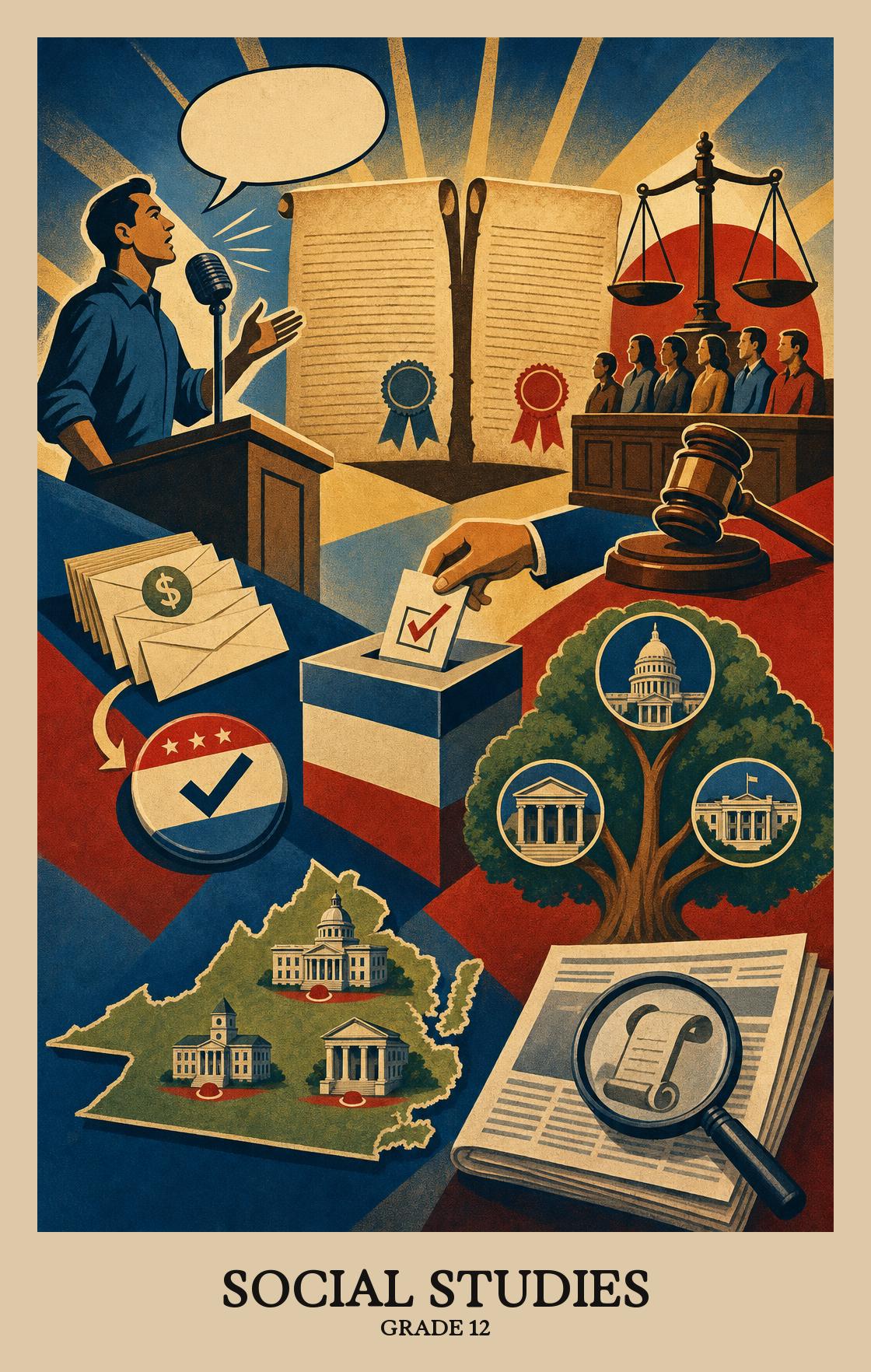
Illustration of what students learn in Grade 12 Social Studies
  • Constitution
  • Bill of Rights
  • Elections
  • Three branches
  • State and local government
  • Civil rights
  • Economic systems
Source: Virginia Virginia Standards of Learning
Year at a glance
How the year usually goes. Every school and district set their own curriculum, so treat this as a guide, not official pacing.
  1. 1

    Foundations of American government

    Students start the year by tracing the ideas behind the U.S. and Virginia constitutions. They read documents from the Magna Carta to the Federalist Papers and look at how thinkers like Locke and Hobbes shaped what counts as a fair government.

  2. 2

    The three branches and the Bill of Rights

    Students dig into how Congress, the president, and the courts actually work, and where each one's power stops. They study the Bill of Rights and look at how Supreme Court cases have shaped free speech, due process, and other everyday rights.

  3. 3

    Elections and citizen participation

    Students learn how campaigns, political parties, and the Electoral College pick the people who run the country. They look at voting rights, redistricting, campaign money, and the role social media plays in shaping what voters see.

  4. 4

    Virginia and local government

    Students turn to government closer to home. They study how Richmond passes laws, how counties and cities are run, and how regular people influence school boards, town councils, and state agencies.

  5. 5

    Economics and the world stage

    Students wrap up by looking at how government shapes the economy through taxes, the Federal Reserve, and trade. They compare capitalism with other systems and consider how U.S. foreign policy fits into a connected world.

Mastery Learning Standards
The required skills a student should display by the end of Grade 12.
Skills
  • The student will apply history and social science skills to the content by

    S.GOVT

    Reading maps, analyzing sources, and weighing evidence are the core tools of this course. Students use those skills to make sense of government and civics content throughout the year.

  • selecting and synthesizing evidence from information sources, including

    S.GOVT.a

    Students pull facts from sources like news articles, charts, and historical documents, then piece that evidence together to answer real questions about how government and politics work.

  • applying geographic skills to determine and/or predict patterns and trends

    S.GOVT.b

    Students use maps, population data, and regional patterns to explain why things happen where they do and predict what might change next.

  • questioning and using inquiry to construct arguments, using evidence…

    S.GOVT.c

    Students build an argument by gathering evidence from more than one source, then use that evidence to answer a question or support a position. The focus is on letting the sources shape the conclusion, not the other way around.

  • investigating and analyzing evidence from multiple sources to construct…

    S.GOVT.d

    Students find evidence from several sources on the same topic, then build an argument or reach a conclusion based on what the sources actually say.

  • comparing and contrasting historical, cultural, economic

    S.GOVT.e

    Students look at the same event or issue from multiple angles, such as how a lawmaker, a business owner, and a citizen might each see it differently, then explain what those views share and where they split.

  • determining cause and effect to analyze connections

    S.GOVT.f

    Students trace how one event or decision leads to another, explaining why something happened and what changed as a result.

  • using economic decision-making models to analyze and explain the incentives…

    S.GOVT.g

    Students pick a real-world decision, such as a tax policy or trade rule, and walk through why someone made that choice and what happened as a result.

  • engaging and communicating as an informed individual with persons with…

    S.GOVT.h

    Students practice talking and listening across disagreement. They learn to share a view clearly, take in a different one, and keep the conversation going even when people don't see things the same way.

  • developing products that reflect an understanding of research and content to…

    S.GOVT.i

    Students take what they learn about government and turn it into something real, like a report, a proposal, or a presentation that connects classroom ideas to how the world actually works.

  • contextualizing, corroborating

    S.GOVT.j

    Students compare sources about government and politics, checking each one for bias or propaganda, then look across all of them to spot patterns in how power and policy have shifted over time.

Foundations of American Constitutional Government
  • The student will apply history and social science skills to understand the…

    GOVT.1

    Reading the founding documents and major debates behind them, students trace how ideas about liberty, representation, and limited government shaped the Constitution we still live under today.

  • describing the features of a democratic republic as influenced by forms of…

    GOVT.1.a

    Students trace how ancient Athens and Rome shaped the American system of government, from voting and representation to the idea that law, not rulers, holds power.

  • analyzing the foundational principles found in historic writings and prior…

    GOVT.1.b

    Students trace how ideas from documents like the Magna Carta and thinkers like Locke and Hobbes shaped the principles behind American government. The goal is to see which older ideas the founders borrowed, and why.

  • evaluating the foundational principles expressed in the Constitution of…

    GOVT.1.c

    Students read the founding documents and weigh how well the ideas in each one, like limited government and individual rights, held up over time and shaped the next document written.

  • analyzing George Mason’s Virginia Declaration of Rights, Thomas Jefferson’s…

    GOVT.1.d

    Students read three founding-era documents and trace how Mason, Jefferson, and Madison shaped the rights written into the Constitution, from religious freedom to the protections listed in the Bill of Rights.

  • The student will apply history and social science skills to describe the…

    GOVT.2

    Democracy is a system where citizens hold political power, either by voting directly on laws or by electing representatives to make decisions on their behalf. Students examine what that power means in practice and how it shapes American government.

  • explaining the concepts of popular sovereignty, natural rights, the rule of…

    GOVT.2.a

    Popular sovereignty, natural rights, and the rule of law are the core ideas behind American democracy. Students explain what each concept means and how they connect to the principle that government gets its power from the people.

  • comparing structures of government including constitutional republic…

    GOVT.2.b

    Students compare how different governments are built: who holds power, how leaders are chosen, and whether citizens vote directly or through elected representatives.

  • recognizing the equality of all citizens under the law

    GOVT.2.c

    Students examine what it means for every person to have equal standing in court and under the law, regardless of wealth, background, or status. No one gets special treatment because of who they are.

  • recognizing majority rule and minority rights

    GOVT.2.d

    Students learn that in a democracy, the majority wins elections and sets policy, but that outcome cannot strip away the basic rights of those who were outvoted.

  • recognizing the necessity of compromise

    GOVT.2.e

    Compromise is how democracy moves forward. Students examine why lawmaking requires give-and-take, and why refusing all compromise usually means nothing gets done.

  • recognizing the freedom of the individual

    GOVT.2.f

    Students study why personal freedom sits at the center of American democracy, looking at what individual rights protect and where the limits on those rights come from.

  • The student will apply history and social science skills to analyze the…

    GOVT.3

    Reading the U.S. and Virginia Constitutions side by side, students break down how each document is structured, what rights it protects, and how those protections have shaped real laws and court decisions.

  • examining the ratification debates and The Federalist Papers, including but not…

    GOVT.3.a

    Students read the arguments for and against ratifying the Constitution, focusing on key Federalist Papers like No. 10 and No. 51, which explain how the new government would prevent any one faction or leader from gaining too much power.

  • evaluating the purposes for government stated in the Preamble

    GOVT.3.b

    Students read the opening lines of the Constitution and explain what problems the founders were trying to solve when they wrote it. The goal is to understand why those promises still matter today.

  • defining the structure and authority of the national government as outlined in…

    GOVT.3.c

    Articles I, II, and III of the Constitution divide federal power into three branches: Congress makes laws, the President carries them out, and the courts interpret them. Students learn what each branch can and cannot do.

  • examining the differences between the powers and authority of state and…

    GOVT.3.d

    Students compare what state governments can do versus what the federal government can do, and learn why the Constitution splits that authority between the two levels.

  • connecting the fundamental principles of checks and balances and separation of…

    GOVT.3.e

    Students trace how the Constitution splits government into three branches and gives each one tools to limit the others, so no single branch can act without a check from somewhere else.

  • describing how the Bill of Rights affirms natural rights as something that…

    GOVT.3.f

    The Bill of Rights doesn't grant rights, it protects rights that exist before any government exists. Students study how the Founders believed certain freedoms belong to people by nature, not because a law created them.

  • explaining the amendment process

    GOVT.3.g

    Students learn how the Constitution can be changed, walking through the steps required to propose and ratify an amendment at both the congressional and state levels.

  • The student will apply history and social science skills to explore and…

    GOVT.4

    Students examine the founding documents, events, and figures that shaped American self-government. The goal is understanding why that founding still matters, not just memorizing names and dates.

  • analyzing the five values of liberty, egalitarianism, individualism, populism

    GOVT.4.a

    Students read Alexis de Tocqueville's observations about America and explain five core values he identified: personal freedom, equality, self-reliance, trust in ordinary people, and limited government involvement in the economy.

  • understanding the meaning and historical significance of the mottos "E Pluribus…

    GOVT.4.b

    Students learn what "E Pluribus Unum" and "In God We Trust" mean, where each phrase came from, and why they became part of American national symbols.

  • describing the fundamental concepts of American constitutional democracy…

    GOVT.4.c

    Students explain where government power comes from and why protecting individual freedom sits at the center of American democracy.

  • defining the meaning of the American Creed that calls on citizens to safeguard…

    GOVT.4.d

    Students examine what the American Creed asks of citizens: protect individual freedom, follow the law, and keep the Constitution intact as the country's foundation.

  • evaluating how the U.S

    GOVT.4.e

    The Constitution sets up what the government can and cannot do. Students examine specific rights it protects, like free speech and fair trials, and explain why those limits on government power matter.

  • The student will apply history and social science skills to explain the rights…

    GOVT.5

    Citizenship comes with both protections and obligations. Students examine the rights Americans hold under the Constitution and the responsibilities, like voting, jury duty, and civic participation, that come with living in a self-governing society.

  • describing the paths to U.S

    GOVT.5.a

    Students learn the main ways a person can become a U.S. citizen, including being born on American soil, being born to a citizen parent abroad, or going through the naturalization process.

  • obeying the law and paying taxes

    GOVT.5.b

    Students learn that following the law and paying taxes are basic duties of citizenship, not optional choices. These obligations keep public services running and hold the legal system together.

  • serving as a juror

    GOVT.5.c

    Jury duty is a legal obligation for adult citizens. Students learn what it means to serve on a jury, how jurors are selected, and how their decisions help determine the outcome of civil and criminal trials.

  • participating in the political process and voting in local, state

    GOVT.5.d

    Voting is one of the core rights of citizenship. Students examine how to take part in local, state, and national elections and why regular participation in the political process matters for a functioning democracy.

  • performing public service

    GOVT.5.e

    Public service means contributing to the community beyond personal gain. Students examine why civic participation matters, from volunteering to working in government, and consider what obligations come with living in a democratic society.

  • keeping informed about current issues

    GOVT.5.f

    Students practice staying up to date on news and public issues as part of being an informed citizen. Knowing what is happening in the country and the world is a core responsibility of citizenship.

  • practicing personal and fiscal responsibility

    GOVT.5.g

    Students learn to manage everyday financial decisions, like budgeting and saving, alongside the civic habits that come with being an adult member of a community.

  • understanding that the United States has a voluntary military and the…

    GOVT.5.h

    Students learn that the U.S. military is staffed by volunteers, not draftees, and that most male citizens are still required by law to register with the Selective Service when they turn 18.

Elections
  • The student will apply history and social science skills to explain the process…

    GOVT.6

    Elections involve multiple steps, from candidate filing and primaries to Election Day itself. Students learn how those steps work at the local, state, and national level and why each one matters.

  • describing how amendments and laws have extended the right to vote to…

    GOVT.6.a

    Voting rights in the U.S. have expanded over time through constitutional amendments and federal laws. Students trace how groups once barred from voting, including women and Black Americans, gained that right through specific legal changes.

  • examining campaign finance laws and campaign funding and spending, including…

    GOVT.6.b

    Students examine where campaign money comes from, how laws limit or allow it, and what Supreme Court rulings have changed the rules. They look at how interest groups and national donors shape who can run and how much candidates spend.

  • describing the nomination and election process, including the organization and…

    GOVT.6.c

    Students learn how a candidate moves from announcing a run to appearing on the ballot, and how political parties and interest groups shape that path at every level of government.

  • analyzing the influence of media coverage, campaign advertising, public opinion…

    GOVT.6.d

    Students examine how news coverage, campaign ads, opinion polls, and social media shape what voters think and who they decide to support.

  • explaining the role of the Electoral College and the impact of reapportionment…

    GOVT.6.e

    The Electoral College is the system used to officially elect the President. Students explain how it works, and how redrawing district boundaries after each census shifts political power across states and affects who wins elections.

  • evaluating challenges of the election process, including redistricting and…

    GOVT.6.f

    Students look at real problems with how elections are run, focusing on how district lines get redrawn and why politicians sometimes draw those lines to favor one party over another.

  • The student will apply history and social science skills to describe the scope…

    GOVT.7

    Article I of the Constitution spells out what Congress can and cannot do. Students learn which powers belong to the House and Senate, where those powers stop, and how the rules written in 1787 still shape the laws passed today.

  • describing its structure and the process for the election of its members

    GOVT.7.a

    Students learn how Congress is organized into two chambers and how voters elect senators and representatives at the federal level.

  • describing how the power of the legislative branch has changed over time

    GOVT.7.b

    Students trace how Congress has gained and lost influence over the years, from shifts in war powers to budget fights, and explain what drove those changes.

  • evaluating how the processes of the legislative branch reflect the…

    GOVT.7.c

    Students examine how Congress makes laws and ask whether the process reflects democratic ideals like representation and accountability. They consider who has a voice in lawmaking and what keeps that power in check.

  • The student will apply history and science skills to describe the scope and…

    GOVT.8

    Students examine what the President can and cannot do under the Constitution, tracing how those rules were written in Article II and how they have played out in real history.

  • describing the structure and organization of the executive branch

    GOVT.8.a

    Students learn how the executive branch is set up, from the President and Vice President down through the Cabinet and federal agencies.

  • describing how the power of the executive branch has changed over time…

    GOVT.8.b

    Students trace how the presidency grew and changed through constitutional amendments, including rules about term limits, transition of power, and what happens when a president cannot serve.

  • comparing and contrasting executive branch processes with those of the…

    GOVT.8.c

    Students compare how the President and Congress each make decisions, looking at where their powers overlap and where one branch can check the other.

  • The student will apply history and social science skills to describe the scope…

    GOVT.9

    Article III of the Constitution creates the federal courts and spells out what cases they can and cannot hear. Students study where judicial power starts, where it stops, and how those boundaries have shaped real court decisions.

  • describing the organization, jurisdiction

    GOVT.9.a

    Federal courts are organized into three levels: district courts, appeals courts, and the Supreme Court. Students learn which cases each level can hear and how a case moves through the system.

  • explaining how the Marshall Court established the Supreme Court as an…

    GOVT.9.b

    Students learn how the Supreme Court claimed the power to strike down laws that conflict with the Constitution, a move that came from an 1803 case and reshaped the balance between the three branches of government.

  • describing how the Supreme Court decides cases

    GOVT.9.c

    Students learn how a case moves through the Supreme Court, from written briefs and oral arguments to the justices' private conference and final written opinion.

  • comparing the philosophy of originalism, judicial pragmatism, judicial activism

    GOVT.9.d

    Students compare four different philosophies judges use when interpreting the Constitution: sticking strictly to its original meaning, adapting it to current conditions, boldly shaping policy through rulings, or deferring to elected lawmakers whenever possible.

State and Local Government
  • The student will apply history and social science skills to explain the…

    GOVT.10

    Students study how Virginia's state and local governments are set up and what each level is allowed to do. They use the Virginia Constitution as the source to explain which powers belong to the state, counties, cities, and towns.

  • analyzing legislative, executive

    GOVT.10.a

    Students examine how Virginia's government is divided into three branches: the legislature that writes laws, the governor who carries them out, and the courts that interpret them.

  • explaining the law-making process at the state and local levels

    GOVT.10.b

    State and local lawmakers follow a step-by-step process to turn an idea into a law. Students trace how a bill moves from proposal to vote at both the state legislature and local government levels.

  • examining the structure and powers of local governments

    GOVT.10.c

    Local governments in Virginia come in three forms: counties, cities, and towns. Students learn how each is structured, what powers it holds, and how it serves the people who live there.

  • analyzing the relationship between state and local governments and the roles of…

    GOVT.10.d

    Students examine how cities, counties, and school boards get their authority from state government, and how regional bodies like planning commissions coordinate decisions that cross local boundaries.

  • comparing partisan and nonpartisan offices

    GOVT.10.e

    Partisan offices, like governor or state legislator, are tied to a political party. Nonpartisan offices, like many local judgeships or school board seats, are not. Students learn which offices in Virginia fall into each category.

  • investigating and explaining the ways individuals and groups exert influence on…

    GOVT.10.f

    Students learn how citizens, businesses, and interest groups shape decisions at the state and local level. That includes voting, contacting officials, joining advocacy groups, and organizing in the community.

  • The student will apply history and social science skills to analyze civil…

    GOVT.11

    Students read court cases, laws, and historical events to explain how civil liberties (protections from government) and civil rights (equal treatment under the law) have expanded or been restricted over time.

  • explaining the difference between civil rights and civil liberties

    GOVT.11.a

    Civil liberties are freedoms the government cannot take away, like free speech. Civil rights are protections that guarantee equal treatment for everyone. Students learn where one ends and the other begins.

  • explaining the purpose of the Bill of Rights, with emphasis on First Amendment…

    GOVT.11.b

    The Bill of Rights lists freedoms the government cannot take away. Students focus on the First Amendment, which protects speech, religion, the press, and the right to gather or petition the government.

  • analyzing the rights of the accused and due process of law expressed in the…

    GOVT.11.c

    The Bill of Rights and the 14th Amendment spell out what the government must do before punishing someone accused of a crime. Students examine rights like a fair trial, legal counsel, and protection from unreasonable searches.

  • explaining how the Supreme Court has applied most of the protections of the…

    GOVT.11.d

    The Supreme Court has ruled, case by case, that most rights in the Bill of Rights also limit what state governments can do to citizens, not just the federal government.

  • evaluating the balance between individual liberties and the public interest

    GOVT.11.e

    Students weigh real conflicts where personal freedoms bump up against what a community needs, such as free speech limits during emergencies or privacy rules in public spaces. The goal is to decide when individual rights should give way and when they should hold firm.

  • examining how civil liberties and civil rights are protected under the law

    GOVT.11.f

    Students examine how the Constitution and federal law protect individual freedoms, like speech and equal treatment, from being violated by the government. They look at real court cases and laws that show where those protections hold and where disputes still arise.

  • The student will apply history and social science skills to understand the role…

    GOVT.12

    Students examine how the U.S. engages with other countries through trade, diplomacy, and conflict. They look at how those choices have shifted over time and what drives American decisions on the world stage.

  • describing the responsibilities of the federal government for foreign policy…

    GOVT.12.a

    Students learn what the federal government is responsible for when dealing with other countries and keeping the nation safe. That means decisions about treaties, military action, and diplomacy belong to Washington, not to state capitals.

  • assessing and analyzing the role of national interest in shaping foreign policy…

    GOVT.12.b

    Foreign policy is built around national interest. Students examine how U.S. leaders decide what the country needs on the world stage and how those decisions shape alliances, conflicts, and efforts to keep the peace.

  • examining the relationship of Virginia and the United States in the global…

    GOVT.12.c

    Students examine how Virginia's businesses and industries connect to world markets, including what the state exports, what it imports, and how shifts in global trade affect the local economy.

  • The student will apply history and social science skills to understand the role…

    GOVT.13

    Students examine how the U.S. responds to global events, alliances, and conflicts. They weigh the country's responsibilities abroad against decisions made at home.

  • evaluating the economic and political systems of capitalism…

    GOVT.13.a

    Students compare how different governments and economies work, from free markets and democratic systems to state-controlled economies and regimes where a single leader or party holds all power.

  • comparing the characteristics of economies as described by Adam Smith…

    GOVT.13.b

    Students compare how six major thinkers, including Adam Smith and Karl Marx, said economies should work: who controls money, who sets prices, and what role government should play.

  • comparing and contrasting capitalism and socialism as economic…

    GOVT.13.c

    Capitalism and socialism organize economies differently. Students compare how much control governments take over businesses and prices in each system, and what economic choices individuals keep for themselves.

  • explaining the differences between the principles of the Bill of Rights and…

    GOVT.13.d

    Students compare two foundational documents: the Bill of Rights, which limits what government can do to individuals, and the Communist Manifesto, which calls for collective ownership and state control over economic life.

  • evaluating the factors that influence production and distribution of goods in…

    GOVT.13.e

    Students look at why certain goods are made in some places and not others, and how those goods move from producers to buyers. Price, resources, competition, and government policy all shape those decisions.

  • explaining how competition and free enterprise influence the local, national

    GOVT.13.f

    Students explain how businesses competing for customers shapes prices and choices at the corner store, across the country, and in trade between nations.

The Role of the Government in the Economy
  • The student will apply history and social science skills to explain the role…

    GOVT.14

    Students examine why governments tax, spend, and regulate, and what those decisions do to prices, jobs, and everyday life in Virginia and the broader U.S. economy.

  • explaining government’s limited but important role in free enterprise and how…

    GOVT.14.a

    In a free enterprise system, the government sets basic rules (like safety standards and contracts) but otherwise lets people and businesses make their own economic choices. Students explain where that line sits and what it means for individual freedom.

  • describing the provision of government goods and services that are not readily…

    GOVT.14.b

    Some goods and services, like national defense, public roads, and clean water systems, won't get built if left to private businesses alone. Students examine why government steps in to provide them and what that means for taxpayers.

  • evaluating government’s establishment and maintenance of the rules and…

    GOVT.14.c

    Governments set the rules that keep markets fair: who owns what, what contracts mean, what protections workers and buyers have, and how businesses compete. Students evaluate how well those rules work and what happens when they change.

  • investigating and describing the types and purposes of taxation that are used…

    GOVT.14.d

    Different levels of government collect different taxes, like property taxes, sales taxes, and income taxes, to pay for services like roads, schools, and public safety. Students examine how each type of tax works and why governments rely on them.

  • analyzing how Congress can use fiscal policy to stabilize the economy

    GOVT.14.e

    Fiscal policy is how Congress uses taxing and spending to steady the economy. Students learn how raising or lowering taxes, or changing government spending, can slow down inflation or help pull the country out of a recession.

  • describing how the Federal Reserve can use monetary policy to pursue price…

    GOVT.14.f

    The Federal Reserve is the U.S. central bank. Students explain how it adjusts interest rates and controls the money supply to keep prices steady, help more people find work, and keep the economy growing at a stable pace.

  • evaluating the trade-offs in government decisions

    GOVT.14.g

    Government decisions usually help some people while costing others. Students examine real policy choices and weigh what was gained against what was given up.

Assessments
The state tests students at this grade and subject take.
National Monitoring

NAEP (National Assessment of Educational Progress)

Federally administered sample-based assessment in reading, mathematics, science, writing, and other subjects. NAEP results inform state-by-state comparisons rather than individual student or school accountability.

When given:
biennial in winter
Frequency:
every two years
Official source
Common Questions
  • What does this government class actually cover?

    Students study how the United States and Virginia governments work, where the ideas came from, and how citizens take part. That includes the Constitution and Bill of Rights, the three branches, elections, civil rights, foreign policy, and how the government shapes the economy.

  • How can families help at home if civics feels far from daily life?

    Talk about the news at dinner. Pick one story a week and ask who decided, who is affected, and what the next step is. Ten minutes of real conversation does more than any flashcard.

  • My senior says government is boring. What can I do?

    Tie it to choices that affect them now: voter registration, jury duty, taxes on a first paycheck, Selective Service at 18. Walk through a sample ballot together or look up the local school board. Real stakes make the reading land.

  • How should the year be sequenced?

    Most teachers start with foundations and the Constitution, move to the three branches and elections, then state and local government, civil rights and liberties, and finish with foreign policy and the economy. Front-loading documents pays off later when students analyze court cases and policy.

  • Which topics usually need the most reteaching?

    Federalism, selective incorporation, and the Electoral College trip students up every year. Campaign finance and the difference between civil rights and civil liberties are close behind. Plan extra time and a second pass for each.

  • How much primary-source reading should students do?

    Steady, short doses work better than long assignments. Pair excerpts from the Declaration, the Constitution, Federalist 10 and 51, and a few Supreme Court opinions with guided questions. Students should leave the year able to read a short founding document and explain the argument.

  • How can a parent help with primary-source reading at home?

    Read one short passage together, like a paragraph of the Bill of Rights or a Supreme Court summary. Ask what the writer wants and what they are worried about. Slow reading and plain questions matter more than knowing every term.

  • What does mastery look like by the end of the year?

    Students can explain how a bill becomes law, how a case reaches the Supreme Court, and how an election is run from primary to Electoral College. They can take a current issue, find evidence from more than one source, and argue a position while fairly stating the other side.

  • How do students get ready to vote and take part as citizens?

    Register to vote at 17 and a half in Virginia, learn what is on a real ballot, and follow one local issue from start to finish. Knowing how to read a news source for bias is as important as knowing the branches of government.