Place value and decimals
Students extend place value into the thousandths. They read, write, compare, and round decimals, and learn how multiplying or dividing by 10 shifts the digits.
This is the year math stretches past whole numbers into decimals and fractions that actually behave like math. Students read and compare decimals to the thousandths place, multiply big numbers the standard way, and divide with two-digit divisors. They add and subtract fractions with different bottom numbers, then multiply and divide with fractions in real situations like sharing food. By spring, students can find the volume of a box by multiplying length, width, and height.
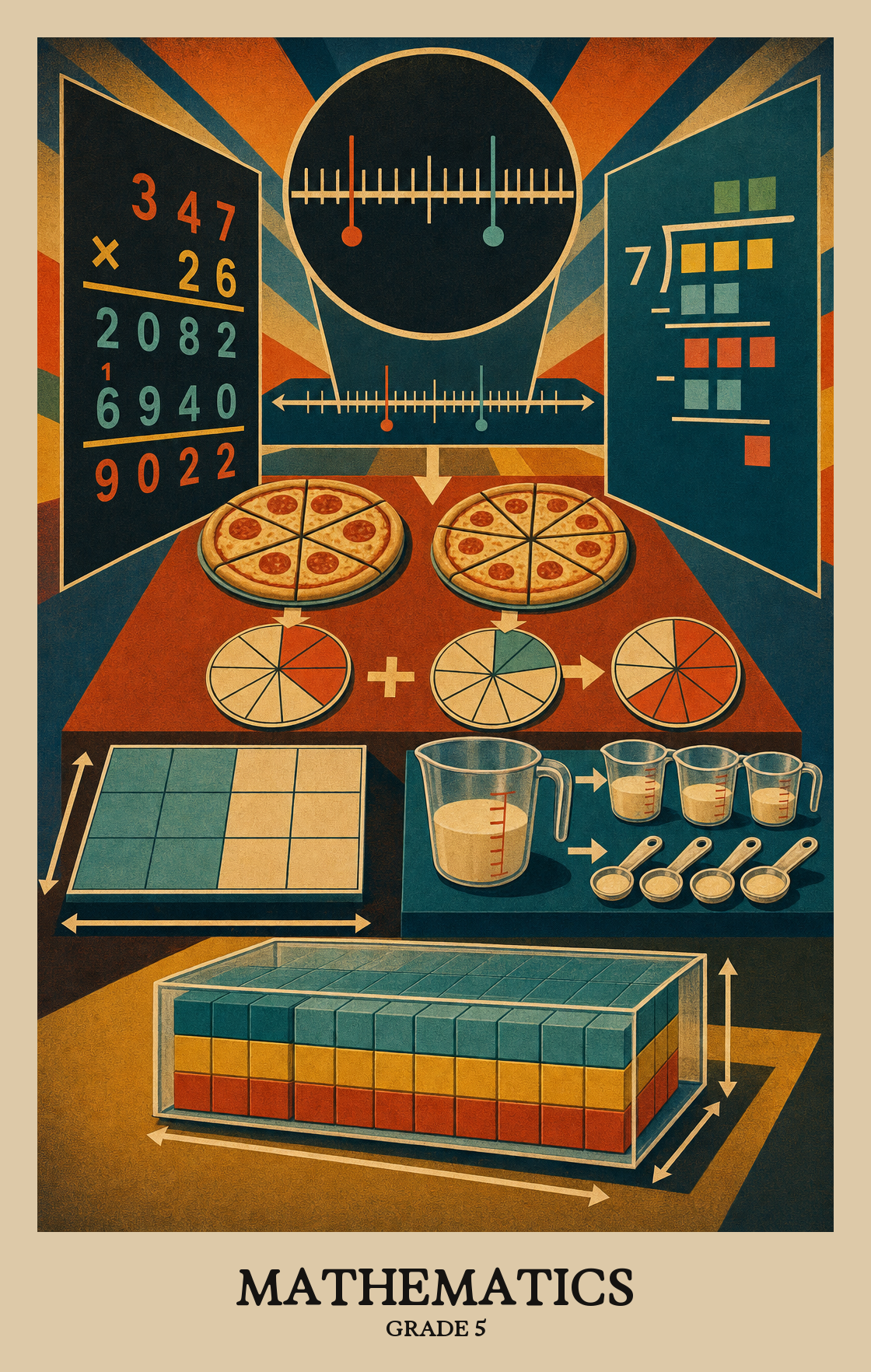
Students extend place value into the thousandths. They read, write, compare, and round decimals, and learn how multiplying or dividing by 10 shifts the digits.
Students multiply large numbers using the standard method and divide with two-digit divisors. They also add, subtract, multiply, and divide decimals in everyday situations like money.
Students add and subtract fractions with different denominators, like one-third plus one-half. They check whether answers make sense using benchmarks they already know.
Students multiply fractions by whole numbers and by other fractions, and divide whole numbers by unit fractions. They see why multiplying by a fraction less than one makes a number smaller.
Students find the volume of boxes by counting unit cubes and using length times width times height. They also convert between units like centimeters and meters when solving problems.
Students write and read number expressions with parentheses and plot points on a grid using x and y coordinates. They look for patterns between two number sequences.
Students write math expressions like (3 + 4) x 2 using parentheses and order of operations, then explain in words what the expression means without actually solving it.
Students learn to read and write math expressions that include parentheses or brackets, then solve them in the correct order. Think of it as following the rules for which part of the problem to calculate first.
Students write math phrases like 2 x (8 + 7) to describe a calculation in order, then read an expression and describe what it means without solving it.
Students look at two number patterns side by side, spot the rule behind each one, and describe how the two patterns relate to each other.
Students follow two counting rules at the same time, list the number pairs they produce, and plot those pairs as dots on a grid. Then they describe what they notice about how the two lists relate to each other.
| Standard | Definition | Code |
|---|---|---|
| Write and interpret numerical expressions | Students write math expressions like (3 + 4) x 2 using parentheses and order of operations, then explain in words what the expression means without actually solving it. | 5.OAT.1 |
| Use parentheses or brackets in numerical expressions and evaluate expressions… | Students learn to read and write math expressions that include parentheses or brackets, then solve them in the correct order. Think of it as following the rules for which part of the problem to calculate first. | M.5.1 |
| Write simple expressions that record calculations with numbers and interpret… | Students write math phrases like 2 x (8 + 7) to describe a calculation in order, then read an expression and describe what it means without solving it. | M.5.2 |
| Analyze patterns and relationships | Students look at two number patterns side by side, spot the rule behind each one, and describe how the two patterns relate to each other. | 5.OAT.2 |
| Generate two numerical patterns using two given rules | Students follow two counting rules at the same time, list the number pairs they produce, and plot those pairs as dots on a grid. Then they describe what they notice about how the two lists relate to each other. | M.5.3 |
Each digit in a number is worth ten times more than the digit to its right. Students read, write, and compare numbers using that pattern, from billions down to thousandths.
Each digit in a number is worth 10 times more than the same digit one spot to its right, and 10 times less than the same digit one spot to its left. The 4 in 400 is worth ten 4s in 40.
Multiplying or dividing a number by 10, 100, or 1,000 shifts its digits left or right on a place value chart. Students explain why that shift happens and write powers of 10 using exponents like 10² or 10³.
Students read, write, and compare decimal numbers down to the thousandths place, like 3.047 or 12.519. They say which number is larger or smaller and put a group of decimals in order.
Students read and write decimal numbers out to the thousandths place three ways: as a standard number, in words, and broken into each digit's value (such as 3 hundreds + 4 tens + 7 ones + 3 tenths).
Students compare two decimal numbers out to the thousandths place by looking at the value of each digit and recording which number is greater, lesser, or equal using the symbols >, <, and =.
Students practice rounding whole numbers and decimals to a chosen place, like rounding 3.867 to the nearest tenth to get 3.9. The focus is on using place value to decide which way to round.
Students add, subtract, multiply, and divide large whole numbers and decimals like $4.75 or 12.30. This is the math behind making change, splitting a bill, or checking a receipt.
Students multiply large whole numbers (like 347 times 86) using the step-by-step written method taught in class. The goal is accuracy and speed, without a calculator.
Students divide large numbers (up to four digits) by a two-digit number and show how they got the answer. They might draw a grid, break the problem into smaller steps, or write out the math in equations.
Students add, subtract, multiply, and divide decimal numbers like $1.25 or $3.40. They use drawings or place-value thinking to solve the problem, then explain in writing why their method works.
| Standard | Definition | Code |
|---|---|---|
| Understand the place value system | Each digit in a number is worth ten times more than the digit to its right. Students read, write, and compare numbers using that pattern, from billions down to thousandths. | 5.NOBT.1 |
| Recognize that in a multi-digit number, a digit in one place represents 10… | Each digit in a number is worth 10 times more than the same digit one spot to its right, and 10 times less than the same digit one spot to its left. The 4 in 400 is worth ten 4s in 40. | M.5.4 |
| Explain how the value of a multi-digit number, including decimals, is changed… | Multiplying or dividing a number by 10, 100, or 1,000 shifts its digits left or right on a place value chart. Students explain why that shift happens and write powers of 10 using exponents like 10² or 10³. | M.5.5 |
| Read, write, and compare decimals to thousandths | Students read, write, and compare decimal numbers down to the thousandths place, like 3.047 or 12.519. They say which number is larger or smaller and put a group of decimals in order. | M.5.6 |
| Read and write decimals to thousandths using base-ten numerals, number names… | Students read and write decimal numbers out to the thousandths place three ways: as a standard number, in words, and broken into each digit's value (such as 3 hundreds + 4 tens + 7 ones + 3 tenths). | M.5.6.a |
| Compare two decimals to thousandths based on meanings of the digits in each… | Students compare two decimal numbers out to the thousandths place by looking at the value of each digit and recording which number is greater, lesser, or equal using the symbols >, <, and =. | M.5.6.b |
| Use place value understanding to round multi-digit numbers, including decimals… | Students practice rounding whole numbers and decimals to a chosen place, like rounding 3.867 to the nearest tenth to get 3.9. The focus is on using place value to decide which way to round. | M.5.7 |
| Perform operations with multi-digit whole numbers and with decimals to… | Students add, subtract, multiply, and divide large whole numbers and decimals like $4.75 or 12.30. This is the math behind making change, splitting a bill, or checking a receipt. | 5.NOBT.2 |
| Fluently (efficiently and accurately) multiply multi-digit whole numbers using… | Students multiply large whole numbers (like 347 times 86) using the step-by-step written method taught in class. The goal is accuracy and speed, without a calculator. | M.5.8 |
| Find whole-number quotients of whole numbers with up to four-digit dividends… | Students divide large numbers (up to four digits) by a two-digit number and show how they got the answer. They might draw a grid, break the problem into smaller steps, or write out the math in equations. | M.5.9 |
| Add, subtract, multiply and divide decimals to hundredths, using concrete… | Students add, subtract, multiply, and divide decimal numbers like $1.25 or $3.40. They use drawings or place-value thinking to solve the problem, then explain in writing why their method works. | M.5.10 |
Students find a common denominator so fractions share the same-size pieces, then add or subtract across the top. This is the core skill behind adding something like 1/2 and 1/3 without guessing.
Students learn to add and subtract fractions that have different bottom numbers, like 1/2 + 1/3, by rewriting them so the bottom numbers match first. It is the same idea as finding a common unit before combining two measurements.
Students add and subtract fractions with different denominators to solve word problems. They also check whether their answer makes sense by comparing it to familiar fractions like one-half or one-fourth.
Students multiply and divide fractions, including whole numbers times fractions and fractions divided by fractions. This builds on what they already know about multiplication and division with whole numbers.
Students learn that a fraction is just a division problem written in a different form: 3/4 means 3 divided by 4. They use diagrams or equations to solve word problems where splitting whole amounts into equal shares produces a fraction or mixed number as the answer.
Students multiply fractions by whole numbers and by other fractions. For example, they find what a half of three-quarters looks like and what that means as a single number.
Multiplying a fraction by a whole number or another fraction means splitting the second number into equal parts, then taking a portion of those parts. For example, (2/3) x 4 means splitting 4 into 3 equal parts and taking 2 of them.
Students figure out the area of a rectangle with fractional side lengths by multiplying the two fractions together. They also see why that multiplication works by picturing the rectangle divided into small equal pieces.
Scaling means stretching or shrinking a number. Students learn to predict whether multiplying by a fraction will give a larger or smaller result, before doing any calculation.
Students figure out whether an answer will be bigger or smaller than a starting number just by looking at what it's being multiplied by, without doing the actual math.
Students explain why multiplying a number by a fraction bigger than 1 makes it grow, and why multiplying by a fraction smaller than 1 makes it shrink. They connect that idea to what happens when you multiply a fraction by 1.
Students use drawings or equations to solve real-world fraction problems, like finding half of a recipe that calls for 2¾ cups of flour. Multiplying fractions and mixed numbers shows up in cooking, building, and other everyday situations.
Dividing a fraction like 1/2 by a whole number, or dividing a whole number by a fraction like 1/3, gets practiced here. Students work out how many pieces fit into a group or how a single piece splits further.
Students divide a simple fraction by a whole number, like splitting one-third of a pizza among 4 people. They draw a picture to show the answer and explain why it works using multiplication.
Students figure out how many small fractional pieces fit into a whole number. For example, dividing 4 by one-fifth means asking how many one-fifth slices fit into 4, and they use a picture or multiplication to check the answer.
Students solve everyday division problems that mix whole numbers and fractions, like splitting half a pound of chocolate among three people. They draw diagrams and write equations to show their thinking.
| Standard | Definition | Code |
|---|---|---|
| Use equivalent fractions as a strategy to add and subtract fractions | Students find a common denominator so fractions share the same-size pieces, then add or subtract across the top. This is the core skill behind adding something like 1/2 and 1/3 without guessing. | 5.NOF.1 |
| Add and subtract fractions with unlike denominators by replacing given… | Students learn to add and subtract fractions that have different bottom numbers, like 1/2 + 1/3, by rewriting them so the bottom numbers match first. It is the same idea as finding a common unit before combining two measurements. | M.5.11 |
| Solve word problems involving addition and subtraction of fractions referring… | Students add and subtract fractions with different denominators to solve word problems. They also check whether their answer makes sense by comparing it to familiar fractions like one-half or one-fourth. | M.5.12 |
| Apply and extend previous understandings of multiplication and division to… | Students multiply and divide fractions, including whole numbers times fractions and fractions divided by fractions. This builds on what they already know about multiplication and division with whole numbers. | 5.NOF.2 |
| Interpret a fraction as division of the numerator by the denominator | Students learn that a fraction is just a division problem written in a different form: 3/4 means 3 divided by 4. They use diagrams or equations to solve word problems where splitting whole amounts into equal shares produces a fraction or mixed number as the answer. | M.5.13 |
| Apply and extend previous understandings of multiplication to multiply a… | Students multiply fractions by whole numbers and by other fractions. For example, they find what a half of three-quarters looks like and what that means as a single number. | M.5.14 |
| Interpret the product | Multiplying a fraction by a whole number or another fraction means splitting the second number into equal parts, then taking a portion of those parts. For example, (2/3) x 4 means splitting 4 into 3 equal parts and taking 2 of them. | M.5.14.a |
| Find the area of a rectangle with fractional side lengths by tiling it with… | Students figure out the area of a rectangle with fractional side lengths by multiplying the two fractions together. They also see why that multiplication works by picturing the rectangle divided into small equal pieces. | M.5.14.b |
| Interpret multiplication as scaling | Scaling means stretching or shrinking a number. Students learn to predict whether multiplying by a fraction will give a larger or smaller result, before doing any calculation. | M.5.15 |
| Comparing the size of a product to the size of one factor on the basis of the… | Students figure out whether an answer will be bigger or smaller than a starting number just by looking at what it's being multiplied by, without doing the actual math. | M.5.15.a |
| Explaining why multiplying a given number by a fraction greater than 1 results… | Students explain why multiplying a number by a fraction bigger than 1 makes it grow, and why multiplying by a fraction smaller than 1 makes it shrink. They connect that idea to what happens when you multiply a fraction by 1. | M.5.15.b |
| Solve real-world problems involving multiplication of fractions and mixed… | Students use drawings or equations to solve real-world fraction problems, like finding half of a recipe that calls for 2¾ cups of flour. Multiplying fractions and mixed numbers shows up in cooking, building, and other everyday situations. | M.5.16 |
| Apply and extend previous understandings of division to divide unit fractions… | Dividing a fraction like 1/2 by a whole number, or dividing a whole number by a fraction like 1/3, gets practiced here. Students work out how many pieces fit into a group or how a single piece splits further. | M.5.17 |
| Interpret division of a unit fraction by a non-zero whole number and compute… | Students divide a simple fraction by a whole number, like splitting one-third of a pizza among 4 people. They draw a picture to show the answer and explain why it works using multiplication. | M.5.17.a |
| Interpret division of a whole number by a unit fraction and compute such… | Students figure out how many small fractional pieces fit into a whole number. For example, dividing 4 by one-fifth means asking how many one-fifth slices fit into 4, and they use a picture or multiplication to check the answer. | M.5.17.b |
| Solve real-world problems involving division of unit fractions by non-zero… | Students solve everyday division problems that mix whole numbers and fractions, like splitting half a pound of chocolate among three people. They draw diagrams and write equations to show their thinking. | M.5.17.c |
Students convert measurements inside the same system, changing feet to inches, kilograms to grams, or hours to minutes. They learn which unit fits the situation and how to move between them without switching systems.
Students practice switching between units in the same system, such as turning centimeters into meters or inches into feet, then use those conversions to solve real problems that take more than one step to figure out.
Students organize measurement data on a line plot, then answer questions about it by adding or subtracting the fractions shown on the plot.
Students record measurements given in fractions on a line plot, then use that data to solve problems, like figuring out how to split a total amount of liquid evenly across several containers.
Students learn what volume means: how much space a 3-D shape takes up inside. They figure out volume by counting unit cubes, then connect that counting to multiplication and addition.
Students learn that volume measures how much space fills a solid shape, like a box or a cube. They explore how that space is measured by counting unit cubes packed inside without gaps or overlaps.
A unit cube is a small cube where every side measures 1 unit. Students use it as the basic building block for measuring volume, the same way they use a single square to measure area.
Volume measures how much space a solid shape takes up. Students find volume by counting how many same-size cubes fill the shape completely, with no gaps or spaces left over.
Students count how many small cubes fit inside a 3-D shape to find its volume. They practice with standard cubes measured in centimeters, inches, or feet, and sometimes with informal stand-ins like sugar cubes or blocks.
Students find the volume of boxes and other rectangular shapes by multiplying length, width, and height, or by adding up the layers. They use that math to solve real problems, like figuring out how much a container holds.
Students figure out the volume of a box by imagining it packed with small cubes, then confirm that multiplying the three side lengths gives the same answer. It connects hands-on counting to the shortcut of multiplication.
Students use the formulas for volume to find how much space fits inside a box-shaped object. They multiply length times width times height, or multiply the base area times the height, to solve real problems with whole-number measurements.
Two boxes stacked or joined together have a total volume equal to the sum of their separate volumes. Students find the volume of each part, then add them to solve real problems like how much a storage unit holds.
| Standard | Definition | Code |
|---|---|---|
| Convert like measurement units within a given measurement system | Students convert measurements inside the same system, changing feet to inches, kilograms to grams, or hours to minutes. They learn which unit fits the situation and how to move between them without switching systems. | 5.MD.1 |
| Convert among different-sized standard measurement units within a given… | Students practice switching between units in the same system, such as turning centimeters into meters or inches into feet, then use those conversions to solve real problems that take more than one step to figure out. | M.5.18 |
| Represent and interpret data | Students organize measurement data on a line plot, then answer questions about it by adding or subtracting the fractions shown on the plot. | 5.MD.2 |
| Make a line plot to display a data set of measurements in fractions of a unit | Students record measurements given in fractions on a line plot, then use that data to solve problems, like figuring out how to split a total amount of liquid evenly across several containers. | M.5.19 |
| Geometric measurement | Students learn what volume means: how much space a 3-D shape takes up inside. They figure out volume by counting unit cubes, then connect that counting to multiplication and addition. | 5.MD.3 |
| Recognize volume as an attribute of solid figures and understand concepts of… | Students learn that volume measures how much space fills a solid shape, like a box or a cube. They explore how that space is measured by counting unit cubes packed inside without gaps or overlaps. | M.5.20 |
| A cube with side length 1 unit, called a "unit cube," is said to have "one… | A unit cube is a small cube where every side measures 1 unit. Students use it as the basic building block for measuring volume, the same way they use a single square to measure area. | M.5.20.a |
| A solid figure which can be packed without gaps or overlaps using b unit cubes… | Volume measures how much space a solid shape takes up. Students find volume by counting how many same-size cubes fill the shape completely, with no gaps or spaces left over. | M.5.20.b |
| Measure volumes by counting unit cubes, using cubic cm, cubic in, cubic ft | Students count how many small cubes fit inside a 3-D shape to find its volume. They practice with standard cubes measured in centimeters, inches, or feet, and sometimes with informal stand-ins like sugar cubes or blocks. | M.5.21 |
| Relate volume to the operations of multiplication and addition and solve… | Students find the volume of boxes and other rectangular shapes by multiplying length, width, and height, or by adding up the layers. They use that math to solve real problems, like figuring out how much a container holds. | M.5.22 |
| Find the volume of a right rectangular prism with whole-number side lengths by… | Students figure out the volume of a box by imagining it packed with small cubes, then confirm that multiplying the three side lengths gives the same answer. It connects hands-on counting to the shortcut of multiplication. | M.5.22.a |
| Apply the formulas V = l × w × h and V = B × h for rectangular prisms to find… | Students use the formulas for volume to find how much space fits inside a box-shaped object. They multiply length times width times height, or multiply the base area times the height, to solve real problems with whole-number measurements. | M.5.22.b |
| Recognize volume as additive and find volumes of solid figures composed of two… | Two boxes stacked or joined together have a total volume equal to the sum of their separate volumes. Students find the volume of each part, then add them to solve real problems like how much a storage unit holds. | M.5.22.c |
Students plot points on a grid using two numbers, one for left-right and one for up-down, to solve math problems and answer real questions about data.
Students learn to plot points on a grid using two numbers, like (3, 5). The first number says how far to move sideways, the second says how far to move up.
| Standard | Definition | Code |
|---|---|---|
| Graph points on the coordinate plane to solve real-world and mathematical… | Students plot points on a grid using two numbers, one for left-right and one for up-down, to solve math problems and answer real questions about data. | 5.G.1 |
| Use a pair of perpendicular number lines, called axes, to define a coordinate… | Students learn to plot points on a grid using two numbers, like (3, 5). The first number says how far to move sideways, the second says how far to move up. | M.5.23 |
Annual statewide mathematics assessment for grades 3 through 8, aligned to West Virginia college- and career-readiness standards.
Dynamic Learning Maps alternate assessment for eligible students with significant cognitive disabilities, covering the same tested subjects as the general summative program.
Students work with decimals to the thousandths place, add and subtract fractions with different bottom numbers, and multiply and divide fractions. They also learn to find the volume of boxes and plot points on a grid using pairs of numbers.
Cooking is the easiest way in. Ask students to double a recipe that uses 2/3 cup or to split 1/2 a pan of brownies into 4 equal pieces. Talking through why 1/2 plus 1/3 is not 2/5 builds real number sense.
Yes. Long multiplication and long division both rest on quick recall of times tables. Five minutes a few nights a week with flashcards or a quick fact game keeps those facts sharp enough to handle bigger problems.
Adding fractions with unlike denominators, dividing a whole number by a unit fraction, and decimal place value past the hundredths place. Plan extra practice and small-group time around these three before moving on.
Start with place value and decimals, then move into multi-digit multiplication and division. Spend the longest stretch on fractions, since it carries the most weight. Save volume and the coordinate grid for the last quarter, when students can apply earlier skills.
Have students draw the problem before writing any numbers. A quick sketch of pizza slices, a stack of boxes, or a number line turns a confusing sentence into something they can see. Ask what the question is really asking before they pick an operation.
By June, students should add and subtract fractions with different denominators, multiply and divide decimals to the hundredths, and find the volume of a rectangular box. They should also explain their reasoning, not just produce an answer.
It's a grid with two number lines that cross at zero. Students use pairs like (3, 4) to plot points. This sets up graphing in middle school and shows up in science, maps, and data work right away.