Matter and its properties
Students look closely at what stuff is made of. They sort materials by properties like hardness and weight, and learn that even things that look solid are made of particles too small to see.
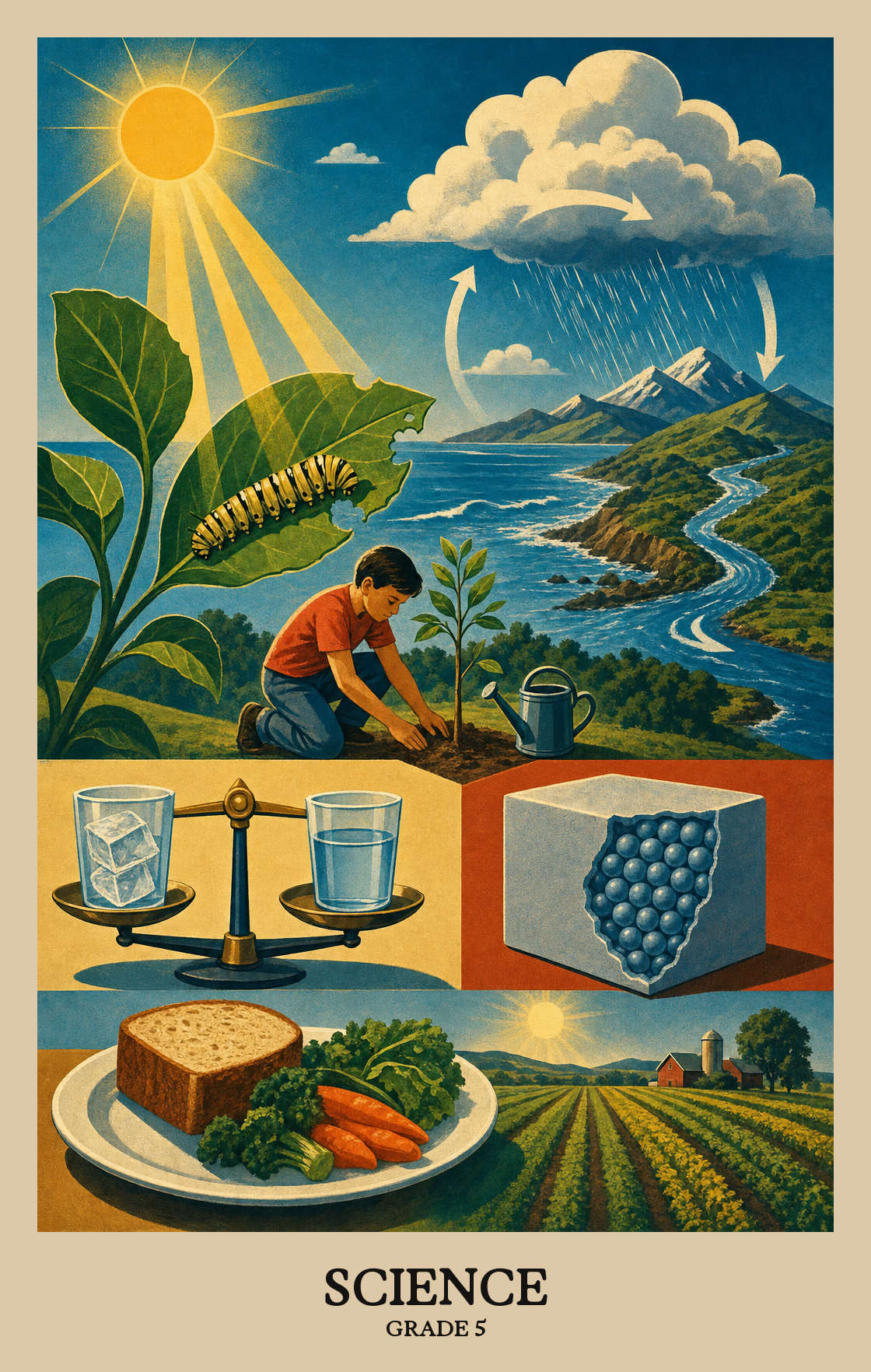
This is the year science zooms out to see how the whole planet works together. Students learn that matter is built from tiny particles too small to see, and that weight stays the same even when things melt, freeze, or mix. They trace energy from the sun into plants, then into animals, and follow water as it moves between oceans, rivers, air, and land. By spring, they can explain where the food on their plate got its energy and point to how people protect Earth's resources.
Students look closely at what stuff is made of. They sort materials by properties like hardness and weight, and learn that even things that look solid are made of particles too small to see.
Students weigh things before and after mixing or heating to see that the total weight stays the same. They also test whether combining two substances makes something new.
Students learn that plants build themselves mostly from air and water, not soil. They trace how energy from the sun moves into food, into animals, and back into the environment through decomposers.
Students graph how much of Earth's water is fresh versus salty and where it is stored. They look at how communities protect land, water, and air, and how the ground, living things, water, and weather affect each other.
Students track shadows, day and night, and the stars that show up in different seasons. They learn that the sun looks much brighter than other stars because it is so much closer to Earth.
Students take on a real problem, like reducing damage from floods or storms, and design something to help. They compare ideas, run fair tests, and improve what does not work.
Students sort and test everyday materials by observing properties like color, texture, flexibility, and whether something sinks or floats. Those properties become clues for identifying what a material is made of.
Matter is made of tiny particles too small to see, even under a magnifying glass. Students build or draw a model showing how those invisible particles make up solid, liquid, and gas.
Students heat, cool, or mix substances and record the weights before and after. The total weight stays the same, showing that matter is not created or destroyed in the process.
Students mix common materials together, like baking soda and vinegar, and observe whether something new forms. They look for signs of change such as bubbling, color shifts, or a new smell.
| Standard | Definition | Code |
|---|---|---|
| Make observations and measurements to identify materials based on their… | Students sort and test everyday materials by observing properties like color, texture, flexibility, and whether something sinks or floats. Those properties become clues for identifying what a material is made of. | S.5.1 |
| Develop a model to describe that matter is made of particles too small to be… | Matter is made of tiny particles too small to see, even under a magnifying glass. Students build or draw a model showing how those invisible particles make up solid, liquid, and gas. | S.5.2 |
| Measure and graph quantities to provide evidence that regardless of the type of… | Students heat, cool, or mix substances and record the weights before and after. The total weight stays the same, showing that matter is not created or destroyed in the process. | S.5.3 |
| Conduct an investigation to determine whether the mixing of two or more… | Students mix common materials together, like baking soda and vinegar, and observe whether something new forms. They look for signs of change such as bubbling, color shifts, or a new smell. | S.5.4 |
Plants pull most of what they need to grow from air and water, not from soil. Students use evidence to explain why that claim holds up.
Animals get their energy from food, and that food energy traces back to the sun. Students use diagrams or models to show how sunlight powers plants, which become food for animals that use it to grow, move, and stay warm.
Students map how matter moves through a food web, showing what plants absorb, what animals eat, and what decomposers break down and return to the soil and air.
| Standard | Definition | Code |
|---|---|---|
| Support an argument that plants get the materials they need for growth chiefly… | Plants pull most of what they need to grow from air and water, not from soil. Students use evidence to explain why that claim holds up. | S.5.5 |
| Use models to describe that energy in animals' food | Animals get their energy from food, and that food energy traces back to the sun. Students use diagrams or models to show how sunlight powers plants, which become food for animals that use it to grow, move, and stay warm. | 5.5.6 |
| Develop a model to describe the movement of matter among plants, animals… | Students map how matter moves through a food web, showing what plants absorb, what animals eat, and what decomposers break down and return to the soil and air. | S.5.7 |
Students graph where Earth's water is found, from oceans to glaciers to groundwater, and compare how much of it is actually fresh water people can drink. Most of Earth's water turns out to be salty.
Students research how real communities protect local resources like water, soil, and air, then combine what they find to explain why those science-based decisions matter.
Students draw or diagram how Earth's parts connect: how rain soaks into soil, how plants hold a hillside in place, or how a volcano sends ash into the air. The model shows that a change in one part of Earth affects the others.
Students learn where energy and fuel come from, like sunlight, wind, coal, and oil, and look at how using those resources changes the land, air, and water around us.
Students think up and compare different ways people can prepare for or protect against natural events like floods, earthquakes, or hurricanes. The goal is to find solutions that actually reduce harm.
Students argue, using evidence, that the sun looks brighter than other stars because it is much closer to Earth, not because it is actually bigger or stronger than every star in the sky.
Students graph measurements of shadows at different times of day, then look for patterns across days and seasons, including which stars appear at night and when.
| Standard | Definition | Code |
|---|---|---|
| Describe and graph the amounts and percentages of water and fresh water in… | Students graph where Earth's water is found, from oceans to glaciers to groundwater, and compare how much of it is actually fresh water people can drink. Most of Earth's water turns out to be salty. | S.5.8 |
| Obtain and combine information about ways individual communities use science… | Students research how real communities protect local resources like water, soil, and air, then combine what they find to explain why those science-based decisions matter. | 5.5.9 |
| Develop a model using an example to describe ways the geosphere, biosphere… | Students draw or diagram how Earth's parts connect: how rain soaks into soil, how plants hold a hillside in place, or how a volcano sends ash into the air. The model shows that a change in one part of Earth affects the others. | 5.5.10 |
| Obtain and combine information to describe that energy and fuels are derived… | Students learn where energy and fuel come from, like sunlight, wind, coal, and oil, and look at how using those resources changes the land, air, and water around us. | 5.5.11 |
| Generate and compare multiple solutions to reduce the impacts of natural Earth… | Students think up and compare different ways people can prepare for or protect against natural events like floods, earthquakes, or hurricanes. The goal is to find solutions that actually reduce harm. | S.5.12 |
| Support an argument that differences in the apparent brightness of the sun… | Students argue, using evidence, that the sun looks brighter than other stars because it is much closer to Earth, not because it is actually bigger or stronger than every star in the sky. | 5.5.13 |
| Represent data in graphical displays to reveal patterns of daily changes in… | Students graph measurements of shadows at different times of day, then look for patterns across days and seasons, including which stars appear at night and when. | 5.5.14 |
Students identify a real problem they want to solve, then set the rules for a good solution before building anything. That means deciding what success looks like and what limits apply, like how much time or money is available.
Students come up with more than one way to solve a problem, then compare their ideas to see which one best fits the rules and limits they were given.
Students test a prototype by changing one thing at a time, watching for what breaks or fails, and using those results to decide what to fix next.
| Standard | Definition | Code |
|---|---|---|
| Define a simple design problem reflecting a need or a want that includes… | Students identify a real problem they want to solve, then set the rules for a good solution before building anything. That means deciding what success looks like and what limits apply, like how much time or money is available. | ED5.5.15 |
| Generate and compare multiple possible solutions to a problem based on how well… | Students come up with more than one way to solve a problem, then compare their ideas to see which one best fits the rules and limits they were given. | ED5.5.16 |
| Plan and carry out fair tests in which variables are controlled and failure… | Students test a prototype by changing one thing at a time, watching for what breaks or fails, and using those results to decide what to fix next. | EDS.5.17 |
Annual statewide science assessment in grades 5 and 8, aligned to West Virginia college- and career-readiness science standards.
Dynamic Learning Maps alternate assessment for eligible students with significant cognitive disabilities, covering the same tested subjects as the general summative program.
Students study three big areas: how matter and materials behave, how living things get the energy and materials they need, and how Earth's water, weather, and sky work. They also tackle small design problems where they build something, test it, and make it better.
Cook together and talk about what happens when ingredients mix or heat up. Step outside at night and find the moon, a bright star, or a shadow that moved since morning. Ask students to explain what they noticed and why they think it happened.
Students should be able to explain that everything is made of tiny particles, that plants build themselves mostly from air and water, and that the sun is the source of energy in food. They should also be able to plan a fair test and use a graph to back up a claim.
Most teachers start with physical science so students get comfortable observing, measuring, and graphing. Life science builds on those habits when students trace energy and matter through plants and animals. Earth and space science comes later in the year, with engineering design woven through every unit.
Conservation of matter is a sticking point, since students think weight disappears when something dissolves or burns. The idea that plants build their bodies from air, not soil, also takes time. Plan extra hands-on work and quick reasoning checks for both.
Not quite. Plants pull water from the soil, but they build most of their bodies from air and water using sunlight. Soil mainly holds the plant up and provides a few nutrients. Trying a sprouting bean in a damp paper towel makes this easy to see.
Students take on small problems with clear rules, like build a shelter that holds a weight using only ten straws. They sketch ideas, test them, find where they fail, and revise. The goal is the habit of fair testing and steady improvement, not a polished product.
Once a week, mark a shadow outside at the same time of day and watch how it shifts over a month. On clear nights, point out one bright star and ask why the sun looks so much bigger and brighter even though stars are similar. Short, regular looks beat one long session.
Ready students can read a simple graph, draw a labeled model, and back up a claim with something they observed or measured. They can also follow a fair-test plan without being walked through each step. If those habits are shaky, spend the last weeks practicing them with familiar content.