Letters, sounds, and book basics
Students learn the names and sounds of every letter, upper and lowercase. They figure out how a book works: where to start reading, which way the words go, and that spaces separate one word from the next.
This is the year letters and sounds turn into reading. Students learn to name every uppercase and lowercase letter, match each one to its sound, and blend those sounds to read short words like cat and sun. They listen to stories and answer questions about the characters and what happened. By spring, students can read simple words on their own and draw and write a few sentences about a topic they care about.
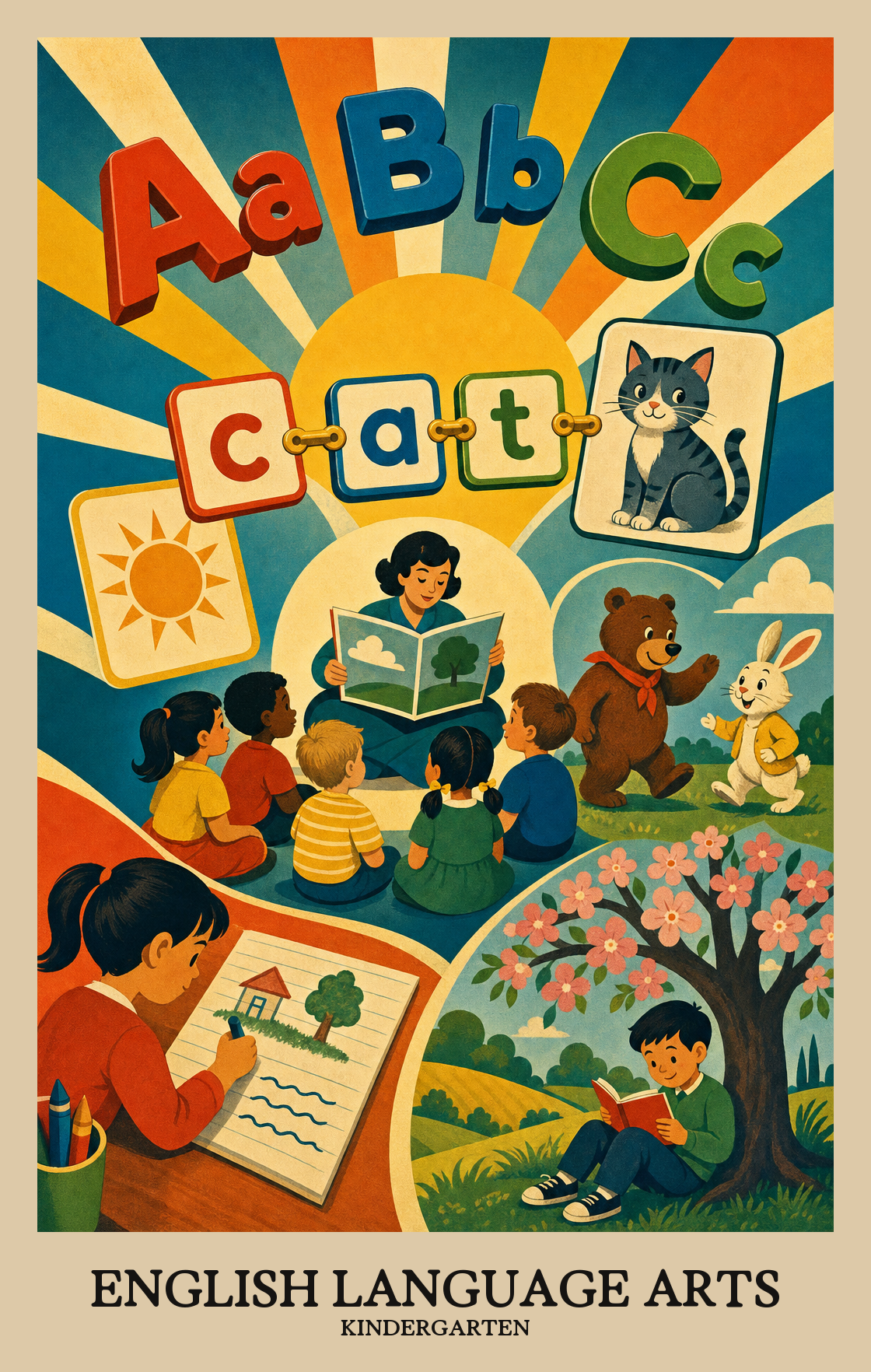
Students learn the names and sounds of every letter, upper and lowercase. They figure out how a book works: where to start reading, which way the words go, and that spaces separate one word from the next.
Students play with the sounds inside spoken words. They clap syllables, find rhymes, and pull apart short words like cat into the sounds c-a-t. This ear training sets up real reading.
Students start sounding out simple words and recognizing common words like the and is on sight. With a teacher's help, they answer questions about a story, name the characters, and retell what happened.
Students use drawing, talking, and beginning writing to share an opinion about a book, tell about something they know, or describe an event. They print letters and spell short words the way they sound.
Students take turns in conversations, ask questions when they are confused, and speak clearly enough for others to follow. They pick up new words from books and read-alouds and use them in their own talk.
Students read simple beginner books out loud with meaning, not just word by word. The goal is to understand what the story or page is actually saying.
Students learn the sounds letters make and use that knowledge to read unfamiliar words. This is the foundation of sounding out words on a page.
Students match each consonant letter to the sound it makes, like knowing that "b" makes the /b/ sound in "ball." This is the foundation for sounding out words.
Students learn that the letter "a" says /a/ in "cat," "e" says /e/ in "bed," and so on for all five vowels. Short vowel sounds are the building blocks of sounding out simple words.
Students recognize common short words like "the," "is," and "you" on sight, without sounding them out. These words show up so often in books that reading gets much easier once students know them by heart.
Students look at two words that are almost identical, like "cat" and "cut," and figure out which letter sounds are different. This builds the habit of reading each letter carefully instead of guessing from the shape of the word.
Students practice writing every letter of the alphabet, both capital and lowercase, by hand.
Students learn to hear and work with the sounds inside spoken words. They clap syllables, blend sounds together, and swap or remove a sound to make a new word.
Students listen to pairs of words and decide if they rhyme, then come up with their own rhyming words. It is an early step toward reading, helping students hear how the ends of words sound alike.
Students clap or tap to break spoken words into syllables, then blend those parts back into the full word. This is early practice hearing how words are built from sound.
Students pull apart a short spoken word into its opening sound and ending chunk, then push them back together. For example, they hear /c/ and /at/, say "cat," or hear "cat" and split it into /c/ and /at/.
Students break apart a short word like "cat" into its three separate sounds: the starting sound, the middle vowel, and the ending sound.
Students swap or add a single sound in a short word to build a new one. Change the "c" in "cat" to "b" and get "bat."
Reading runs left to right, top to bottom, and each clump of letters is a separate word. Students learn how a page of writing is organized before they start reading on their own.
Reading moves in a direction. Students learn that words on a page go left to right, line by line, starting at the top and moving down as you read.
Reading a written word means matching the letters on the page to the sounds in the spoken word. Students learn that every word is spelled with a specific set of letters, in a specific order.
Reading a page means noticing the white gaps between words. Students learn that each cluster of letters sitting between two spaces is its own word.
Students name each letter of the alphabet in both its capital and small forms. This is one of the first steps toward reading and writing words.
| Standard | Definition | Code |
|---|---|---|
| Read emergent- and beginner- reader texts with purpose and understanding | Students read simple beginner books out loud with meaning, not just word by word. The goal is to understand what the story or page is actually saying. | ELA.K.I |
| Know and apply grade-level phonics and word analysis skills in decoding words | Students learn the sounds letters make and use that knowledge to read unfamiliar words. This is the foundation of sounding out words on a page. | ELA.K.II |
| Demonstrate basic knowledge of one-to-one letter-sound correspondences by… | Students match each consonant letter to the sound it makes, like knowing that "b" makes the /b/ sound in "ball." This is the foundation for sounding out words. | ELA.K.II.a |
| Associate common spellings with the five major short vowel sounds | Students learn that the letter "a" says /a/ in "cat," "e" says /e/ in "bed," and so on for all five vowels. Short vowel sounds are the building blocks of sounding out simple words. | ELA.K.II.b |
| Read common high-frequency words by sight | Students recognize common short words like "the," "is," and "you" on sight, without sounding them out. These words show up so often in books that reading gets much easier once students know them by heart. | ELA.K.II.c |
| Distinguish between similarly spelled words by identifying the sounds of the… | Students look at two words that are almost identical, like "cat" and "cut," and figure out which letter sounds are different. This builds the habit of reading each letter carefully instead of guessing from the shape of the word. | ELA.K.II.d |
| Print upper- and lowercase letters | Students practice writing every letter of the alphabet, both capital and lowercase, by hand. | ELA.K.III |
| Demonstrate understanding of spoken words, syllables | Students learn to hear and work with the sounds inside spoken words. They clap syllables, blend sounds together, and swap or remove a sound to make a new word. | ELA.K.IV |
| Recognize and produce rhyming words | Students listen to pairs of words and decide if they rhyme, then come up with their own rhyming words. It is an early step toward reading, helping students hear how the ends of words sound alike. | ELA.K.IV.a |
| Count, pronounce, blend | Students clap or tap to break spoken words into syllables, then blend those parts back into the full word. This is early practice hearing how words are built from sound. | ELA.K.IV.b |
| Blend and segment onsets and rimes of single-syllable spoken words | Students pull apart a short spoken word into its opening sound and ending chunk, then push them back together. For example, they hear /c/ and /at/, say "cat," or hear "cat" and split it into /c/ and /at/. | ELA.K.IV.c |
| Isolate and pronounce the initial, medial vowel | Students break apart a short word like "cat" into its three separate sounds: the starting sound, the middle vowel, and the ending sound. | ELA.K.IV.d |
| Add or substitute individual sounds in simple, one-syllable words to make new… | Students swap or add a single sound in a short word to build a new one. Change the "c" in "cat" to "b" and get "bat." | ELA.K.IV.e |
| Demonstrate understanding of the organization and basic features of print | Reading runs left to right, top to bottom, and each clump of letters is a separate word. Students learn how a page of writing is organized before they start reading on their own. | ELA.K.V |
| Follow words from left to right, top to bottom | Reading moves in a direction. Students learn that words on a page go left to right, line by line, starting at the top and moving down as you read. | ELA.K.V.a |
| Recognize that spoken words are represented in written language by specific… | Reading a written word means matching the letters on the page to the sounds in the spoken word. Students learn that every word is spelled with a specific set of letters, in a specific order. | ELA.K.V.b |
| Understand that words are separated by spaces in print | Reading a page means noticing the white gaps between words. Students learn that each cluster of letters sitting between two spaces is its own word. | ELA.K.V.c |
| Recognize and name upper- and lowercase letters of the alphabet | Students name each letter of the alphabet in both its capital and small forms. This is one of the first steps toward reading and writing words. | ELA.K.V.d |
With a teacher's help, students ask and answer simple questions about stories they hear or read. They point to details in the text that back up what they say.
With a little help from a teacher, students retell a story they know, covering who was in it, what happened, and how it ended.
Students name who is in a story, where it takes place, and what happens. A teacher or parent helps by asking guiding questions.
Reading a nonfiction book out loud, students answer questions about what they just heard and ask their own questions about details that caught their attention.
A teacher reads a nonfiction book aloud and asks questions to help students figure out what the book is mostly about. Students then retell the important details they heard.
Reading a nonfiction book, students explain how two things in it are connected. A teacher or adult helps them find the link, like how rain leads to puddles or why a person became famous.
Students hear a story read aloud and stop to ask what an unfamiliar word means. With a teacher's help, they talk through what the word might mean based on what's happening in the story.
Students learn to tell the difference between a storybook and a how-to book, a poem and a sign. Teachers help them notice what kind of writing they're looking at before they read.
Students learn who wrote a book and who drew the pictures, and what each person's job was in making the story.
Students ask about words they don't know in a nonfiction book or passage. A teacher helps them find the answer by looking at the words and pictures nearby.
Students learn which part of a book is the front, which is the back, and where to find the title page. A teacher or adult helps them look.
Students learn who wrote a book and who drew the pictures, then explain what each person's job was in making that book.
Students look at the pictures in a story and explain how they connect to what is happening in the words. A teacher or adult helps them make that connection.
Students look at two characters from stories they know and talk about what is alike and different in what happens to them.
Students look at the pictures in a nonfiction book and explain how those pictures connect to what the words say. A teacher or adult helps them make that connection.
Students learn to notice why an author said something, not just what they said. With a teacher's help, students point to the sentences that give reasons behind the author's main idea.
Two books can cover the same topic but tell it differently. Students look at both and spot what matches and what doesn't, with help from a teacher.
Students listen to stories read aloud and join in as a group, talking about what happened and why. The books are chosen to stretch what kindergartners can understand.
Students listen to and talk about nonfiction books read aloud in class. The goal is understanding what the book is about, not just sitting quietly while it's read.
| Standard | Definition | Code |
|---|---|---|
| With prompting and support, ask and answer questions about key details in a… | With a teacher's help, students ask and answer simple questions about stories they hear or read. They point to details in the text that back up what they say. | ELA.K.l |
| With prompting and support, retell familiar stories, including key details in… | With a little help from a teacher, students retell a story they know, covering who was in it, what happened, and how it ended. | ELA.K.2 |
| With prompting and support, identify characters, settings | Students name who is in a story, where it takes place, and what happens. A teacher or parent helps by asking guiding questions. | ELA.K.3 |
| With prompting and support, ask and answer questions about key details in an… | Reading a nonfiction book out loud, students answer questions about what they just heard and ask their own questions about details that caught their attention. | ELA.K.4 |
| With prompting and support, identify the main topic and retell key details of… | A teacher reads a nonfiction book aloud and asks questions to help students figure out what the book is mostly about. Students then retell the important details they heard. | ELA.K.5 |
| With prompting and support, describe the connection between two individuals… | Reading a nonfiction book, students explain how two things in it are connected. A teacher or adult helps them find the link, like how rain leads to puddles or why a person became famous. | ELA.K.6 |
| With prompting and support, ask and answer questions about unknown words in a… | Students hear a story read aloud and stop to ask what an unfamiliar word means. With a teacher's help, they talk through what the word might mean based on what's happening in the story. | ELA.K.7 |
| With prompting and support, recognize common types of texts | Students learn to tell the difference between a storybook and a how-to book, a poem and a sign. Teachers help them notice what kind of writing they're looking at before they read. | ELA.K.8 |
| With prompting and support, name the author and illustrator of a story and… | Students learn who wrote a book and who drew the pictures, and what each person's job was in making the story. | ELA.K.9 |
| With prompting and support, ask and answer questions about unknown words in an… | Students ask about words they don't know in a nonfiction book or passage. A teacher helps them find the answer by looking at the words and pictures nearby. | ELA.K.10 |
| With prompting and support, identify the front cover, back cover | Students learn which part of a book is the front, which is the back, and where to find the title page. A teacher or adult helps them look. | ELA.K.11 |
| With prompting and support, name the author and illustrator of a text and… | Students learn who wrote a book and who drew the pictures, then explain what each person's job was in making that book. | ELA.K.12 |
| With prompting and support, describe the relationship between illustrations and… | Students look at the pictures in a story and explain how they connect to what is happening in the words. A teacher or adult helps them make that connection. | ELA.K.13 |
| With prompting and support, compare and contrast the adventures and experiences… | Students look at two characters from stories they know and talk about what is alike and different in what happens to them. | ELA.K.14 |
| With prompting and support, describe the relationship between illustrations and… | Students look at the pictures in a nonfiction book and explain how those pictures connect to what the words say. A teacher or adult helps them make that connection. | ELA.K.15 |
| With prompting and support, identify the reasons an author gives to support… | Students learn to notice why an author said something, not just what they said. With a teacher's help, students point to the sentences that give reasons behind the author's main idea. | ELA.K.16 |
| With prompting and support, identify basic similarities in and differences… | Two books can cover the same topic but tell it differently. Students look at both and spot what matches and what doesn't, with help from a teacher. | ELA.K.17 |
| Actively engage in group reading activities of grade-appropriate complex… | Students listen to stories read aloud and join in as a group, talking about what happened and why. The books are chosen to stretch what kindergartners can understand. | ELA.K.18 |
| Actively engage in group reading activities of grade-appropriate complex… | Students listen to and talk about nonfiction books read aloud in class. The goal is understanding what the book is about, not just sitting quietly while it's read. | ELA.K.19 |
Students pick a favorite book or topic and share why they like it, using pictures, spoken words, or written letters. The opinion and the topic both appear in the piece.
Students pick a topic and explain it using pictures, spoken words, or written letters and words. The goal is to share a few real facts, not tell a story.
Students draw pictures and write or dictate words to tell a short story about something that happened, keeping events in order and sharing how they felt about it.
This standard starts in third grade. There is nothing for kindergarteners to practice here yet.
With a teacher's help, students look back at what they wrote and add words or pictures that make the meaning clearer or the story more complete.
With a teacher's help, students try out tools like a keyboard or tablet to write and share their work with others.
Students work with a teacher or small group to look something up and write about what they find together.
Students answer a simple question by drawing on something they remember or by looking through a book or other source a teacher provides. The thinking is their own; the adult just helps them get started.
This standard doesn't start until grade 4. Kindergarten writing focuses on drawing, dictating, and writing to share opinions, information, and stories.
This standard doesn't apply in Kindergarten. Writing range expectations start in third grade.
| Standard | Definition | Code |
|---|---|---|
| Use a combination of drawing, dictating | Students pick a favorite book or topic and share why they like it, using pictures, spoken words, or written letters. The opinion and the topic both appear in the piece. | ELA.K.20 |
| Use a combination of drawing, dictating | Students pick a topic and explain it using pictures, spoken words, or written letters and words. The goal is to share a few real facts, not tell a story. | ELA.K.21 |
| Use a combination of drawing, dictating | Students draw pictures and write or dictate words to tell a short story about something that happened, keeping events in order and sharing how they felt about it. | ELA.K.22 |
| Begins in grade 3 | This standard starts in third grade. There is nothing for kindergarteners to practice here yet. | ELA.K.23 |
| With guidance and support from adults and collaborative discussions, add… | With a teacher's help, students look back at what they wrote and add words or pictures that make the meaning clearer or the story more complete. | ELA.K.24 |
| With guidance and support from adults, explore a variety of age-appropriate… | With a teacher's help, students try out tools like a keyboard or tablet to write and share their work with others. | ELA.K.25 |
| With guidance and support, participate in shared research and writing | Students work with a teacher or small group to look something up and write about what they find together. | ELA.K.26 |
| With guidance and support from adults, recall information from experiences or… | Students answer a simple question by drawing on something they remember or by looking through a book or other source a teacher provides. The thinking is their own; the adult just helps them get started. | ELA.K.27 |
| Begins in grade 4 | This standard doesn't start until grade 4. Kindergarten writing focuses on drawing, dictating, and writing to share opinions, information, and stories. | ELA.K.28 |
| Begins in grade 3 | This standard doesn't apply in Kindergarten. Writing range expectations start in third grade. | ELA.K.29 |
Students take turns talking and listening in group conversations about books and classroom topics, with both classmates and adults.
Students take turns talking, listen while others speak, and stick to the topic the class is discussing.
Students keep a back-and-forth conversation going by listening to what someone says and responding with something new, not just repeating themselves.
After listening to a story or lesson, students ask questions about what happened and answer questions from others. If something is confusing, they speak up and ask for it to be explained again.
Students practice asking questions when they need help or don't understand something, and answering questions when someone asks them. It's the back-and-forth of a real conversation.
Students talk about people, places, or things they know, like a family member or a favorite spot. With a little help from a teacher, they add more details to make their description clearer.
Students draw a picture to go along with what they say or write, giving listeners or readers a clearer idea of what they mean.
Students practice saying their thoughts out loud in a voice loud enough for the class to hear. The goal is a clear, complete sentence, not just a word or two.
| Standard | Definition | Code |
|---|---|---|
| Participate in collaborative conversations with diverse partners about… | Students take turns talking and listening in group conversations about books and classroom topics, with both classmates and adults. | ELA.K.30 |
| Follow agreed-upon rules for discussions | Students take turns talking, listen while others speak, and stick to the topic the class is discussing. | ELA.K.30.a |
| Continue a conversation through multiple exchanges | Students keep a back-and-forth conversation going by listening to what someone says and responding with something new, not just repeating themselves. | ELA.K.30.b |
| Confirm understanding of a text read aloud or information presented orally or… | After listening to a story or lesson, students ask questions about what happened and answer questions from others. If something is confusing, they speak up and ask for it to be explained again. | ELA.K.31 |
| Ask and answer questions in order to seek help, get information | Students practice asking questions when they need help or don't understand something, and answering questions when someone asks them. It's the back-and-forth of a real conversation. | ELA.K.32 |
| Describe familiar people, places, things | Students talk about people, places, or things they know, like a family member or a favorite spot. With a little help from a teacher, they add more details to make their description clearer. | ELA.K.33 |
| Add drawings or other visuals to descriptions as desired to provide additional… | Students draw a picture to go along with what they say or write, giving listeners or readers a clearer idea of what they mean. | ELA.K.34 |
| Speak audibly and express thoughts, feelings | Students practice saying their thoughts out loud in a voice loud enough for the class to hear. The goal is a clear, complete sentence, not just a word or two. | ELA.K.35 |
Students practice using everyday naming words and action words, making plurals by adding "s" or "es," and asking questions. They build complete sentences out loud and in writing during class activities.
Students learn to start sentences with a capital letter, use periods and question marks, and spell simple words by matching letters to the sounds they hear.
This standard doesn't apply to kindergarten. Students start this language work in second grade.
Students figure out what an unfamiliar word means by using the words and sentences around it. This skill covers words that show up in stories, books, and classroom topics.
A word can mean more than one thing. Students learn that "bark" can be a tree's skin or a dog's sound, then use each meaning correctly in a sentence or conversation.
Students learn that small word parts like "-ed," "-ing," or "un-" change what a word means. Spotting those additions helps students figure out unfamiliar words on their own.
Students learn that words can be related or slightly different in meaning. For example, "happy" and "excited" both describe good feelings, but not quite the same one.
Students sort everyday objects, like foods, animals, or clothing, into groups and start to understand what those groups mean.
Students learn words by pairing them with their opposites: fast and slow, hot and cold, happy and sad. This builds the habit of thinking about what a word means by comparing it to what it isn't.
Students connect a word they've just learned to something they've seen or touched in real life. A teacher might teach "cold," and students think of ice cream or a winter morning.
Students learn that words like "walk," "stomp," and "tiptoe" all describe moving but mean something different. They act out each word to feel the difference.
Students use new words they picked up from books, conversations, and class discussions when they talk and write. The focus is on putting those words to work, not just recognizing them.
| Standard | Definition | Code |
|---|---|---|
| Demonstrate command of the conventions of Standard English grammar and usage… | Students practice using everyday naming words and action words, making plurals by adding "s" or "es," and asking questions. They build complete sentences out loud and in writing during class activities. | ELA.K.36 |
| Demonstrate command of the conventions of Standard English capitalization … | Students learn to start sentences with a capital letter, use periods and question marks, and spell simple words by matching letters to the sounds they hear. | ELA.K.37 |
| Begins in grade 2 | This standard doesn't apply to kindergarten. Students start this language work in second grade. | ELA.K.38 |
| Determine or clarify the meaning of unknown and multiple-meaning words and… | Students figure out what an unfamiliar word means by using the words and sentences around it. This skill covers words that show up in stories, books, and classroom topics. | ELA.K.39 |
| Identify new meanings for familiar words and apply them accurately | A word can mean more than one thing. Students learn that "bark" can be a tree's skin or a dog's sound, then use each meaning correctly in a sentence or conversation. | ELA.K.39.a |
| Introduce the most frequently occurring inflections and affixes as a clue to… | Students learn that small word parts like "-ed," "-ing," or "un-" change what a word means. Spotting those additions helps students figure out unfamiliar words on their own. | ELA.K.39.b |
| With guidance and support from adults, explore word relationships and nuances… | Students learn that words can be related or slightly different in meaning. For example, "happy" and "excited" both describe good feelings, but not quite the same one. | ELA.K.40 |
| Sort common objects into categories to gain a sense of the concepts the… | Students sort everyday objects, like foods, animals, or clothing, into groups and start to understand what those groups mean. | ELA.K.40.a |
| Demonstrate understanding of frequently occurring verbs and adjectives by… | Students learn words by pairing them with their opposites: fast and slow, hot and cold, happy and sad. This builds the habit of thinking about what a word means by comparing it to what it isn't. | ELA.K.40.b |
| Identify real-life connections between words and their use | Students connect a word they've just learned to something they've seen or touched in real life. A teacher might teach "cold," and students think of ice cream or a winter morning. | ELA.K.40.c |
| Distinguish shades of meaning among verbs describing the same general action by… | Students learn that words like "walk," "stomp," and "tiptoe" all describe moving but mean something different. They act out each word to feel the difference. | ELA.K.40.d |
| Use words and phrases acquired through conversations, reading, being read to | Students use new words they picked up from books, conversations, and class discussions when they talk and write. The focus is on putting those words to work, not just recognizing them. | ELA.K.41 |
Annual statewide English language arts assessment for grades 3 through 8, aligned to West Virginia college- and career-readiness standards.
Dynamic Learning Maps alternate assessment for eligible students with significant cognitive disabilities, covering the same tested subjects as the general summative program.
Students name every letter, match letters to sounds, and read short words like cat, sit, and pup. They read a small set of common words on sight, such as the, and, is. They listen to longer stories and answer questions about what happened.
Read a picture book out loud and stop to ask what is happening and why. Point under each word as you read so students see that print goes left to right. A few times a week, sound out short words together on signs, cereal boxes, or notes.
No. Reversing letters like b, d, and s is normal at this age. Keep practicing with chunky crayons, sidewalk chalk, or a finger in shaving cream, and gently model the correct form without erasing their work.
Phonemic awareness is hearing the separate sounds in a spoken word, like hearing c-a-t in cat. It is the strongest predictor of later reading. Practice it in the car with rhyming games, clapping syllables in names, and asking what sound starts dog or ends with sun.
Start with letter names and the most common consonant sounds, then layer in short vowels so students can blend CVC words by midyear. Add a small set of high-frequency words each week. Spend the spring stretching to longer words and simple sentences in decodable text.
Writing is a mix of drawing, labeling, and dictating. Students might draw a picture of a trip to the store and write STR underneath. Accept invented spelling that shows the sounds they hear, and have them read their writing back.
Short vowel sounds, blending three sounds into a word, and segmenting the middle sound in CVC words are the common sticking points. Build in daily five-minute warmups all year, even after a skill looks solid. Pull small groups for students who still confuse similar sounds like e and i.
Ready students blend and segment sounds in short words, read a bank of about 25 common words by sight, and read simple decodable sentences with understanding. They can also retell a story with characters and what happened, and write a sentence others can read.
Yes, rereading is how young readers build fluency and confidence. After the third or fourth read, ask them to point to words they know, predict the next page, or act out a favorite part. Then offer a new book on the same topic.