Watching the weather
Students notice what the sky and air do each day. They track sunny, rainy, windy, and snowy days, and start to spot patterns in how weather changes through the seasons.
This is the year science becomes something students do, not just hear about. Students push and pull objects to see what makes them move faster or change direction. They watch the weather, track sunny and rainy days, and notice what plants and animals need to live. By spring, students can answer a simple question by trying something out and sharing what they saw.
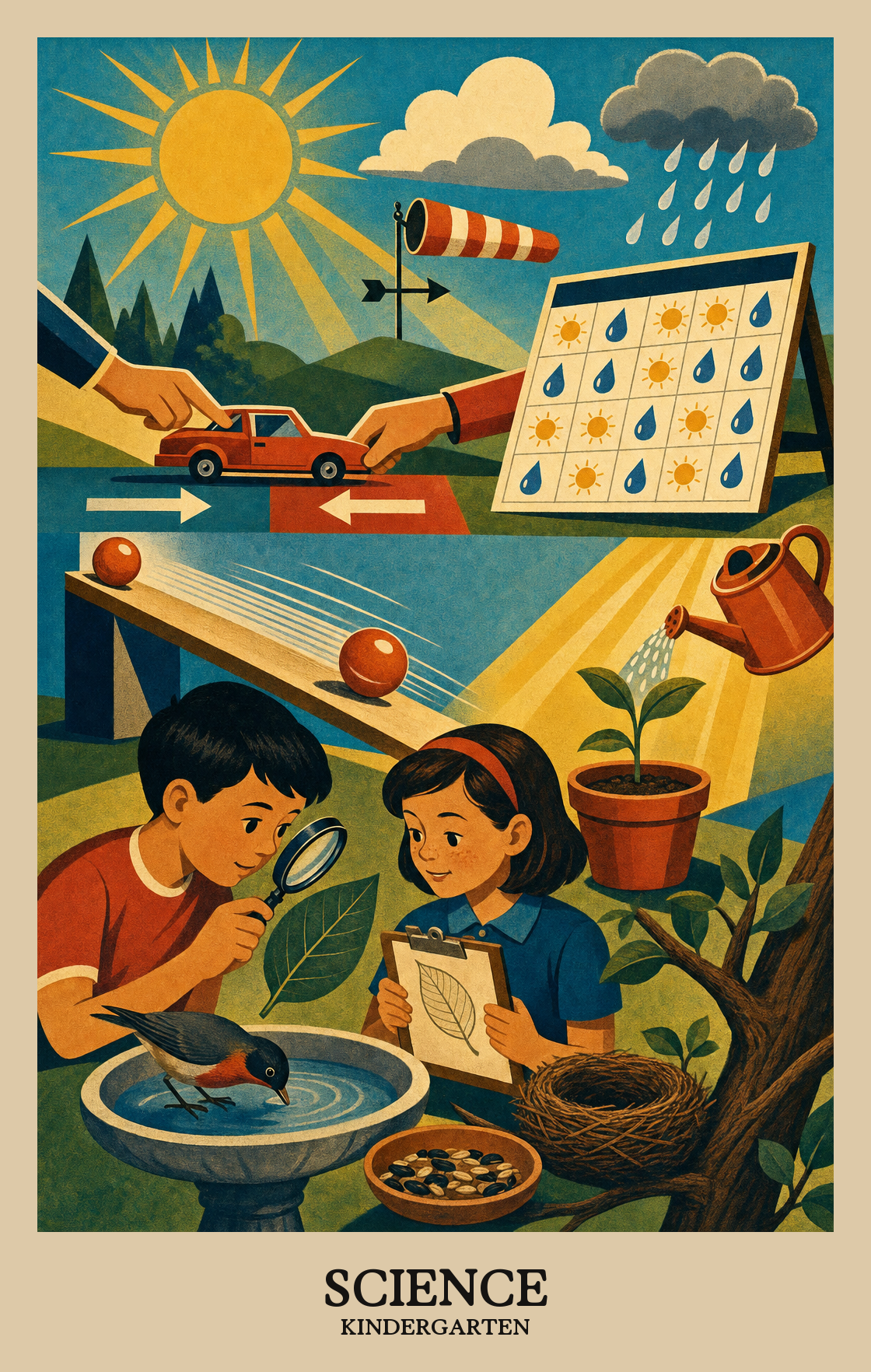
Students notice what the sky and air do each day. They track sunny, rainy, windy, and snowy days, and start to spot patterns in how weather changes through the seasons.
Students play with ramps, balls, and small carts to see how a gentle push or a hard pull changes how something moves. They test ideas and notice what makes an object speed up, slow down, or turn.
Students look at plants, pets, and people to figure out what every living thing needs to stay alive. They talk about food, water, air, sunlight, and shelter, and where different animals and plants live.
Students feel how the sun warms sidewalks, sand, and playground equipment. They try out materials like foil, cloth, and cardboard to build a small shade and see which one keeps a spot coolest.
Students look at how people affect the land, water, and air around their school and home. They come up with small ways to help, like picking up litter, saving water, or feeding birds in winter.
Students act like young inventors. They spot a small problem, sketch an idea, build it from simple materials, and test two versions to see which one works better.
Students push and pull objects to see how hard or which way they need to push to make something move faster, slower, or in a different direction.
Students test whether pushing or pulling a toy or block makes it move faster, slower, or in a different direction. They check if their idea worked the way they expected.
| Standard | Definition | Code |
|---|---|---|
| Plan and conduct an investigation to compare the effects of different strengths… | Students push and pull objects to see how hard or which way they need to push to make something move faster, slower, or in a different direction. | S.K.1 |
| Analyze data to determine if a design solution works as intended to change the… | Students test whether pushing or pulling a toy or block makes it move faster, slower, or in a different direction. They check if their idea worked the way they expected. | S.K.2 |
Students observe real plants and animals to find patterns in what keeps them alive, like water, food, light, and shelter. The goal is noticing that living things share basic needs.
Plants and animals change their surroundings to get what they need. Students look at real examples, like a bird building a nest or a beaver blocking a stream, and explain why the change happens.
Plants and animals live where their basic needs are met. Students use simple models, like drawings or diagrams, to show why a fish needs a pond or a bear needs a forest.
Students think of ways people can take better care of the land, water, air, and animals nearby, then share those ideas with others.
| Standard | Definition | Code |
|---|---|---|
| Use observations to describe patterns of what plants and animals | Students observe real plants and animals to find patterns in what keeps them alive, like water, food, light, and shelter. The goal is noticing that living things share basic needs. | S.K.3 |
| Construct an argument supported by evidence for how plants and animals | Plants and animals change their surroundings to get what they need. Students look at real examples, like a bird building a nest or a beaver blocking a stream, and explain why the change happens. | S.K.4 |
| Use a model to represent the relationship between the needs of different plants… | Plants and animals live where their basic needs are met. Students use simple models, like drawings or diagrams, to show why a fish needs a pond or a bear needs a forest. | S.K.5 |
| Communicate solutions that will reduce the impact of humans on the land, water… | Students think of ways people can take better care of the land, water, air, and animals nearby, then share those ideas with others. | S.K.6 |
Students watch the weather outside and track what they notice over days and weeks. They look for patterns, like whether it tends to rain more in one season or stay sunny for stretches at a time.
Students learn why weather forecasts matter by asking questions about severe weather like storms and floods. The goal is understanding how forecasts help people stay safe and get ready before bad weather arrives.
Students watch what sunlight does to sand, soil, and water, noticing which materials warm up and which stay cool. The goal is to see that the sun heats different parts of Earth's surface in different ways.
Students design and build a simple shade structure, like a roof or canopy, to block sunlight and keep an area cooler. The focus is on testing whether their design actually reduces heat.
| Standard | Definition | Code |
|---|---|---|
| Use and share observations of local weather conditions to describe patterns… | Students watch the weather outside and track what they notice over days and weeks. They look for patterns, like whether it tends to rain more in one season or stay sunny for stretches at a time. | S.K.7 |
| Ask questions to obtain information about the purpose of weather forecasting to… | Students learn why weather forecasts matter by asking questions about severe weather like storms and floods. The goal is understanding how forecasts help people stay safe and get ready before bad weather arrives. | S.K.8 |
| Make observations to determine the effect of sunlight on Earth's surface | Students watch what sunlight does to sand, soil, and water, noticing which materials warm up and which stay cool. The goal is to see that the sun heats different parts of Earth's surface in different ways. | S.K.9 |
| Use tools and materials to design and build a structure that will reduce the… | Students design and build a simple shade structure, like a roof or canopy, to block sunlight and keep an area cooler. The focus is on testing whether their design actually reduces heat. | S.K.10 |
Students look at something that isn't working well, ask questions about it, and gather information to figure out exactly what the problem is before trying to fix it.
Students draw or build a simple model to show how the shape of something helps it do its job. A flat roof keeps rain from pooling; a pointed nose helps a toy rocket cut through air.
Students test two different designs that solve the same problem, then compare which one works better and why. It's early practice in figuring out what a design does well and where it falls short.
| Standard | Definition | Code |
|---|---|---|
| Ask questions, make observations | Students look at something that isn't working well, ask questions about it, and gather information to figure out exactly what the problem is before trying to fix it. | EDS.K.1 |
| Develop a simple sketch, drawing | Students draw or build a simple model to show how the shape of something helps it do its job. A flat roof keeps rain from pooling; a pointed nose helps a toy rocket cut through air. | EDS.K.2 |
| Analyze data from tests of two objects designed to solve the same problem to… | Students test two different designs that solve the same problem, then compare which one works better and why. It's early practice in figuring out what a design does well and where it falls short. | EDS.K.3 |
Dynamic Learning Maps alternate assessment for eligible students with significant cognitive disabilities, covering the same tested subjects as the general summative program.
Students push and pull objects to see how they move, watch plants and animals to figure out what they need, and track the weather day by day. They also try simple building projects, like making a sunshade, and talk about what worked.
Go outside and notice things together. Watch how a ball rolls on grass versus on the sidewalk, point out what birds eat, or check the sky each morning and guess if it will rain. Five minutes of noticing counts.
No. Most of the work is looking closely, talking about what they see, and drawing pictures. If students can describe a pattern out loud, like the weather getting colder, they are doing the thinking the year asks for.
They should describe how a stronger push moves something farther, name what plants and animals need to live, and talk about weather patterns over a week. They should also sketch a simple idea to solve a small problem.
Many teachers start with weather, since students can observe it from day one and build a routine. Pushes and pulls fit well in winter with indoor materials. Save plant and animal needs for spring, when students can watch things grow outside.
Comparing two designs trips students up. They want to say which one they like instead of which one worked better. Build in side-by-side tests early, with one clear question, and ask students to point to the evidence before they give an answer.
Plan for a few short build-and-test cycles across the year, not one big project. A sunshade for a thermometer, a ramp for a toy car, or a bird feeder each take a week or so and connect back to a science idea students already met.
They can ask a question about something they noticed, try a simple test, and say what happened in their own words. They should also be able to spot a pattern, like sunny days feeling warmer than cloudy ones, without being told.