Skip to content

What does a student learn in ?

This is the year math stretches from counting to thinking in hundreds. Students add and subtract within 100 quickly in their heads and start working with numbers up to 1,000 by hundreds, tens, and ones. They also pick up rulers, read clocks to the nearest five minutes, and count mixed coins. By spring, students can solve a two-step word problem and tell time on an analog clock.

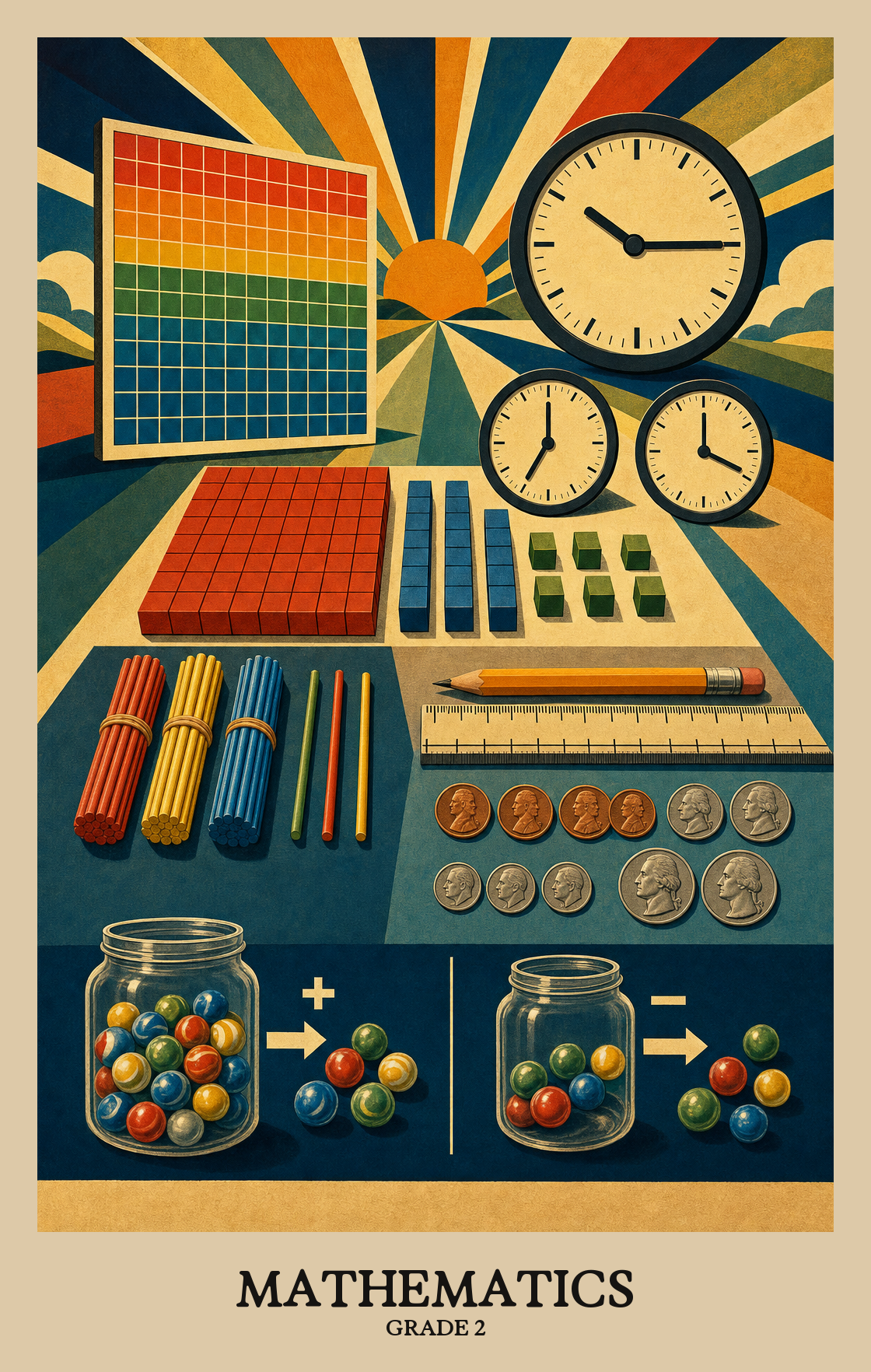
Illustration of what students learn in Grade 2 Mathematics
  • Place value
  • Addition and subtraction
  • Telling time
  • Counting money
  • Measuring length
  • Halves and fourths
Source: West Virginia West Virginia College- and Career-Ready Standards
Year at a glance
How the year usually goes. Every school and district set their own curriculum, so treat this as a guide, not official pacing.
  1. 1

    Adding and subtracting within 20

    Students start the year getting fast and confident with small addition and subtraction facts. By the end of this stretch, they should know sums like 7 plus 8 from memory and use those facts to solve short word problems.

  2. 2

    Place value to 1000

    Students learn that the digits in a number like 706 stand for hundreds, tens, and ones. They count past 1000, skip-count by 5s, 10s, and 100s, and compare numbers using the greater than and less than signs.

  3. 3

    Adding and subtracting bigger numbers

    Students move into adding and subtracting two-digit and three-digit numbers, often by breaking them into hundreds, tens, and ones. They also practice adding 10 or 100 to a number in their head.

  4. 4

    Measuring, time, and money

    Students use rulers and yardsticks to measure real objects in inches, feet, and centimeters. They tell time to the nearest five minutes on analog and digital clocks, and solve simple word problems with dollar bills and coins.

  5. 5

    Shapes, arrays, and equal shares

    Students name shapes by their sides and angles, split rectangles into rows and columns of squares, and cut circles and rectangles into halves, thirds, and fourths. This sets the stage for multiplication and fractions next year.

Mastery Learning Standards
The required skills a student should display by the end of Grade 2.
Operations and Algebraic Thinking
  • Represent and solve problems involving addition and subtraction

    2.OAT.1

    Students read a short word problem and figure out whether to add or subtract to find the answer. They practice turning everyday situations, like sharing snacks or counting coins, into number sentences.

  • Use addition and subtraction within 100 to solve one- and two-step word…

    M.2.1

    Students read short story problems and use addition or subtraction to find missing numbers up to 100. Problems may take two steps to solve, and students show their thinking with drawings or simple equations.

  • Solve problems involving addition and subtraction and identify and explain…

    2.OAT.2

    Adding and subtracting numbers and spotting patterns in how those answers work. Students practice until the basic facts come quickly, then use those patterns to solve new problems.

  • Fluently (efficiently, flexibly

    M.2.2

    Students add and subtract numbers up to 20 in their heads, working toward knowing these math facts from memory. By the end of second grade, they can recall any combination of single-digit numbers without stopping to count.

  • Analyze a number pattern to determine the rule

    M.2.3

    Students look at a row of numbers and figure out what is being added each time to make the pattern work, such as adding 2 or adding 10.

  • Work with equal groups of objects to gain foundations for multiplication

    2.OAT.3

    Students sort objects into equal groups and count how many are in each one. This is the first step toward understanding multiplication.

  • Determine whether a group of objects

    M.2.4

    Students sort a group of up to 20 objects into pairs to decide if the total is odd or even. If every object has a partner, the number is even, and students write it as two equal parts added together, like 6 = 3 + 3.

  • Use addition to find the total number of objects arranged in rectangular arrays…

    M.2.5

    Students count objects arranged in rows and columns, like a grid of dots, by adding equal groups together. They write the addition as a number sentence, such as 3 + 3 + 3 for three rows of three.

Number and Operations in Base Ten
  • Understand place value

    2.NOBT.1

    Students learn that the position of a digit in a number tells its value. A 3 in the tens place means 30, not 3.

  • Understand that the three digits of a three-digit number represent amounts of…

    M.2.6

    A three-digit number like 706 has three separate jobs: the first digit counts hundreds, the middle counts tens, and the last counts ones. Students learn to break apart any number this way.

  • 100 can be thought of as a bundle of ten tens – called a "hundred."

    M.2.6.a

    Students learn that ten groups of ten make one hundred. It's the same idea as bundling ten sticks into one group, done one more time.

  • Numbers 100, 200, 300, 400, 500, 600, 700, 800, 900 refer to one, two, three…

    M.2.6.b

    Students learn that 300 means exactly 3 hundreds, with no tens or ones left over. Round numbers like 400 or 700 are just a clean count of hundreds, nothing more.

  • Count within 1000 and skip-count by 5s, 10s and 100s

    M.2.7

    Students count forward to 1000 and practice jumping by 5s, 10s, or 100s. Skip-counting by 100s means landing on 100, 200, 300 and so on, the way a number line skips ahead in equal steps.

  • Read and write numbers to 1000 using base-ten numerals, number names and…

    M.2.8

    Students read and write numbers up to 1,000 three ways: as digits (357), as words (three hundred fifty-seven), and broken apart by place value (300 + 50 + 7).

  • Compare two three-digit numbers based on meanings of the hundreds, tens and…

    M.2.9

    Students look at two three-digit numbers, decide which is bigger or smaller using the hundreds, tens, and ones places, then write the result using the symbols >, =, or <. They also put a group of numbers in order from least to greatest.

  • Use place value understanding and properties of operations to add and subtract

    2.NOBT.2

    Students add and subtract two- and three-digit numbers by thinking about hundreds, tens, and ones. They use what they know about how numbers are built to solve problems, not just memorize steps.

  • Fluently add and subtract within 100 using strategies based on place value…

    M.2.10

    Adding and subtracting any two numbers up to 100, quickly and without much help. Students use what they know about tens and ones to work through the math.

  • Add up to four two-digit numbers using strategies based on place value and…

    M.2.11

    Students add up to four two-digit numbers at once, grouping tens and ones to make the work easier. This builds on what they know about how numbers are put together.

  • Add and subtract within 1000, using concrete models or drawings and strategies…

    M.2.12

    Students add and subtract numbers up to 1,000 by breaking them into hundreds, tens, and ones. Sometimes a group of ten ones needs to be bundled into a ten, or a ten broken apart, to make the math work.

  • Mentally add 10 or 100 to a given number 100-900 and mentally subtract 10 or…

    M.2.13

    Students add or subtract 10 or 100 from any three-digit number in their head, no pencil needed. The hundreds digit or tens digit changes by one; everything else stays the same.

  • Explain why addition and subtraction strategies work, using place value and the…

    M.2.14

    Students don't just solve addition and subtraction problems. They explain why their method works, using what they know about tens and ones to show the reasoning behind each step.

Measurement and Data
  • Measure and estimate lengths in standard units

    2.MD.1

    Students measure objects using rulers, yardsticks, and tape measures. They learn to read the marks and record how long something is in inches or centimeters.

  • Measure the length of an object by selecting and using appropriate tools such…

    M.2.15

    Students pick the right measuring tool for the job, like a ruler for a pencil or a tape measure for a table, and use it to find how long the object is.

  • Measure the length of an object twice, using length units of different lengths…

    M.2.16

    Measuring the same object with a short unit (like a paperclip) and a long unit (like a ruler) gives different numbers. Students learn that smaller units produce bigger counts, and bigger units produce smaller counts.

  • Estimate lengths using units of inches, feet, centimeters

    M.2.17

    Students guess how long something is before measuring it, using inches, feet, centimeters, or meters. This builds number sense for real objects like a pencil, a desk, or a room.

  • Measure to determine how much longer one object is than another, expressing the…

    M.2.18

    Students measure two objects, then subtract to find the difference. For example, if one pencil is 7 inches and another is 4 inches, students say the first pencil is 3 inches longer.

  • Relate addition and subtraction to length

    2.MD.2

    Students use a ruler or number line to add and subtract lengths. For example, they figure out how much longer one object is than another, or what total length two objects make together.

  • Use addition and subtraction within 100 to solve word problems involving…

    M.2.19

    Word problems ask students to add or subtract lengths, like figuring out how much longer one ribbon is than another. Students write an equation and use a symbol to stand in for the missing number.

  • Represent whole numbers as lengths from 0 on a number line diagram with equally…

    M.2.20

    Students place whole numbers on a number line by marking evenly spaced points starting at 0, then use the same number line to add and subtract numbers up to 100 by hopping forward or back.

  • Work with time and money

    2.MD.3

    Students estimate lengths by guessing whether something is closer to an inch or a foot, a centimeter or a meter, then measure to check. It builds the habit of sizing things up before reaching for a ruler.

  • Tell and write time from analog and digital clocks to the nearest five minutes…

    M.2.21

    Students read both the hour-and-minute hands on a clock face and a digital display, then record the time to the nearest five minutes. They also label the time as a.m. or p.m. to show morning or afternoon.

  • Solve word problems involving dollar bills, quarters, dimes, nickels

    M.2.22

    Students add up a mix of coins and dollar bills to solve simple story problems, then write the answer with the right symbol, like 23¢ or $1.05.

  • Represent and interpret data

    2.MD.4

    Students measure objects with a ruler and record the results on a simple picture or bar graph. They read the graph to compare lengths and answer questions about the differences.

  • Generate measurement data by measuring lengths of several objects to the…

    M.2.23

    Students measure objects with a ruler and record each result as a dot on a number line. The finished chart, called a line plot, shows at a glance how the measurements compare.

  • Draw a picture graph and a bar graph

    M.2.24

    Students collect information, sort it into groups, and draw a picture graph or bar graph to show what they found. Then they use the graph to answer simple questions, like how many more or fewer items are in one group than another.

Geometry
  • Reason with shapes and their attributes

    2.G.1

    Students sort and describe shapes like squares, triangles, and hexagons by counting their sides and corners. They recognize these shapes even when the sizes or positions look different.

  • Recognize and draw shapes having specified attributes, such as a given number…

    M.2.25

    Students sort and sketch shapes by counting their sides, corners, or flat faces. They name specific shapes, including triangles, four-sided figures, five-sided figures, six-sided figures, and cubes.

  • Partition a rectangle into rows and columns of same-size squares and count to…

    M.2.26

    Students cut a rectangle into a grid of equal squares, then count every square to find the total. It's an early look at how multiplication and area work.

  • Partition circles and rectangles into two, three

    M.2.27

    Cutting a circle or rectangle into equal pieces, students name each piece a half, third, or fourth. Two halves or four fourths make the same whole, even when the pieces are cut into different shapes.

No state assessments at this grade
Students take their next one in Grade 3.
State Summative

West Virginia General Summative Assessment: Mathematics

Annual statewide mathematics assessment for grades 3 through 8, aligned to West Virginia college- and career-readiness standards.

When given:
spring
Frequency:
annual
Official source
Alternate assessment

West Virginia Alternate Summative Assessment

Dynamic Learning Maps alternate assessment for eligible students with significant cognitive disabilities, covering the same tested subjects as the general summative program.

When given:
state testing window
Frequency:
annual
Official source
Common Questions
  • What math should students know by the end of the year?

    Students should add and subtract within 100 quickly, read and write numbers up to 1000, tell time to the nearest five minutes, and measure with a ruler. They should also know all the basic addition facts within 20 from memory.

  • How can families practice math at home in a few minutes?

    Count coins from a jar and ask how much is there. Read the clock together at breakfast and bedtime. Ask quick addition and subtraction questions while driving, like what is 38 plus 25. Five minutes a day adds up.

  • What does it mean to know addition facts from memory?

    Students should answer single-digit sums like 7 plus 8 within about three seconds, without counting on fingers. Quick recall frees up their thinking for bigger problems later. Flashcards or quick verbal quizzes a few times a week help most students get there.

  • How should place value be sequenced across the year?

    Start with tens and ones, then build to hundreds before pushing into three-digit addition and subtraction. Students need solid bundling work with base-ten blocks before they can compose and decompose hundreds on paper. Expect place value to take longer than the pacing guide suggests.

  • Which skills usually need the most reteaching?

    Subtraction with regrouping across a zero, telling time to five minutes past the half hour, and counting mixed coins. Word problems with the unknown at the start, like blank plus 14 equals 22, also trip students up. Plan spiral review for these all year.

  • What should families do if students get stuck on a word problem?

    Ask them to draw the problem before writing an equation. A simple sketch of the objects or a number line often unlocks the answer. If they are still stuck, act it out with coins, blocks, or small toys.

  • Why is measuring with a ruler harder than it looks?

    Many students line up the object with the end of the ruler instead of the zero mark, or count tick marks instead of spaces. Give frequent short practice with real rulers, yardsticks, and measuring tapes on objects around the room. Estimating first helps catch mistakes.

  • How do students learn fractions in second grade?

    Students split circles and rectangles into halves, thirds, and fourths, and learn that equal shares of the same shape can look different. Cutting sandwiches, pizzas, or paper into equal pieces at home builds this idea. Symbols like 1/2 come later.

  • How do teachers know students are ready for third grade?

    By June, students should add and subtract within 100 fluently, work with numbers to 1000, solve two-step word problems, and explain their strategies using place value. Students who still count on fingers for facts within 20 will struggle with multiplication next year.