Sorting and testing materials
Students look closely at everyday materials like fabric, wood, and plastic. They test which ones are hard, soft, bendy, or strong, and use what they find to pick the right material for a job.
This is the year science becomes hands-on testing. Students sort materials by how they feel and act, then pick the right one for a job like a sturdy bridge or a warm coat. They watch how plants grow, how animals spread seeds, and how wind and water reshape the land over time. By spring, students can run a simple test, write down what they saw, and use that evidence to answer a question.
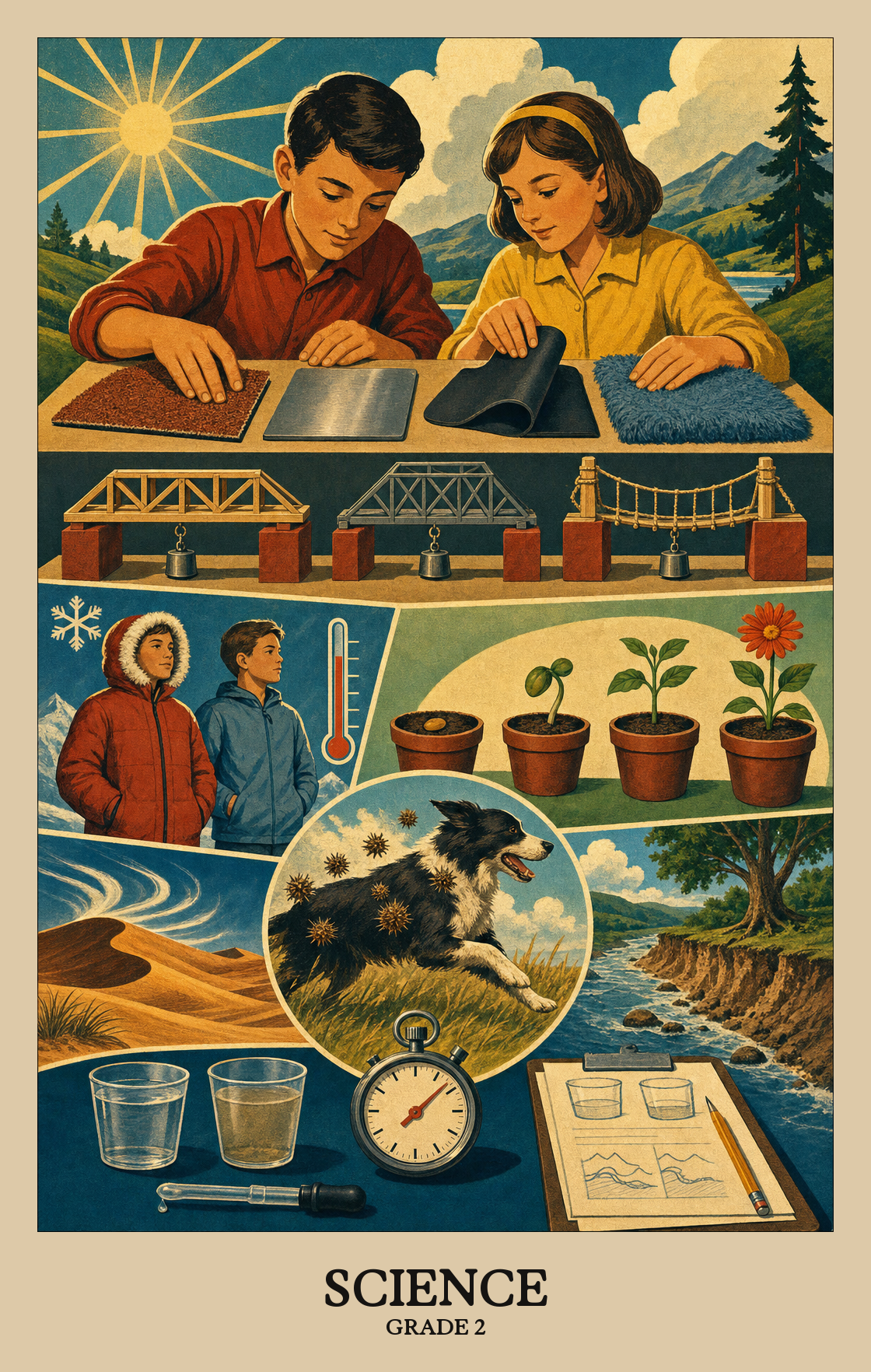
Students look closely at everyday materials like fabric, wood, and plastic. They test which ones are hard, soft, bendy, or strong, and use what they find to pick the right material for a job.
Students take small sets of pieces apart and rebuild them into something new. They also notice which changes from heating or cooling, like melting ice or baking dough, can be undone and which cannot.
Students grow plants to see what they need to stay healthy and watch how animals help move seeds and pollen. They compare the kinds of plants and animals that live in different places.
Students map the hills, rivers, and lakes around them and learn where water shows up as ice or liquid. They look at how wind and water slowly reshape the land, and how people try to slow that down.
Students pick a small, real problem and sketch or build something to fix it. They test two designs against each other and talk about what worked, what did not, and what to try next.
Students sort everyday materials like wood, metal, fabric, and plastic by what they can see, feel, or measure about them. They plan a simple test and record what they find.
Students test materials like wood, fabric, or foil to figure out which one works best for a specific job. A waterproof material keeps things dry; a flexible one bends without breaking.
Students take apart a simple object, like a block structure or toy, and use the same pieces to build something new. The goal is to show that the pieces themselves don't change, only the shape they're arranged in.
Heating and cooling can change matter in ways that can sometimes be undone. Students learn to tell the difference: melting ice back to water is reversible, but burning wood is not.
| Standard | Definition | Code |
|---|---|---|
| Plan and conduct an investigation to describe and classify different kinds of… | Students sort everyday materials like wood, metal, fabric, and plastic by what they can see, feel, or measure about them. They plan a simple test and record what they find. | S.2.1 |
| Analyze data obtained from testing different materials to determine which… | Students test materials like wood, fabric, or foil to figure out which one works best for a specific job. A waterproof material keeps things dry; a flexible one bends without breaking. | S.2.2 |
| Make observations to construct an evidence-based account of how an object made… | Students take apart a simple object, like a block structure or toy, and use the same pieces to build something new. The goal is to show that the pieces themselves don't change, only the shape they're arranged in. | S.2.3 |
| Construct an argument with evidence that some changes caused by heating or… | Heating and cooling can change matter in ways that can sometimes be undone. Students learn to tell the difference: melting ice back to water is reversible, but burning wood is not. | S.2.4 |
Students set up a simple experiment to find out whether plants grow better with or without sunlight and water. They observe and record what happens over time.
Students build a simple model that shows how an animal moves seeds to a new spot or carries pollen from flower to flower. Think of a bee brushing past a flower or a bird dropping a seed somewhere new.
Students look at plants and animals in different places, like a pond, a forest, or a backyard, and notice how the mix of living things changes from one spot to the next.
| Standard | Definition | Code |
|---|---|---|
| Plan and conduct an investigation to determine if plants need sunlight and… | Students set up a simple experiment to find out whether plants grow better with or without sunlight and water. They observe and record what happens over time. | S.2.5 |
| Develop a simple model that mimics the function of an animal in dispersing… | Students build a simple model that shows how an animal moves seeds to a new spot or carries pollen from flower to flower. Think of a bee brushing past a flower or a bird dropping a seed somewhere new. | S.2.6 |
| Make observations of plants and animals to compare the diversity of life in… | Students look at plants and animals in different places, like a pond, a forest, or a backyard, and notice how the mix of living things changes from one spot to the next. | S.2.7 |
Students gather facts from books, videos, or observations to show that some Earth changes happen in seconds (like an earthquake) and others take thousands of years (like a canyon forming).
Students look at different ways people try to protect land from wind and water erosion, such as planting trees or building barriers, and decide which solutions work best.
Students draw or build a simple map showing the landforms and bodies of water in an area, such as hills, rivers, or lakes. The model helps them see how land and water are arranged in a place.
Water covers most of Earth's surface and exists in two forms. Students identify where water is found, including oceans, rivers, lakes, and ice, and explain why some water is liquid while other water is solid.
| Standard | Definition | Code |
|---|---|---|
| Use information from several sources to provide evidence that Earth events can… | Students gather facts from books, videos, or observations to show that some Earth changes happen in seconds (like an earthquake) and others take thousands of years (like a canyon forming). | S.2.8 |
| Compare multiple solutions designed to slow or prevent wind or water from… | Students look at different ways people try to protect land from wind and water erosion, such as planting trees or building barriers, and decide which solutions work best. | S.2.9 |
| Develop a model to represent the shapes and kinds of land and bodies of water… | Students draw or build a simple map showing the landforms and bodies of water in an area, such as hills, rivers, or lakes. The model helps them see how land and water are arranged in a place. | S.2.10 |
| Obtain information to identify where water is found on Earth and that it can be… | Water covers most of Earth's surface and exists in two forms. Students identify where water is found, including oceans, rivers, lakes, and ice, and explain why some water is liquid while other water is solid. | S.2.11 |
Students look closely at an everyday problem, ask questions about it, and collect information to figure out exactly what needs fixing before they start building or inventing a solution.
Students draw or build a simple model to show how an object's shape helps it do its job. A wide base keeps something from tipping; a pointed tip pushes through material easily.
Students test two different inventions built to solve the same problem, then compare how well each one worked and where each one fell short.
| Standard | Definition | Code |
|---|---|---|
| Ask questions, make observations | Students look closely at an everyday problem, ask questions about it, and collect information to figure out exactly what needs fixing before they start building or inventing a solution. | EDS.2.12 |
| Develop a simple sketch, drawing | Students draw or build a simple model to show how an object's shape helps it do its job. A wide base keeps something from tipping; a pointed tip pushes through material easily. | EDS.2.13 |
| Analyze data from tests of two objects designed to solve the same problem to… | Students test two different inventions built to solve the same problem, then compare how well each one worked and where each one fell short. | EDS.2.14 |
Dynamic Learning Maps alternate assessment for eligible students with significant cognitive disabilities, covering the same tested subjects as the general summative program.
Students spend the year testing things, watching them change, and explaining what they saw. They sort objects by what they feel and look like, check what plants need, and notice how land and water change over time. Most learning happens by doing, not by reading.
Pick everyday moments and ask what students notice. Sort the laundry by fabric, watch ice melt in a glass, plant a bean in a cup by the window, or look at puddles after rain. Five minutes of noticing and a few questions go a long way.
Not really. The point is to describe what they observe in their own words. Terms like solid, liquid, habitat, and material come up often, but students should be able to use them after seeing examples, not recite definitions.
Many teachers start with properties of materials in the fall, since it sets up careful observation and sorting. Plants and animals fit well in spring when seeds can actually grow. Earth changes and engineering can be woven in across the year as short investigations.
Reversible versus irreversible change trips students up, especially telling melting apart from burning or cooking. Constructing an argument from evidence is also new for this age, so expect to model how to point at what they saw and explain what it shows.
Students decide what they want to find out, choose what to test, and agree on what counts as a fair comparison. At this age it might be as simple as giving one plant water and one no water, then watching for a week and writing down what happened.
Engineering shows up in small design tasks across the year, like sketching a tool, building something to slow water from washing away soil, or comparing two designs to see which works better. It should feel like problem solving with simple materials, not a separate unit.
By spring, students should be able to describe what they observed, sort objects by properties, and back up a simple claim with what they saw. They should know plants need sunlight and water, and that land and water can change quickly or slowly.
Walks are some of the best science time. Look at how rain has shaped a dirt path, watch bees on flowers, collect leaves from different trees, or notice where puddles form and where they do not. Talk about why students think it happened that way.