Counting and numbers to 120
Students count forward and backward to 120, starting from any number. They read and write these numbers and count groups of objects to match.
First grade is the year numbers stretch past ten and start working in groups. Students count, read, and write up to 120, and they begin to see a number like 47 as 4 tens and 7 ones. They add and subtract within 20, learn coins, tell time to the hour and half hour, and split shapes into halves and fourths. By spring, students can add and subtract within 10 from memory and compare two numbers up to 100 using greater than and less than.
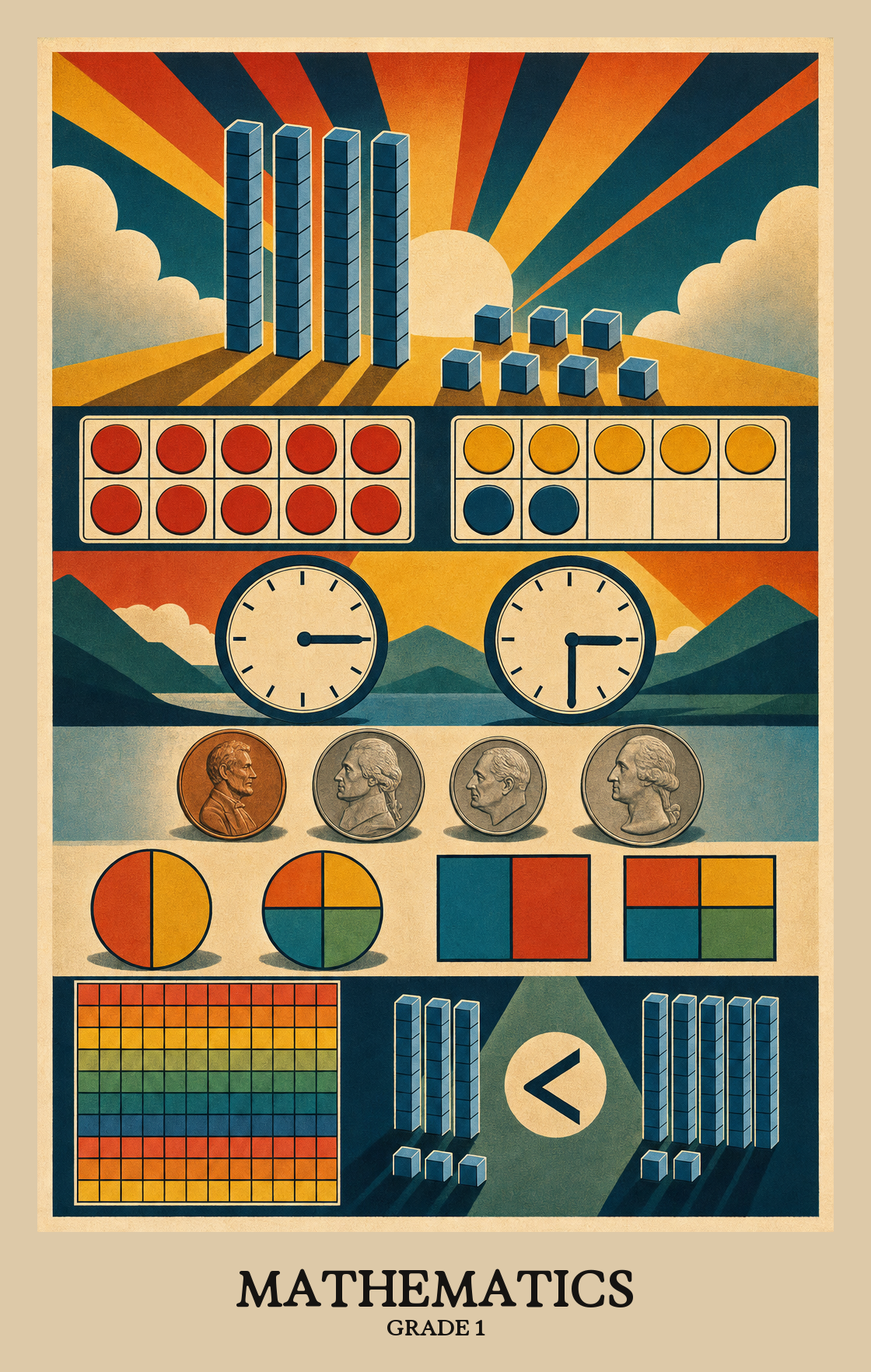
Students count forward and backward to 120, starting from any number. They read and write these numbers and count groups of objects to match.
Students learn that a two-digit number like 47 is made of 4 tens and 7 ones. They use this to compare numbers up to 100 with the symbols greater than, less than, and equal.
Students add and subtract within 20 using pictures, objects, and number sentences. They get fast and confident with the smaller facts within 10 and start to see how addition and subtraction undo each other.
Students name and sort flat and solid shapes, put smaller shapes together to make new ones, and split circles and rectangles into halves and fourths. They also extend patterns that grow, shrink, or repeat.
Students add and subtract with two-digit numbers up to 100, including jumps of 10. They learn to find 10 more or 10 less in their head without counting one by one.
Students measure how long objects are using paper clips or cubes and put objects in order from shortest to longest. They tell time to the hour and half hour and learn the value of pennies, nickels, dimes, and quarters.
When math gets hard, students keep trying instead of giving up. They ask for help when they're stuck, listen to feedback, and learn to notice when their own approach isn't working.
Students figure out what a problem is asking before they start solving it, then keep trying even when the work gets hard.
Students take a real problem, like counting coins or measuring a shelf, and think about what the numbers actually mean. They move between the math and the real situation to make sure the answer makes sense.
Students explain how they got their answer and listen to how a classmate solved the same problem. They practice saying why an answer makes sense and pointing out where another student's thinking might have gone wrong.
Students use drawings, objects, or number sentences to show a real-world problem, like counting coins or splitting a snack equally. A picture or diagram helps them think through the math before writing an answer.
Students learn to pick the right tool for the job, like choosing a ruler to measure length or counters to solve an addition problem, instead of guessing.
Students check their work carefully, use the right words to explain their thinking, and make sure numbers and labels in their answers are correct.
Students notice patterns and rules hiding in numbers or shapes, then use those patterns to solve problems. For example, if adding zero never changes a number, students use that rule instead of recounting every time.
Students notice when the same steps keep showing up in a problem and use that pattern as a shortcut. Spotting what repeats helps them solve new problems faster and with more confidence.
| Standard | Definition | Code |
|---|---|---|
| Display perseverance and patience in problem-solving | When math gets hard, students keep trying instead of giving up. They ask for help when they're stuck, listen to feedback, and learn to notice when their own approach isn't working. | 1.MP |
| Make sense of problems and persevere in solving them | Students figure out what a problem is asking before they start solving it, then keep trying even when the work gets hard. | 1.MP.1 |
| Reason abstractly and quantitatively | Students take a real problem, like counting coins or measuring a shelf, and think about what the numbers actually mean. They move between the math and the real situation to make sure the answer makes sense. | 1.MP.2 |
| Construct viable arguments and critique the reasoning of others | Students explain how they got their answer and listen to how a classmate solved the same problem. They practice saying why an answer makes sense and pointing out where another student's thinking might have gone wrong. | 1.MP.3 |
| Model with mathematics | Students use drawings, objects, or number sentences to show a real-world problem, like counting coins or splitting a snack equally. A picture or diagram helps them think through the math before writing an answer. | 1.MP.4 |
| Use appropriate tools strategically | Students learn to pick the right tool for the job, like choosing a ruler to measure length or counters to solve an addition problem, instead of guessing. | 1.MP.5 |
| Attend to precision | Students check their work carefully, use the right words to explain their thinking, and make sure numbers and labels in their answers are correct. | 1.MP.6 |
| Look for and make use of structure | Students notice patterns and rules hiding in numbers or shapes, then use those patterns to solve problems. For example, if adding zero never changes a number, students use that rule instead of recounting every time. | 1.MP.7 |
| Look for and express regularity in repeated reasoning | Students notice when the same steps keep showing up in a problem and use that pattern as a shortcut. Spotting what repeats helps them solve new problems faster and with more confidence. | 1.MP.8 |
Students count, read, and write whole numbers up to 120. They understand where each number falls in sequence, like knowing 97 comes before 98 and both come before 100.
Students cut a circle, square, or rectangle into two equal halves or four equal fourths. They name the parts but don't color them in.
Students count up and count back from any number up to 120, not just from zero. This builds the number sense they need before adding and subtracting larger numbers.
Students count by 2s, 5s, and 10s instead of counting one at a time. This builds the number patterns behind adding, multiplying, and reading a clock or coins.
Students count a group of objects up to 120, keeping track so nothing gets counted twice. This builds the number sense they need before they start adding and subtracting larger numbers.
Students break a two-digit number apart (47 becomes 40 and 7) and put numbers together to build one. This builds the foundation for adding and subtracting bigger numbers later.
Students look at two numbers up to 100 and decide which is greater, which is less, or if they match. They practice with numbers like 47 and 74, learning to read place value before they compare.
Students add and subtract numbers up to 10 quickly and accurately, without counting on fingers or pausing to figure it out. These are the basic number facts that underpin almost all the math that comes next.
Students add and subtract numbers up to 20, using what they already know about how numbers work to solve problems more easily.
Students count, compare, and work with numbers up to 100 by understanding how tens and ones fit together. A number like 47 means four groups of ten and seven leftover ones.
Students count and extend patterns that go up by 1s, 5s, or 10s, like filling in a number line or skip-counting on a hundreds chart. They figure out what number comes next and why.
Students recognize a pattern that repeats, like a row of shapes or a number sequence, and figure out what comes next.
Students sort shapes by what they notice about them: how many sides, whether edges are straight or curved, whether the shape is flat or solid. They use the right names for what they find.
Students put simple shapes together to build new shapes, like fitting triangles into a rectangle or stacking blocks to form a taller solid. The focus is on how smaller shapes combine to make bigger ones.
Students pick a small object, like a paperclip or a block, and use it to measure how long something is. This builds the idea that length is measured by repeating a same-size unit end to end.
Students line up three objects and say which is longest, shortest, or in between, using everyday items like paper clips or cubes to measure instead of a ruler.
Students sort objects or answers into groups (up to three), then read a simple chart or picture graph to say which group has more, less, or the same.
Students learn what each common coin is worth: a penny equals 1 cent, a nickel 5, a dime 10, and a quarter 25. They can look at a coin and name its value.
Students read a clock to tell whether it's exactly on the hour or on the half hour, then write that time in numbers.
Students figure out how much time has passed between two points on a clock. They might see that school started at 8 o'clock and ends at 3 o'clock, then count how many hours went by.
| Standard | Definition | Code |
|---|---|---|
| Whole numbers to 120 | Students count, read, and write whole numbers up to 120. They understand where each number falls in sequence, like knowing 97 comes before 98 and both come before 100. | 1.LP1.1.1 |
| Partition shapes into halves and quarters/fourths | Students cut a circle, square, or rectangle into two equal halves or four equal fourths. They name the parts but don't color them in. | 1.LP1.1.2 |
| Counting forward and backward within 120 | Students count up and count back from any number up to 120, not just from zero. This builds the number sense they need before adding and subtracting larger numbers. | 1.LP1.2.1 |
| Skip counting by 2s, 5s | Students count by 2s, 5s, and 10s instead of counting one at a time. This builds the number patterns behind adding, multiplying, and reading a clock or coins. | 1.LP1.2.2 |
| Counting objects to 120 | Students count a group of objects up to 120, keeping track so nothing gets counted twice. This builds the number sense they need before they start adding and subtracting larger numbers. | 1.LP1.2.3 |
| Compose and decompose 2-digit numbers | Students break a two-digit number apart (47 becomes 40 and 7) and put numbers together to build one. This builds the foundation for adding and subtracting bigger numbers later. | 1.LP1.3.1 |
| Comparing numbers to 100 | Students look at two numbers up to 100 and decide which is greater, which is less, or if they match. They practice with numbers like 47 and 74, learning to read place value before they compare. | 1.LP1.4.1 |
| Fluency with addition and subtraction within 10 | Students add and subtract numbers up to 10 quickly and accurately, without counting on fingers or pausing to figure it out. These are the basic number facts that underpin almost all the math that comes next. | 1.LP1.5.1 |
| Within 20 (using properties of operations) | Students add and subtract numbers up to 20, using what they already know about how numbers work to solve problems more easily. | 1.LP1.6.1 |
| Within 100 (using base ten understanding) | Students count, compare, and work with numbers up to 100 by understanding how tens and ones fit together. A number like 47 means four groups of ten and seven leftover ones. | 1.LP1.6.2 |
| Growing and repeating patterns of 1s, 5s | Students count and extend patterns that go up by 1s, 5s, or 10s, like filling in a number line or skip-counting on a hundreds chart. They figure out what number comes next and why. | 1.LP2.1.1 |
| Repeated operations, shapes or numbers | Students recognize a pattern that repeats, like a row of shapes or a number sequence, and figure out what comes next. | 1.LP2.1.2 |
| Identify, sort, and classify 2D & 3D shapes based on specific attributes using… | Students sort shapes by what they notice about them: how many sides, whether edges are straight or curved, whether the shape is flat or solid. They use the right names for what they find. | 1.LP3.1.1 |
| Compose 2D shapes & 3D shapes | Students put simple shapes together to build new shapes, like fitting triangles into a rectangle or stacking blocks to form a taller solid. The focus is on how smaller shapes combine to make bigger ones. | 1.LP3.1.2 |
| Measure length in non-standard units | Students pick a small object, like a paperclip or a block, and use it to measure how long something is. This builds the idea that length is measured by repeating a same-size unit end to end. | 1.LP4.1.1 |
| Compare, describe and order up to 3 objects using length in non-standard units | Students line up three objects and say which is longest, shortest, or in between, using everyday items like paper clips or cubes to measure instead of a ruler. | 1.LP4.1.2 |
| Display and interpret categorical data | Students sort objects or answers into groups (up to three), then read a simple chart or picture graph to say which group has more, less, or the same. | 1.LP4.1.3 |
| Identify value of pennies, nickels, dimes and quarters | Students learn what each common coin is worth: a penny equals 1 cent, a nickel 5, a dime 10, and a quarter 25. They can look at a coin and name its value. | 1.LP4.2.1 |
| Tell & write time in hours and half hours | Students read a clock to tell whether it's exactly on the hour or on the half hour, then write that time in numbers. | 1.LP4.3.1 |
| Measure elapsed time to the hour | Students figure out how much time has passed between two points on a clock. They might see that school started at 8 o'clock and ends at 3 o'clock, then count how many hours went by. | 1.LP4.3.2 |
Students count, read, and write numbers up to 120, and compare two numbers up to 100 to decide which is larger or smaller.
Students count forward and backward from any starting number up to 120, then write the numeral that matches a group of objects.
Reading a two-digit number means seeing two separate ideas: how many groups of ten and how many leftovers. The number 47, for example, means 4 tens and 7 ones, not just "forty-seven."
Students look at two numbers up to 100 and decide which is bigger, smaller, or equal. They show their thinking with drawings or objects, then write the answer using the symbols >, <, or =.
Adding and subtracting are opposites, and students use that connection to solve everyday number problems up to 20. If 7 + 5 = 12, then 12 - 5 = 7.
Solving addition and subtraction problems up to 20 using more than one method. Students might count on, use a number line, or break numbers apart to find the answer.
Students use drawings and number sentences to spot patterns across a set of related addition and subtraction problems, building faster ways to find answers within 20.
Adding and subtracting are opposites. Students use that connection to check their work, so if 7 + 8 = 15, they know 15 - 8 = 7.
Adding and subtracting numbers up to 10 becomes quick and reliable. Students practice enough ways to solve these problems that they can pick the right approach without stopping to count on their fingers.
Students decide whether an addition or subtraction equation is true or false by checking that both sides of the equal sign show the same amount.
Students find the missing number in an equation like 4 + ? = 11 or 9 - ? = 3. They work with all three numbers in the problem to figure out which one is hiding.
Adding and subtracting can follow helpful patterns. Students use those patterns, like knowing that order doesn't change a sum, to figure out math problems where answers stay within 20.
Students add and subtract numbers up to 100 using blocks, drawings, or place-value thinking. They learn to work with tens and ones so the math connects to something they can see or touch.
Students practice adding and subtracting numbers up to 100, using tools like drawings or counters to solve real problems. They build more than one way to find the answer.
Students pick any two-digit number and figure out what's 10 more or 10 less in their head, no counting needed. They can also explain how they knew.
Students add and subtract round numbers like 10, 20, or 30. They practice seeing how tens stack up and come apart, building toward bigger addition and subtraction problems.
| Standard | Definition | Code |
|---|---|---|
| Extend the count sequence to 120 | Students count, read, and write numbers up to 120, and compare two numbers up to 100 to decide which is larger or smaller. | 1.NR.1 |
| Count within 120, forward and backward, starting at any number | Students count forward and backward from any starting number up to 120, then write the numeral that matches a group of objects. | 1.NR.1.1 |
| Explain that the two digits of a 2-digit number represent the amounts of tens… | Reading a two-digit number means seeing two separate ideas: how many groups of ten and how many leftovers. The number 47, for example, means 4 tens and 7 ones, not just "forty-seven." | 1.NR.1.2 |
| Compare and order whole numbers up to 100 using concrete models, drawings | Students look at two numbers up to 100 and decide which is bigger, smaller, or equal. They show their thinking with drawings or objects, then write the answer using the symbols >, <, or =. | 1.NR.1.3 |
| Explain the relationship between addition and subtraction and apply the… | Adding and subtracting are opposites, and students use that connection to solve everyday number problems up to 20. If 7 + 5 = 12, then 12 - 5 = 7. | 1.NR.2 |
| Use a variety of strategies to solve addition and subtraction problems within… | Solving addition and subtraction problems up to 20 using more than one method. Students might count on, use a number line, or break numbers apart to find the answer. | 1.NR.2.1 |
| Use pictures, drawings | Students use drawings and number sentences to spot patterns across a set of related addition and subtraction problems, building faster ways to find answers within 20. | 1.NR.2.2 |
| Recognize the inverse relationship between subtraction and addition within 20… | Adding and subtracting are opposites. Students use that connection to check their work, so if 7 + 8 = 15, they know 15 - 8 = 7. | 1.NR.2.3 |
| Fluently add and subtract within 10 using a variety of strategies | Adding and subtracting numbers up to 10 becomes quick and reliable. Students practice enough ways to solve these problems that they can pick the right approach without stopping to count on their fingers. | 1.NR.2.4 |
| Use the meaning of the equal sign to determine whether equations involving… | Students decide whether an addition or subtraction equation is true or false by checking that both sides of the equal sign show the same amount. | 1.NR.2.5 |
| Determine the unknown whole number in an addition or subtraction equation… | Students find the missing number in an equation like 4 + ? = 11 or 9 - ? = 3. They work with all three numbers in the problem to figure out which one is hiding. | 1.NR.2.6 |
| Apply properties of operations as strategies to solve addition and subtraction… | Adding and subtracting can follow helpful patterns. Students use those patterns, like knowing that order doesn't change a sum, to figure out math problems where answers stay within 20. | 1.NR.2.7 |
| Use concrete models, the base ten structure | Students add and subtract numbers up to 100 using blocks, drawings, or place-value thinking. They learn to work with tens and ones so the math connects to something they can see or touch. | 1.NR.5 |
| Use a variety of strategies to solve applicable, mathematical addition and… | Students practice adding and subtracting numbers up to 100, using tools like drawings or counters to solve real problems. They build more than one way to find the answer. | 1.NR.5.1 |
| Given a two-digit number, mentally find 10 more or 10 less than the number… | Students pick any two-digit number and figure out what's 10 more or 10 less in their head, no counting needed. They can also explain how they knew. | 1.NR.5.2 |
| Add and subtract multiples of 10 within 100 | Students add and subtract round numbers like 10, 20, or 30. They practice seeing how tens stack up and come apart, building toward bigger addition and subtraction problems. | 1.NR.5.3 |
Students learn to spot, describe, and continue patterns that repeat, grow, or shrink, like clapping rhythms, staircase shapes, or rows of objects. They also make up their own patterns from everyday things around them.
Students find and build repeating patterns, like red-blue-red-blue or 1-2-3-1-2-3, where the same group of up to three things keeps cycling. They also predict what comes next.
Students spot patterns that grow or shrink by adding or subtracting 1, 2, 5, or 10 each time, like counting nickels or skipping ahead on a number line. They also make their own patterns using the same rules.
| Standard | Definition | Code |
|---|---|---|
| Identify, describe, extend | Students learn to spot, describe, and continue patterns that repeat, grow, or shrink, like clapping rhythms, staircase shapes, or rows of objects. They also make up their own patterns from everyday things around them. | 1.PAR.3 |
| Investigate, create, and make predictions about repeating patterns with a core… | Students find and build repeating patterns, like red-blue-red-blue or 1-2-3-1-2-3, where the same group of up to three things keeps cycling. They also predict what comes next. | 1.PAR.3.1 |
| Identify, describe, and create growing, shrinking | Students spot patterns that grow or shrink by adding or subtracting 1, 2, 5, or 10 each time, like counting nickels or skipping ahead on a number line. They also make their own patterns using the same rules. | 1.PAR.3.2 |
Students put simple shapes together to build bigger ones, then look at what makes each shape what it is: how many sides, how many corners, how the parts fit into the whole.
Students sort everyday shapes like squares, triangles, and spheres by what makes them unique, such as the number of sides or corners. They also draw and build shapes that match those same rules.
Students build pictures and structures by fitting basic shapes together, then use that combined shape as a building block to make something even bigger. Think puzzle pieces snapping into new puzzles.
Students cut circles and rectangles into 2 or 4 equal pieces, like splitting a pizza in half or into four slices.
| Standard | Definition | Code |
|---|---|---|
| Compose shapes, analyze the attributes of shapes | Students put simple shapes together to build bigger ones, then look at what makes each shape what it is: how many sides, how many corners, how the parts fit into the whole. | 1.GSR.4 |
| Identify common two-dimensional shapes and three-dimensional figures, sort and… | Students sort everyday shapes like squares, triangles, and spheres by what makes them unique, such as the number of sides or corners. They also draw and build shapes that match those same rules. | 1.GSR.4.1 |
| Compose two-dimensional shapes | Students build pictures and structures by fitting basic shapes together, then use that combined shape as a building block to make something even bigger. Think puzzle pieces snapping into new puzzles. | 1.GSR.4.2 |
| Partition circles and rectangles into two and four equal shares | Students cut circles and rectangles into 2 or 4 equal pieces, like splitting a pizza in half or into four slices. | 1.GSR.4.3 |
Students use rulers to measure objects, read clocks to compare lengths of time, and sort coins by value. They also read simple charts and graphs to answer questions about real data.
Students pick a small object (like a paper clip or cube) and use it to measure how long other things are. They compare up to three objects by length and put them in order from shortest to longest.
Students read a clock to tell time by the hour and half-hour, then figure out how much time has passed between two points using a number line.
Students learn the value of a quarter and practice comparing coins: which is worth more, a dime or a nickel, a penny or a quarter. They use coin values to make sense of everyday money amounts.
Students look at a simple chart or graph, then ask and answer questions about the numbers shown, like which group has more or which number is biggest.
| Standard | Definition | Code |
|---|---|---|
| Use appropriate tools to measure, order | Students use rulers to measure objects, read clocks to compare lengths of time, and sort coins by value. They also read simple charts and graphs to answer questions about real data. | 1.MDR.6 |
| Estimate, measure, and record lengths of objects using non-standard units | Students pick a small object (like a paper clip or cube) and use it to measure how long other things are. They compare up to three objects by length and put them in order from shortest to longest. | 1.MDR.6.1 |
| Tell and write time in hours and half-hours using analog and digital clocks | Students read a clock to tell time by the hour and half-hour, then figure out how much time has passed between two points using a number line. | 1.MDR.6.2 |
| Identify the value of quarters and compare the values of pennies, nickels, dimes | Students learn the value of a quarter and practice comparing coins: which is worth more, a dime or a nickel, a penny or a quarter. They use coin values to make sense of everyday money amounts. | 1.MDR.6.3 |
| Ask questions and answer them based on gathered information, observations | Students look at a simple chart or graph, then ask and answer questions about the numbers shown, like which group has more or which number is biggest. | 1.MDR.6.4 |
End-of-grade mathematics assessment for grades 3 through 8, aligned to Georgia's state-adopted math standards.
Students count to 120, read and write those numbers, and add and subtract within 20. They tell time to the hour and half hour, name coins, and split shapes into halves and fourths. Adding and subtracting within 10 should feel quick and automatic.
Count things together. Coins in a jar, steps to the car, crackers on a plate. Ask questions like "How many if I add two more?" or "How many are left if you eat three?" Short, daily counting beats long weekend sessions.
These facts are the base for everything that comes later. Students need to know them without counting on fingers before they tackle bigger numbers and word problems. Quick recall in first grade saves a lot of struggle in second and third grade.
Build fluency within 10 first using strategies like making ten, doubles, and counting on. Then stretch those same strategies to 20, and finally to two-digit problems within 100 using place value. Save mental math for 10 more and 10 less once tens and ones are solid.
Students learn that a number like 47 means 4 tens and 7 ones. They use cubes, ten-frames, and drawings to show this before working with the symbols alone. Place value is what lets them add and subtract larger numbers and find 10 more or 10 less in their head.
The equal sign tends to trip students up, since many read it as "the answer is" rather than "the same as." Telling time to the half hour, finding the unknown number in equations like 8 + ? = 13, and comparing coin values also need extra practice rounds.
Yes, for facts within 10 by the end of the year. The goal is quick recall, not speed drills. Card games, dice games, and short flash card sessions a few times a week work better than long practice on weekends.
Keep an analog clock visible and ask what time dinner starts or how long until bedtime. Sort coins on the floor and name each one with its value. Real coins and a real clock teach this faster than worksheets.
Students can count to 120 from any starting number, add and subtract within 20 with strategies, and add and subtract within 100 using tens and ones. They can also tell time to the half hour, compare two-digit numbers, and split a shape into equal halves and fourths.