Watching the weather
Students track the weather each day using a thermometer, rain gauge, and wind vane. They sort rain, snow, sleet, and hail by whether the water is solid or liquid, and they record what they see on a class calendar.
This is the year science moves from noticing the world to investigating it on purpose. Students track the weather with real tools like thermometers and rain gauges, and they look for patterns across the seasons. They explore how light lets us see, how shadows shift, how vibrations make sound, and how magnets pull or push. By spring, they can explain what a plant needs to live and name its parts at the kitchen table.
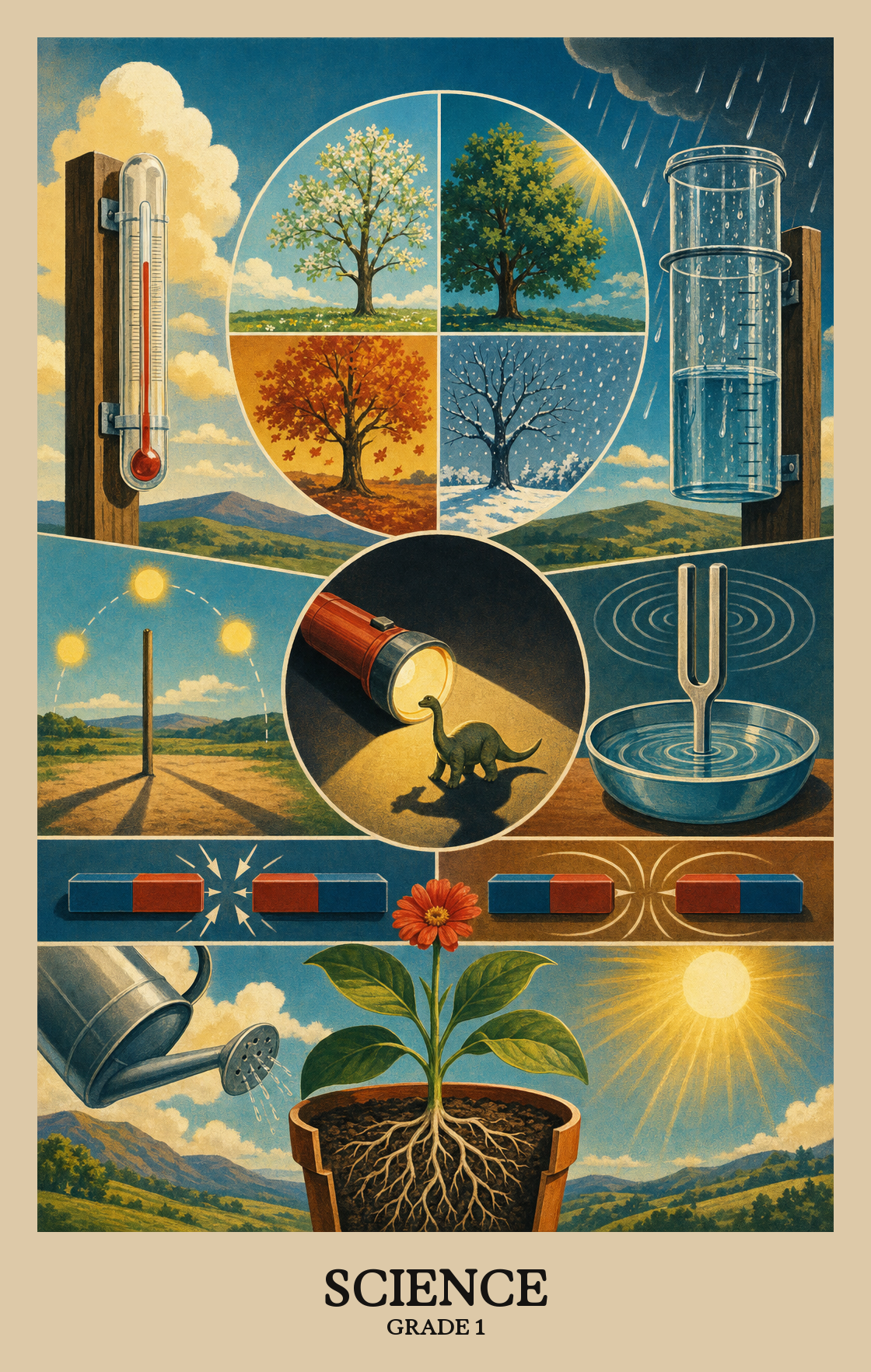
Students track the weather each day using a thermometer, rain gauge, and wind vane. They sort rain, snow, sleet, and hail by whether the water is solid or liquid, and they record what they see on a class calendar.
Students look back at weeks of weather notes and graph what they found. They start to spot how temperature and storms shift from one season to the next.
Students figure out why a room has to have light before they can see anything in it. They test what happens to a shadow when an object moves closer to or farther from a flashlight, and they compare different sources of light.
Students feel how a guitar string, a drum, or their own throat shakes when it makes a sound. They use what they learn about light and sound to design a signal, like a flashing light or a buzzer, that warns someone from far away.
Students try magnets on paper clips, coins, and other everyday objects to see what sticks and what does not. They notice how two magnets can pull together or push apart, and they spot magnets used at home.
Students build models of a plant and label the roots, stem, leaves, and flower. They compare what a plant needs to grow with what an animal needs to live, then design a way to keep a plant or pet healthy.
Students collect daily weather observations like temperature and cloud cover, then look for patterns, such as which days tend to be rainy or sunny.
Students record daily weather observations in a simple table or graph, then use that data to spot patterns, like which types of weather show up most often and what each type looks and feels like.
Students sort types of precipitation, like snow, sleet, and hail, as solid or liquid. They ask questions about what falls from the sky and use the answers to spot patterns in weather.
Students measure temperature, wind direction, and rainfall using simple tools, then record what they find in a journal or on a calendar. Over time, those records help students spot patterns in the weather.
Students look at weather data collected across months to spot patterns, like how winter is colder than summer or how spring brings more rain. They practice noticing how seasons repeat year after year.
| Standard | Definition | Code |
|---|---|---|
| Obtain, evaluate, and communicate weather data to identify weather patterns | Students collect daily weather observations like temperature and cloud cover, then look for patterns, such as which days tend to be rainy or sunny. | S1E1 |
| Represent data in tables and/or graphs to identify and describe different types… | Students record daily weather observations in a simple table or graph, then use that data to spot patterns, like which types of weather show up most often and what each type looks and feels like. | S1E1.a |
| Ask questions to identify forms of precipitation such as rain, snow, sleet | Students sort types of precipitation, like snow, sleet, and hail, as solid or liquid. They ask questions about what falls from the sky and use the answers to spot patterns in weather. | S1E1.b |
| Plan and carry out investigations on current weather conditions by observing… | Students measure temperature, wind direction, and rainfall using simple tools, then record what they find in a journal or on a calendar. Over time, those records help students spot patterns in the weather. | S1E1.c |
| Analyze data to identify seasonal patterns of change | Students look at weather data collected across months to spot patterns, like how winter is colder than summer or how spring brings more rain. They practice noticing how seasons repeat year after year. | S1E1.d |
Students explore how light and sound work by observing, asking questions, and sharing what they find. They look at how light travels and bounces, and how sounds are made by things that vibrate.
Students explain why objects disappear in the dark. They observe that light has to hit something before you can see it.
Students look at everyday objects and ask which ones give off light. They compare sources like the sun, a lamp, and a flashlight to understand that light can come from many places.
Students place objects at different distances from a light source and watch how the shadow changes size. They record what they notice and look for a pattern.
Students learn that sound comes from things vibrating, like a drum skin shaking when struck. They also see that a loud sound can make nearby objects shake in return.
Students design a warning signal, like a flashing light or a loud sound pattern, that could alert people in an emergency from far away.
Magnets push and pull other magnets, and they attract some objects but not others. Students test what a magnet moves, holds, or repels.
Students explain how magnets are used in real objects around them, like cabinet latches, refrigerator doors, or toys. The focus is on connecting what magnets do to things students already see and touch.
Students plan and run a hands-on test to see how two magnets push away or pull toward each other, then check which everyday objects a magnet will stick to and which ones it won't.
| Standard | Definition | Code |
|---|---|---|
| Obtain, evaluate, and communicate information to investigate light and sound | Students explore how light and sound work by observing, asking questions, and sharing what they find. They look at how light travels and bounces, and how sounds are made by things that vibrate. | S1P1 |
| Use observations to construct an explanation of how light is required to make… | Students explain why objects disappear in the dark. They observe that light has to hit something before you can see it. | S1P1.a |
| Ask questions to identify and compare sources of light | Students look at everyday objects and ask which ones give off light. They compare sources like the sun, a lamp, and a flashlight to understand that light can come from many places. | S1P1.b |
| Plan and carry out an investigation of shadows by placing objects at various… | Students place objects at different distances from a light source and watch how the shadow changes size. They record what they notice and look for a pattern. | S1P1.c |
| Construct an explanation supported by evidence that vibrating materials can… | Students learn that sound comes from things vibrating, like a drum skin shaking when struck. They also see that a loud sound can make nearby objects shake in return. | S1P1.d |
| Design a signal that can serve as an emergency alert using light and/or sound… | Students design a warning signal, like a flashing light or a loud sound pattern, that could alert people in an emergency from far away. | S1P1.e |
| Obtain, evaluate, and communicate information to demonstrate the effects of… | Magnets push and pull other magnets, and they attract some objects but not others. Students test what a magnet moves, holds, or repels. | S1P2 |
| Construct an explanation of how magnets are used in everyday life | Students explain how magnets are used in real objects around them, like cabinet latches, refrigerator doors, or toys. The focus is on connecting what magnets do to things students already see and touch. | S1P2.a |
| Plan and carry out an investigation to demonstrate how magnets attract and… | Students plan and run a hands-on test to see how two magnets push away or pull toward each other, then check which everyday objects a magnet will stick to and which ones it won't. | S1P2.b |
Plants and animals need specific things to stay alive. Students learn what those things are, like water, food, air, and light, and how living things get what they need.
Students draw or label a plant to show its four main parts: roots, stem, leaves, and flower. Each part has a job that keeps the plant alive.
Plants and animals both need air and water to survive, but they meet other needs differently. Students compare what plants need (like light and nutrients from soil) with what animals need (like food and shelter).
Students pick a plant or animal, figure out what it needs to survive, and come up with a plan to provide those things. The focus is on solving a real problem, not just naming the needs.
| Standard | Definition | Code |
|---|---|---|
| Obtain, evaluate, and communicate information about the basic needs of plants… | Plants and animals need specific things to stay alive. Students learn what those things are, like water, food, air, and light, and how living things get what they need. | S1L1 |
| Develop models to identify the parts of a plant—root, stem, leaf | Students draw or label a plant to show its four main parts: roots, stem, leaves, and flower. Each part has a job that keeps the plant alive. | S1L1.a |
| Ask questions to compare and contrast the basic needs of plants | Plants and animals both need air and water to survive, but they meet other needs differently. Students compare what plants need (like light and nutrients from soil) with what animals need (like food and shelter). | S1L1.b |
| Design a solution to ensure that a plant or animal has all of its needs met | Students pick a plant or animal, figure out what it needs to survive, and come up with a plan to provide those things. The focus is on solving a real problem, not just naming the needs. | S1L1.c |
Federally administered sample-based assessment in reading, mathematics, science, writing, and other subjects. NAEP results inform state-by-state comparisons rather than individual student or school accountability.
Students study weather, light and sound, magnets, and the basic needs of plants and animals. They spend a lot of time watching, measuring, and recording what they see, then talking or drawing about what it means.
Look at the sky together each morning and name the weather. Watch shadows move across the kitchen floor. Stick magnets on the fridge and test what sticks. Five minutes of noticing and asking why is enough.
Students can read a simple weather chart, explain that light lets us see things, show that magnets pull or push, and name the parts of a plant. They can also describe what a plant or pet needs to stay alive.
Weather works well as a year-long thread because seasons change while other units run. Light and sound fit nicely in winter when shadows are long and rooms are dark. Magnets and plant and animal needs land well in spring.
Shadows trip students up. Many think the shadow moves because the object moves, not because the light source changes position. Plan extra time with a flashlight and a small toy, moving the light around the object.
Yes. At this age, science is mostly noticing patterns and asking questions. Pouring water, dropping ice cubes, tapping pans to hear different sounds, and watching bugs in the yard all count. Follow the curiosity.
A small set of words matters: root, stem, leaf, flower, attract, repel, vibrate, temperature, precipitation. Use the words in real moments, like pointing to the stem of a flower or saying the magnets repel. Drilling flashcards is not needed.
A few thermometers, a rain gauge, a class wind vane, flashlights, a tub of magnets with mixed metal and plastic objects, and a bean plant or two cover most of the year. Simple tools used often beat fancy kits used once.