Where we live on the map
Students start the year close to home. They find their city, county, state, country, and continent on a map and a globe, and they learn the names of the seven continents and four oceans.
This is the year social studies opens up beyond the classroom and starts connecting people, places, and choices. Students meet figures like Benjamin Franklin, Thomas Jefferson, Lewis and Clark with Sacagawea, Theodore Roosevelt, George Washington Carver, and Ruby Bridges, and compare how those lives looked then versus now. They learn to find their city, state, and country on a map, name the seven continents and four oceans, and spot mountains, deserts, and coasts. By spring, students can explain how a person earns money, why we cannot have everything we want, and what makes someone a good citizen.
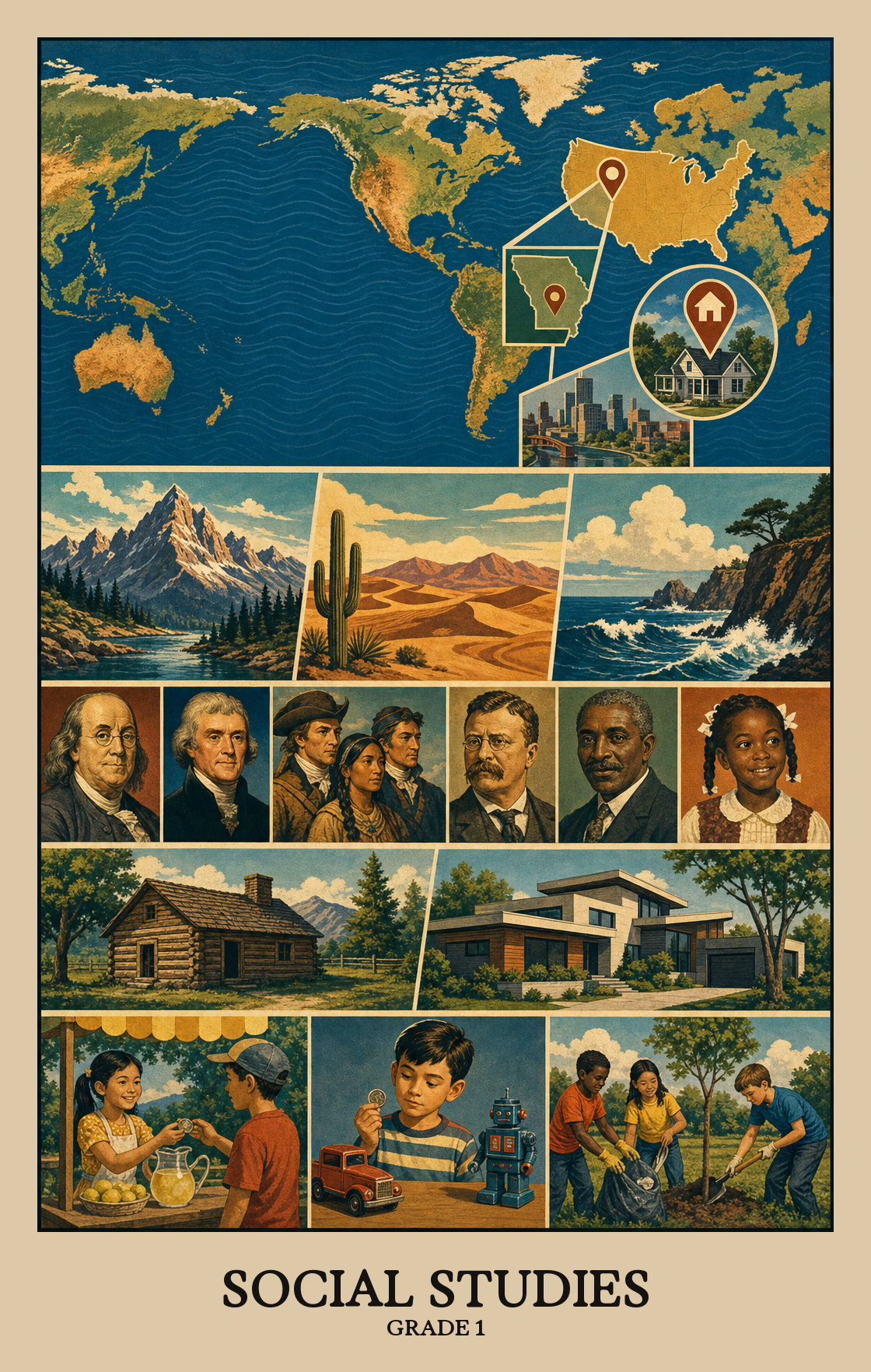
Students start the year close to home. They find their city, county, state, country, and continent on a map and a globe, and they learn the names of the seven continents and four oceans.
Students learn the words for the big shapes of the earth. They point out mountains, deserts, valleys, and coasts, and start to notice how the land looks different from place to place.
Students read about Benjamin Franklin, Thomas Jefferson, Lewis and Clark with Sacagawea, Theodore Roosevelt, George Washington Carver, and Ruby Bridges. They compare how these people lived long ago with how families live today.
Students look at the traits these figures showed, such as courage, fairness, and perseverance. They also listen to America and America the Beautiful and talk about what words like freedom and pride mean.
Students learn the difference between things people make and jobs people do for each other. They see that wants are bigger than what we have, and that people earn money by working and choose what to save and spend.
Students learn what Benjamin Franklin, Thomas Jefferson, Ruby Bridges, and other historical Americans did and why it still matters. They also compare how those people lived daily life, food, clothing, and travel, to how we live today.
| Standard | Definition | Code |
|---|---|---|
| Read about and describe the life of historical figures in American… | Students learn what Benjamin Franklin, Thomas Jefferson, Ruby Bridges, and other historical Americans did and why it still matters. They also compare how those people lived daily life, food, clothing, and travel, to how we live today. | SS1H1 |
Students explain how the place and time period a historical figure lived in shaped what they did and cared about. For example, growing up near the frontier or in the South pushed people like Sacagawea or Ruby Bridges toward different challenges and choices.
Students find their city, county, state, country, and continent on a map or globe. They practice moving from their own neighborhood outward to the larger world.
Students find and name large landforms and bodies of water on a map or globe, such as mountains, oceans, and rivers.
Students point to all seven continents on a world map and learn each one by name, from North America and Africa to Australia and Antarctica.
Students point out the four major oceans on a map or globe: the Arctic, Atlantic, Pacific, and Indian. They learn where each ocean sits in relation to the continents.
Students learn to recognize and describe landforms like mountains, deserts, valleys, and coasts. They practice naming what makes each one different and where these features show up on a map or globe.
| Standard | Definition | Code |
|---|---|---|
| Describe how each historic figure in SS1H1a was influenced by his or her time… | Students explain how the place and time period a historical figure lived in shaped what they did and cared about. For example, growing up near the frontier or in the South pushed people like Sacagawea or Ruby Bridges toward different challenges and choices. | SS1G1 |
| Identify and locate the student's city, county, state, nation | Students find their city, county, state, country, and continent on a map or globe. They practice moving from their own neighborhood outward to the larger world. | SS1G2 |
| Locate major topographical features of the earth's surface | Students find and name large landforms and bodies of water on a map or globe, such as mountains, oceans, and rivers. | SS1G3 |
| Locate all of the continents | Students point to all seven continents on a world map and learn each one by name, from North America and Africa to Australia and Antarctica. | SS1G3.a |
| Locate the major oceans | Students point out the four major oceans on a map or globe: the Arctic, Atlantic, Pacific, and Indian. They learn where each ocean sits in relation to the continents. | SS1G3.b |
| Identify and describe landforms | Students learn to recognize and describe landforms like mountains, deserts, valleys, and coasts. They practice naming what makes each one different and where these features show up on a map or globe. | SS1G3.c |
Students look at real historical figures and name the character traits those people showed, like courage, fairness, or perseverance. It connects biography to the idea that how a person acts shapes their place in history.
Students learn what words like "liberty" and "freedom" mean by listening to patriotic songs such as "America the Beautiful." The goal is understanding why Americans feel proud of their country.
| Standard | Definition | Code |
|---|---|---|
| Describe how the historical figures in SS1H1a display positive character traits… | Students look at real historical figures and name the character traits those people showed, like courage, fairness, or perseverance. It connects biography to the idea that how a person acts shapes their place in history. | SS1CG1 |
| Explore the concept of patriotism through the words in the songs America | Students learn what words like "liberty" and "freedom" mean by listening to patriotic songs such as "America the Beautiful." The goal is understanding why Americans feel proud of their country. | SS1CG2 |
Goods are things people make, like bread or furniture. Services are things people do for others, like cutting hair or fixing a car. Students learn to tell the difference between the two.
Scarcity means there is never enough of everything to satisfy what people want. Students learn why families and communities have to make choices about what to buy, make, or keep.
People make things or do jobs (that makes them producers) and also buy or use what others make (that makes them consumers). Students learn that the same person can be both at different times.
Working at a job earns income, or money people get paid. Students learn why families have to decide how much of that money to save for later and how much to spend now.
| Standard | Definition | Code |
|---|---|---|
| Identify goods that people make and services that people provide for each other | Goods are things people make, like bread or furniture. Services are things people do for others, like cutting hair or fixing a car. Students learn to tell the difference between the two. | SS1E1 |
| Explain that scarcity is when unlimited wants are greater than limited… | Scarcity means there is never enough of everything to satisfy what people want. Students learn why families and communities have to make choices about what to buy, make, or keep. | SS1E2 |
| Describe how people are both producers and consumers | People make things or do jobs (that makes them producers) and also buy or use what others make (that makes them consumers). Students learn that the same person can be both at different times. | SS1E3 |
| Explain that people earn income by working and that they must make choices… | Working at a job earns income, or money people get paid. Students learn why families have to decide how much of that money to save for later and how much to spend now. | SS1E4 |
Federally administered sample-based assessment in reading, mathematics, science, writing, and other subjects. NAEP results inform state-by-state comparisons rather than individual student or school accountability.
Students learn about famous Americans like Ben Franklin, Thomas Jefferson, Sacagawea, and Ruby Bridges. They also find places on a map, talk about being a good citizen, and learn how people earn and spend money.
Pull up a globe or a map app and find the city, the state, the country, and the continent together. Point out oceans and big mountains when reading books or watching shows. Five minutes a few times a week is plenty.
Students should understand that people work to earn money and then choose what to save and what to spend. They should also see the difference between things people make, like bread, and jobs people do, like cutting hair.
Group them by time and place so the geography and history reinforce each other. Franklin and Jefferson fit the colonial unit, Lewis and Clark with Sacagawea fit westward exploration, Roosevelt anchors the national parks, and Carver and Bridges fit the Southern unit.
Sing or chant the seven continents and four oceans while pointing to each one on a map. Repeat it during car rides or bath time for a week or two. Most students lock it in once they have a tune and a finger pointing along.
Students should name what each person is known for, place them in roughly the right time and region, and point to a character trait the person showed, such as courage or perseverance. Short oral retellings work better than written tests at this age.
Scarcity and the producer-consumer relationship trip up many students because the words feel abstract. Use snack time, classroom jobs, and a pretend store to make it concrete, and circle back every month rather than teaching it once.
When a story or show comes up, name the trait out loud: that was fair, that took courage, that showed respect. Tie it back to a figure from class when possible. Students this age learn character traits by hearing adults label them in real moments.
They can locate their city, state, country, and continent, name basic landforms, and tell a short fact about each historical figure. They can also explain that people work to earn money and make choices about spending it.