Place value to ten thousand
Students read, write, and compare numbers up to 10,000 and round them to the nearest ten or hundred. Expect homework with number lines and questions like which number is bigger and why.
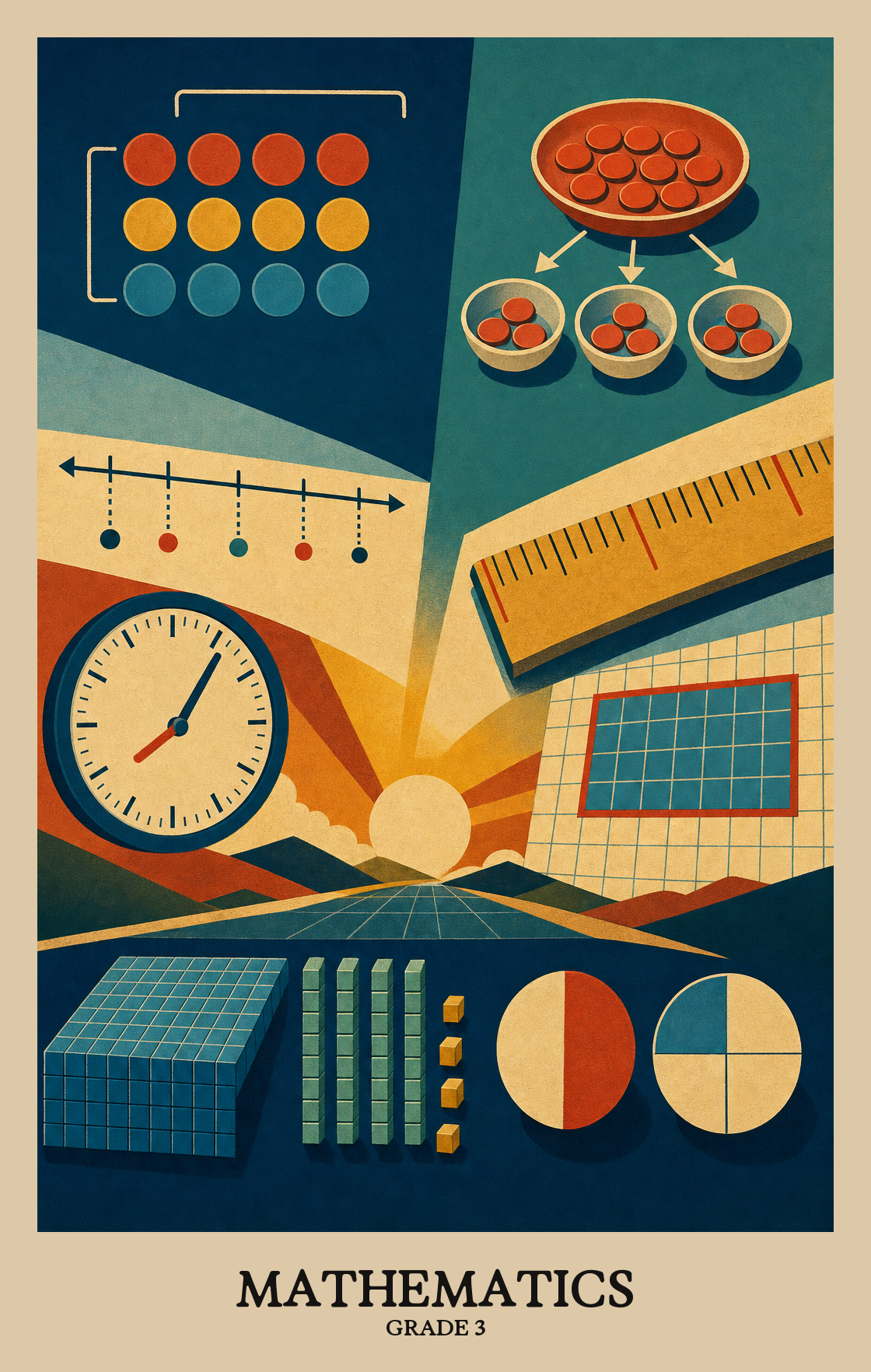
This is the year math leans into multiplication, division, and fractions. Students learn their times tables, divide within 100, and start seeing fractions as real numbers on a ruler or number line. They also add and subtract larger numbers up to 1,000 and find the area and perimeter of shapes. By spring, students can recall multiplication facts quickly, tell time to the minute, and explain why one-fourth is smaller than one-half.
Students read, write, and compare numbers up to 10,000 and round them to the nearest ten or hundred. Expect homework with number lines and questions like which number is bigger and why.
Students add and subtract fluently within 1,000 and tackle word problems up to 10,000. They write equations with a letter for the unknown and explain why their answer makes sense.
This is the year of times tables. Students learn what multiplication and division mean, find patterns in the facts, and use them to solve real problems within 100.
Students see fractions on number lines, in shapes, and in groups of objects. They compare halves, thirds, fourths, sixths, and eighths and notice when two different fractions name the same amount.
Students tell time to the minute, figure out how much time has passed, and measure length, weight, and liquid amounts. They also read bar graphs and picture graphs to answer questions.
Students sort quadrilaterals by their sides and angles and look for lines of symmetry. They find the area of rectangles by multiplying side lengths and measure the distance around a shape.
Students keep trying when a math problem gets hard, ask for help when they're stuck, and talk through their thinking with others. They learn to notice when a strategy isn't working and try a different one.
Students read a math problem carefully, figure out what it's asking, and keep trying even when the first approach doesn't work. They check their own thinking along the way.
Students take a real math problem, like finding how many chairs fit in a row, and work with it two ways: as numbers on paper and as a situation that has to make sense in real life.
Students back up their math answers with reasons, then listen to how classmates solved the same problem and explain where they agree or disagree.
Students use drawings, diagrams, or number sentences to show a real-world problem, like splitting a bag of apples equally or figuring out how much change is left after buying something.
Students learn to pick the right tool for the problem, whether that means grabbing a ruler, drawing a picture, or using a number line. Knowing which tool helps most is part of solving the problem.
Students check their work carefully, use the right words and units, and make sure their answers say exactly what they mean.
Students notice patterns and shortcuts hiding inside a problem, like seeing that a row of equal groups can be counted by multiplying instead of adding one by one.
Students notice when the same steps keep appearing in a problem and use that pattern as a shortcut. Spotting repetition helps them work smarter on the next problem.
| Standard | Definition | Code |
|---|---|---|
| Display perseverance and patience in problem-solving | Students keep trying when a math problem gets hard, ask for help when they're stuck, and talk through their thinking with others. They learn to notice when a strategy isn't working and try a different one. | 3.MP |
| Make sense of problems and persevere in solving them | Students read a math problem carefully, figure out what it's asking, and keep trying even when the first approach doesn't work. They check their own thinking along the way. | 3.MP.1 |
| Reason abstractly and quantitatively | Students take a real math problem, like finding how many chairs fit in a row, and work with it two ways: as numbers on paper and as a situation that has to make sense in real life. | 3.MP.2 |
| Construct viable arguments and critique the reasoning of others | Students back up their math answers with reasons, then listen to how classmates solved the same problem and explain where they agree or disagree. | 3.MP.3 |
| Model with mathematics | Students use drawings, diagrams, or number sentences to show a real-world problem, like splitting a bag of apples equally or figuring out how much change is left after buying something. | 3.MP.4 |
| Use appropriate tools strategically | Students learn to pick the right tool for the problem, whether that means grabbing a ruler, drawing a picture, or using a number line. Knowing which tool helps most is part of solving the problem. | 3.MP.5 |
| Attend to precision | Students check their work carefully, use the right words and units, and make sure their answers say exactly what they mean. | 3.MP.6 |
| Look for and make use of structure | Students notice patterns and shortcuts hiding inside a problem, like seeing that a row of equal groups can be counted by multiplying instead of adding one by one. | 3.MP.7 |
| Look for and express regularity in repeated reasoning | Students notice when the same steps keep appearing in a problem and use that pattern as a shortcut. Spotting repetition helps them work smarter on the next problem. | 3.MP.8 |
Students work with whole numbers and fractions, building the number sense they need to count, compare, and calculate with confidence in third grade math.
| Standard | Definition | Code |
|---|---|---|
| Numerical Reasoning | Students work with whole numbers and fractions, building the number sense they need to count, compare, and calculate with confidence in third grade math. | 3.NR.1 |
Reading and writing numbers up to 10,000 in two ways: as a standard number (4,352) and broken into parts by place value (4,000 + 300 + 50 + 2).
Students compare four-digit numbers by looking at place value, then write which number is greater, smaller, or equal using the symbols >, <, and =.
Students round numbers to the nearest 10 or 100. For example, 347 rounds to 350 (nearest 10) or 300 (nearest 100), based on which value it sits closest to.
Students show fractions like one-half or three-fourths by drawing pictures, shading shapes, and marking points on a number line. The focus is on seeing what a fraction looks like, not just writing the number.
Students learn that fractions are built from equal pieces, starting with one piece (1/2, 1/4, 1/8) and stacking copies to make larger fractions. They show this using shapes, groups of objects, and number lines.
Students look at two simple fractions, like 1/3 and 1/8, and figure out which is larger. They use drawings, fraction strips, or number lines to explain why.
Fractions can describe parts of a shape, a group, or a number line. Students show the same fraction several ways, including amounts larger than one whole, using pictures and diagrams.
Students find two fractions that name the same amount, like 1/2 and 2/4, and show why they match using a picture or diagram.
| Standard | Definition | Code |
|---|---|---|
| Read and write multi-digit whole numbers up to 10,000 to the thousands using… | Reading and writing numbers up to 10,000 in two ways: as a standard number (4,352) and broken into parts by place value (4,000 + 300 + 50 + 2). | 3.NR.1.1 |
| Use place value reasoning to compare multi-digit numbers up to 10,000, using >… | Students compare four-digit numbers by looking at place value, then write which number is greater, smaller, or equal using the symbols >, <, and =. | 3.NR.1.2 |
| Use place value understanding to round whole numbers within up to 1000 to the… | Students round numbers to the nearest 10 or 100. For example, 347 rounds to 350 (nearest 10) or 300 (nearest 100), based on which value it sits closest to. | 3.NR.1.3 |
| Represent fractions with denominators of 2, 3, 4, 6 and 8 in multiple ways… | Students show fractions like one-half or three-fourths by drawing pictures, shading shapes, and marking points on a number line. The focus is on seeing what a fraction looks like, not just writing the number. | 3.NR.4 |
| Describe a unit fraction and explain how multiple copies of a unit fraction… | Students learn that fractions are built from equal pieces, starting with one piece (1/2, 1/4, 1/8) and stacking copies to make larger fractions. They show this using shapes, groups of objects, and number lines. | 3.NR.4.1 |
| Compare two unit fractions by flexibly using a variety of tools and strategies | Students look at two simple fractions, like 1/3 and 1/8, and figure out which is larger. They use drawings, fraction strips, or number lines to explain why. | 3.NR.4.2 |
| Represent fractions, including fractions greater than one, in multiple ways | Fractions can describe parts of a shape, a group, or a number line. Students show the same fraction several ways, including amounts larger than one whole, using pictures and diagrams. | 3.NR.4.3 |
| Recognize and generate simple equivalent fractions | Students find two fractions that name the same amount, like 1/2 and 2/4, and show why they match using a picture or diagram. | 3.NR.4.4 |
Students read, write, and compare whole numbers up to 10,000. They understand that each digit in a number has a place value, the way a digit in 4,352 means something different depending on whether it sits in the ones, tens, hundreds, or thousands spot.
Students learn that fractions like 1/2, 1/3, or 1/4 represent one equal piece of a whole. They practice identifying and working with these single pieces when a shape or set is split into 2, 3, 4, 6, or 8 equal parts.
Students divide shapes or groups of objects into equal parts and name each part as a fraction, like one-half or one-fourth. They show fractions on paper and explain what the top and bottom numbers mean.
Students learn that different fractions can name the same amount. For example, two-fourths and one-half cover the same part of a shape or a number line.
Students learn to shade parts of a shape to show fractions, then compare shaded amounts to see which fraction is larger or smaller.
Students count pieces of a whole the way they count whole numbers. If a pizza is cut into 4 equal slices, they count one-fourth, two-fourths, three-fourths, just like counting 1, 2, 3.
Students practice rounding numbers up to 1,000 to the nearest 10 or 100. Given a number like 347, they decide whether it's closer to 340 or 350, and closer to 300 or 400.
Students read and write whole numbers up to the thousands place, like 4,729. They recognize what each digit stands for and can write those numbers in words or standard form.
Students compare numbers up to 10,000, deciding which is greater or less and explaining why. They use place value to make sense of numbers in the thousands.
Students learn that unit fractions like 1/2 or 1/4 represent one equal piece of a whole. The number on the bottom tells how many equal parts the whole is split into.
Students recall multiplication and division facts with single-digit numbers quickly and accurately, the way they know addition facts by heart. This is the foundation for all the longer math they do in third grade and beyond.
Students add and subtract numbers up to 1,000 quickly and accurately, without counting on fingers or drawing tallies. They know the steps well enough to work through problems without stopping to figure out the method.
Students read and write numbers up to 10,000, understanding how the place of each digit (ones, tens, hundreds, thousands) changes its value.
Students add and subtract numbers up to 100, building toward larger calculations they'll use in everyday math.
Students multiply a whole number by 10, 20, 30, and so on, seeing how place value shifts the digits left. They use patterns like 4 x 30 = 120 to build toward larger multiplication.
Students look at a row of numbers and figure out the multiplication rule behind it, like noticing that 3, 6, 9, 12 keeps growing by 3. They use that rule to predict what comes next.
Students look at a number or shape pattern, figure out the rule behind it, and use that rule to say what comes next or what a later step will look like.
Students sort and name four-sided shapes like squares, rectangles, and rhombuses. They learn what makes each one different, such as equal sides or right corners.
Students learn to spot parallel lines (lines that never meet) and perpendicular lines (lines that cross at a square corner) in four-sided shapes like squares and rectangles.
Students find the lines of symmetry in four-sided shapes like squares and rectangles, checking whether each half folds exactly onto the other.
Students find the area of rectangles by counting or multiplying to see how many same-size squares cover the shape. This builds toward understanding why length times width gives the total.
Students add up all four sides of a rectangle to find the total distance around it. They practice with shapes on grid paper and real objects like picture frames or tables.
Students measure things like water in cups, objects in inches, and items in pounds. They practice reading tools like rulers and measuring cups to record real amounts.
Students measure everyday objects with a ruler, reading the tick marks that fall between whole inches to find measurements like 2 and a half or 3 and a quarter inches.
Students sort information into categories or put numbers in order to answer a question. They read charts and graphs to spot patterns or compare amounts.
Students use coins and dollar bills to solve real-world problems, such as finding the total cost of items or figuring out how much change to expect.
Reading a clock face and writing times like 7:43 or 2:08, to the nearest minute. Students practice both digital and analog clocks.
Students practice guessing whether something takes seconds, minutes, or hours before they measure it. The goal is building a sense of time before checking the clock.
Students figure out how much time has passed between a start time and an end time, working to the nearest hour, half hour, or quarter hour on a clock face.
| Standard | Definition | Code |
|---|---|---|
| Whole numbers to 10,000 | Students read, write, and compare whole numbers up to 10,000. They understand that each digit in a number has a place value, the way a digit in 4,352 means something different depending on whether it sits in the ones, tens, hundreds, or thousands spot. | 3.LP1.1.1 |
| Unit fractions with denominators of 2, 3, 4, 6 | Students learn that fractions like 1/2, 1/3, or 1/4 represent one equal piece of a whole. They practice identifying and working with these single pieces when a shape or set is split into 2, 3, 4, 6, or 8 equal parts. | 3.LP1.1.2 |
| Represent fractions | Students divide shapes or groups of objects into equal parts and name each part as a fraction, like one-half or one-fourth. They show fractions on paper and explain what the top and bottom numbers mean. | 3.LP1.1.3 |
| Equivalence of simple fractions | Students learn that different fractions can name the same amount. For example, two-fourths and one-half cover the same part of a shape or a number line. | 3.LP1.1.4 |
| Introduce shading to identify and compare fractional parts | Students learn to shade parts of a shape to show fractions, then compare shaded amounts to see which fraction is larger or smaller. | 3.LP1.1.5 |
| Counting unit fractions | Students count pieces of a whole the way they count whole numbers. If a pizza is cut into 4 equal slices, they count one-fourth, two-fourths, three-fourths, just like counting 1, 2, 3. | 3.LP1.2.1 |
| Round numbers to 1000 to nearest 10 or 100 | Students practice rounding numbers up to 1,000 to the nearest 10 or 100. Given a number like 347, they decide whether it's closer to 340 or 350, and closer to 300 or 400. | 3.LP1.3.1 |
| Read & write multi-digit whole numbers to thousands | Students read and write whole numbers up to the thousands place, like 4,729. They recognize what each digit stands for and can write those numbers in words or standard form. | 3.LP1.3.2 |
| Comparing numbers to 10,000 | Students compare numbers up to 10,000, deciding which is greater or less and explaining why. They use place value to make sense of numbers in the thousands. | 3.LP1.4.1 |
| Unit fractions | Students learn that unit fractions like 1/2 or 1/4 represent one equal piece of a whole. The number on the bottom tells how many equal parts the whole is split into. | 3.LP1.4.2 |
| Fluency with multiplication and division with single-digit numbers | Students recall multiplication and division facts with single-digit numbers quickly and accurately, the way they know addition facts by heart. This is the foundation for all the longer math they do in third grade and beyond. | 3.LP1.5.1 |
| Fluency with addition and subtraction within 1,000 | Students add and subtract numbers up to 1,000 quickly and accurately, without counting on fingers or drawing tallies. They know the steps well enough to work through problems without stopping to figure out the method. | 3.LP1.5.2 |
| Within 10,000 | Students read and write numbers up to 10,000, understanding how the place of each digit (ones, tens, hundreds, thousands) changes its value. | 3.LP1.6.1 |
| Within 100 | Students add and subtract numbers up to 100, building toward larger calculations they'll use in everyday math. | 3.LP1.7.1 |
| Multiply by multiples of 10 | Students multiply a whole number by 10, 20, 30, and so on, seeing how place value shifts the digits left. They use patterns like 4 x 30 = 120 to build toward larger multiplication. | 3.LP1.7.2 |
| Numerical patterns related to multiplication | Students look at a row of numbers and figure out the multiplication rule behind it, like noticing that 3, 6, 9, 12 keeps growing by 3. They use that rule to predict what comes next. | 3.LP2.1.1 |
| Make predictions based on patterns | Students look at a number or shape pattern, figure out the rule behind it, and use that rule to say what comes next or what a later step will look like. | 3.LP2.1.2 |
| Quadrilaterals | Students sort and name four-sided shapes like squares, rectangles, and rhombuses. They learn what makes each one different, such as equal sides or right corners. | 3.LP3.1.1 |
| Parallel & perpendicular line segments, points, lines, line segments, & right… | Students learn to spot parallel lines (lines that never meet) and perpendicular lines (lines that cross at a square corner) in four-sided shapes like squares and rectangles. | 3.LP3.1.2 |
| Lines of symmetry with quadrilaterals | Students find the lines of symmetry in four-sided shapes like squares and rectangles, checking whether each half folds exactly onto the other. | 3.LP3.1.3 |
| Area of rectangles | Students find the area of rectangles by counting or multiplying to see how many same-size squares cover the shape. This builds toward understanding why length times width gives the total. | 3.LP3.2.1 |
| Perimeter of rectangles | Students add up all four sides of a rectangle to find the total distance around it. They practice with shapes on grid paper and real objects like picture frames or tables. | 3.LP3.2.2 |
| Measure liquid volume, length and mass in customary units | Students measure things like water in cups, objects in inches, and items in pounds. They practice reading tools like rulers and measuring cups to record real amounts. | 3.LP4.1.1 |
| Use rulers to measure lengths in halves and fourths of an inch | Students measure everyday objects with a ruler, reading the tick marks that fall between whole inches to find measurements like 2 and a half or 3 and a quarter inches. | 3.LP4.1.2 |
| Analyze numerical and categorical data with whole number values | Students sort information into categories or put numbers in order to answer a question. They read charts and graphs to spot patterns or compare amounts. | 3.LP4.1.3 |
| Using money to solve problems | Students use coins and dollar bills to solve real-world problems, such as finding the total cost of items or figuring out how much change to expect. | 3.LP4.2.1 |
| Tell time to the nearest minute | Reading a clock face and writing times like 7:43 or 2:08, to the nearest minute. Students practice both digital and analog clocks. | 3.LP4.3.1 |
| Estimate relative time | Students practice guessing whether something takes seconds, minutes, or hours before they measure it. The goal is building a sense of time before checking the clock. | 3.LP4.3.2 |
| Elapsed time to hour, half hour & quarter hour | Students figure out how much time has passed between a start time and an end time, working to the nearest hour, half hour, or quarter hour on a clock face. | 3.LP4.3.3 |
Students break numbers into parts to solve addition and subtraction problems with numbers up to 10,000. They use what they know about how numbers fit together to work through real-life situations.
Students add and subtract numbers up to 1,000 quickly and accurately to solve everyday problems. They move beyond counting and use what they know about place value to get to the right answer.
Students add and subtract numbers up to 10,000 by breaking them apart by place value. They write equations using a letter for the missing number and explain how they got their answer.
Multiplication and division problems get solved by thinking about how numbers break into groups. Students work out problems like "24 divided into 6 equal groups" or "7 times 8" using what they know about parts and wholes.
Students look at a sequence of numbers that grows by multiplying, figure out the rule behind it, and use that rule to predict what comes next.
Students practice multiplication and division facts up to 9x9, using arrays, groups, or drawings to make sense of them. They also explain why multiplication and division are two sides of the same idea, like how 4x3=12 and 12÷3=4 connect.
Knowing that 4 x 6 gives the same answer as 6 x 4, or that breaking 7 x 8 into smaller pieces can make it easier, students use those shortcuts to solve multiplication and division problems up to 100.
Students decide whether two math expressions are equal by asking: do both sides of the equation balance? They practice this with addition, subtraction, and multiplication, learning that the equal sign means "the same as," not just "the answer."
Students figure out problems like 6 x 40 by thinking about tens. Knowing that 40 is four tens helps them use what they already know about smaller numbers.
Students break apart numbers to solve multiplication and division problems, using drawings or objects to show their thinking. All answers stay within 100.
Students solve everyday multiplication and division problems with numbers up to 100, then write an equation using a letter as a stand-in for the missing number. They also explain how they know their answer is right.
| Standard | Definition | Code |
|---|---|---|
| Use part-whole strategies to represent and solve real-life problems involving… | Students break numbers into parts to solve addition and subtraction problems with numbers up to 10,000. They use what they know about how numbers fit together to work through real-life situations. | 3.PAR.2 |
| Fluently add and subtract within 1000 to solve problems | Students add and subtract numbers up to 1,000 quickly and accurately to solve everyday problems. They move beyond counting and use what they know about place value to get to the right answer. | 3.PAR.2.1 |
| Apply part-whole strategies, properties of operations and place value… | Students add and subtract numbers up to 10,000 by breaking them apart by place value. They write equations using a letter for the missing number and explain how they got their answer. | 3.PAR.2.2 |
| Use part-whole strategies to solve real-life, mathematical problems involving… | Multiplication and division problems get solved by thinking about how numbers break into groups. Students work out problems like "24 divided into 6 equal groups" or "7 times 8" using what they know about parts and wholes. | 3.PAR.3 |
| Describe, extend, and create numeric patterns related to multiplication | Students look at a sequence of numbers that grows by multiplying, figure out the rule behind it, and use that rule to predict what comes next. | 3.PAR.3.1 |
| Represent single digit multiplication and division facts using a variety of… | Students practice multiplication and division facts up to 9x9, using arrays, groups, or drawings to make sense of them. They also explain why multiplication and division are two sides of the same idea, like how 4x3=12 and 12÷3=4 connect. | 3.PAR.3.2 |
| Apply properties of operations | Knowing that 4 x 6 gives the same answer as 6 x 4, or that breaking 7 x 8 into smaller pieces can make it easier, students use those shortcuts to solve multiplication and division problems up to 100. | 3.PAR.3.3 |
| Use the meaning of the equal sign to determine whether expressions involving… | Students decide whether two math expressions are equal by asking: do both sides of the equation balance? They practice this with addition, subtraction, and multiplication, learning that the equal sign means "the same as," not just "the answer." | 3.PAR.3.4 |
| Use place value reasoning and properties of operations to multiply one-digit… | Students figure out problems like 6 x 40 by thinking about tens. Knowing that 40 is four tens helps them use what they already know about smaller numbers. | 3.PAR.3.5 |
| Solve practical, relevant problems involving multiplication and division within… | Students break apart numbers to solve multiplication and division problems, using drawings or objects to show their thinking. All answers stay within 100. | 3.PAR.3.6 |
| Use multiplication and division to solve problems involving whole numbers to 100 | Students solve everyday multiplication and division problems with numbers up to 100, then write an equation using a letter as a stand-in for the missing number. They also explain how they know their answer is right. | 3.PAR.3.7 |
Students solve everyday problems involving measurement, reading clocks, scales, and measuring cups to find answers. They also read bar graphs and picture graphs to make sense of real data.
Students read bar graphs, picture graphs, and tally charts to answer questions about real data. They also come up with their own questions about what the data shows.
Students read an analog clock to the nearest minute and estimate whether the time is closer to the hour, quarter hour, or half hour. They also write the time in numbers.
Students figure out how much time has passed between two clock times, like from 2:00 p.m. to 4:30 p.m. All start and end times land on the hour, half hour, or quarter hour, and both times are either in the morning or afternoon.
Students use a ruler to measure objects to the nearest whole inch, half inch, and quarter inch. Reading those small marks on a ruler is the focus, not just the big numbers.
Students estimate and measure things like water in a cup or the weight of an object using inches, pounds, and ounces. They solve word problems using those measurements and compare units, like figuring out whether a foot is longer or shorter than a yard.
| Standard | Definition | Code |
|---|---|---|
| Solve real-life, mathematical problems involving length, liquid volume, mass | Students solve everyday problems involving measurement, reading clocks, scales, and measuring cups to find answers. They also read bar graphs and picture graphs to make sense of real data. | 3.MDR.5 |
| Ask questions and answer them based on gathered information, observations | Students read bar graphs, picture graphs, and tally charts to answer questions about real data. They also come up with their own questions about what the data shows. | 3.MDR.5.1 |
| Tell and write time to the nearest minute and estimate time to the nearest… | Students read an analog clock to the nearest minute and estimate whether the time is closer to the hour, quarter hour, or half hour. They also write the time in numbers. | 3.MDR.5.2 |
| Solve meaningful problems involving elapsed time, including intervals of time… | Students figure out how much time has passed between two clock times, like from 2:00 p.m. to 4:30 p.m. All start and end times land on the hour, half hour, or quarter hour, and both times are either in the morning or afternoon. | 3.MDR.5.3 |
| Use rulers to measure lengths in halves and fourths | Students use a ruler to measure objects to the nearest whole inch, half inch, and quarter inch. Reading those small marks on a ruler is the focus, not just the big numbers. | 3.MDR.5.4 |
| Estimate and measure liquid volumes, lengths and masses of objects using… | Students estimate and measure things like water in a cup or the weight of an object using inches, pounds, and ounces. They solve word problems using those measurements and compare units, like figuring out whether a foot is longer or shorter than a yard. | 3.MDR.5.5 |
Students sort shapes by their properties: whether sides run parallel, meet at a right angle, or mirror each other across a line of symmetry. The focus is on what makes each shape different from the others.
Students learn to spot right angles (like the corners of a square), parallel lines (lines that never cross), and perpendicular lines (lines that meet in a perfect corner) in shapes, then use those ideas to solve problems.
Students sort and compare four-sided shapes like squares, rectangles, and rhombuses by their sides and angles. They also look at 3-D objects like boxes and pyramids to find those same four-sided shapes on their flat faces.
Students look at shapes like squares and triangles to find the fold line that splits them into two matching halves. A shape can have one line of symmetry, several, or none at all.
Area measures how much flat space a rectangle covers. Students count square units or multiply side lengths to find the area of rectangles in everyday problems, like figuring out how many tiles fit on a floor.
Students cover a rectangle completely with same-size squares, fitting them edge to edge with no gaps, then count how many squares it took. That count is the area.
Students find the area of a rectangle by filling it with same-size squares and counting how many fit. This shows up in real problems like figuring out how much tile covers a floor or how big a garden is.
Students learn that multiplying a rectangle's length by its width gives its area, the same total you'd get by counting every square unit inside it. This works for any rectangle, from a floor tile to a parking lot.
Students find the total distance around a shape by adding up the length of each side. This comes up with real objects like fences, picture frames, and floor tiles.
Students find the total distance around a shape by adding up the lengths of all its sides. They use this to solve problems like figuring out how much fencing surrounds a yard.
Two rectangles can share the same perimeter but cover different amounts of space inside, and vice versa. Students explore this by drawing and comparing rectangles to see how perimeter and area can change independently of each other.
| Standard | Definition | Code |
|---|---|---|
| Identify the attributes of polygons, including parallel segments, perpendicular… | Students sort shapes by their properties: whether sides run parallel, meet at a right angle, or mirror each other across a line of symmetry. The focus is on what makes each shape different from the others. | 3.GSR.6 |
| Identify perpendicular line segments, parallel line segments | Students learn to spot right angles (like the corners of a square), parallel lines (lines that never cross), and perpendicular lines (lines that meet in a perfect corner) in shapes, then use those ideas to solve problems. | 3.GSR.6.1 |
| Classify, compare, and contrast polygons, with a focus on quadrilaterals, based… | Students sort and compare four-sided shapes like squares, rectangles, and rhombuses by their sides and angles. They also look at 3-D objects like boxes and pyramids to find those same four-sided shapes on their flat faces. | 3.GSR.6.2 |
| Identify lines of symmetry in polygons | Students look at shapes like squares and triangles to find the fold line that splits them into two matching halves. A shape can have one line of symmetry, several, or none at all. | 3.GSR.6.3 |
| Identify area as a measurable attribute of rectangles and determine the area of… | Area measures how much flat space a rectangle covers. Students count square units or multiply side lengths to find the area of rectangles in everyday problems, like figuring out how many tiles fit on a floor. | 3.GSR.7 |
| Investigate area by covering the space of rectangles presented in realistic… | Students cover a rectangle completely with same-size squares, fitting them edge to edge with no gaps, then count how many squares it took. That count is the area. | 3.GSR.7.1 |
| Determine the area of rectangles | Students find the area of a rectangle by filling it with same-size squares and counting how many fit. This shows up in real problems like figuring out how much tile covers a floor or how big a garden is. | 3.GSR.7.2 |
| Discover and explain how area can be found by multiplying the dimensions of a… | Students learn that multiplying a rectangle's length by its width gives its area, the same total you'd get by counting every square unit inside it. This works for any rectangle, from a floor tile to a parking lot. | 3.GSR.7.3 |
| Determine the perimeter of a polygon presented in real-life, mathematical… | Students find the total distance around a shape by adding up the length of each side. This comes up with real objects like fences, picture frames, and floor tiles. | 3.GSR.8 |
| Determine the perimeter of a polygon and explain that the perimeter represents… | Students find the total distance around a shape by adding up the lengths of all its sides. They use this to solve problems like figuring out how much fencing surrounds a yard. | 3.GSR.8.1 |
| Investigate and describe how rectangles with the same perimeter can have… | Two rectangles can share the same perimeter but cover different amounts of space inside, and vice versa. Students explore this by drawing and comparing rectangles to see how perimeter and area can change independently of each other. | 3.GSR.8.2 |
End-of-grade mathematics assessment for grades 3 through 8, aligned to Georgia's state-adopted math standards.
Students should know their multiplication and division facts within 100, add and subtract within 1,000 without a calculator, read and write numbers up to 10,000, and understand fractions like 1/2, 1/3, 1/4, 1/6, and 1/8. They should also find the area and perimeter of rectangles and tell time to the minute.
Short, daily practice works better than long sessions. Five minutes a day with flash cards, a deck of playing cards, or skip-counting out loud while walking will build speed. Connect facts to real things: six rows of four eggs, four wheels on three cars.
Most teachers start with place value and addition or subtraction within 1,000, then move into multiplication and division, then fractions, and finish with area, perimeter, and measurement. Fractions and multiplication take the longest, so protect time for both.
At this age, finger counting for basic facts slows students down when they start multiplying and working with larger numbers. Practice making ten, doubles, and near-doubles with small games at home. Fluency with addition within 20 is the foundation for everything else this year.
Fractions and the difference between area and perimeter cause the most confusion. Students often think a bigger denominator means a bigger fraction, and they mix up the distance around a shape with the space inside it. Plan extra time and hands-on work for both.
Cut food into equal parts and talk about it. Half a sandwich, a quarter of a pizza, one third of a chocolate bar. Ask which piece is bigger and why. A ruler with halves and fourths of an inch is also useful, since students measure with one this year.
Keep an analog clock visible at home and ask what time it is, then ask how long until dinner or bedtime. Elapsed time is hardest when it crosses the hour, so practice questions like "It is 2:45 now. What time will it be in 30 minutes?"
By spring, students should solve a two-step word problem with multiplication or division, compare two fractions with the same numerator or same denominator, and find the area of a rectangle by multiplying its sides. If those three hold up on cold problems, students are ready.
Yes. Students who know their facts can focus on the harder thinking in word problems, fractions, and area instead of getting stuck on 7 times 8. Aim for quick recall of all facts through 10 by the end of the year.