Rocks and soils up close
Students start the year as young geologists. They sort rocks by color, feel, shine, and hardness, and test different soils to see which ones hold water and grow plants.
This is the year science gets hands-on and rooted in Georgia. Students sort rocks by how they look and feel, test soils to see which one grows the best plants, and read fossils as clues about animals that lived long ago. They track how sunlight heats different objects with a thermometer, and they learn why a black bear belongs in the mountains while a sea turtle belongs on the coast. By spring, students can explain how an animal's features help it survive where it lives.
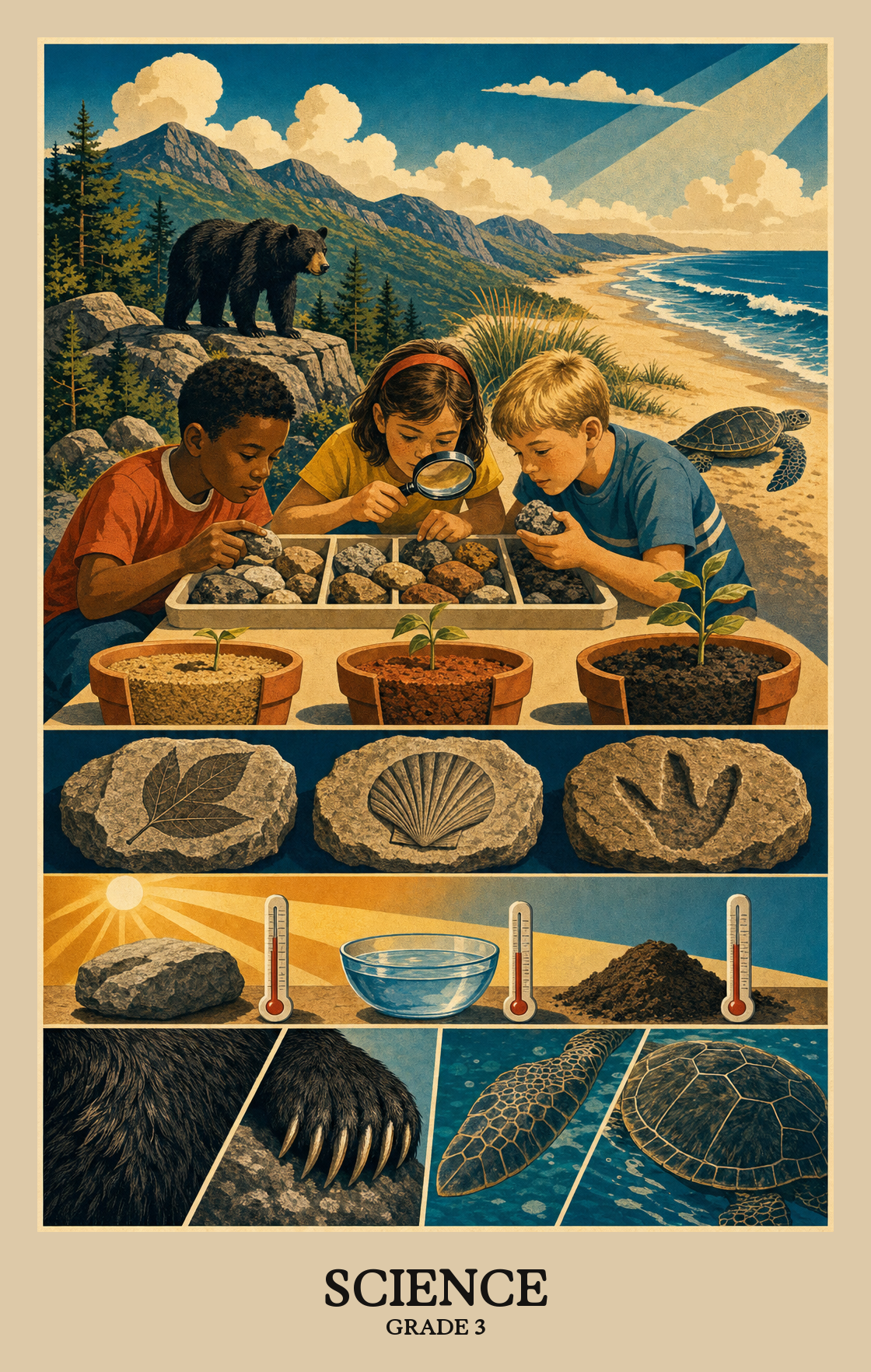
Students start the year as young geologists. They sort rocks by color, feel, shine, and hardness, and test different soils to see which ones hold water and grow plants.
Students look around their own neighborhood for signs that wind and water have moved soil or worn down rocks. They also study fossils as clues about animals and plants that lived long ago.
Students name everyday sources of heat and use thermometers to track how the sun warms different objects. They then build a small structure that traps or blocks sunlight.
Students explore the plants, animals, and habitats of Georgia's five regions, from the mountains to the coast. They explain how features like camouflage, hibernation, and migration help animals survive where they live.
Students close the year by looking at how air, land, and water pollution affect plants and animals. They research everyday actions, such as recycling and saving resources, that help protect the places animals call home.
Rocks and soils have physical traits students can observe and describe. Students sort rocks by color, texture, and hardness, and compare different types of soil to see how they look and feel.
Students sort rocks by how they look and feel. They run simple tests to check color, texture, shine, and hardness, then use what they find to group the rocks into categories.
Students dig into sand, clay, and loam to see how each soil looks and feels, how well it holds water, and whether plants can grow in it.
Students look at rocks, soil, and nearby land to explain how wind and moving water slowly wear things down or carry them away. This is erosion in action, found right outside.
Fossils are clues left behind by plants and animals that lived long ago. Students study what those clues reveal about creatures that no longer exist on Earth today.
Students look at real or replica fossils and explain what they reveal about animals and plants that lived long ago, including what the environment around them may have looked like.
Students put events in order to show how a dead plant or animal can slowly turn into a fossil. They explain what conditions, like being buried quickly in mud or sand, make that process more likely to happen.
| Standard | Definition | Code |
|---|---|---|
| Obtain, evaluate, and communicate information about the physical attributes of… | Rocks and soils have physical traits students can observe and describe. Students sort rocks by color, texture, and hardness, and compare different types of soil to see how they look and feel. | S3E1 |
| Ask questions and analyze data to classify rocks by their physical attributes | Students sort rocks by how they look and feel. They run simple tests to check color, texture, shine, and hardness, then use what they find to group the rocks into categories. | S3E1.a |
| Plan and carry out investigations to describe properties | Students dig into sand, clay, and loam to see how each soil looks and feels, how well it holds water, and whether plants can grow in it. | S3E1.b |
| Make observations of the local environment to construct an explanation of how… | Students look at rocks, soil, and nearby land to explain how wind and moving water slowly wear things down or carry them away. This is erosion in action, found right outside. | S3E1.c |
| Obtain, evaluate, and communicate information on how fossils provide evidence… | Fossils are clues left behind by plants and animals that lived long ago. Students study what those clues reveal about creatures that no longer exist on Earth today. | S3E2 |
| Construct an argument from observations of fossils | Students look at real or replica fossils and explain what they reveal about animals and plants that lived long ago, including what the environment around them may have looked like. | S3E2.a |
| Develop a model to describe the sequence and conditions required for an… | Students put events in order to show how a dead plant or animal can slowly turn into a fossil. They explain what conditions, like being buried quickly in mud or sand, make that process more likely to happen. | S3E2.b |
Heat moves from warm objects to cool ones by touching, flowing through air, or radiating outward. Students learn how to measure temperature and explain what happens when objects heat up or cool down.
Students identify where heat comes from, things like the sun, a stove, or friction between two surfaces rubbed together. This standard focuses on asking good questions about heat sources, not just naming them.
Students use thermometers to measure how warm different objects get in sunlight, then record the results in a table or chart to compare them.
Students build a simple device, like a shade or a cover, to test how different materials heat up or cool down in sunlight. They use everyday objects to control how much sun reaches each material.
| Standard | Definition | Code |
|---|---|---|
| Obtain, evaluate, and communicate information about the ways heat energy is… | Heat moves from warm objects to cool ones by touching, flowing through air, or radiating outward. Students learn how to measure temperature and explain what happens when objects heat up or cool down. | S3P1 |
| Ask questions to identify sources of heat energy | Students identify where heat comes from, things like the sun, a stove, or friction between two surfaces rubbed together. This standard focuses on asking good questions about heat sources, not just naming them. | S3P1.a |
| Plan and carry out an investigation to gather data using thermometers to… | Students use thermometers to measure how warm different objects get in sunlight, then record the results in a table or chart to compare them. | S3P1.b |
| Use tools and every day materials to design and construct a device/structure… | Students build a simple device, like a shade or a cover, to test how different materials heat up or cool down in sunlight. They use everyday objects to control how much sun reaches each material. | S3P1.c |
Students compare the plants, animals, and landscapes found in Georgia's five geographic regions. They look at what lives in the mountains versus the coast and explain what makes each region's habitat distinct.
Students compare the plants, animals, and habitats found across Georgia's five regions, from the Blue Ridge Mountains to the Coastal Plains, by asking questions about how they differ from one place to the next.
Students learn how animals use body features and behaviors like hiding in plain sight, sleeping through winter, or traveling to warmer places to survive where they live.
Students explain why an animal or plant survives in one place but struggles in another. A fish needs water; a cactus needs dry sand. Habitats match organisms to the food, water, and shelter they need to live.
Pollution from cars, factories, and trash can harm animals, plants, and water. Students study real examples of air, land, and water pollution to understand how human choices change the environment.
Students research where pollution comes from and what it does to nearby plants and animals, then record what they find.
Students research real problems like habitat loss or polluted water, then explain ways people can help, such as recycling or using fewer resources.
| Standard | Definition | Code |
|---|---|---|
| Obtain, evaluate, and communicate information about the similarities and… | Students compare the plants, animals, and landscapes found in Georgia's five geographic regions. They look at what lives in the mountains versus the coast and explain what makes each region's habitat distinct. | S3L1 |
| Ask questions to differentiate between plants, animals | Students compare the plants, animals, and habitats found across Georgia's five regions, from the Blue Ridge Mountains to the Coastal Plains, by asking questions about how they differ from one place to the next. | S3L1.a |
| Construct an explanation of how external features and adaptations | Students learn how animals use body features and behaviors like hiding in plain sight, sleeping through winter, or traveling to warmer places to survive where they live. | S3L1.b |
| Use evidence to construct an explanation of why some organisms can thrive in… | Students explain why an animal or plant survives in one place but struggles in another. A fish needs water; a cactus needs dry sand. Habitats match organisms to the food, water, and shelter they need to live. | S3L1.c |
| Obtain, evaluate, and communicate information about the effects of pollution | Pollution from cars, factories, and trash can harm animals, plants, and water. Students study real examples of air, land, and water pollution to understand how human choices change the environment. | S3L2 |
| Ask questions to collect information and create records of sources and effects… | Students research where pollution comes from and what it does to nearby plants and animals, then record what they find. | S3L2.a |
| Explore, research, and communicate solutions, such as conservation of resources… | Students research real problems like habitat loss or polluted water, then explain ways people can help, such as recycling or using fewer resources. | S3L2.b |
Federally administered sample-based assessment in reading, mathematics, science, writing, and other subjects. NAEP results inform state-by-state comparisons rather than individual student or school accountability.
Students study rocks, soils, and fossils, how heat from the sun warms different objects, and the plants, animals, and habitats found across the state's regions. They also look at pollution and what people can do to protect living things.
Go outside and look at rocks, dirt, puddles, and bugs together. Ask what students notice and why they think it happened. Ten minutes of real observation in a yard or park is worth more than a worksheet.
Collect a few rocks from the yard and sort them by color, how rough they feel, and how shiny they look. Try the same with handfuls of sandy dirt and dark garden soil. Talk about which one would be better for growing a tomato plant.
Put a dark sock and a white sock in a sunny window for an hour, then feel both. Ask which one got warmer and why. A cheap kitchen thermometer makes it even better.
Most teachers start with rocks and soils in the fall while the ground is workable, move into fossils, then run the heat and sunlight investigations in winter when the sun angle is low and easy to track. Save habitats and pollution for spring so field study and schoolyard observation are options.
Soil properties get mixed up with rock properties, and students often confuse adaptations like camouflage and mimicry. Building a sorting chart students keep in their notebook all year helps both stick.
Plan for an investigation or observation in almost every unit. Students need to handle real rocks, test real soil, read real thermometers, and look at real fossils or good reproductions. Reading about it is not enough at this age.
Students can sort rocks and soils by what they see and feel, explain how a fossil forms, read a thermometer and chart what they find, and describe how an animal's body helps it survive in its habitat. They can also name one way people can cut down on pollution.
Pick one region of the state and watch a short nature video or read a library book about its animals. Then talk about what those animals eat and where they live. A weekend trip to a state park makes it real.
Students write short explanations, build arguments from what they observe, and record data in simple tables and charts. Asking students to explain their thinking out loud at home or in class builds the same muscle.