Skip to content

What does a student learn in ?

This is the year math stretches into decimals and trickier fractions. Students see how each place in a number is ten times the one to its right, round and multiply decimals, and add or subtract fractions with different bottom numbers. They also start finding the volume of a box by filling it with cubes. By spring, students can multiply large numbers, divide with two-digit divisors, and add fractions like 1/2 and 1/3.

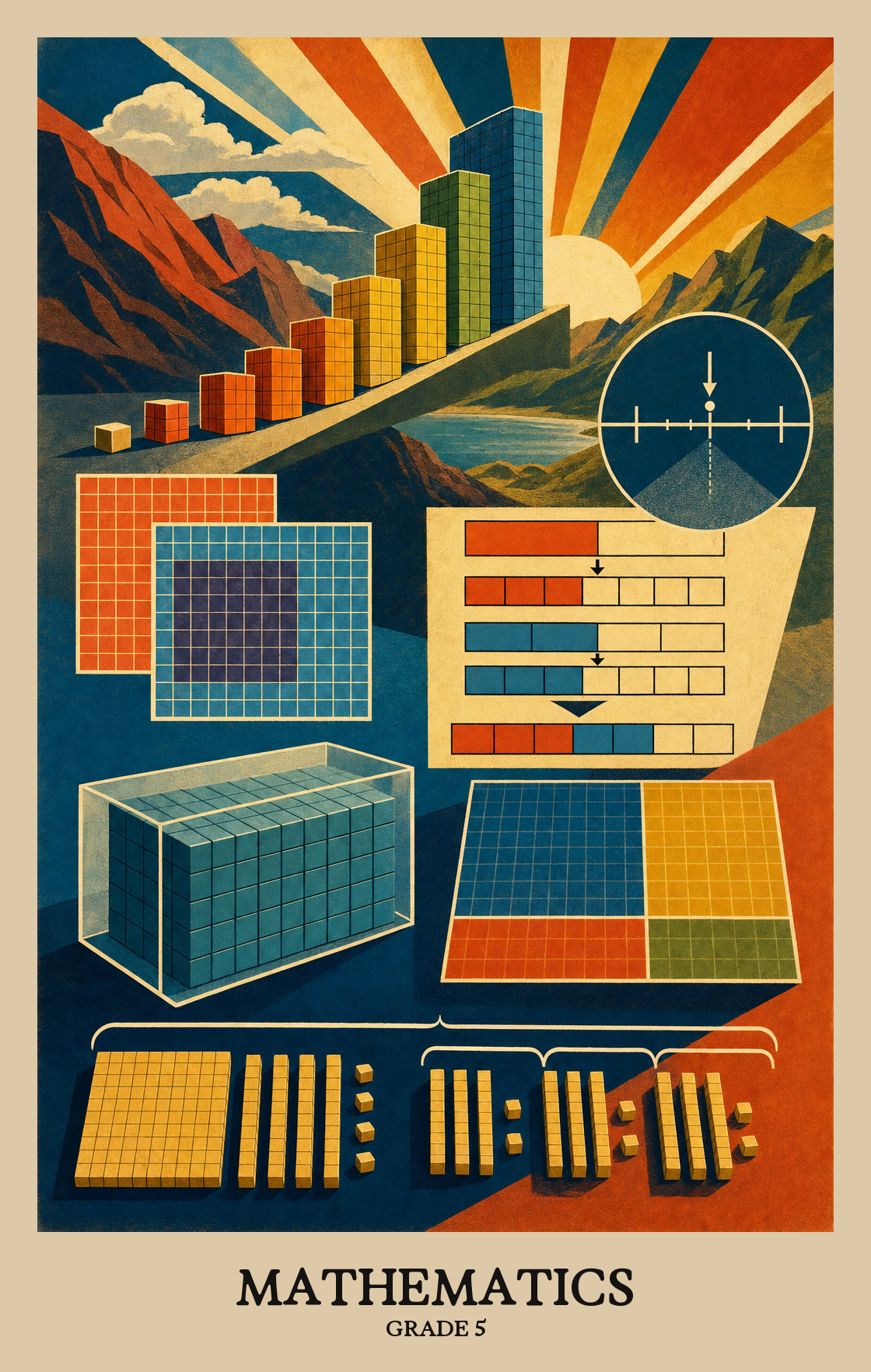
Illustration of what students learn in Grade 5 Mathematics
  • Place value
  • Decimals
  • Fractions
  • Long division
  • Volume
  • Coordinate grid
Source: Kansas Kansas Standards
Year at a glance
How the year usually goes. Every school and district set their own curriculum, so treat this as a guide, not official pacing.
  1. 1

    Place value and decimals

    Students stretch place value into the decimal side of numbers, reading and writing amounts as small as thousandths. They compare and round decimals and notice what happens to a number when it is multiplied or divided by 10, 100, or 1,000.

  2. 2

    Multi-digit multiplication and division

    Students multiply larger whole numbers using a steady, reliable method and divide numbers up to four digits by two-digit divisors. They also add, subtract, multiply, and divide decimals to the hundredths place using money-like problems.

  3. 3

    Expressions and order of operations

    Students write number sentences that use parentheses and read them without solving. They learn to follow the order the parentheses set and to describe what a written expression is doing in plain words.

  4. 4

    Fractions with unlike denominators

    Students add and subtract fractions and mixed numbers when the bottom numbers do not match, using equivalent fractions to line them up. They also see a fraction as a division problem and check whether their answers make sense.

  5. 5

    Multiplying and dividing fractions

    Students multiply a fraction by a whole number or by another fraction and predict whether the answer will be bigger or smaller than what they started with. They also divide a whole number by a unit fraction and a unit fraction by a whole number in real situations like sharing and cutting.

  6. 6

    Volume, measurement, and graphing

    Students measure the space inside boxes by counting unit cubes and using length times width times height. They convert between units like centimeters and meters, plot points on a coordinate grid, and sort shapes such as squares, rectangles, and rhombuses by their properties.

Mastery Learning Standards
The required skills a student should display by the end of Grade 5.
Operations and Algebraic Thinking
  • Use parentheses in numerical expressions and evaluate expressions with these…

    5.OA.1

    Parentheses tell students which part of a math problem to solve first. Students read and calculate expressions like (3 + 4) x 2, following the order the parentheses set.

  • Write simple expressions that record calculations with numbers

    5.OA.2

    Students write math expressions like (8 + 4) x 3 to describe a calculation, and read expressions to say what operation they show without solving them. The focus is on what the expression means, not the answer.

Number and Operations in Base Ten
  • Recognize that in a multi-digit number, a digit in one place represents 10…

    5.NBT.1

    Each digit in a number is worth 10 times more than the same digit one spot to its right. So a 4 in the hundreds place is worth ten times more than a 4 in the tens place.

  • Explain patterns in the number of zeros of the product when multiplying a…

    5.NBT.2

    Multiplying by 10, 100, or 1,000 shifts the decimal point to the right; dividing shifts it to the left. Students also learn to write those powers of 10 using exponents, like 10² instead of 100.

  • Read, write, and compare decimals to thousandths

    5.NBT.3

    Students read and write decimal numbers like 3.742, then compare two of them to decide which is larger. They use place value to explain why digits in the tenths, hundredths, and thousandths columns matter.

  • Read and write decimals to thousandths using base-ten numerals, number names…

    5.NBT.3.a

    Students read and write decimal numbers like 3.047 in four ways: as a standard number, in words, broken into place values (3 + 0.04 + 0.007), and as units (3 ones, 4 hundredths, 7 thousandths).

  • Compare two decimals to thousandths based on meanings of the digits in each…

    5.NBT.3.b

    Students look at two decimal numbers, figure out which is larger or smaller by reading each digit's place value, and write the result using symbols like > or <. The comparison goes down to the thousandths place.

  • Use place value understanding to round decimals to any place

    5.NBT.4

    Students practice rounding decimal numbers like 3.867 to the nearest whole number, tenth, or hundredth. They use what they know about place value to decide which number a decimal is closest to.

  • Fluently (efficiently, accurately

    5.NBT.5

    Multiplying large numbers together quickly and correctly. Students solve problems like 347 x 68 using a reliable method they understand, whether that's the traditional stacked method or another approach that gets the right answer every time.

  • Find whole-number quotients of whole numbers with up to four-digit dividends…

    5.NBT.6

    Students divide large numbers (up to four digits) by a two-digit number and show how they got the answer. They use drawings, grids, or equations to explain their thinking, not just the final result.

  • Add, subtract, multiply

    5.NBT.7

    Students add, subtract, multiply, and divide decimal numbers like $1.25 or $3.40. They use drawings or place-value thinking to work out the answer, then explain in writing why their method works.

Measurement and Data
  • Convert among different-sized standard measurement units within a given…

    5.MD.1

    Students practice switching between units in the same system, like turning centimeters into meters or ounces into pounds. Then they use those conversions to solve real-world problems that take more than one step.

  • Make a data display

    5.MD.2

    Students collect measurements in fractions, plot them on a line plot or bar graph, then use that graph to add or subtract fractions to answer questions about the data.

  • Recognize volume as an attribute of solid figures and understand concepts of…

    5.MD.3

    Volume measures how much space a three-dimensional solid takes up. Students learn that volume is measured by counting how many same-sized unit cubes fit inside a shape without gaps or overlaps.

  • A cube with side length 1 unit, called a "unit cube," is said to have "one…

    5.MD.3.a

    A unit cube is a small cube where every side measures 1 unit. Students use it as the building block for measuring volume, the same way they use a square tile to measure area.

  • A solid figure which can be packed without gaps or overlaps using n unit cubes…

    5.MD.3.b

    Packing a 3-D shape with small cubes (no gaps, no overlaps) measures its volume. The number of cubes that fit inside is the volume, counted in cubic units.

  • Measure volumes by counting unit cubes such as cubic cm, cubic in, cubic ft

    5.MD.4

    Students fill a box-shaped figure with small equal cubes and count how many fit inside to measure its volume. The number of cubes gives the volume, whether those cubes are centimeters, inches, feet, or another unit.

  • Relate volume to the operations of multiplication and addition and solve real…

    5.MD.5

    Students find the volume of boxes and irregular shapes by multiplying length, width, and height, or by breaking a shape into smaller pieces and adding the volumes together.

  • Find the volume of a right rectangular prism with whole-number side lengths by…

    5.MD.5.a

    Students figure out the volume of a box-shaped object by imagining it filled with small equal cubes, then confirm that multiplying the length, width, and height gives the same answer. Both methods count the same space.

  • Apply the formulas V = l·w·h and V = B·h

    5.MD.5.b

    Students use two formulas to find the volume of a box-shaped object: multiply length times width times height, or multiply the base area times the height. They practice both approaches on real-world problems with whole-number measurements.

  • Recognize volume as additive

    5.MD.5.c

    Students find the volume of an L-shaped or stepped solid by splitting it into two box-shaped pieces, calculating each piece separately, and adding the results. This shows up in real problems like figuring out how much a container holds.

Geometry
  • Use a pair of perpendicular number lines, called axes, to define a coordinate…

    5.G.1

    Students read and plot points on a grid using two numbers, like (3, 5). The first number shows how far to move left or right, and the second shows how far to move up or down.

  • Represent real world and mathematical problems by graphing points in the first…

    5.G.2

    Students plot points on a grid to show real-world relationships, like how cost changes as quantity grows. They also read a point on the grid and explain what it means in context.

  • Understand that attributes belonging to a category of two-dimensional figures…

    5.G.3

    A property shared by a category of shapes applies to every shape inside it. Because rectangles are parallelograms, every rectangle has all the properties a parallelogram has, plus its own.

  • Classify two-dimensional figures in a hierarchy based on properties

    5.G.4

    Students sort shapes into groups based on their properties, then organize those groups by what they have in common. A square fits inside the rectangle group, which fits inside the parallelogram group, and so on up the chain.

Number and Operations—Fractions
  • Add and subtract fractions with unlike denominators

    5.NF.1

    Adding fractions with different bottom numbers, like 1/2 + 1/3, by rewriting both fractions so they share the same bottom number first. Students use this skill with simple fractions and with mixed numbers like 2 1/4.

  • Solve word problems involving addition and subtraction of fractions referring…

    5.NF.2

    Students add and subtract fractions with different bottom numbers by finding a common denominator. They also use familiar fractions like 1/2 to check whether their answer is in the right ballpark before they finish.

  • Interpret a fraction as division of the numerator by the denominator

    5.NF.3

    Fractions are just division in disguise. Students learn that 3/4 means 3 divided by 4, then use that idea to solve word problems where sharing or splitting a whole number gives an answer like 1/2 or 2 3/4.

  • Apply and extend previous understandings of multiplication to multiply a…

    5.NF.4

    Multiplying a fraction by a whole number or another fraction. Students find a part of a part, like figuring out what half of three-quarters actually is, and connect that idea to the area of a rectangle with fractional side lengths.

  • Interpret the product a/b·q as a parts of a partition of q into b equal parts

    5.NF.4.a

    Multiplying a fraction times a whole number means splitting that number into equal groups and taking some of those groups. For example, 2/3 of 12 means splitting 12 into 3 equal groups and taking 2 of them.

  • Find the area of a rectangle with fractional side lengths by tiling it with…

    5.NF.4.b

    Students figure out the area of a rectangle whose sides are fractions by multiplying those side lengths together. They also check that answer by filling the rectangle with small fraction-sized squares and counting them up.

  • Interpret multiplication as scaling

    5.NF.5

    Multiplying a number doesn't always mean making it bigger. Students learn to predict whether a product will be larger or smaller than the original number based on what it's being multiplied by.

  • Comparing the size of a product to the size of one factor based on the size of…

    5.NF.5.a

    Multiplying a number by a fraction smaller than 1 shrinks the result. Students recognize this without doing the full calculation: half of 3 is smaller than 3, and two-thirds of 10 is smaller than 10.

  • Explain why multiplying a given number by a fraction greater than 1 results in…

    5.NF.5.b

    Students explain why multiplying a number by a fraction bigger than 1 makes the result larger, and why multiplying by a fraction smaller than 1 makes it smaller. They connect that idea to what happens when you scale a number up or down.

  • Solve real world problems involving multiplication of fractions and mixed…

    5.NF.6

    Students multiply fractions and mixed numbers to solve real problems, like finding the area of a garden plot or scaling a recipe. They use drawings or equations to show their work.

  • Apply and extend previous understandings of division, to divide unit fractions…

    5.NF.7

    Dividing a fraction like 1/2 by a whole number, or dividing a whole number by a fraction like 1/3, means figuring out how many groups fit or how much each share is. Students work both directions and explain what the answer means.

  • Interpret division of a unit fraction by a non-zero whole number

    5.NF.7.a

    Dividing a fraction by a whole number means splitting it into even smaller pieces. Students figure out, for example, what you get when you cut one-half of a pizza into 3 equal slices, then calculate the answer.

  • Interpret division of a whole number by a unit fraction

    5.NF.7.b

    Dividing a whole number by a fraction like 1/4 asks how many quarter-sized pieces fit into that number. Students figure out the answer and explain what it means.

  • Solve real world problems involving division of unit fractions by non-zero…

    5.NF.7.c

    Students solve everyday problems that involve dividing a fraction by a whole number or a whole number by a fraction, such as splitting half a pizza among 3 people or figuring out how many quarter-miles fit in 3 miles.

Assessments
The state tests students at this grade and subject take.
State Summative

Kansas Assessment Program: Mathematics

KAP mathematics assessment for grades 3 through 8 and grade 10, aligned to the Kansas Mathematics Standards.

When given:
spring
Frequency:
annual
Official source
Common Questions
  • What does fifth grade math look like overall?

    Fifth grade math is the year decimals and fractions get serious. Students add, subtract, multiply, and divide fractions, work with decimals out to the thousandths place, and start finding the volume of boxes. They also learn to plot points on a graph.

  • How can I help with fractions at home?

    Cook together. Doubling a recipe that calls for 3/4 cup of flour or splitting 2 cups of rice among 3 people is exactly the math students are doing in class. Ask out loud how much you need and let them figure it out on paper.

  • Do students still need to practice multiplication facts?

    Yes. Fifth grade multiplies bigger numbers and divides four-digit numbers by two-digit numbers, and slow facts make every step harder. Five minutes a few nights a week with a deck of cards or a quick flashcard game pays off all year.

  • How should I sequence the year?

    Most teachers start with place value and decimal operations, since that work supports almost everything else. Fractions usually come next, then volume and measurement, with the coordinate plane and shape classification near the end. Expressions and parentheses can be woven in throughout.

  • Which topics usually need the most reteaching?

    Dividing fractions trips up the most students, especially telling the difference between 1/4 divided by 2 and 2 divided by 1/4. Decimal place value when multiplying or dividing by powers of 10 is the other common sticking point. Build in extra practice and quick checks for both.

  • My child says the answer is wrong if it has a remainder. Is that right?

    Not anymore. Fifth graders learn that a division problem can give a fraction or a decimal as the answer. So 7 divided by 4 can be written as 1 remainder 3, 1 and 3/4, or 1.75. All three are correct, depending on the problem.

  • What is volume and why is it new this year?

    Volume is how much space a solid shape takes up, measured in cubic units like cubic inches. Students fill rectangular boxes with unit cubes and learn that length times width times height gives the same answer. Stacking blocks or counting sugar cubes in a box at home reinforces this.

  • How do I know students are ready for sixth grade?

    By June, students should add and subtract fractions with unlike denominators, multiply multi-digit numbers fluently, divide with two-digit divisors, and handle decimal operations to the hundredths. They should also plot points on a coordinate grid and find the volume of a rectangular prism without prompting.

  • What does a good homework routine look like?

    Keep it short and steady. Fifteen to twenty minutes a night beats an hour on Sunday. Ask students to explain one problem out loud, even if the answer is right, so they practice the reasoning that shows up on tests.