What matter is made of
Students learn that all stuff around them is made of tiny particles too small to see. They weigh things before and after melting, dissolving, or mixing to show the amount of matter stays the same.
This is the year science zooms out to the whole planet and in to the tiny pieces that make it up. Students start picturing matter as particles too small to see, and they track how energy from the sun moves through plants, animals, and the food on their plates. They also study how air, water, land, and living things shape each other. By spring, students can explain why a plant grows from mostly air and water, and weigh substances before and after mixing to show the total stays the same.
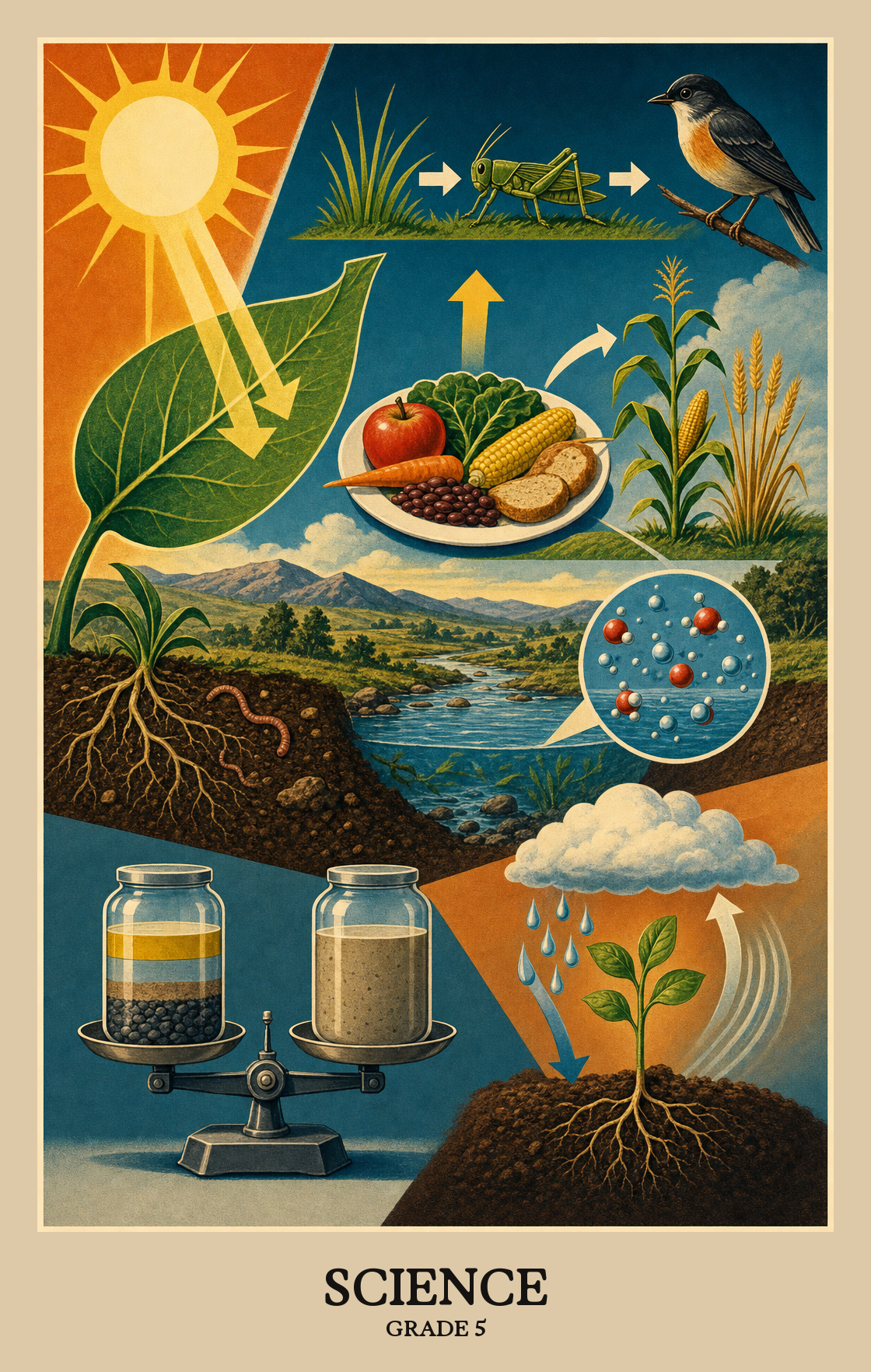
Students learn that all stuff around them is made of tiny particles too small to see. They weigh things before and after melting, dissolving, or mixing to show the amount of matter stays the same.
Students sort materials by properties like hardness, color, and whether they dissolve. They mix substances and look for clues, such as bubbles or a color change, that something new has formed.
Students argue that Earth pulls objects down and that plants build themselves mostly from air and water, not soil. They trace the energy in a hamburger or an apple back to the sun.
Students map how matter moves between plants, animals, and decomposers in a forest or pond. They also show how land, water, air, and living things shape each other, like a river carving a hillside.
Students figure out that the sun looks bright because it is close, while other stars are much farther away. They graph how shadows shift during the day and which stars show up in different seasons.
Students chart how little of Earth's water is fresh and usable. They research ways communities save water, cut waste, and protect land, then share what they learn.
Students learn what matter is made of and how it changes. They explore why substances mix, react, or stay the same when heated, cooled, or combined with something else.
Students study why objects move, slow down, or stay still. They learn how forces like gravity and friction act on everyday objects and how those forces can be balanced or overcome.
Students trace how plants turn sunlight into food, and how that energy moves through animals and ecosystems. It's the science behind why plants need light and why eating food gives you energy to move.
Plants and animals are built from smaller parts that each do a specific job. Students learn how those structures help living things grow, get energy, and survive.
Students learn how living things in an ecosystem depend on each other and on their environment to survive. They trace how energy moves through food webs and explore what happens when part of an ecosystem changes.
Students study the sun, moon, and stars to understand how Earth moves through space and why we see patterns like seasons and moon phases.
Students study how Earth's oceans, land, atmosphere, and living things work together as connected systems. They look at how water moves through the environment and how energy from the sun shapes weather and climate.
Students explore how human activity affects Earth's land, water, and living things. They look at real problems like pollution or habitat loss and consider solutions people can use to protect natural resources.
| Standard | Definition | Code |
|---|---|---|
| Matter and Its Interactions | Students learn what matter is made of and how it changes. They explore why substances mix, react, or stay the same when heated, cooled, or combined with something else. | 5-PS1 |
| Motion and Stability | Students study why objects move, slow down, or stay still. They learn how forces like gravity and friction act on everyday objects and how those forces can be balanced or overcome. | 5-PS2 |
| Energy | Students trace how plants turn sunlight into food, and how that energy moves through animals and ecosystems. It's the science behind why plants need light and why eating food gives you energy to move. | 5-PS3 |
| From Molecules to Organisms | Plants and animals are built from smaller parts that each do a specific job. Students learn how those structures help living things grow, get energy, and survive. | 5-LS1 |
| Ecosystems: Interactions, Energy | Students learn how living things in an ecosystem depend on each other and on their environment to survive. They trace how energy moves through food webs and explore what happens when part of an ecosystem changes. | 5-LS2 |
| Earth's Place in the Universe | Students study the sun, moon, and stars to understand how Earth moves through space and why we see patterns like seasons and moon phases. | 5-ESS1 |
| Earth's Systems | Students study how Earth's oceans, land, atmosphere, and living things work together as connected systems. They look at how water moves through the environment and how energy from the sun shapes weather and climate. | 5-ESS2 |
| Earth and Human Activity | Students explore how human activity affects Earth's land, water, and living things. They look at real problems like pollution or habitat loss and consider solutions people can use to protect natural resources. | 5-ESS3 |
Matter is made of tiny particles too small to see, even under a microscope. Students build diagrams or physical models to show how those invisible particles make up solids, liquids, and gases.
Students weigh substances before and after heating, cooling, or mixing them, then graph the results to show that the total weight stays the same no matter what changes happen.
Students sort and identify materials by measuring and observing properties like color, hardness, flexibility, or how something reacts with water. The observations are the evidence.
Students mix everyday materials together and observe whether something new forms. The goal is to figure out if a chemical change happened or if the original substances are still there.
| Standard | Definition | Code |
|---|---|---|
| Develop a model to describe that matter is made of particles too small to be… | Matter is made of tiny particles too small to see, even under a microscope. Students build diagrams or physical models to show how those invisible particles make up solids, liquids, and gases. | 5-PS1-1 |
| Measure and graph quantities to provide evidence that regardless of the type of… | Students weigh substances before and after heating, cooling, or mixing them, then graph the results to show that the total weight stays the same no matter what changes happen. | 5-PS1-2 |
| Make observations and measurements to identify materials based on their… | Students sort and identify materials by measuring and observing properties like color, hardness, flexibility, or how something reacts with water. The observations are the evidence. | 5-PS1-3 |
| Conduct an investigation to determine whether the mixing of two or more… | Students mix everyday materials together and observe whether something new forms. The goal is to figure out if a chemical change happened or if the original substances are still there. | 5-PS1-4 |
Students gather evidence to support the idea that gravity always pulls objects straight down toward Earth, no matter where the object is or what it looks like.
| Standard | Definition | Code |
|---|---|---|
| Support an argument that the gravitational force exerted by Earth on objects is… | Students gather evidence to support the idea that gravity always pulls objects straight down toward Earth, no matter where the object is or what it looks like. | 5-PS2-1 |
Students trace the energy in food back to the sun. They use diagrams or models to show how that energy keeps animals moving, growing, and warm.
| Standard | Definition | Code |
|---|---|---|
| Use models to describe that energy in animals' food | Students trace the energy in food back to the sun. They use diagrams or models to show how that energy keeps animals moving, growing, and warm. | 5-PS3-1 |
Plants don't grow mostly from soil. Students use evidence to argue that plants pull the materials they need to grow mainly from air and water.
| Standard | Definition | Code |
|---|---|---|
| Support an argument that plants get the materials they need for growth chiefly… | Plants don't grow mostly from soil. Students use evidence to argue that plants pull the materials they need to grow mainly from air and water. | 5-LS1-1 |
Students draw or diagram how matter moves through a food web, showing how plants, animals, and decomposers pass materials back into the soil, water, and air.
| Standard | Definition | Code |
|---|---|---|
| Develop a model to describe the movement of matter among plants, animals… | Students draw or diagram how matter moves through a food web, showing how plants, animals, and decomposers pass materials back into the soil, water, and air. | 5-LS2-1 |
Students use data about star brightness to argue that stars look dim not because they are small or faint, but because they are much farther away than the sun. Distance explains what we see in the night sky.
Students graph how shadows shift throughout a day and track which stars appear in different seasons. The patterns in those graphs show how Earth's movement around the Sun shapes what we see in the sky.
| Standard | Definition | Code |
|---|---|---|
| Support an argument that differences in the apparent brightness of the sun… | Students use data about star brightness to argue that stars look dim not because they are small or faint, but because they are much farther away than the sun. Distance explains what we see in the night sky. | 5-ESS1-1 |
| Represent data in graphical displays to reveal patterns of daily changes in… | Students graph how shadows shift throughout a day and track which stars appear in different seasons. The patterns in those graphs show how Earth's movement around the Sun shapes what we see in the sky. | 5-ESS1-2 |
Students draw or diagram how parts of Earth (land, living things, water, and air) affect each other. For example, they might show how rain soaks into soil and feeds plant roots.
Students find out where Earth's water actually is: mostly salt water in the oceans, with only a small slice as fresh water in glaciers, rivers, and lakes. They read graphs and make their own to show how those amounts compare.
| Standard | Definition | Code |
|---|---|---|
| Develop a model using an example to describe ways the geosphere, biosphere… | Students draw or diagram how parts of Earth (land, living things, water, and air) affect each other. For example, they might show how rain soaks into soil and feeds plant roots. | 5-ESS2-1 |
| Describe and graph the amounts and percentages of water and fresh water in… | Students find out where Earth's water actually is: mostly salt water in the oceans, with only a small slice as fresh water in glaciers, rivers, and lakes. They read graphs and make their own to show how those amounts compare. | 5-ESS2-2 |
Students research how real communities use science to protect water, soil, and air. They pull facts from multiple sources and put the ideas together in their own explanation.
| Standard | Definition | Code |
|---|---|---|
| Obtain and combine information about ways individual communities use science… | Students research how real communities use science to protect water, soil, and air. They pull facts from multiple sources and put the ideas together in their own explanation. | 5-ESS3-1 |
KAP science assessment in grades 5, 8, and 11, aligned to the Kansas Science Standards.
Students study four big areas: matter and how it changes, forces like gravity, energy from the sun, and Earth systems including water, weather, and space. They also learn how plants, animals, and decomposers move matter through an ecosystem.
Cook together and talk about what changes when you heat, cool, or mix things. Look at the moon and stars on clear nights. Ask what plants need to grow, and where the food on the dinner plate started. Short kitchen and backyard talks count.
Students learn that everything is made of particles too small to see, and that weight stays the same when you melt ice, dissolve sugar, or mix substances. Try weighing a sealed jar before and after the ice inside melts.
Many fifth grade teachers start with properties of matter and mixtures because the lab routines transfer everywhere else. Energy from the sun bridges into plants and ecosystems. Save Earth and space for spring when shadow and star patterns are easier to track over weeks.
Conservation of weight after a change trips up most students, especially when a solid dissolves or a gas is released. Plants getting their mass from air and water, not soil, is the other sticking point. Plan extra hands-on time for both.
Memorizing lists is less important than explaining how things connect. Students should be able to describe how water moves between oceans, air, ice, and rivers, and why the sun looks brighter than other stars even though it is smaller than many of them.
Students can run a simple investigation, record measurements, and graph results to support a claim. They can build a model of an ecosystem or an Earth system and explain how matter and energy move through it using evidence from their own data.
Students are expected to argue from evidence, not just observe. They measure, graph, and build models to explain what they see. Expect more lab notebooks and more writing about results than in third or fourth grade.