Adding and subtracting within 20
Students start the year getting quick and confident with small addition and subtraction facts. They learn to count on, make a ten, and use what they already know to figure out what they don't.
This is the year math jumps from counting to thinking in groups of hundreds, tens, and ones. Students read, write, and compare numbers up to 1,000, then add and subtract within 100 using strategies that lean on place value. They also start measuring with rulers in inches and centimeters, telling time to the nearest five minutes, and counting mixed coins and bills. By spring, they can solve a two-step word problem and split a rectangle into equal halves, thirds, or fourths.
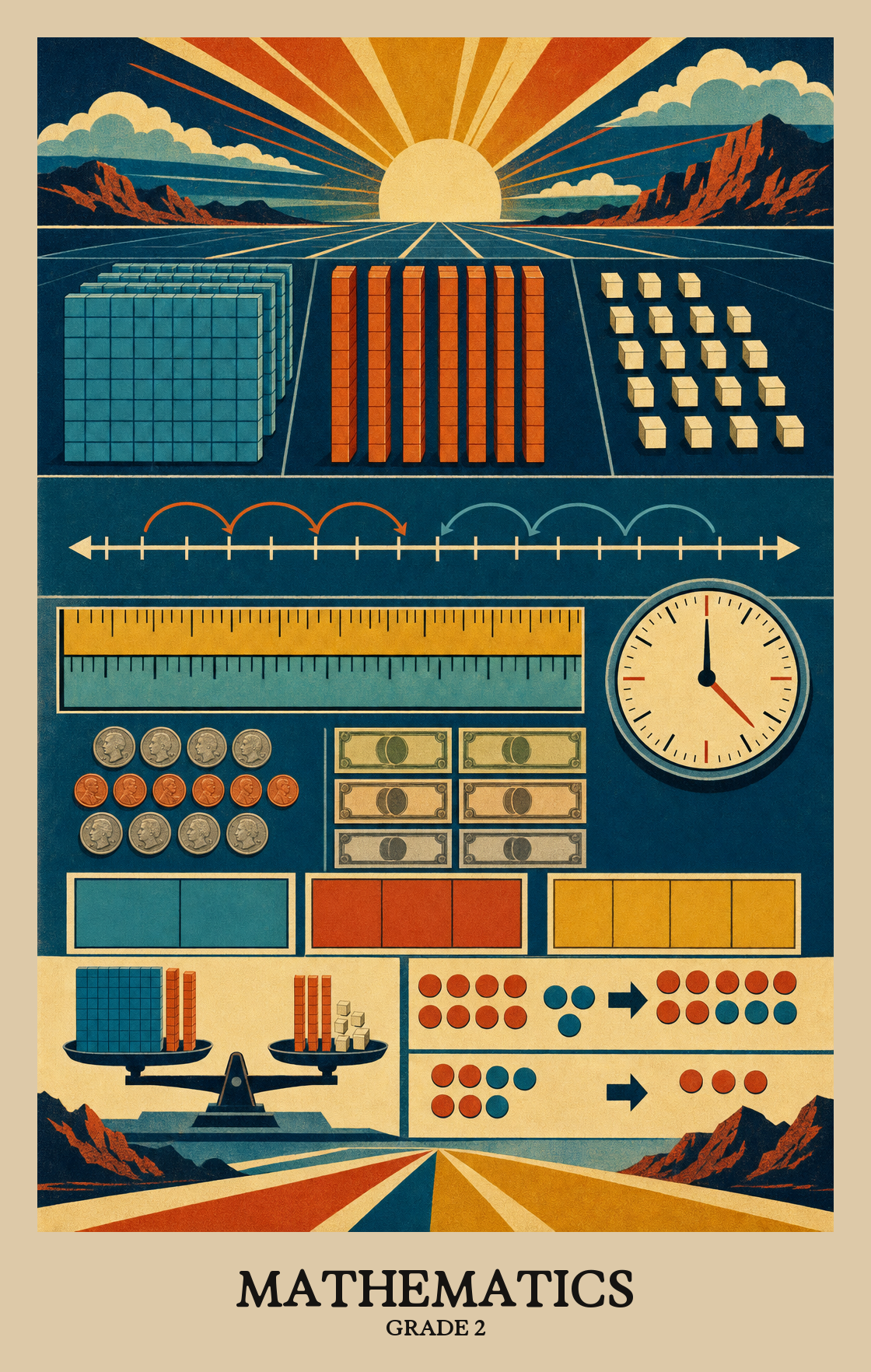
Students start the year getting quick and confident with small addition and subtraction facts. They learn to count on, make a ten, and use what they already know to figure out what they don't.
Students learn that the digits in a number like 706 stand for hundreds, tens, and ones. They read, write, and compare numbers up to 1000, and skip-count by 2s, 5s, 10s, and 100s.
Students move from facts to two- and three-digit problems. They add and subtract within 100 fluently, work with numbers up to 1000 using drawings and place value, and solve word problems with one or two steps.
Students pick up a ruler and measure in inches and centimeters, estimate lengths, and find how much longer one object is than another. They also tell time on a clock to the nearest five minutes and solve word problems with coins and bills.
Students identify triangles, pentagons, hexagons, and cubes, and split rectangles and circles into halves, thirds, and fourths. They also build simple picture graphs and bar graphs and answer questions using the data.
Students read short story problems and figure out a missing number by adding or subtracting, sometimes in two steps. The missing number can hide anywhere in the problem, and students show their thinking with drawings or number sentences.
Adding and subtracting any two numbers up to 20 quickly and in their head, without counting on fingers. Students know their sums and differences well enough to solve them multiple ways.
Students sort a group of up to 20 objects into pairs to decide if the total is odd or even. If every object has a partner, the number is even, and students write it as two equal parts added together.
Students count objects arranged in a grid (like a 4-by-3 arrangement of dots) by adding equal groups in each row. Then they write an addition equation that shows how those equal groups combine into a total.
| Standard | Definition | Code |
|---|---|---|
| Use addition and subtraction within 100 to solve one- and two-step word… | Students read short story problems and figure out a missing number by adding or subtracting, sometimes in two steps. The missing number can hide anywhere in the problem, and students show their thinking with drawings or number sentences. | 2.OA.1 |
| Fluently (efficiently, accurately | Adding and subtracting any two numbers up to 20 quickly and in their head, without counting on fingers. Students know their sums and differences well enough to solve them multiple ways. | 2.OA.2 |
| Determine whether a group of objects | Students sort a group of up to 20 objects into pairs to decide if the total is odd or even. If every object has a partner, the number is even, and students write it as two equal parts added together. | 2.OA.3 |
| Use addition to find the total number of objects arranged in rectangular arrays… | Students count objects arranged in a grid (like a 4-by-3 arrangement of dots) by adding equal groups in each row. Then they write an addition equation that shows how those equal groups combine into a total. | 2.OA.4 |
Three-digit numbers are built from hundreds, tens, and ones. Students read a number like 706 and say exactly how many hundreds, tens, and ones are hiding inside it.
Grouping ten sets of ten ones together makes 100. Students learn that a hundred is just a neat bundle of ten tens, which is why a dollar has ten dimes and a dime has ten pennies.
Hundreds are whole bundles of 100. Students learn that 300 means three of those bundles, 700 means seven, and so on, with nothing left over in the tens or ones place.
Students break apart and rebuild numbers in different ways using hundreds, tens, and ones. For example, 207 can be 2 hundreds and 7 ones, or 20 tens and 7 ones, and both are correct.
Students count forward past 100, all the way to 1000, and practice skip-counting by 2s, 5s, 10s, and 100s. They also notice and explain the patterns those counts make.
Students read and write numbers up to 1,000 four different ways: as digits (347), as words ("three hundred forty-seven"), as an addition sentence (300 + 40 + 7), and by naming how many hundreds, tens, and ones.
Students look at two three-digit numbers and decide which is larger, smaller, or equal by comparing the hundreds first, then the tens, then the ones. They record the result using symbols like > and <.
Students add and subtract any two numbers up to 100 quickly and accurately, using whatever method makes sense to them, such as breaking numbers into tens and ones or counting on a number line.
Students add up to four two-digit numbers at a time by grouping tens together and ones together instead of adding straight down a column. This is the groundwork for the column addition students will use for the rest of school.
Students add and subtract numbers up to 1,000 by grouping hundreds, tens, and ones. When a column has too many or too few, they regroup, the way you carry or borrow in written math.
Students practice adding or subtracting 10 or 100 in their heads, starting from any three-digit number. No pencil needed: just recognize which digit changes and by how much.
Students explain *why* a math strategy works, not just the answer it gives. They might sketch a quick picture or use objects to show how breaking numbers into tens and ones makes adding or subtracting easier.
| Standard | Definition | Code |
|---|---|---|
| Understand that the three digits of a three-digit number represent amounts of… | Three-digit numbers are built from hundreds, tens, and ones. Students read a number like 706 and say exactly how many hundreds, tens, and ones are hiding inside it. | 2.NBT.1 |
| 100 can be thought of as a bundle of ten tens—called a "hundred." | Grouping ten sets of ten ones together makes 100. Students learn that a hundred is just a neat bundle of ten tens, which is why a dollar has ten dimes and a dime has ten pennies. | 2.NBT.1.a |
| The numbers 100, 200, 300, 400, 500, 600, 700, 800, 900 refer to one, two… | Hundreds are whole bundles of 100. Students learn that 300 means three of those bundles, 700 means seven, and so on, with nothing left over in the tens or ones place. | 2.NBT.1.b |
| Show flexibility in composing and decomposing hundreds, tens and ones | Students break apart and rebuild numbers in different ways using hundreds, tens, and ones. For example, 207 can be 2 hundreds and 7 ones, or 20 tens and 7 ones, and both are correct. | 2.NBT.1.c |
| Count within 1000; skip-count by 2s, 5s, 10s | Students count forward past 100, all the way to 1000, and practice skip-counting by 2s, 5s, 10s, and 100s. They also notice and explain the patterns those counts make. | 2.NBT.2 |
| Read and write numbers within 1000 using base-ten numerals, number names… | Students read and write numbers up to 1,000 four different ways: as digits (347), as words ("three hundred forty-seven"), as an addition sentence (300 + 40 + 7), and by naming how many hundreds, tens, and ones. | 2.NBT.3 |
| Compare two three-digit numbers based on meanings of the hundreds, tens | Students look at two three-digit numbers and decide which is larger, smaller, or equal by comparing the hundreds first, then the tens, then the ones. They record the result using symbols like > and <. | 2.NBT.4 |
| Fluently (efficiently, accurately | Students add and subtract any two numbers up to 100 quickly and accurately, using whatever method makes sense to them, such as breaking numbers into tens and ones or counting on a number line. | 2.NBT.5 |
| Add up to four two-digit numbers using strategies based on place value and… | Students add up to four two-digit numbers at a time by grouping tens together and ones together instead of adding straight down a column. This is the groundwork for the column addition students will use for the rest of school. | 2.NBT.6 |
| Add and subtract within 1000, using concrete models or drawings and strategies… | Students add and subtract numbers up to 1,000 by grouping hundreds, tens, and ones. When a column has too many or too few, they regroup, the way you carry or borrow in written math. | 2.NBT.7 |
| Mentally add 10 or 100 to a given number 100 – 900 | Students practice adding or subtracting 10 or 100 in their heads, starting from any three-digit number. No pencil needed: just recognize which digit changes and by how much. | 2.NBT.8 |
| Explain why addition and subtraction strategies work using place value and the… | Students explain *why* a math strategy works, not just the answer it gives. They might sketch a quick picture or use objects to show how breaking numbers into tens and ones makes adding or subtracting easier. | 2.NBT.9 |
Students measure objects with a ruler, then plot each measurement as a mark on a number line. The result is a simple chart showing how the measurements spread out.
Students collect data into up to four groups, then draw a picture graph and a bar graph to show the results. They use the bar graph to answer questions like how many total, how many fewer, or which group has more.
Students pick the right measuring tool for the job and use it to find how long an object is. A short pencil calls for a ruler; a longer distance might need a tape measure.
Students measure the same object twice, once with a short unit and once with a longer one, then explain why the two numbers came out different. Bigger units give smaller counts; smaller units give bigger counts.
Students make a reasonable guess about how long something is before measuring it, using inches, feet, centimeters, or meters as the unit. This builds number sense around real objects like a pencil, a desk, or a door.
Students measure two objects with the same ruler, then figure out the difference in length. For example, a pencil that is 7 inches and a crayon that is 4 inches are 3 inches apart.
Students solve story problems where lengths are measured in the same unit, adding or subtracting to find a missing distance. They might draw a ruler sketch or write an equation with a blank to show their thinking.
Students place numbers on a number line like steps on a ruler, then use that same line to add and subtract. They find sums and differences within 100 by jumping forward or backward between marked points.
Students read both kinds of clocks and write down the time to the nearest five minutes. They practice with the round clock face and the number display.
Students count mixed coins and dollar bills to solve simple money problems, then write the amount using the $ or ¢ symbol. For example, they figure out how much a small purchase costs or how much change is left over.
Students name pennies, nickels, dimes, quarters, and common bills, then say how much each one is worth.
| Standard | Definition | Code |
|---|---|---|
| Generate measurement data by measuring lengths of several objects to the… | Students measure objects with a ruler, then plot each measurement as a mark on a number line. The result is a simple chart showing how the measurements spread out. | 2.MD.10 |
| Draw a picture graph and a bar graph | Students collect data into up to four groups, then draw a picture graph and a bar graph to show the results. They use the bar graph to answer questions like how many total, how many fewer, or which group has more. | 2.MD.11 |
| Measure the length of an object by selecting and using appropriate tools such… | Students pick the right measuring tool for the job and use it to find how long an object is. A short pencil calls for a ruler; a longer distance might need a tape measure. | 2.MD.1 |
| Measure the length of an object twice, using length units of different lengths… | Students measure the same object twice, once with a short unit and once with a longer one, then explain why the two numbers came out different. Bigger units give smaller counts; smaller units give bigger counts. | 2.MD.2 |
| Estimate lengths using whole units of inches, feet, centimeters | Students make a reasonable guess about how long something is before measuring it, using inches, feet, centimeters, or meters as the unit. This builds number sense around real objects like a pencil, a desk, or a door. | 2.MD.3 |
| Measure to determine how much longer one object is than another, expressing the… | Students measure two objects with the same ruler, then figure out the difference in length. For example, a pencil that is 7 inches and a crayon that is 4 inches are 3 inches apart. | 2.MD.4 |
| Use addition and subtraction within 100 to solve one- and two-step word… | Students solve story problems where lengths are measured in the same unit, adding or subtracting to find a missing distance. They might draw a ruler sketch or write an equation with a blank to show their thinking. | 2.MD.5 |
| Represent whole numbers as lengths from 0 on a number line diagram with equally… | Students place numbers on a number line like steps on a ruler, then use that same line to add and subtract. They find sums and differences within 100 by jumping forward or backward between marked points. | 2.MD.6 |
| Tell and write time from analog and digital clocks to the nearest five minutes | Students read both kinds of clocks and write down the time to the nearest five minutes. They practice with the round clock face and the number display. | 2.MD.7 |
| Solve word problems involving dollar bills, quarters, dimes, nickels | Students count mixed coins and dollar bills to solve simple money problems, then write the amount using the $ or ¢ symbol. For example, they figure out how much a small purchase costs or how much change is left over. | 2.MD.8 |
| Identify coins and bills and their values | Students name pennies, nickels, dimes, quarters, and common bills, then say how much each one is worth. | 2.MD.9 |
Students sort and draw shapes by counting their sides and corners. They name triangles, four-sided shapes, five-sided shapes, six-sided shapes, and cubes.
Students divide a rectangle into equal-sized squares arranged in rows and columns, then count all the squares to find the total. It's early practice with area before that word is introduced.
Students cut circles and rectangles into equal parts and name those parts using words like halves, thirds, and fourths. Two halves make a whole, three thirds make a whole, and the pieces don't have to look identical to be equal.
| Standard | Definition | Code |
|---|---|---|
| Recognize and draw shapes having specified attributes, such as a given number… | Students sort and draw shapes by counting their sides and corners. They name triangles, four-sided shapes, five-sided shapes, six-sided shapes, and cubes. | 2.G.1 |
| Partition a rectangle into rows and columns of same-size squares and count to… | Students divide a rectangle into equal-sized squares arranged in rows and columns, then count all the squares to find the total. It's early practice with area before that word is introduced. | 2.G.2 |
| Partition circles and rectangles into two, three | Students cut circles and rectangles into equal parts and name those parts using words like halves, thirds, and fourths. Two halves make a whole, three thirds make a whole, and the pieces don't have to look identical to be equal. | 2.G.3 |
KAP mathematics assessment for grades 3 through 8 and grade 10, aligned to the Kansas Mathematics Standards.
By spring, students should add and subtract numbers up to 100 in their head or on paper, read and write numbers up to 1000, tell time to the nearest five minutes, and measure objects with a ruler. They should also know coins and bills well enough to solve simple money problems.
Count out loud while walking up stairs or driving. Ask how much change a five-dollar bill gives back at the store. Have students read the clock at bedtime and figure out how many minutes until lights out. Short and frequent beats long and rare.
Not yet, but the goal this year is to add and subtract within 20 quickly without counting one by one. Practice pairs that make ten (6 and 4, 7 and 3) and doubles (6 and 6, 7 and 7). Once those are automatic, harder facts get easier.
Place value is the idea that the 3 in 342 stands for 300, not just 3. Students need this to add and subtract larger numbers, compare them, and add or subtract 10 or 100 in their head. Coins help: a dime is a ten, a penny is a one.
Start with tens and ones inside 100, then build hundreds with bundled tens before introducing three-digit numbers. Spend real time on composing and decomposing (1 hundred 9 tens 17 ones is still 207) before moving to written addition and subtraction within 1000. Mental math with 10 and 100 should run alongside the whole unit.
Two-step word problems, subtraction across a ten or hundred, and telling time on an analog clock between the five-minute marks. Counting mixed coins also trips students up, especially when quarters are involved. Build in spiral review on these from the first month.
Both. Teach strategies first (making ten, doubles plus one, using a known fact) so students understand what they are doing, then use short daily fluency practice to build speed. Five minutes a day of mixed practice beats a weekly timed test.
Students should solve one- and two-step problems within 100, including compare problems (how many more, how many fewer) and problems with the unknown in different spots. A drawing or a labeled equation should back up the answer. The number sentence matters as much as the answer.
Ready students add and subtract within 100 without much thought, explain their thinking with place value, read a ruler and a clock, and handle money problems with coins and bills. They also recognize equal rows and columns in a rectangle, which sets up multiplication next year.