Sorting and testing materials
Students look closely at everyday things like wood, fabric, metal, and plastic. They sort them by what they can see and feel, then test which material works best for a job like keeping something dry or warm.
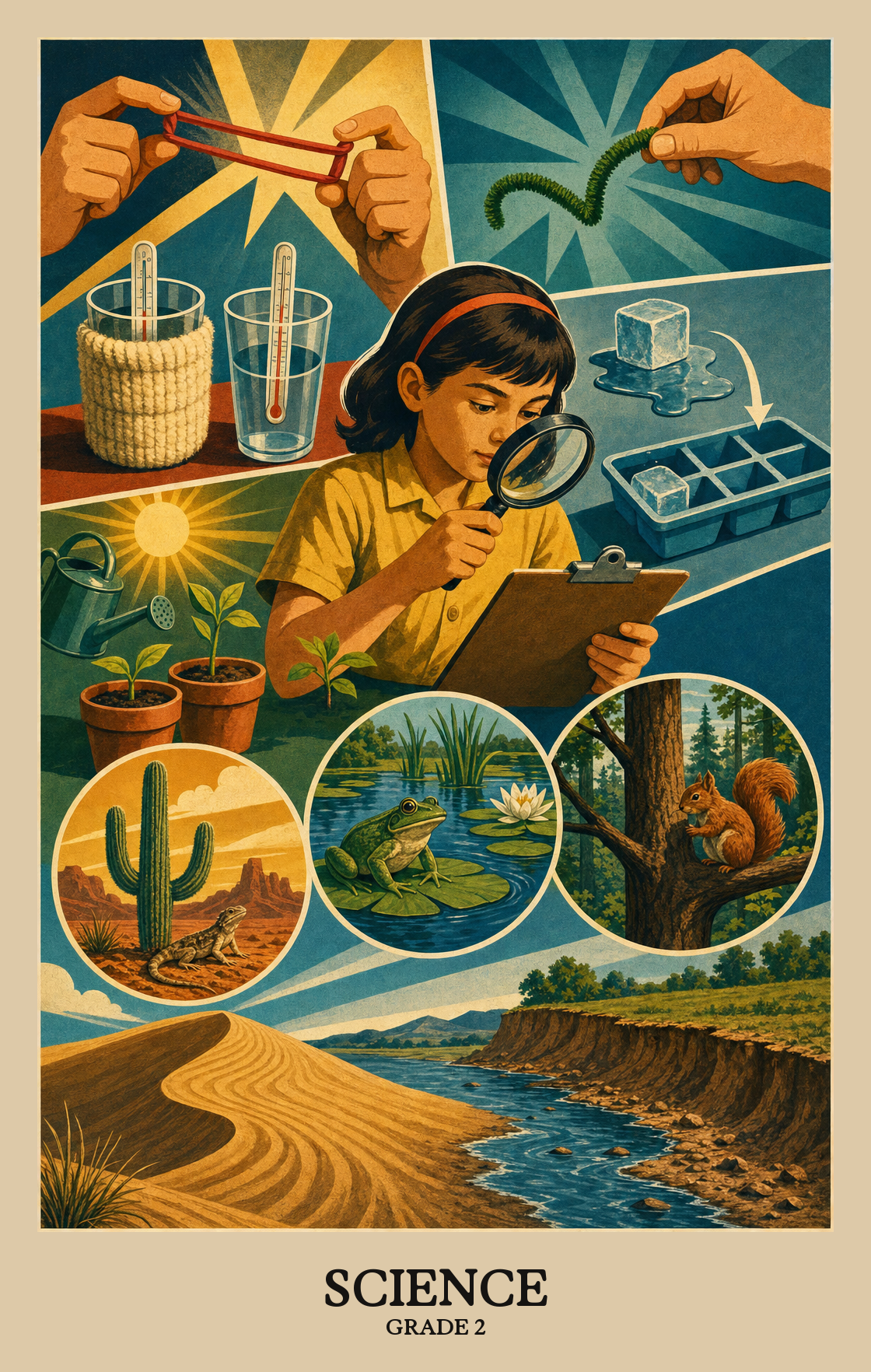
This is the year science becomes hands-on investigation. Students test different materials to see which ones bend, stretch, or hold heat, and they figure out which changes from heating or cooling can be undone. They also grow plants to learn what those plants need, compare animals and plants across different habitats, and study how wind and water reshape the land. By spring, students can run a simple experiment, record what they see, and use that evidence to back up an idea.
Students look closely at everyday things like wood, fabric, metal, and plastic. They sort them by what they can see and feel, then test which material works best for a job like keeping something dry or warm.
Students take a small object apart and use the same pieces to build something new. They also notice that some changes from heating or cooling can be undone, like melting ice, and some cannot, like baking an egg.
Students grow plants to find out what happens with and without sunlight and water. They also act out how bees, birds, and other animals help move pollen and seeds from place to place.
Students compare the plants and animals that live in different places, like a forest, a pond, and a desert. They notice that each habitat is home to a different mix of living things.
Students build simple maps and models that show hills, rivers, lakes, and coastlines in an area. They also learn where water is found on Earth and that it can be ice or liquid.
Students see that some Earth changes happen fast, like a volcano, and others happen slowly, like a canyon forming. They compare ways people try to slow wind and water from wearing the land away.
Students examine everyday materials like wood, metal, and water to figure out what things are made of and how their properties affect what they can do.
Students study how plants and animals depend on each other and their surroundings to survive. They look at what living things need, like water, sunlight, and food, and how those needs connect plants, animals, and the places they live.
Students sort and compare living things by looking at what makes each animal or plant different from others. They build the habit of noticing that creatures in the same place can look and behave very differently.
Students learn that Earth has a place in a larger universe, looking at patterns in the sky like sunrise, sunset, and seasons to understand how Earth moves and changes over time.
Students observe and describe how wind and water change the shape of land over time. They also study maps and materials to understand what Earth's surface looks like.
| Standard | Definition | Code |
|---|---|---|
| Matter and its Interactions | Students examine everyday materials like wood, metal, and water to figure out what things are made of and how their properties affect what they can do. | 2-PS1 |
| Ecosystems: Interactions, Energy | Students study how plants and animals depend on each other and their surroundings to survive. They look at what living things need, like water, sunlight, and food, and how those needs connect plants, animals, and the places they live. | 2-LS2 |
| Biological Evolution | Students sort and compare living things by looking at what makes each animal or plant different from others. They build the habit of noticing that creatures in the same place can look and behave very differently. | 2-LS4 |
| Earth's Place in the Universe | Students learn that Earth has a place in a larger universe, looking at patterns in the sky like sunrise, sunset, and seasons to understand how Earth moves and changes over time. | 2-ESS1 |
| Earth's Systems | Students observe and describe how wind and water change the shape of land over time. They also study maps and materials to understand what Earth's surface looks like. | 2-ESS2 |
Students sort everyday materials like wood, metal, plastic, and fabric by what they can observe: color, texture, hardness, and flexibility. They plan a simple test, collect results, and group what they find.
Students test materials like cloth, metal, and plastic to figure out which one works best for a specific job. A raincoat needs a waterproof material; a bridge needs something strong.
Students take apart a simple object and use the same pieces to build something new. The pieces don't change, just the shape they're put into.
Heating and cooling can change materials, but not always in ways you can undo. Students sort examples like melting ice or cooking an egg to figure out which changes can be reversed and which ones are permanent.
| Standard | Definition | Code |
|---|---|---|
| Plan and conduct an investigation to describe and classify different kinds of… | Students sort everyday materials like wood, metal, plastic, and fabric by what they can observe: color, texture, hardness, and flexibility. They plan a simple test, collect results, and group what they find. | 2-PS1-1 |
| Analyze data obtained from testing different materials to determine which… | Students test materials like cloth, metal, and plastic to figure out which one works best for a specific job. A raincoat needs a waterproof material; a bridge needs something strong. | 2-PS1-2 |
| Make observations to construct an evidence-based account of how an object made… | Students take apart a simple object and use the same pieces to build something new. The pieces don't change, just the shape they're put into. | 2-PS1-3 |
| Construct an argument with evidence that some changes caused by heating or… | Heating and cooling can change materials, but not always in ways you can undo. Students sort examples like melting ice or cooking an egg to figure out which changes can be reversed and which ones are permanent. | 2-PS1-4 |
Students plan a simple experiment to find out whether plants die, shrink, or grow depending on how much sunlight and water they get.
Students build or draw a model showing how an animal moves seeds or carries pollen from flower to flower. The goal is to show what the animal actually does, not just name it.
| Standard | Definition | Code |
|---|---|---|
| Plan and conduct an investigation to determine if plants need sunlight and… | Students plan a simple experiment to find out whether plants die, shrink, or grow depending on how much sunlight and water they get. | 2-LS2-1 |
| Develop a simple model that mimics the function of an animal in dispersing… | Students build or draw a model showing how an animal moves seeds or carries pollen from flower to flower. The goal is to show what the animal actually does, not just name it. | 2-LS2-2 |
Students look closely at the plants and animals living in two or more places, like a pond and a forest, and notice how the variety of living things differs from one habitat to the next.
| Standard | Definition | Code |
|---|---|---|
| Make observations of plants and animals to compare the diversity of life in… | Students look closely at the plants and animals living in two or more places, like a pond and a forest, and notice how the variety of living things differs from one habitat to the next. | 2-LS4-1 |
Students gather facts from books, videos, and other sources to show that some Earth events (like earthquakes) happen in seconds, while others (like mountains forming) take millions of years.
| Standard | Definition | Code |
|---|---|---|
| Use information from several sources to provide evidence that Earth events can… | Students gather facts from books, videos, and other sources to show that some Earth events (like earthquakes) happen in seconds, while others (like mountains forming) take millions of years. | 2-ESS1-1 |
Students look at different ways people protect land from wind and water erosion, such as planting trees or building barriers, and decide which ones work better.
Students draw or build a simple map showing the landforms and bodies of water in a place, like hills, rivers, and lakes, and use it to explain what that area looks like.
Water covers most of Earth, and students learn where it shows up: oceans, rivers, lakes, glaciers, and more. They also learn that water changes form, sitting as liquid in a puddle or solid ice in a frozen lake.
| Standard | Definition | Code |
|---|---|---|
| Compare multiple solutions designed to slow or prevent wind or water from… | Students look at different ways people protect land from wind and water erosion, such as planting trees or building barriers, and decide which ones work better. | 2-ESS2-1 |
| Develop a model to represent the shapes and kinds of land and bodies of water… | Students draw or build a simple map showing the landforms and bodies of water in a place, like hills, rivers, and lakes, and use it to explain what that area looks like. | 2-ESS2-2 |
| Obtain information to identify where water is found on Earth and that it can be… | Water covers most of Earth, and students learn where it shows up: oceans, rivers, lakes, glaciers, and more. They also learn that water changes form, sitting as liquid in a puddle or solid ice in a frozen lake. | 2-ESS2-3 |
Federally administered sample-based assessment in reading, mathematics, science, writing, and other subjects. NAEP results inform state-by-state comparisons rather than individual student or school accountability.
Students study four big areas: materials and how they change, plants and animals and what they need, how Earth's surface changes, and where water is found. Most of the year is hands-on observing, testing, and explaining what they noticed.
Talk about what things are made of and why. Sort the recycling together and ask which materials bend, stretch, or break. Watch ice melt in a cup, then try to freeze it again. Short kitchen and backyard moments do more than worksheets at this age.
Students should be able to plan a simple test, record what they saw, and use that evidence to explain an idea. They should know that some changes from heating or cooling can be undone and some cannot, and that plants need sunlight and water.
Yes. Second graders learn science by doing it. Sorting buttons by hardness or watching a seed sprout is how they build the habit of noticing, asking questions, and backing up answers with evidence. That habit matters more right now than memorizing facts.
Many teachers start with properties of materials in the fall, move to plants and animals and habitats in winter when seeds and indoor growing work well, and finish with Earth's surface and water in spring when weather supports outdoor observation. Engineering tasks can sit inside any unit.
Reversible versus irreversible changes trips students up. Melting and freezing feel the same to them as baking or burning. Plan extra time to compare side-by-side examples and to push students past the word change toward what actually happened to the material.
Enough to capture what students saw and what they think it means. Labeled drawings, a sentence or two, and simple charts work well. The goal is evidence on the page, not polished paragraphs.
Take a walk and look for signs that wind or water has moved dirt, sand, or leaves. Compare two spots in the yard or park and notice which plants and animals live in each. Bring home a few safe items and sort them by how they feel and what they do.
They can ask a testable question, set up a fair comparison with help, and point to what they saw as the reason for their answer. They can also describe a plant or animal using more than color and size, and explain that Earth changes in ways fast and slow.