Looking at then and now
Students start the year noticing how daily life has changed and what has stayed the same. They compare old photos, tools, and routines with the ones they know today.
This is the year students start thinking like historians, noticing what stays the same and what changes over time. Students look at how their school, neighborhood, and country have shifted from the past to today, and what has held steady. They begin connecting old stories to something happening right now. By spring, students can point to one thing that has changed and one that has stayed the same, and explain why it matters.
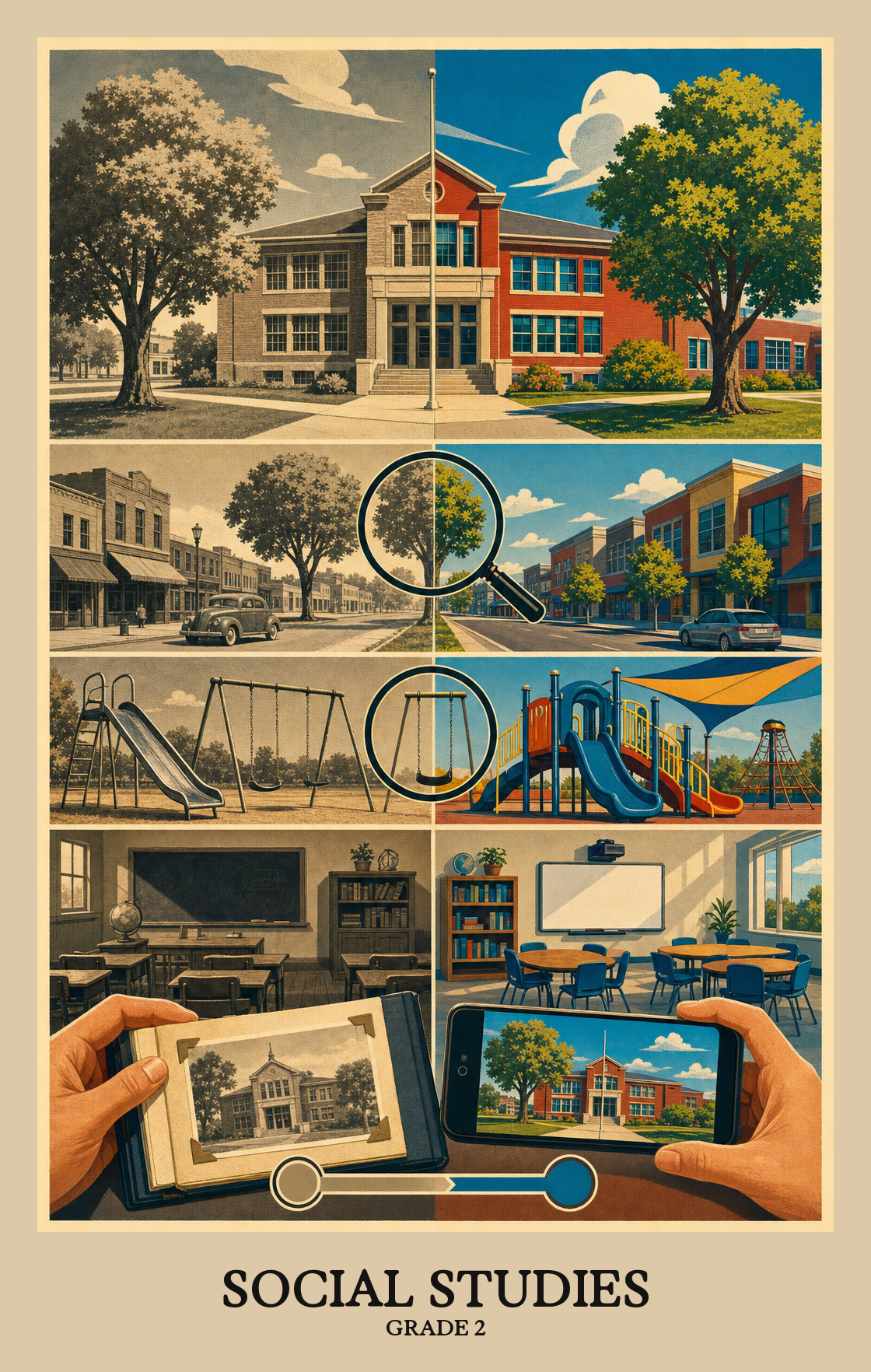
Students start the year noticing how daily life has changed and what has stayed the same. They compare old photos, tools, and routines with the ones they know today.
Students dig into the reasons behind changes in a family, school, or neighborhood. They look at the time and place around an event to explain what was going on.
Students link an old story or pattern to something happening now in their school or community. They see that issues today often have roots in the past.
Students take a stand on a question about change and back it up. They use pictures, stories, and facts they have gathered to explain what they think and why.
Societies change over time, but some things stay the same. Students look at how communities are different today than they were in the past, and what has stayed the same across generations.
Students look at how life in their community has stayed the same and how it has changed over the years, comparing things like schools, homes, and transportation from the past to today.
Students look at how a community, custom, or place has stayed the same over time and how it has changed. They use what they notice to explain why those changes happened.
Students look at how something in their community (like a school, a neighborhood, or a local tradition) has stayed the same or shifted over time, then connect that history to something happening today.
Students pick something that has changed over time (a neighborhood, a school, a job) and write a claim about why it changed, then back it up with facts or examples.
| Standard | Definition | Code |
|---|---|---|
| Societies experience continuity and change over time | Societies change over time, but some things stay the same. Students look at how communities are different today than they were in the past, and what has stayed the same across generations. | 2.4 |
| The student will recognize and evaluate continuity and change over time | Students look at how life in their community has stayed the same and how it has changed over the years, comparing things like schools, homes, and transportation from the past to today. | 2.4.1 |
| The student will analyze the context and draw conclusions about continuity and… | Students look at how a community, custom, or place has stayed the same over time and how it has changed. They use what they notice to explain why those changes happened. | 2.4.2 |
| The student will investigate and connect continuity and change to a… | Students look at how something in their community (like a school, a neighborhood, or a local tradition) has stayed the same or shifted over time, then connect that history to something happening today. | 2.4.3 |
| The student will use their understanding of continuity and change to make a… | Students pick something that has changed over time (a neighborhood, a school, a job) and write a claim about why it changed, then back it up with facts or examples. | 2.4.4 |
Federally administered sample-based assessment in reading, mathematics, science, writing, and other subjects. NAEP results inform state-by-state comparisons rather than individual student or school accountability.
Students look at how life stays the same and how it changes over time. They compare things like schools, homes, jobs, and toys from long ago with how those things look today. The goal is to notice what changed, what stayed, and ask why.
Pull out an old family photo and ask what looks different from today and what looks the same. Talking about grandparents' childhoods, old neighborhoods, or how a favorite holiday has changed gives students real practice with the year's big idea.
Students should be able to point to something that changed over time, explain why it changed, and back up their thinking with an example. They should also connect that change to something happening in their own community today.
Start with personal and family change in the fall, since students already have memories to draw on. Move to school and neighborhood change midyear, then push toward broader community change in the spring when students are ready to support a claim with evidence.
The jump from noticing change to explaining why it happened tends to stall students. Plan extra time for cause and effect conversations, and model how to use a picture, a story, or an interview as evidence before asking students to do it on their own.
Make it personal. Ask older relatives to share one story about school or play when they were young, then ask the student what surprised them. A two-minute story from a real person sticks better than any worksheet.
Not really. The focus is on noticing change and explaining it, not on memorizing names and years. Asking good questions and giving an example to back up an answer matters more than reciting facts.
Ready students can describe one clear example of something that changed in their community, give a reason it changed, and connect it to an issue people are talking about now. They should also be able to share that thinking in a few sentences or a short drawing with labels.