Light and how we see
Students explore why a dark room hides objects until a light turns on. They test what happens when light hits different materials and build a simple model showing how light bounces off things and into our eyes.
This is the year science shifts from watching to testing. Students plan small experiments, like seeing how light passes through different materials or how sunlight and water change a plant's growth. They build simple models to explain what they observe, from how eyes see objects to how animals survive in their habitats. By spring, students can run a basic experiment, record what they find, and use that evidence to back up an idea.
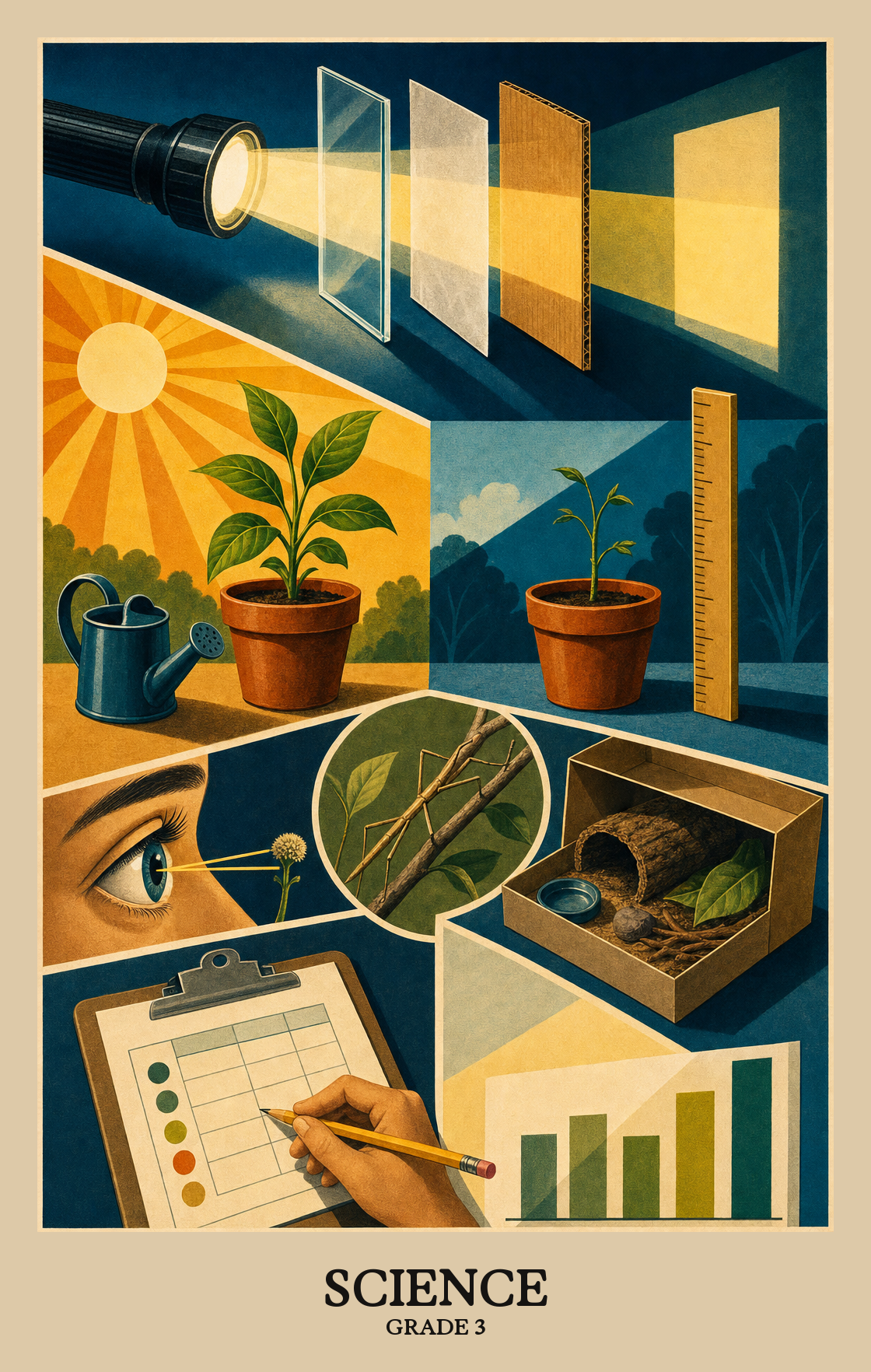
Students explore why a dark room hides objects until a light turns on. They test what happens when light hits different materials and build a simple model showing how light bounces off things and into our eyes.
Students track the sun, moon, and stars over time and notice what comes back around. They chart how daylight gets longer or shorter through the year and learn how Minnesota American Indian Tribes and other cultures use star patterns to plan.
Students set up a real experiment with plants, changing how much sun or water each one gets. They record what happens and use the results to explain what plants need to grow.
Students compare how different animals and plants are born, grow, have young, and die. They look at how small differences between individuals, like a faster runner or a brighter color, can help one survive when another does not.
Students build arguments about the strategies animals use to find food, stay safe, and raise young. They pull information from books, videos, and websites to show how body parts and behaviors help living things survive.
Students notice something puzzling about the physical world and turn it into a question worth investigating. That question becomes the starting point for a science experiment or problem to solve.
Students ask questions about things they notice, experiments they run, and ideas classmates share. Curiosity is the work here, not just finding answers.
Students look at objects in a dark room and ask questions about why those objects can only be seen once a light source shines on them.
Students plan and run simple tests to answer a science question, then record what they observe. The focus is on setting up the test carefully so the results actually mean something.
Students design a test to answer a science question, then collect and record results. The data they gather becomes the evidence behind any claim they make about what they observed.
Students plan and run a test to find out what happens when a beam of light hits different materials. They learn whether each material blocks the light, lets it pass through, or bends it.
Students build and use simple models to show how something in the physical world works. A model might be a drawing, a diagram, or a physical object that helps explain an idea they can't easily observe directly.
Students build diagrams or drawings to show how something works, then update them as they learn more. The model helps students explain their thinking and share ideas with others.
Students build a simple diagram showing how light bounces off an object and travels to the eye. The model explains why we can only see things when light reaches them.
| Standard | Definition | Code |
|---|---|---|
| Asking questions and defining problems | Students notice something puzzling about the physical world and turn it into a question worth investigating. That question becomes the starting point for a science experiment or problem to solve. | 3P.1.1 |
| Students will be able to ask questions about aspects of the phenomena they… | Students ask questions about things they notice, experiments they run, and ideas classmates share. Curiosity is the work here, not just finding answers. | 3P.1.1.1 |
| Ask questions based on observations about why objects in darkness can be seen… | Students look at objects in a dark room and ask questions about why those objects can only be seen once a light source shines on them. | 3P.1.1.1.1 |
| Planning and carrying out investigations | Students plan and run simple tests to answer a science question, then record what they observe. The focus is on setting up the test carefully so the results actually mean something. | 3P.1.2 |
| Students will be able to design and conduct investigations in the classroom… | Students design a test to answer a science question, then collect and record results. The data they gather becomes the evidence behind any claim they make about what they observed. | 3P.1.2.1 |
| Plan and conduct a controlled investigation to determine the effect of placing… | Students plan and run a test to find out what happens when a beam of light hits different materials. They learn whether each material blocks the light, lets it pass through, or bends it. | 3P.1.2.1.1 |
| Developing and using models | Students build and use simple models to show how something in the physical world works. A model might be a drawing, a diagram, or a physical object that helps explain an idea they can't easily observe directly. | 3P.3.1 |
| Students will be able to develop, revise | Students build diagrams or drawings to show how something works, then update them as they learn more. The model helps students explain their thinking and share ideas with others. | 3P.3.1.1 |
| Develop a model to describe that light reflecting from objects and entering the… | Students build a simple diagram showing how light bounces off an object and travels to the eye. The model explains why we can only see things when light reaches them. | 3P.3.1.1.1 |
Students plan a simple experiment to answer a science question, then carry it out and record what they observe. The focus is on thinking through the steps before starting, not just following instructions.
Students design a test to answer a science question, then collect and record data to back up their answer. The investigation can happen at a desk, in a lab, or outside.
Students plan and run a test to see how more or less sunlight or water changes how a plant grows. They track what happens when conditions change.
Students build or draw models to show how something in nature works, like how a plant gets water or how an animal's body parts help it survive.
Students build diagrams or drawings to show how something in nature works, then update those models as they learn more and use them to explain their thinking to others.
Students draw or build more than one model showing how different animals and plants move through life. Each organism follows its own path, but every life cycle includes being born, growing, reproducing, and dying.
Students look at a problem in nature and explain why it happens, then think through what a solution might look like. The focus is on building a clear reason before jumping to an answer.
Students use facts and observations to explain why something happened in nature, then check whether their explanation (or someone else's) actually holds up against the evidence.
Some animals in a species look or behave slightly differently from others. Students explain, using evidence, how those differences can help certain individuals survive longer or reproduce more successfully.
Students use facts from what they observed or read to back up a claim about living things. They explain why the evidence supports their thinking, not just what they believe.
Students back up their science ideas with evidence, listen to other students' reasoning, and change their thinking when new facts point a different way.
Students pick one animal survival strategy (like camouflage or migration) and build a short argument explaining why it helps the animal live. They support their claim with facts from what they read or observed.
Students read books, diagrams, and articles about living things, then explain what they learned in their own words, in writing or conversation.
Reading about living things, students compare sources to decide which information is trustworthy. They practice sharing what they find through writing, drawing, or talking.
Students find facts from books, videos, or websites to back up the idea that plants and animals have body parts, inside and out, that help them survive, grow, and have offspring.
| Standard | Definition | Code |
|---|---|---|
| Planning and carrying out investigations | Students plan a simple experiment to answer a science question, then carry it out and record what they observe. The focus is on thinking through the steps before starting, not just following instructions. | 3L.1.2 |
| Students will be able to design and conduct investigations in the classroom… | Students design a test to answer a science question, then collect and record data to back up their answer. The investigation can happen at a desk, in a lab, or outside. | 3L.1.2.1 |
| Plan and conduct an investigation to determine how amounts of sunlight and… | Students plan and run a test to see how more or less sunlight or water changes how a plant grows. They track what happens when conditions change. | 3L.1.2.1.2 |
| Developing and using models | Students build or draw models to show how something in nature works, like how a plant gets water or how an animal's body parts help it survive. | 3L.3.1 |
| Students will be able to develop, revise | Students build diagrams or drawings to show how something in nature works, then update those models as they learn more and use them to explain their thinking to others. | 3L.3.1.1 |
| Develop multiple models to describe how organisms have unique and diverse life… | Students draw or build more than one model showing how different animals and plants move through life. Each organism follows its own path, but every life cycle includes being born, growing, reproducing, and dying. | 3L.3.1.1.2 |
| Constructing explanations and designing solutions | Students look at a problem in nature and explain why it happens, then think through what a solution might look like. The focus is on building a clear reason before jumping to an answer. | 3L.3.2 |
| Students will be able to apply scientific principles and empirical evidence | Students use facts and observations to explain why something happened in nature, then check whether their explanation (or someone else's) actually holds up against the evidence. | 3L.3.2.1 |
| Construct an explanation using evidence from various sources for how the… | Some animals in a species look or behave slightly differently from others. Students explain, using evidence, how those differences can help certain individuals survive longer or reproduce more successfully. | 3L.3.2.1.1 |
| Engaging in argument from evidence | Students use facts from what they observed or read to back up a claim about living things. They explain why the evidence supports their thinking, not just what they believe. | 3L.4.1 |
| Students will be able to engage in argument from evidence for the explanations… | Students back up their science ideas with evidence, listen to other students' reasoning, and change their thinking when new facts point a different way. | 3L.4.1.1 |
| Construct an argument about strategies animals use to survive | Students pick one animal survival strategy (like camouflage or migration) and build a short argument explaining why it helps the animal live. They support their claim with facts from what they read or observed. | 3L.4.1.1.1 |
| Obtaining, evaluating and communicating information | Students read books, diagrams, and articles about living things, then explain what they learned in their own words, in writing or conversation. | 3L.4.2 |
| Students will be able to read and interpret multiple sources to obtain… | Reading about living things, students compare sources to decide which information is trustworthy. They practice sharing what they find through writing, drawing, or talking. | 3L.4.2.1 |
| Obtain information from various types of media to support an argument that… | Students find facts from books, videos, or websites to back up the idea that plants and animals have body parts, inside and out, that help them survive, grow, and have offspring. | 3L.4.2.1.1 |
Students read charts and simple graphs to find patterns in weather, rocks, or other earth science data. They use what they see to answer a question or explain a trend.
Students collect observations about the natural world and organize them into charts or graphs. Then they look for patterns in those results and think about what might be causing them.
Students watch the sky over time and write down what they notice about the sun, moon, and stars. Then they use those notes to spot patterns, like when the moon changes shape or how shadows shift through the day.
Students use numbers and simple calculations to describe patterns in weather, seasons, or other Earth science data. They might count rainy days in a month or compare temperatures across seasons to find trends.
Students use numbers and simple equations to describe things like temperature, rainfall, or distance. Then they check whether the math actually matches what they see in the real world.
Students track how daylight hours change across the seasons, then organize that data into a chart or graph to spot the pattern of longer days in summer and shorter days in winter.
Students read books, articles, and charts about Earth and space, then share what they learned by talking, drawing, or writing. The goal is finding reliable information and explaining it clearly to others.
Students research how different cultures, including Minnesota American Indian tribes, explain natural events and solve real-world problems. They compare these approaches and share what they find.
Students learn how Native communities and other cultures have used patterns in the night sky to plan for seasons, travel, and daily life. They gather that information and explain it in their own words.
| Standard | Definition | Code |
|---|---|---|
| Analyzing and interpreting data | Students read charts and simple graphs to find patterns in weather, rocks, or other earth science data. They use what they see to answer a question or explain a trend. | 3E.2.1 |
| Students will be able to represent observations and data in order to recognize… | Students collect observations about the natural world and organize them into charts or graphs. Then they look for patterns in those results and think about what might be causing them. | 3E.2.1.1 |
| Record observations of the sun, moon | Students watch the sky over time and write down what they notice about the sun, moon, and stars. Then they use those notes to spot patterns, like when the moon changes shape or how shadows shift through the day. | 3E.2.1.1.1 |
| Using mathematics and computational thinking | Students use numbers and simple calculations to describe patterns in weather, seasons, or other Earth science data. They might count rainy days in a month or compare temperatures across seasons to find trends. | 3E.2.2 |
| Students will be able to use mathematics to represent physical variables and… | Students use numbers and simple equations to describe things like temperature, rainfall, or distance. Then they check whether the math actually matches what they see in the real world. | 3E.2.2.1 |
| Organize and electronically present collected data to identify and describe… | Students track how daylight hours change across the seasons, then organize that data into a chart or graph to spot the pattern of longer days in summer and shorter days in winter. | 3E.2.2.1.1 |
| Obtaining, evaluating and communicating information | Students read books, articles, and charts about Earth and space, then share what they learned by talking, drawing, or writing. The goal is finding reliable information and explaining it clearly to others. | 3E.4.2 |
| Students will be able to gather information about and communicate the methods… | Students research how different cultures, including Minnesota American Indian tribes, explain natural events and solve real-world problems. They compare these approaches and share what they find. | 3E.4.2.2 |
| Gather information and communicate how Minnesota American Indian Tribes and… | Students learn how Native communities and other cultures have used patterns in the night sky to plan for seasons, travel, and daily life. They gather that information and explain it in their own words. | 3E.4.2.2.1 |
Alternate standards-based assessment for eligible students with the most significant cognitive disabilities, administered in the same subjects and grades as the MCA program.
Students study three big areas: light and how we see things, plants and animals and how they survive, and patterns in the sun, moon, and stars. They learn by asking questions, running small experiments, and explaining what they find using evidence.
Go outside and notice things together. Watch the moon over a few weeks, plant a few seeds in different windows, or shine a flashlight on different objects in a dark room. Ask students what they notice and what they think will happen next.
Students should plan a simple fair test, draw a model that explains an idea, and use evidence to back up a claim. They should also be able to describe predictable patterns in nature, like the phases of the moon or how a plant grows.
Not at this level. Most of the year is about doing science, not memorizing it. Students ask questions, run small investigations, and build explanations from what they see. Knowing facts helps, but using them is the point.
Many teachers start with light in the fall, move into life science in winter when classroom plant and animal observations are easiest to track, and finish with sun, moon, and star patterns in spring. The order is flexible, but each unit needs several weeks for students to investigate, not just read.
Designing a fair test trips students up most often. They want to change several things at once instead of one. Building an argument from evidence is the other sticky spot, since students tend to share opinions before checking what their data actually shows.
Students pick one thing to change, like the amount of water a plant gets, keep everything else the same, and record what happens over time. The write-up should include a question, a prediction, observations, and a short explanation tied to the data.
Step outside a few nights a week and sketch the moon's shape. Over a month, students will see the pattern repeat. If skies are clear, point out a few bright stars in the same spot each week and talk about why the view changes with the seasons.
Ready students can read a simple data table, spot a pattern, and explain it in a sentence or two. They can also tell the difference between what they observed and what they think it means.