Communities and where we live
Students start the year looking at the places around them. They use maps and pictures to describe their neighborhood, city, and state, and notice what makes each place feel different.
This is the year students start looking at how communities work and how they got that way. Students learn how local, state, federal, and Tribal Nations governments make rules, how people use maps to understand places, and how families and communities make choices about money. They also ask questions about the past and notice whose stories get told. By spring, students can name a community problem, find evidence about it, and suggest a way people could help fix it.
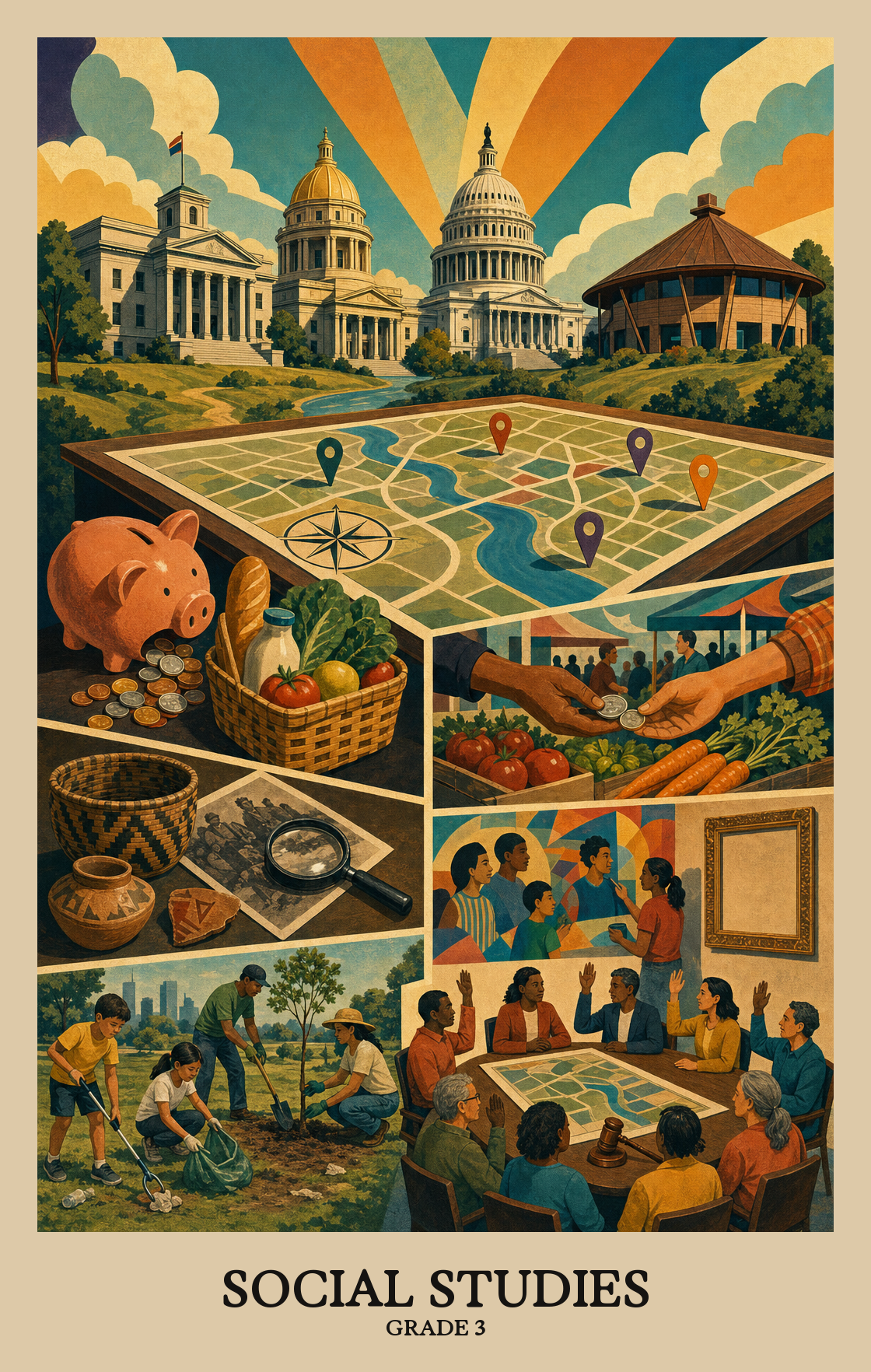
Students start the year looking at the places around them. They use maps and pictures to describe their neighborhood, city, and state, and notice what makes each place feel different.
Students learn how leaders, voters, and everyday people make rules and solve problems together. They look at local government, the role of Tribal Nations in Minnesota, and what rights and responsibilities people share.
Students explore how families and communities decide what to buy, save, and share when they cannot have everything. They look at how goods and services move between people and how prices and choices affect each other.
Students act like history detectives. They ask questions, look at old photos, letters, and objects, and compare different people's accounts of the same event to figure out what happened and whose story is missing.
Students study individuals and groups who pushed for fairness in their communities, both long ago and today. They connect those efforts to a current issue and sketch out a small plan for how people can take action.
Students practice thinking through real community problems, weighing different sides, and deciding what they believe. These habits are the foundation for voting, speaking up, and taking part in public life.
Students learn what rights they have as members of a community and what responsibilities come with them. They practice explaining why both matter in a democracy.
Rules and laws come from different levels of government: local, state, federal, and Tribal Nations. Students learn how each level makes and enforces those rules and practice deciding whether the rules are fair or working well.
Students learn how laws and community rules get made, and who shapes them. They look at how ordinary people, local groups, and government offices all push for change when a problem needs fixing.
Students learn that Tribal Nations are self-governing, with their own laws and leaders, and that the U.S. government has a formal, ongoing relationship with each one. This standard asks students to think about what that means for how Tribal Nations make decisions.
| Standard | Definition | Code |
|---|---|---|
| Civic Skills: Apply civic reasoning and demonstrate civic skills for the… | Students practice thinking through real community problems, weighing different sides, and deciding what they believe. These habits are the foundation for voting, speaking up, and taking part in public life. | 3.1.1.1 |
| Rights and Responsibilities | Students learn what rights they have as members of a community and what responsibilities come with them. They practice explaining why both matter in a democracy. | 3.1.3.1 |
| Governmental Institutions and Political Processes: Explain and evaluate… | Rules and laws come from different levels of government: local, state, federal, and Tribal Nations. Students learn how each level makes and enforces those rules and practice deciding whether the rules are fair or working well. | 3.1.4.1 |
| Public Policy: Analyze how public policy is shaped by governmental and… | Students learn how laws and community rules get made, and who shapes them. They look at how ordinary people, local groups, and government offices all push for change when a problem needs fixing. | 3.1.5.1 |
| Tribal Nations: Evaluate the unique political status, trust relationships and… | Students learn that Tribal Nations are self-governing, with their own laws and leaders, and that the U.S. government has a formal, ongoing relationship with each one. This standard asks students to think about what that means for how Tribal Nations make decisions. | 3.1.6.1 |
Scarcity means there isn't enough of something for everyone who wants it. Students learn how that shortage forces people, businesses, and governments to make trade-offs, and how those choices can make things more or less fair for different groups.
Students practice setting money goals and making a plan to reach them. They also look at real-world conditions, like job availability or family history, that can make saving easier or harder.
Students learn why people, businesses, and governments make economic choices, and what happens as a result. They look at how rewards and costs push those decisions, and whether the outcomes are fair for everyone involved.
| Standard | Definition | Code |
|---|---|---|
| Fundamental Economic Concepts: Analyze how scarcity and artificial shortages… | Scarcity means there isn't enough of something for everyone who wants it. Students learn how that shortage forces people, businesses, and governments to make trade-offs, and how those choices can make things more or less fair for different groups. | 3.2.8.1 |
| Personal Finance: Apply economic concepts and models to develop individual… | Students practice setting money goals and making a plan to reach them. They also look at real-world conditions, like job availability or family history, that can make saving easier or harder. | 3.2.9.1 |
| Microeconomics: Explain and evaluate how resources are used and how goods and… | Students learn why people, businesses, and governments make economic choices, and what happens as a result. They look at how rewards and costs push those decisions, and whether the outcomes are fair for everyone involved. | 3.2.10.1 |
Students use maps, globes, and digital tools to answer location-based questions, like why a city is built near a river or how far apart two places are.
Students learn that borders, rules, and who holds power can shape what a place looks like and how people live there. A government's decisions, for example, can change a neighborhood, a city, or an entire region.
Students look at why people, goods, and ideas move from place to place, and how those movements connect towns, countries, and cultures to each other.
Students look at how the same neighborhood, city, or landmark can feel completely different depending on who grew up there and what traditions they carry. Culture shapes what a place means to the people who live in it.
| Standard | Definition | Code |
|---|---|---|
| Geospatial Skills and Inquiry | Students use maps, globes, and digital tools to answer location-based questions, like why a city is built near a river or how far apart two places are. | 3.3.13.1 |
| Places and Regions: Describe places and regions, explaining how they are… | Students learn that borders, rules, and who holds power can shape what a place looks like and how people live there. A government's decisions, for example, can change a neighborhood, a city, or an entire region. | 3.3.14.1 |
| Human Systems: Analyze patterns of movement and interconnectedness within… | Students look at why people, goods, and ideas move from place to place, and how those movements connect towns, countries, and cultures to each other. | 3.3.15.1 |
| Culture: Investigate how sense of place is impacted by different cultural… | Students look at how the same neighborhood, city, or landmark can feel completely different depending on who grew up there and what traditions they carry. Culture shapes what a place means to the people who live in it. | 3.3.17.1 |
Students learn to ask questions about why things happened in the past and whose stories got told, and whose didn't. They look at how life changed over time and what stayed the same.
Students learn to ask questions about why things happened in history and whose stories got told, and whose didn't. They look at how life changed over time and what stayed the same.
Reading history means understanding that two people can witness the same event and remember it differently. Students learn to spot whose point of view a source reflects and why that person's background shapes what they noticed and what they left out.
Students look at old photos, letters, and written accounts to figure out who created them, why, and whose story might be missing. They practice reading history as a set of choices, not just a list of facts.
Students pull facts from more than one source about a past event, then use those facts to build a written argument or story that explains what happened and why.
Students pull facts from more than one source about a historical event, then use those facts to build a clear argument or tell a focused story about what happened and why.
Students trace a problem happening today back to its historical roots, then build a plan to address it. They practice thinking like historians: finding sources, asking why things happened, and connecting past events to present-day life.
| Standard | Definition | Code |
|---|---|---|
| Context, Change, and Continuity: Ask historical questions about context… | Students learn to ask questions about why things happened in the past and whose stories got told, and whose didn't. They look at how life changed over time and what stayed the same. | 3.4.18.1 |
| Context, Change, and Continuity: Ask historical questions about context… | Students learn to ask questions about why things happened in history and whose stories got told, and whose didn't. They look at how life changed over time and what stayed the same. | 3.4.18.2 |
| Historical Perspectives | Reading history means understanding that two people can witness the same event and remember it differently. Students learn to spot whose point of view a source reflects and why that person's background shapes what they noticed and what they left out. | 3.4.19.1 |
| Historical Sources and Evidence: Investigate a variety of historical sources… | Students look at old photos, letters, and written accounts to figure out who created them, why, and whose story might be missing. They practice reading history as a set of choices, not just a list of facts. | 3.4.20.1 |
| Causation and Argumentation: Integrate evidence from multiple… | Students pull facts from more than one source about a past event, then use those facts to build a written argument or story that explains what happened and why. | 3.4.21.1 |
| Causation and Argumentation: Integrate evidence from multiple… | Students pull facts from more than one source about a historical event, then use those facts to build a clear argument or tell a focused story about what happened and why. | 3.4.21.2 |
| Connecting Past and Present | Students trace a problem happening today back to its historical roots, then build a plan to address it. They practice thinking like historians: finding sources, asking why things happened, and connecting past events to present-day life. | 3.4.22.1 |
Students learn how people and communities have stood up against unfair systems to win lasting rights and dignity. They look at real examples of change, then think about how they can work with others to make things fairer today.
| Standard | Definition | Code |
|---|---|---|
| Resistance: Describe how individuals and communities have fought for freedom… | Students learn how people and communities have stood up against unfair systems to win lasting rights and dignity. They look at real examples of change, then think about how they can work with others to make things fairer today. | 3.5.24.1 |
Federally administered sample-based assessment in reading, mathematics, science, writing, and other subjects. NAEP results inform state-by-state comparisons rather than individual student or school accountability.
Students learn how communities, governments, and economies work, starting with their own neighborhood and stretching out to the country and the world. They also study maps, history, and the rights and responsibilities people have as members of a community.
Talk about the news at dinner in plain language. Point out rules at home, at the store, or at a park, and ask who made the rule and why. Looking at a map together before a car trip also counts.
Students learn that Tribal Nations are sovereign governments with their own leaders, laws, and long histories in Minnesota. Reading a book by a Native author or visiting a Tribal Nation's website together is a good way to support this at home.
A common path is to start with self and community, move into government and economics in the fall, then geography and history in the winter, and finish with bigger questions about change and fairness in the spring. Threads like Tribal sovereignty and multiple perspectives belong in every unit, not a single week.
Students look at real things from the past, such as photos, letters, old maps, or objects, and ask who made it and why. At home, family photos, old recipes, or a grandparent's story work well as a first primary source.
Reading maps with a key and scale, telling primary from secondary sources, and explaining cause and effect in history tend to need several passes. Short, repeated practice across units works better than one long lesson.
Students think about why people can't have everything they want and how they decide what to buy, save, or share. A weekly conversation about a small spending or saving choice at home builds the same thinking.
Pick one event or place per unit and pair two short sources from different points of view. Ask students what each person noticed and what each one might have left out. That habit carries the rest of the standard.
By spring, students should read a simple map, explain a rule or law and why it exists, describe a community problem and one way people are working on it, and use a source to back up something they say about the past.