Counting and naming how many
Students count objects out loud, touching one at a time so each thing gets one number. They learn that the last number tells how many are in the group, and they can spot small sets of up to five without counting.
This is the year numbers start to mean something. Students learn to count objects one at a time, see at a glance how many are in a small group, and tell which pile has more. They begin adding and taking away with small numbers, and they name and sort shapes like circles, triangles, and cubes. By spring, students can count out ten objects, break a number like 7 into 5 and 2, and add and subtract within 5 without stopping to think.
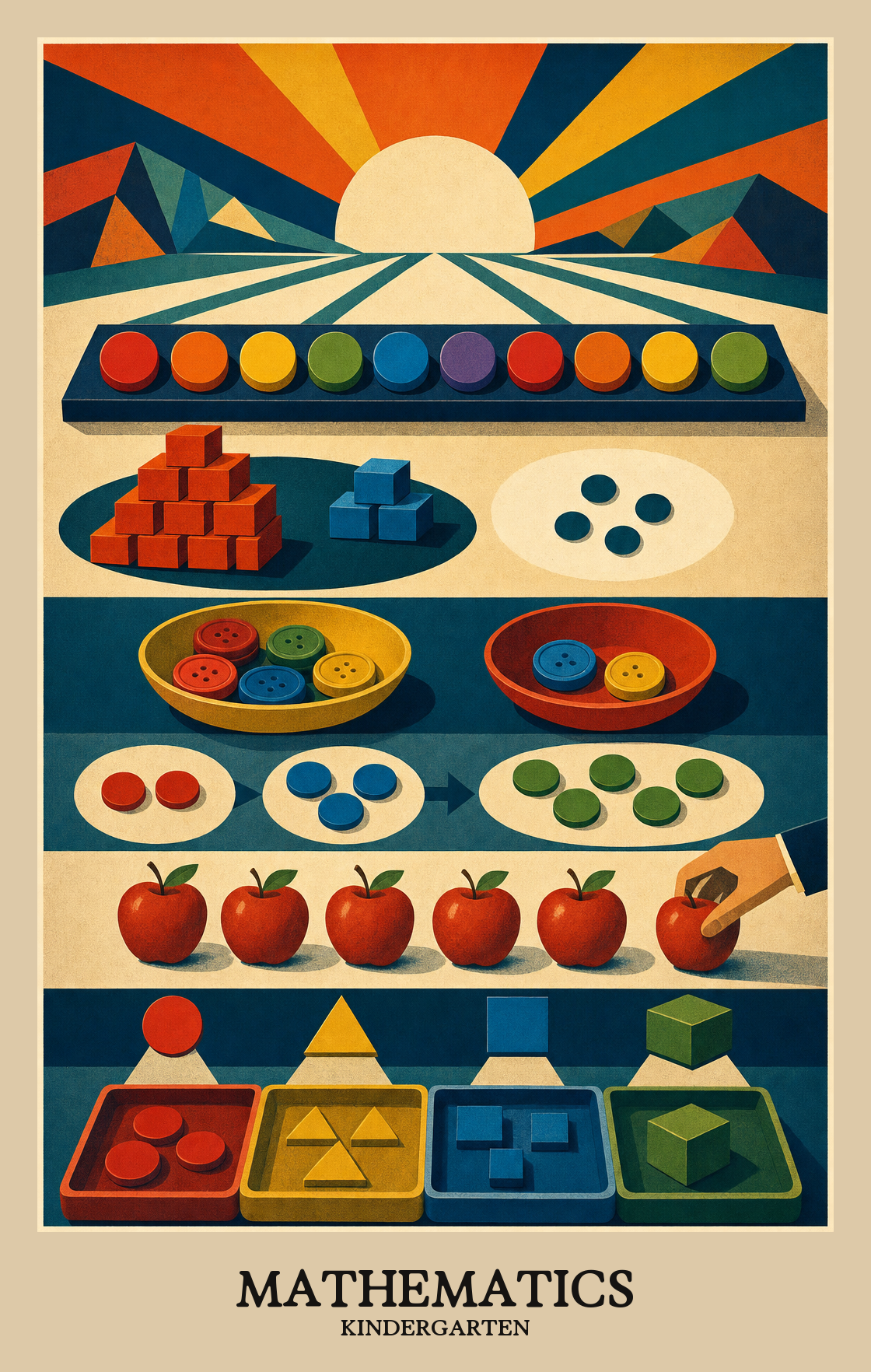
Students count objects out loud, touching one at a time so each thing gets one number. They learn that the last number tells how many are in the group, and they can spot small sets of up to five without counting.
Students line up two groups and figure out which has more, which has less, or whether the groups are equal. Parents may hear words like more than, less than, and the same as at the dinner table.
Students name circles, squares, triangles, rectangles, and hexagons, plus solid shapes like cubes, cones, and spheres. They sort shapes by what they look like and put smaller shapes together to build bigger ones.
Students put groups together and take groups apart using fingers, cubes, and drawings. They get quick and confident with sums and differences up to 5, and practice the pairs of numbers that make 10.
Students look at numbers like 13 or 17 as one group of ten with extra ones. This is the first step toward place value and sets up the work with bigger numbers in first grade.
Students sort objects into groups by color, shape, or size, then count how many are in each group and compare the counts. It looks like simple sorting, but it is the start of reading charts and graphs.
Counting isn't just reciting numbers in order. Students learn that the last number they say when counting a group of objects tells how many are in that group.
Counting means saying one number for each object, in order, without skipping or double-counting. Students point to each item as they count so every object gets exactly one number.
Students look at a small group of dots or objects and know the amount right away, without counting one by one. This works with up to 5 objects arranged in familiar patterns, like the dots on a die.
Counting a group of objects gives that group a number. Students count items in a set and say how many are there in total.
Students look at two numbers or groups of objects and decide which is more, which is less, or whether they match. This is the start of understanding how numbers relate to each other.
Students line up two groups of objects and say which group has more, fewer, or the same amount. This is how they start making sense of bigger and smaller numbers.
| Standard | Definition | Code |
|---|---|---|
| Understand the relationship between numbers and quantities | Counting isn't just reciting numbers in order. Students learn that the last number they say when counting a group of objects tells how many are in that group. | K.NS.B |
| Say the number names when counting objects, in the standard order, pairing each… | Counting means saying one number for each object, in order, without skipping or double-counting. Students point to each item as they count so every object gets exactly one number. | K.NS.B.5 |
| Recognize, without counting, the quantity of groups up to 5 objects arranged in… | Students look at a small group of dots or objects and know the amount right away, without counting one by one. This works with up to 5 objects arranged in familiar patterns, like the dots on a die. | K.NS.B.8 |
| Demonstrate that a number can be used to represent “how many” are in a set | Counting a group of objects gives that group a number. Students count items in a set and say how many are there in total. | K.NS.B.9 |
| Compare numbers | Students look at two numbers or groups of objects and decide which is more, which is less, or whether they match. This is the start of understanding how numbers relate to each other. | K.NS.C |
| Compare two or more sets of objects and identify which set is equal to, more… | Students line up two groups of objects and say which group has more, fewer, or the same amount. This is how they start making sense of bigger and smaller numbers. | K.NS.C.10 |
Numbers 11 through 19 are built from a group of ten plus some leftover ones. Students practice breaking those numbers apart so they understand how place value works before tackling bigger numbers.
Numbers 11 through 19 are made of one group of ten and some leftover ones. Students practice breaking those numbers apart and building them back up, like seeing 14 as ten blocks plus four more.
| Standard | Definition | Code |
|---|---|---|
| Work with numbers 11 – 19 to gain foundations of place value | Numbers 11 through 19 are built from a group of ten plus some leftover ones. Students practice breaking those numbers apart so they understand how place value works before tackling bigger numbers. | K.NBT.A |
| Compose and decompose numbers from 11 to 19 into sets of tens with additional… | Numbers 11 through 19 are made of one group of ten and some leftover ones. Students practice breaking those numbers apart and building them back up, like seeing 14 as ten blocks plus four more. | K.NBT.A.1 |
Addition means putting two groups of things together to find how many there are in all. Subtraction means taking some away and counting what's left.
Adding means putting groups together; subtracting means taking some away. Students use objects, drawings, or fingers to show addition and subtraction problems with numbers up to 10.
Adding and subtracting with numbers up to 5 becomes quick and confident work. Students solve these small problems, like 3 plus 2 or 4 minus 1, without counting on their fingers each time.
Students break a number like 7 into two smaller groups in more than one way, such as 5 and 2, or 4 and 3. They learn that the same number can be split differently each time.
Students practice finding the missing piece that completes a group of 10. If there are 6 apples, how many more make 10? They work this out for every number from 1 to 9.
| Standard | Definition | Code |
|---|---|---|
| Understand addition as putting together or adding to | Addition means putting two groups of things together to find how many there are in all. Subtraction means taking some away and counting what's left. | K.RA.A |
| Represent addition and subtraction within 10 | Adding means putting groups together; subtracting means taking some away. Students use objects, drawings, or fingers to show addition and subtraction problems with numbers up to 10. | K.RA.A.1 |
| Demonstrate fluency for addition and subtraction within 5 | Adding and subtracting with numbers up to 5 becomes quick and confident work. Students solve these small problems, like 3 plus 2 or 4 minus 1, without counting on their fingers each time. | K.RA.A.2 |
| Decompose numbers less than or equal to 10 in more than one way | Students break a number like 7 into two smaller groups in more than one way, such as 5 and 2, or 4 and 3. They learn that the same number can be split differently each time. | K.RA.A.3 |
| Make 10 for any number from 1 to 9 | Students practice finding the missing piece that completes a group of 10. If there are 6 apples, how many more make 10? They work this out for every number from 1 to 9. | K.RA.A.4 |
Students learn to recognize and compare basic shapes, from flat ones like triangles and hexagons to 3-D ones like cones and spheres. They look at what makes each shape different from the others.
Students name shapes like squares, circles, and triangles when they spot them on signs, blocks, or around the classroom. A triangle is still a triangle whether it's tiny or tipped sideways.
Students look at shapes like squares, circles, and triangles, name what they notice (number of sides, corners, round or flat), and use those details to sort a mixed pile into groups.
Students draw basic flat shapes like squares, circles, and triangles by hand or build them with blocks, string, or other simple materials.
Students put small shapes together to build a bigger shape, the way puzzle pieces fit to fill an outline.
| Standard | Definition | Code |
|---|---|---|
| Analyze squares, circles, triangles, rectangles, hexagons, cubes, cones… | Students learn to recognize and compare basic shapes, from flat ones like triangles and hexagons to 3-D ones like cones and spheres. They look at what makes each shape different from the others. | K.GM.C |
| Identify shapes and describe objects in the environment using names of… | Students name shapes like squares, circles, and triangles when they spot them on signs, blocks, or around the classroom. A triangle is still a triangle whether it's tiny or tipped sideways. | K.GM.C.6 |
| Identify and describe the attribute of shapes | Students look at shapes like squares, circles, and triangles, name what they notice (number of sides, corners, round or flat), and use those details to sort a mixed pile into groups. | K.GM.C.8 |
| Draw or model simple two-dimensional shapes | Students draw basic flat shapes like squares, circles, and triangles by hand or build them with blocks, string, or other simple materials. | K.GM.C.9 |
| Compose simple shapes to form larger shapes using manipulatives | Students put small shapes together to build a bigger shape, the way puzzle pieces fit to fill an outline. | K.GM.C.10 |
Students sort everyday objects into groups (by color, shape, or size) and count how many are in each group.
Students sort a group of objects into categories, then use words like "more," "fewer," and "the same" to compare how many are in each group.
| Standard | Definition | Code |
|---|---|---|
| Classify objects and count the number of objects in each category | Students sort everyday objects into groups (by color, shape, or size) and count how many are in each group. | K.DS.A |
| Compare category counts using appropriate language | Students sort a group of objects into categories, then use words like "more," "fewer," and "the same" to compare how many are in each group. | K.DS.A.2 |
Missouri Assessment Program grade-level mathematics assessment for grades 3 through 8.
Alternate assessment for eligible students with significant cognitive disabilities, covering the state-tested grade-level and end-of-course subjects.
Students count objects up to about 20, add and subtract small numbers within 5 without much thinking, and break apart numbers up to 10 in different ways. They also name common shapes and sort small groups of things by how many there are.
Count real things together, like steps on the stairs, crackers on a plate, or socks from the laundry. Touch each item once as the number is said out loud. The goal is one touch, one number, with no skipping or doubling up.
Yes, this is very common at this age. Saying numbers in order and counting actual objects are two different skills. Practice with small piles of 6 to 10 items and gently slow the pointing down so each object gets one number.
Students answer simple problems like 2 plus 3 or 4 minus 1 quickly, without lining up fingers and counting one by one. They start to just know the answer because they have seen the pairs many times. Building this takes daily short practice across the year.
Spend the first months on counting, matching numbers to amounts, and comparing small groups. Move into adding and subtracting within 5, then breaking apart numbers up to 10 and making 10 from any number. Save teen numbers as ten and some extra ones for later in the year, alongside shapes and sorting.
Counting objects accurately past 10, making 10 from a given number, and seeing teen numbers as ten and some more are the common sticking points. Many students also need extra time recognizing small groups instantly without counting one by one.
Point out shapes in the kitchen, on signs, and in buildings. Ask what makes it a triangle or a rectangle, such as the number of sides or corners. Turn a shape sideways or upside down and ask if it is still the same shape.
Writing numbers is part of the year, but neat handwriting is not the main goal. What matters more is that students can show a number using fingers, dots, or objects, and can match the written number to the right amount.
A ready student counts a group of about 20 objects accurately, compares two small groups and says which has more, adds and subtracts within 5 quickly, and can break 10 into pairs like 6 and 4. They also name basic shapes no matter how the shape is turned.