Starting to ask questions
Students learn that social studies starts with curiosity. They ask simple questions about people, places, and how things work, and they get help finding answers.
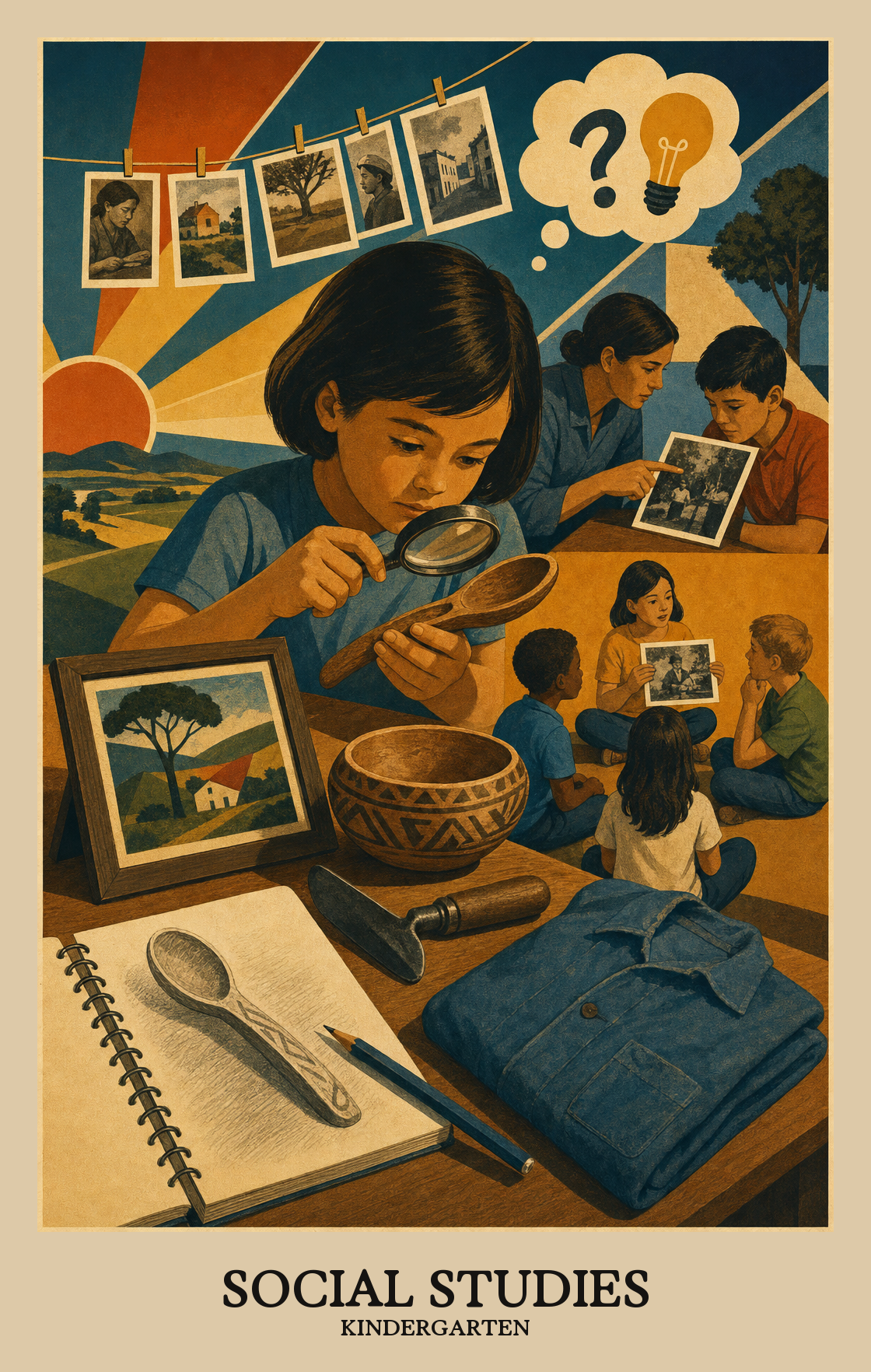
This is the year students start to see themselves as part of a bigger world. With help from an adult, students look at simple sources like photos, tools, clothing, and works of art to learn about people and places. Students ask questions, find answers, and share what they learn through drawings or pictures. By spring, they can study an object or image and tell a small group what it shows about how people live.
Students learn that social studies starts with curiosity. They ask simple questions about people, places, and how things work, and they get help finding answers.
Students explore artifacts like old tools, clothes, pottery, and musical instruments. They notice what these objects show about how people lived and what they made.
Students use pictures, simple maps, and drawings to take in information. They also start using pictures of their own to show an idea to someone else.
Students pull together what they learned and share it with the class. A parent might see a drawing, a show-and-tell object, or a few sentences about a topic students chose.
With a teacher's help, students look at maps, photos, or books about people and places and put a name to what kind of source each one is.
Students use real objects like tools, clothing, or works of art to learn about how people lived and then share what they found out.
| Standard | Definition | Code |
|---|---|---|
| Label and analyze different social studies sources with guidance and support… | With a teacher's help, students look at maps, photos, or books about people and places and put a name to what kind of source each one is. | K.TS.7.A.a |
| Use artifacts (building structures and materials, works of art… | Students use real objects like tools, clothing, or works of art to learn about how people lived and then share what they found out. | K.TS.7.A.b |
Students draw pictures, make simple maps, or create charts to share what they know about a topic. The goal is showing information visually, not just saying it out loud or writing it down.
| Standard | Definition | Code |
|---|---|---|
| Use visual tools to communicate information | Students draw pictures, make simple maps, or create charts to share what they know about a topic. The goal is showing information visually, not just saying it out loud or writing it down. | K.TS.7.B.a |
Students pick a topic, learn about it, and then tell classmates what they found out, in words or pictures.
| Standard | Definition | Code |
|---|---|---|
| Share findings about a topic | Students pick a topic, learn about it, and then tell classmates what they found out, in words or pictures. | K.TS.7.D.a |
Students pick a question they want to answer, then look for the answer in books, photos, or other sources with a teacher's help.
| Standard | Definition | Code |
|---|---|---|
| Ask questions and find answers about a topic, with assistance | Students pick a question they want to answer, then look for the answer in books, photos, or other sources with a teacher's help. | K.TS.7.E.a |
Alternate assessment for eligible students with significant cognitive disabilities, covering the state-tested grade-level and end-of-course subjects.
Students start learning how to ask questions about the world around them and find simple answers. They look at pictures, tools, clothing, and other objects to learn about people and places. Most work happens through talking, drawing, and sharing what they notice.
When students wonder about something, take five minutes to look it up together in a book or online. Ask what they noticed and what they still want to know. The goal is the habit of asking and looking, not a perfect answer.
A source can be a photo, a picture book, a song, a piece of clothing, a toy, or a tool from another time or place. Students look at these objects and talk about what they show. Real items work better than worksheets at this age.
Start with noticing and describing objects in the fall, then move to asking simple questions about them. By winter, students can sort sources and share what they learned through drawings. By spring, they can plan a short investigation with adult support.
Visual tools are drawings, charts, maps, and labeled pictures students make to show what they learned. At this age, a labeled picture or a simple chart counts. Visual tools matter because most students can draw an idea before they can write it.
After a museum visit, library trip, or family story, ask students to draw one thing they learned and tell about it. Listen without correcting too much. Practicing how to share an idea out loud is the main skill this year.
Asking a real question, rather than making a statement, is the hardest part for most students. Sorting sources by what they show, instead of by color or size, also takes practice. Plan short, repeated practice with both skills across units.
By the end of the year, students should be able to look at an object or picture, ask a question about it, and share one thing they learned through a drawing or short talk. They should also know that different objects can teach us about different people.