Looking closely at objects
Students start the year as observers. They sort and describe everyday things by size, shape, color, and weight, and they learn to share what they notice in clear words and simple drawings.
This is the year science becomes noticing on purpose. Students watch the world around them and start describing what they see, from the shape and color of an object to how a push makes a ball roll faster or change direction. They track sunny days and rainy days, notice that some seasons have more daylight, and figure out what plants and animals need to live. By spring, they can sketch a simple solution to a real problem, like a shade to keep a spot cool on a hot day.
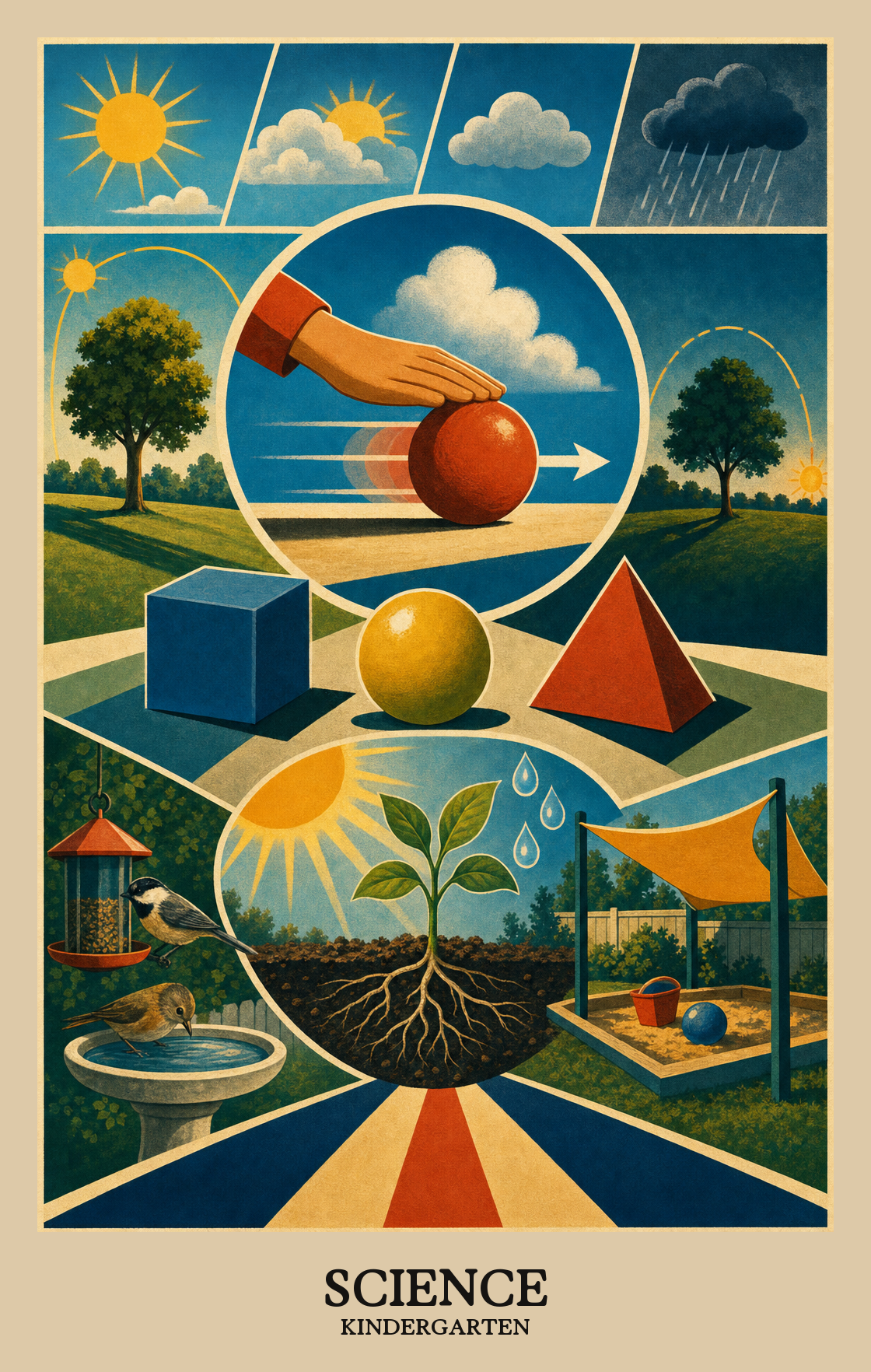
Students start the year as observers. They sort and describe everyday things by size, shape, color, and weight, and they learn to share what they notice in clear words and simple drawings.
Students roll, slide, and nudge objects to see what makes things speed up, slow down, or change direction. They plan small tests and talk about what happened and why.
Students track the weather day by day and feel how the sun warms different surfaces. They notice how daylight shifts with the seasons and design a simple shade to keep an area cooler.
Students watch plants and animals to figure out what each one needs to live, such as water, food, air, and a safe place. They draw models that match animals and plants to where they live.
Students look at how people and animals shape the world around them. They talk about small ways to take better care of the land, water, and air near home and school.
Students wrap up the year as young designers. They spot a problem worth solving, sketch an idea, build it, and test two versions to see which one works better.
Students look closely at everyday objects and notice things like how big they are, what shape they are, what color they are, and whether they feel heavy or light.
| Standard | Definition | Code |
|---|---|---|
| Make qualitative observations of the physical properties of objects | Students look closely at everyday objects and notice things like how big they are, what shape they are, what color they are, and whether they feel heavy or light. | K.PS1.A |
Students push and pull objects to see how hard or which way they push changes how far or fast the object moves.
Students practice pushing and pulling objects to see what makes them speed up, slow down, change direction, or stop. They learn that motion changes when a force is applied.
| Standard | Definition | Code |
|---|---|---|
| Plan and conduct an investigation to compare the effects of different strengths… | Students push and pull objects to see how hard or which way they push changes how far or fast the object moves. | K.PS2.A.a |
| Describe ways to change the motion of an object | Students practice pushing and pulling objects to see what makes them speed up, slow down, change direction, or stop. They learn that motion changes when a force is applied. | K.PS2.A.b |
Students watch what sunlight does to sand, soil, and water. They notice that surfaces in the sun get warmer than surfaces in the shade.
Students build something (like a shade or a roof) to block sunlight and keep a spot cooler. The focus is on testing whether a simple structure actually changes how warm a surface gets.
| Standard | Definition | Code |
|---|---|---|
| Make observations to determine the effect of sunlight on Earth's surface | Students watch what sunlight does to sand, soil, and water. They notice that surfaces in the sun get warmer than surfaces in the shade. | K.PS3.A |
| With prompting and support, use tools and materials to design and build a… | Students build something (like a shade or a roof) to block sunlight and keep a spot cooler. The focus is on testing whether a simple structure actually changes how warm a surface gets. | K.PS3.B |
Plants and animals need food, water, and light or air to stay alive. Students observe real living things and look for patterns in what those living things need.
| Standard | Definition | Code |
|---|---|---|
| Use observations to describe patterns of what plants and animals | Plants and animals need food, water, and light or air to stay alive. Students observe real living things and look for patterns in what those living things need. | K.LS1.C |
Students watch how daylight changes across the year, noticing that some seasons bring long bright days and others bring short ones that turn dark early.
| Standard | Definition | Code |
|---|---|---|
| Make observations during different seasons to relate the amount of daylight to… | Students watch how daylight changes across the year, noticing that some seasons bring long bright days and others bring short ones that turn dark early. | K.ESS1.B |
Students watch the weather outside each day and look for patterns, like noticing that mornings are often cold or that it rains more in certain months.
Plants and animals change the land around them. Students learn how living things shape the soil, rocks, and ground beneath their feet.
Plants and animals change their environment to get what they need. Students look at real examples, like a bird building a nest or a person clearing land, and explain why that change happened.
| Standard | Definition | Code |
|---|---|---|
| Use and share observations of local weather conditions to describe patterns… | Students watch the weather outside each day and look for patterns, like noticing that mornings are often cold or that it rains more in certain months. | K.ESS2.D |
| Biogeology | Plants and animals change the land around them. Students learn how living things shape the soil, rocks, and ground beneath their feet. | ESS2.E |
| With prompting and support, construct an argument using evidence for how plants… | Plants and animals change their environment to get what they need. Students look at real examples, like a bird building a nest or a person clearing land, and explain why that change happened. | K.ESS2.E |
Plants and animals need specific things to survive, like food, water, and shelter. Students use pictures or simple models to show why different living things are found in certain places.
Students come up with simple ideas for protecting the land, water, or air near where they live, like picking up litter or using less water.
| Standard | Definition | Code |
|---|---|---|
| Use a model to represent the relationship between the needs of different plants… | Plants and animals need specific things to survive, like food, water, and shelter. Students use pictures or simple models to show why different living things are found in certain places. | K.ESS3.A |
| Communicate solutions that will reduce the impact of humans on the land, water… | Students come up with simple ideas for protecting the land, water, or air near where they live, like picking up litter or using less water. | K.ESS3.B |
Students look at something that isn't working well, ask questions about it, and figure out what a new or better tool could fix. It's the first step in solving a real problem.
Students draw or build a simple model to show how the shape of something helps it do its job. A wide, flat base keeps a tower from falling over. A pointed tip helps something push through.
Students test two different solutions to the same problem and compare how well each one works, noting what each does well and where it falls short.
| Standard | Definition | Code |
|---|---|---|
| Ask questions, make observations | Students look at something that isn't working well, ask questions about it, and figure out what a new or better tool could fix. It's the first step in solving a real problem. | K.ETS1.A |
| Develop a simple sketch, drawing | Students draw or build a simple model to show how the shape of something helps it do its job. A wide, flat base keeps a tower from falling over. A pointed tip helps something push through. | K.ETS1.B |
| Analyze data from tests of two objects designed to solve the same problem to… | Students test two different solutions to the same problem and compare how well each one works, noting what each does well and where it falls short. | K.ETS1.C |
Alternate assessment for eligible students with significant cognitive disabilities, covering the state-tested grade-level and end-of-course subjects.
Most of the year is about noticing the world and asking questions. Students sort objects by size, shape, and color, watch the weather, push and pull toys to see what moves, and figure out what plants and animals need to live.
Go outside and talk about what is happening. Watch the clouds, feel the sun on a sidewalk versus the grass, push a ball hard then soft, water a plant and check it each day. Five minutes of noticing out loud counts as science at this age.
Not really. Plain words are fine. Saying a rock is heavy, smooth, and gray matters more than knowing the word property. The science words come later once students have something real to attach them to.
Weather and seasons run all year as a daily routine. Slot in pushes and pulls in the fall, sunlight and shade in the spring when the sun is stronger, and plant and animal needs whenever a class pet or garden gives a natural hook.
Very little. Most thinking shows up in drawings, sorting, and talking. A labeled picture of a plant or a quick sketch of a shade structure is plenty of evidence at this age.
That is the point. Pushing cars down a ramp, building a fort to block the sun, or watching a bug on the sidewalk is real science work in kindergarten. The thinking happens while the hands are busy.
Recording observations over time is the hardest part. Students can notice the weather today but forget to compare it to yesterday. A simple weather chart on the wall, filled in every morning, fixes most of this by midyear.
By spring, students should describe an object using a few properties, predict what will make a toy move faster or stop, name what a plant or animal needs, and point out patterns in weather and daylight across the seasons.