Adding and subtracting to 20
Students start the year getting quick and confident with small addition and subtraction. Parents may notice answers coming faster, without finger counting on every problem.
This is the year numbers grow into the hundreds and students start thinking in groups, not just ones. They add and subtract within 1,000, learn that 247 means two hundreds, four tens, and seven ones, and get quick with their basic facts up to 20. Money, rulers, and graphs show up too, so math starts to look like real life. By spring, students can count out a handful of coins, measure a pencil with a ruler, and tell you which of two three-digit numbers is bigger.
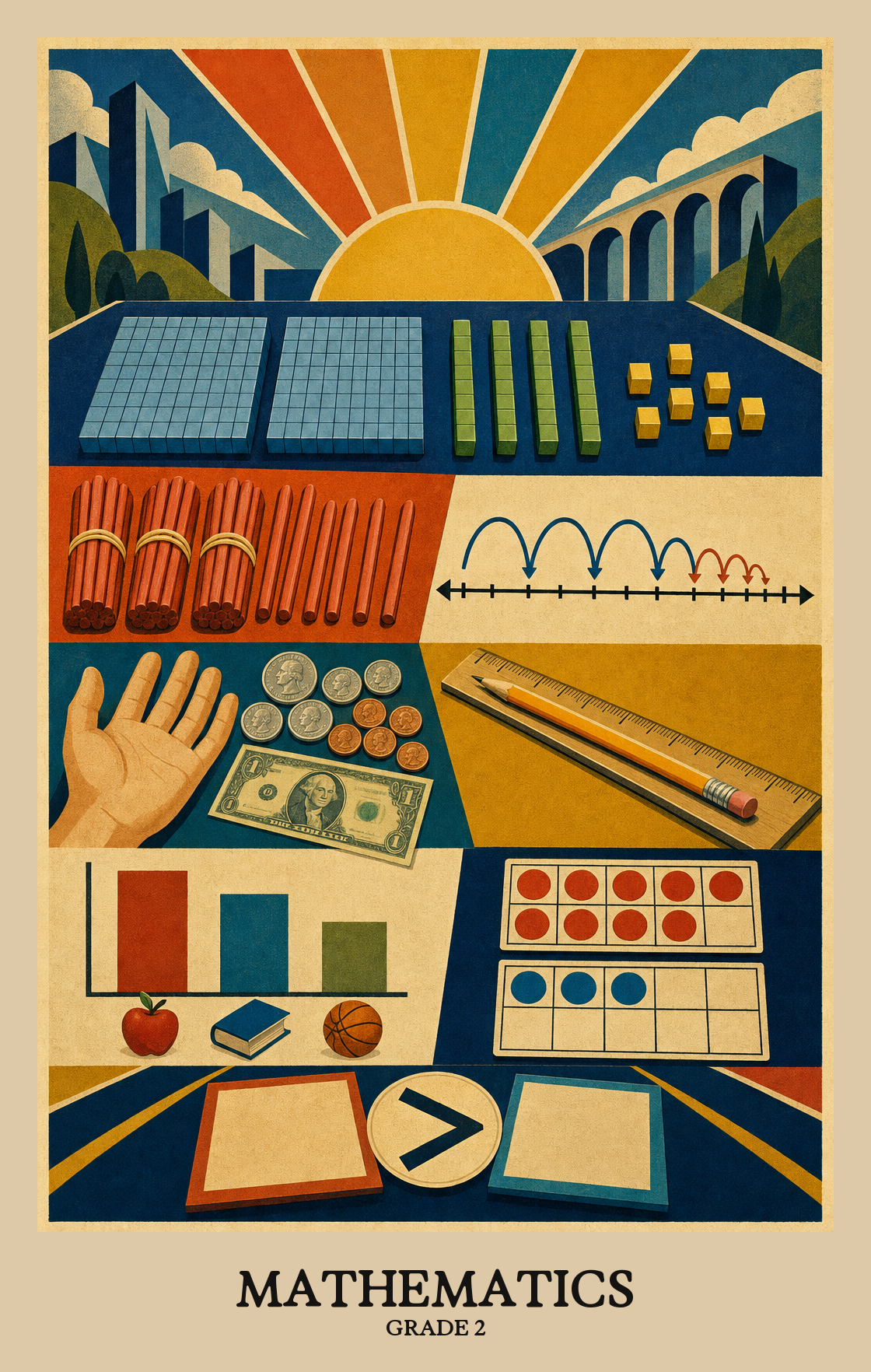
Students start the year getting quick and confident with small addition and subtraction. Parents may notice answers coming faster, without finger counting on every problem.
Students learn that a three-digit number is made of hundreds, tens, and ones. They compare numbers and use the symbols greater than, less than, and equal to.
Students add and subtract numbers up to 1000 and explain how they got the answer. They also use addition to check subtraction and the other way around.
Students measure objects with rulers and compare what happens when they use inches versus centimeters. They also count mixed coins and dollar bills and read amounts written with $ and ¢.
Students share shapes into equal parts and see that equal pieces can look different. They also add equal rows of objects and plot sums and differences on a number line.
Students pull information from picture graphs, bar graphs, and line plots and answer questions about what they see. Parents may hear them say things like how many more or how many in all.
Three-digit numbers have hundreds, tens, and ones. Students learn what each digit in a number like 347 actually stands for, so they can read, write, and compare numbers up to 999.
Reading a three-digit number means knowing what each digit stands for. The first digit counts the hundreds, the middle counts the tens, and the last counts the ones.
Students look at two three-digit numbers and decide which is bigger, smaller, or equal, then write the correct symbol between them. Think of it like deciding which number on a scoreboard is winning.
Adding and subtracting with two- and three-digit numbers, using what students know about hundreds, tens, and ones to make the math make sense.
Students add and subtract numbers up to 1000 and explain how they got the answer. They might use a number line, mental math, or what they know about hundreds, tens, and ones to show their work makes sense.
Students explain why an addition or subtraction answer makes sense by connecting it to the opposite operation. If 23 + 14 = 37, students can check it by subtracting 14 from 37.
| Standard | Definition | Code |
|---|---|---|
| Understand place value of three digit numbers | Three-digit numbers have hundreds, tens, and ones. Students learn what each digit in a number like 347 actually stands for, so they can read, write, and compare numbers up to 999. | 2.NBT.A |
| Understand three-digit numbers are composed of hundreds, tens and ones | Reading a three-digit number means knowing what each digit stands for. The first digit counts the hundreds, the middle counts the tens, and the last counts the ones. | 2.NBT.A.1 |
| Compare two three-digit numbers using the symbols >, = or < | Students look at two three-digit numbers and decide which is bigger, smaller, or equal, then write the correct symbol between them. Think of it like deciding which number on a scoreboard is winning. | 2.NBT.A.5 |
| Use place value understanding and properties of operations to add and subtract | Adding and subtracting with two- and three-digit numbers, using what students know about hundreds, tens, and ones to make the math make sense. | 2.NBT.B |
| Add or subtract within 1000 | Students add and subtract numbers up to 1000 and explain how they got the answer. They might use a number line, mental math, or what they know about hundreds, tens, and ones to show their work makes sense. | 2.NBT.B.8 |
| Use the relationship between addition and subtraction to solve problems | Students explain why an addition or subtraction answer makes sense by connecting it to the opposite operation. If 23 + 14 = 37, students can check it by subtracting 14 from 37. | 2.NBT.B.9 |
Students practice adding and subtracting numbers up to 20, building toward doing it quickly from memory.
Adding and subtracting any two numbers up to 20 from memory, without counting on fingers or drawing dots. Students know facts like 7 + 8 or 15 - 6 quickly and accurately.
Students begin building the ideas behind multiplication and division before learning the formal operations. They practice grouping objects into equal sets and sharing things out evenly among a few people or containers.
Students count objects arranged in rows and columns (like a grid of stamps or dots) and write an addition sentence that shows the total using equal groups.
| Standard | Definition | Code |
|---|---|---|
| Add and subtract within 20 | Students practice adding and subtracting numbers up to 20, building toward doing it quickly from memory. | 2.RA.A |
| Demonstrate fluency with addition and subtraction within 20 | Adding and subtracting any two numbers up to 20 from memory, without counting on fingers or drawing dots. Students know facts like 7 + 8 or 15 - 6 quickly and accurately. | 2.RA.A.1 |
| Develop foundations for multiplication and division | Students begin building the ideas behind multiplication and division before learning the formal operations. They practice grouping objects into equal sets and sharing things out evenly among a few people or containers. | 2.RA.B |
| Find the total number of objects arranged in a rectangular array with up to 5… | Students count objects arranged in rows and columns (like a grid of stamps or dots) and write an addition sentence that shows the total using equal groups. | 2.RA.B.3 |
Students sort and describe shapes by their sides, angles, and other features. They also split shapes into equal parts and connect those parts to early fraction ideas.
Cutting a sandwich into two rectangles or two triangles gives equal halves either way. Students learn that equal shares of the same whole can look different from each other.
Students measure objects using rulers and other standard tools, then make reasonable guesses about lengths they haven't measured yet. The focus is on inches, feet, centimeters, and meters.
Students measure the same object twice, once with a big unit and once with a small unit, then compare the counts. A longer ruler means fewer units fit; a shorter one means more.
Students use addition and subtraction to solve real problems about length, like figuring out how much longer one object is than another or what total length two objects make together.
Students mark whole numbers as points on a number line, then use that same line to add and subtract. They solve problems like 47 + 35 or 80 - 26 by jumping forward or backward along the line.
Students read clocks to the nearest five minutes and count coins and dollar bills to find a total. This standard covers the everyday math of telling time and making change.
Students add up a mix of bills and coins, then write the total using a dollar sign or cent symbol in the right place.
| Standard | Definition | Code |
|---|---|---|
| Reason with shapes and their attributes | Students sort and describe shapes by their sides, angles, and other features. They also split shapes into equal parts and connect those parts to early fraction ideas. | 2.GM.A |
| Demonstrate that equal shares of identical wholes need not have the same shape | Cutting a sandwich into two rectangles or two triangles gives equal halves either way. Students learn that equal shares of the same whole can look different from each other. | 2.GM.A.3a |
| Measure and estimate lengths in standard units | Students measure objects using rulers and other standard tools, then make reasonable guesses about lengths they haven't measured yet. The focus is on inches, feet, centimeters, and meters. | 2.GM.B |
| Analyze the results of measuring the same object with different units | Students measure the same object twice, once with a big unit and once with a small unit, then compare the counts. A longer ruler means fewer units fit; a shorter one means more. | 2.GM.B.5 |
| Relate addition and subtraction to length | Students use addition and subtraction to solve real problems about length, like figuring out how much longer one object is than another or what total length two objects make together. | 2.GM.C |
| Represent whole numbers as lengths on a number line | Students mark whole numbers as points on a number line, then use that same line to add and subtract. They solve problems like 47 + 35 or 80 - 26 by jumping forward or backward along the line. | 2.GM.C.9 |
| Work with time and money | Students read clocks to the nearest five minutes and count coins and dollar bills to find a total. This standard covers the everyday math of telling time and making change. | 2.GM.D |
| Find the value of combinations of dollar bills, quarters, dimes, nickels and… | Students add up a mix of bills and coins, then write the total using a dollar sign or cent symbol in the right place. | 2.GM.D.12 |
Students collect simple information, organize it into picture graphs or bar graphs, and answer questions about what the data shows.
Students read line plots, picture graphs, and bar graphs to answer questions about the data shown. They figure out totals, compare amounts, and solve simple math problems using the charts.
Students look at a finished graph and answer questions about what it shows. They explain which group has more, which has less, and what the data tells them overall.
| Standard | Definition | Code |
|---|---|---|
| Represent and interpret data | Students collect simple information, organize it into picture graphs or bar graphs, and answer questions about what the data shows. | 2.DS.A |
| Solve problems using information presented in line plots, picture graphs and… | Students read line plots, picture graphs, and bar graphs to answer questions about the data shown. They figure out totals, compare amounts, and solve simple math problems using the charts. | 2.DS.A.4 |
| Draw conclusions from line plots, picture graphs and bar graphs | Students look at a finished graph and answer questions about what it shows. They explain which group has more, which has less, and what the data tells them overall. | 2.DS.A.5 |
Missouri Assessment Program grade-level mathematics assessment for grades 3 through 8.
Alternate assessment for eligible students with significant cognitive disabilities, covering the state-tested grade-level and end-of-course subjects.
Students should add and subtract within 20 from memory, work with numbers up to 1000 using hundreds, tens, and ones, and tell time and count coins and bills. They should also measure with a ruler and read simple graphs.
Count out coins to make a dollar, ask quick addition and subtraction facts in the car, or measure household objects with a ruler. Reading the time on an analog clock during the day also builds a habit that pays off.
Students answer facts like 8 plus 7 or 15 minus 6 within a few seconds, without counting on fingers every time. They do not need to be fast under pressure, but the answers should come without a long pause.
Start with building and breaking apart two-digit numbers, then move to hundreds, tens, and ones with base-ten blocks before symbols. Save comparing three-digit numbers and adding or subtracting within 1000 for later in the year, once students can name what each digit means.
Subtraction with regrouping, telling time to the nearest five minutes, and counting mixed coins are the common sticking points. Plan to revisit them in short bursts across the year rather than teaching each one once and moving on.
Finger counting is fine while students are learning, but by the end of the year most facts within 20 should come from memory. Practice a small set of facts each week, mixing the ones they know with one or two new ones, until the answers feel automatic.
Read the problem together and ask what is happening before talking about numbers. Acting it out with coins, blocks, or drawings often unlocks the math faster than asking students to find a keyword.
Arrays of rows and columns are the bridge to multiplication next year. Students count the total and write it as a repeated addition sentence, so 3 rows of 4 becomes 4 plus 4 plus 4.
By spring, students should add and subtract within 100 with confidence, read three-digit numbers, count coins to a dollar or two, and pull information from a simple bar graph or picture graph. If those four are solid, third grade math will land on stable ground.