Sorting and testing materials
Students look closely at everyday stuff like fabric, paper, plastic, and metal. They sort items by what they notice, then test which material works best for a job, like soaking up a spill or holding a heavy book.
This is the year science becomes hands-on testing. Students plan small experiments and write down what they see, like which materials make the best raincoat or how plants grow with and without light. They watch how a push or a pull changes the way something moves, and how vibrations make sound. By spring, they can sort materials by their properties and explain what a plant needs to grow.
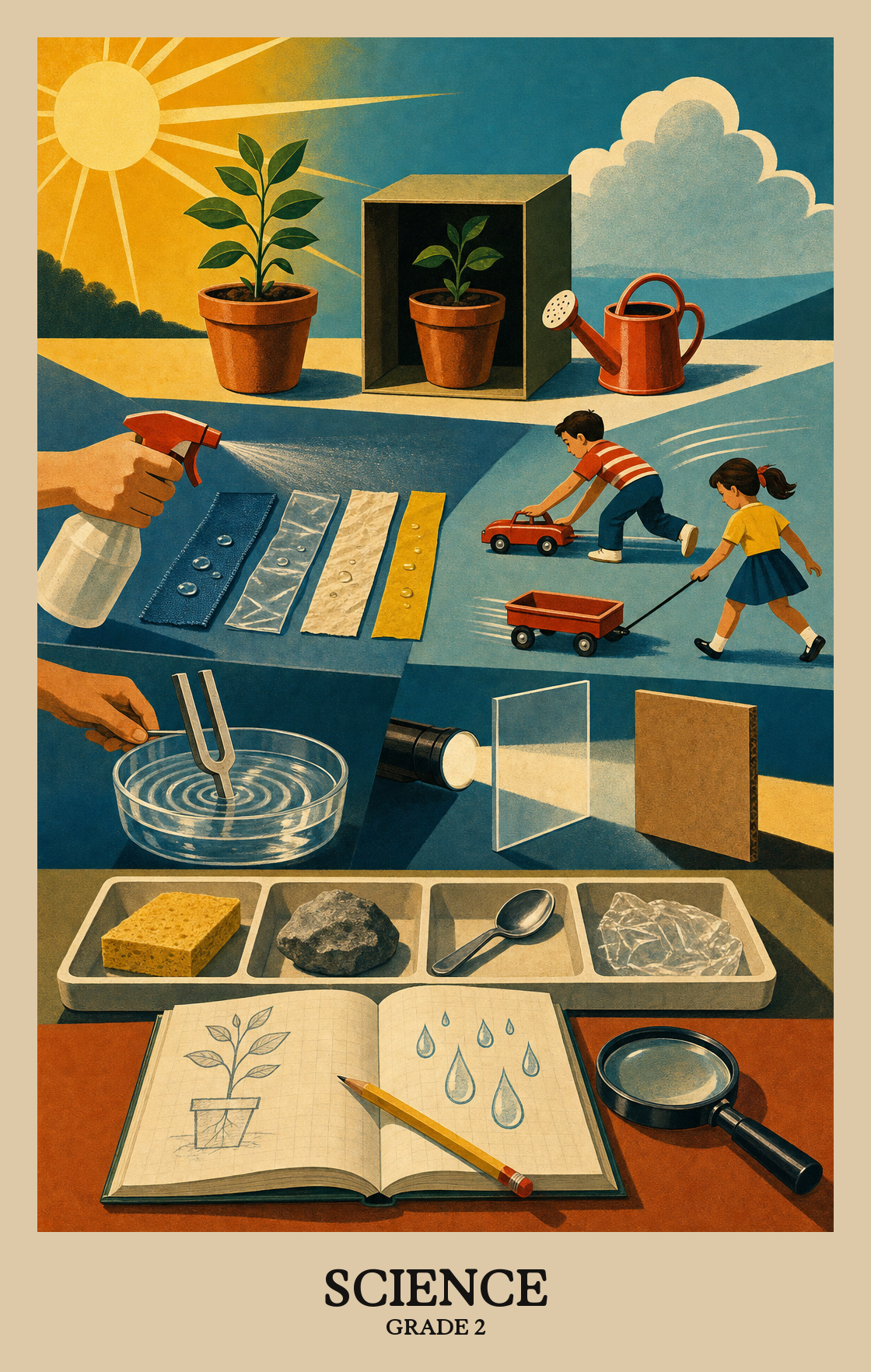
Students look closely at everyday stuff like fabric, paper, plastic, and metal. They sort items by what they notice, then test which material works best for a job, like soaking up a spill or holding a heavy book.
Students watch how a push or pull changes the way a ball or toy car moves, and notice that heavier things are harder to move. They also explore how a guitar string, a drum, or their own voice makes sound by vibrating.
Students grow plants in different conditions to see what they need, like water and light. They also learn how bees, birds, and other animals move seeds and pollen from one place to another.
Students build maps and small models of hills, rivers, lakes, and oceans. They learn where water sits on Earth and that it can be liquid in a pond or solid as ice.
Students see that some changes to the land happen in seconds, like a volcano or landslide, while others take years, like a river slowly wearing down rock. They compare ways to slow wind and water from washing away soil.
Students find a small problem worth solving, sketch an idea, and build a simple version to try out. They test two designs side by side and talk about which one worked better and why.
Students learn what stuff is made of and how it can change. They sort, mix, and observe materials like water, wood, and metal to figure out what makes each one different.
Students learn what makes things move, stop, or change direction. They explore how pushes and pulls affect objects, from a rolling ball to a swinging door.
Students learn how living things in one place depend on each other and on their surroundings to survive. A deer needs plants to eat; plants need sunlight and soil; predators need prey.
| Standard | Definition | Code |
|---|---|---|
| Matter and Its Interactions | Students learn what stuff is made of and how it can change. They sort, mix, and observe materials like water, wood, and metal to figure out what makes each one different. | PS1 |
| Motion and Stability | Students learn what makes things move, stop, or change direction. They explore how pushes and pulls affect objects, from a rolling ball to a swinging door. | PS2 |
| Ecosystems: Interactions, Energy | Students learn how living things in one place depend on each other and on their surroundings to survive. A deer needs plants to eat; plants need sunlight and soil; predators need prey. | LS2 |
Matter is anything that takes up space and has weight. Students learn to describe and sort materials by their properties, like hardness, texture, and whether something bends, absorbs water, or lets light through.
Students sort everyday materials like wood, metal, and fabric by what they can observe: color, texture, hardness, and whether it bends or breaks. They plan a simple test, collect results, and group materials by what they find.
Students test different materials to find the best one for a job, like figuring out which material keeps water out or holds weight. The data from those tests shows which material fits the purpose.
| Standard | Definition | Code |
|---|---|---|
| Structure and Properties of Matter | Matter is anything that takes up space and has weight. Students learn to describe and sort materials by their properties, like hardness, texture, and whether something bends, absorbs water, or lets light through. | PS1.A |
| Plan and conduct an investigation to describe and classify different kinds of… | Students sort everyday materials like wood, metal, and fabric by what they can observe: color, texture, hardness, and whether it bends or breaks. They plan a simple test, collect results, and group materials by what they find. | 2.PS1.A.a |
| Analyze data obtained from testing different materials to determine which… | Students test different materials to find the best one for a job, like figuring out which material keeps water out or holds weight. The data from those tests shows which material fits the purpose. | 2.PS1.A.b |
Students learn how pushes and pulls make objects move faster, slower, or in a different direction. A harder push moves something farther; a gentler push moves it less.
Students push or pull objects and look at what happens: how fast they move, how far they go, and whether heavier objects behave differently than lighter ones.
| Standard | Definition | Code |
|---|---|---|
| Forces and Motion | Students learn how pushes and pulls make objects move faster, slower, or in a different direction. A harder push moves something farther; a gentler push moves it less. | PS2.A |
| Analyze data to determine how the motion of an object changed by an applied… | Students push or pull objects and look at what happens: how fast they move, how far they go, and whether heavier objects behave differently than lighter ones. | 2.PS2.A |
Students test how changing the speed or size of a vibration changes the sound it makes, such as plucking a rubber band harder or softer and listening to what happens.
| Standard | Definition | Code |
|---|---|---|
| Plan and conduct investigations to provide evidence that changes in vibration… | Students test how changing the speed or size of a vibration changes the sound it makes, such as plucking a rubber band harder or softer and listening to what happens. | 2.PS4.A |
Plants and animals in a habitat depend on each other to survive. Students learn how living things are connected, like how bees help flowers grow and how animals rely on plants for food and shelter.
Students grow plants under different conditions, like with or without light, to find out what plants actually need to survive.
Students build or draw a simple model showing how an animal, like a bee visiting flowers or a bird dropping seeds, helps plants reproduce and spread to new places.
| Standard | Definition | Code |
|---|---|---|
| Interdependent Relationships in Ecosystems | Plants and animals in a habitat depend on each other to survive. Students learn how living things are connected, like how bees help flowers grow and how animals rely on plants for food and shelter. | LS2.A |
| Plan and conduct investigations on the growth of plants when growing conditions… | Students grow plants under different conditions, like with or without light, to find out what plants actually need to survive. | 2.LS2.A.a |
| Develop a simple model that mimics the function of an animal in dispersing… | Students build or draw a simple model showing how an animal, like a bee visiting flowers or a bird dropping seeds, helps plants reproduce and spread to new places. | 2.LS2.A.b |
Rocks, fossils, and landforms hold clues about what Earth looked like long ago. Students look at evidence like layered rock and animal remains to piece together how Earth has changed over time.
Students gather facts from books, videos, or photos to show that some Earth events happen in seconds (like an earthquake) and others take thousands of years (like a canyon forming).
| Standard | Definition | Code |
|---|---|---|
| The History of Planet Earth | Rocks, fossils, and landforms hold clues about what Earth looked like long ago. Students look at evidence like layered rock and animal remains to piece together how Earth has changed over time. | ESS1.C |
| Use information from several sources to provide evidence that Earth events can… | Students gather facts from books, videos, or photos to show that some Earth events happen in seconds (like an earthquake) and others take thousands of years (like a canyon forming). | 2.ESS1.C |
Rocks, soil, water, and air make up the world around us. Students learn how these materials work together and how changes in one (like rain soaking into soil) can affect the others.
Students look at different ways people try to protect the land from wind and water, then decide which ones work better. Think seawalls, planted grass, or sandbags holding back erosion.
Students learn how Earth's outer layer is broken into large, slow-moving pieces that shift over millions of years. That movement builds mountains, causes earthquakes, and reshapes continents.
Students draw or build a simple map showing the land and water in an area, such as a hill, river, lake, or coastline. The model helps them describe what the ground and water around them actually look like.
Water shapes the land over time. Students learn how rain, rivers, and oceans wear down rocks, carry soil from place to place, and build up new land where that material settles.
Water covers most of Earth's surface and exists in more than one form. Students identify where water is found, from oceans and rivers to frozen ice, and explain why some water is liquid while other water is solid.
| Standard | Definition | Code |
|---|---|---|
| Earth Materials and Systems | Rocks, soil, water, and air make up the world around us. Students learn how these materials work together and how changes in one (like rain soaking into soil) can affect the others. | ESS2.A |
| Compare multiple solutions designed to slow or prevent wind or water from… | Students look at different ways people try to protect the land from wind and water, then decide which ones work better. Think seawalls, planted grass, or sandbags holding back erosion. | 2.ESS2.A |
| Plate Tectonics and Large-Scale Systems | Students learn how Earth's outer layer is broken into large, slow-moving pieces that shift over millions of years. That movement builds mountains, causes earthquakes, and reshapes continents. | ESS2.B |
| Develop a model to represent the shapes and kinds of land and bodies of water… | Students draw or build a simple map showing the land and water in an area, such as a hill, river, lake, or coastline. The model helps them describe what the ground and water around them actually look like. | 2.ESS2.B |
| The Role of Water in Earth's Surface Processes | Water shapes the land over time. Students learn how rain, rivers, and oceans wear down rocks, carry soil from place to place, and build up new land where that material settles. | ESS2.C |
| Obtain information to identify where water is found on Earth and that it can be… | Water covers most of Earth's surface and exists in more than one form. Students identify where water is found, from oceans and rivers to frozen ice, and explain why some water is liquid while other water is solid. | 2.ESS2.C |
Students look closely at something that isn't working well, ask questions about it, and collect information. Then they describe the problem clearly enough that someone could design a new tool or object to fix it.
Students draw or build a simple model of an object and explain how its shape helps it do its job, like showing why a cup is round or why a ramp is sloped to solve a specific problem.
Students test two different solutions to the same problem, then compare how each one worked and where each one fell short.
| Standard | Definition | Code |
|---|---|---|
| Ask questions, make observations | Students look closely at something that isn't working well, ask questions about it, and collect information. Then they describe the problem clearly enough that someone could design a new tool or object to fix it. | 2.ETS1.A |
| Develop a simple sketch, drawing | Students draw or build a simple model of an object and explain how its shape helps it do its job, like showing why a cup is round or why a ramp is sloped to solve a specific problem. | 2.ETS1.B |
| Analyze data from tests of two objects designed to solve the same problem to… | Students test two different solutions to the same problem, then compare how each one worked and where each one fell short. | 2.ETS1.C |
Alternate assessment for eligible students with significant cognitive disabilities, covering the state-tested grade-level and end-of-course subjects.
Students do hands-on investigations with materials, plants, water, and land. They test which materials work best for a job, watch how plants grow with and without light or water, and build small models of hills, rivers, and lakes. Most of the year is doing and observing, not reading about science.
Ask students to notice and describe things. What is this made of? Is it hard, soft, bendy, or shiny? Why did the puddle dry up? Short questions during walks, baths, or cooking build the same observation skills used in class.
Yes. Pulling things apart and asking how they work is exactly what good second grade scientists do. Save broken toys, old flashlights, or cardboard tubes for tinkering time. Ask what each part is for and what would happen without it.
Students define a small problem, sketch an idea, build it, and test it. For example, they might design a barrier to stop a fan from blowing sand off a tray. At home, building forts, ramps for toy cars, or paper airplanes is the same kind of thinking.
No. Many teachers run science in longer blocks two or three times a week so students have time to set up, test, and clean up. Short daily science often turns into reading about science, which is not the goal at this grade.
A common order is matter and properties in the fall, forces and sound in the winter, then plants, water, and landforms in the spring when outdoor work is easier. Engineering design fits inside each unit rather than as its own block.
Sorting objects by more than one property at a time is harder than it looks, and so is the idea that some Earth changes are fast and some are slow. Plan extra sort-and-explain tasks for materials, and use before-and-after photos for slow changes like erosion.
Plan a simple test, record what they see, and explain what the results mean in their own words. They should also be able to build a small model or sketch to show how something works, like a map of a pond or a seed that sticks to fur.
Not lists of definitions. Words like solid, liquid, vibration, erosion, and pollinate should come up often enough in real activities that students start using them on their own. Talking about what they did in class is the best way to lock the words in.