Asking good questions
Students start the year by wondering about people, places, and the past. With a little help, they turn curiosity into questions a class can actually look into.
This is the year social studies starts to feel like real investigation. Students begin asking their own questions about people and places, then figure out where to look for answers using books, pictures, objects, and trusted adults. They start to notice the difference between a fact and an opinion, and learn that two people can see the same event in different ways. By spring, students can pick a topic they wonder about, gather a few sources, and share what they found.
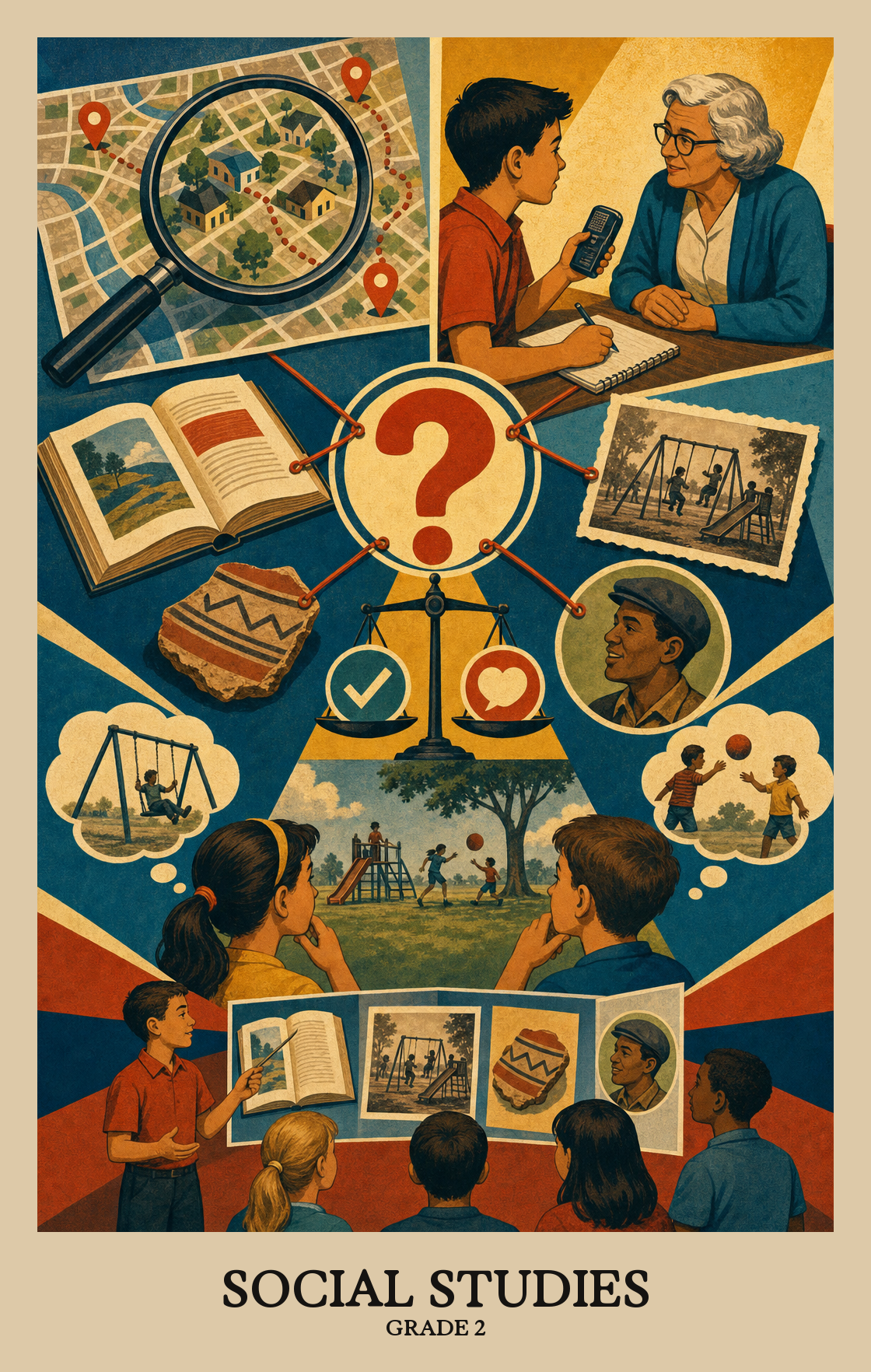
Students start the year by wondering about people, places, and the past. With a little help, they turn curiosity into questions a class can actually look into.
Students learn that some information comes straight from the people who were there, and some comes from books and articles written later. They start picking sources that fit their question.
Students notice the difference between something you can check and something someone believes. They also see that two people can describe the same event in very different ways.
Students put their research together using pictures, maps, charts, and short writing. They present what they found out to classmates and explain how they know.
Students learn the difference between firsthand sources (like a diary or photograph) and secondhand sources (like a textbook). With teacher guidance, they talk through what each source shows and whether it can be trusted.
Students pick real objects or pictures of objects (like an old coin, a photograph, or a tool) to help explain something they learned about history, community, or geography.
| Standard | Definition | Code |
|---|---|---|
| Describe and analyze primary and secondary social studies’ sources in classroom… | Students learn the difference between firsthand sources (like a diary or photograph) and secondhand sources (like a textbook). With teacher guidance, they talk through what each source shows and whether it can be trusted. | 2.TS.7.A.a |
| Select and use artifacts to share information on social studies’ topics | Students pick real objects or pictures of objects (like an old coin, a photograph, or a tool) to help explain something they learned about history, community, or geography. | 2.TS.7.A.b |
Students pick a chart, map, or picture to share what they learned about a topic, then use it to explain their ideas to others.
| Standard | Definition | Code |
|---|---|---|
| Use visual tools and informational texts to communicate information | Students pick a chart, map, or picture to share what they learned about a topic, then use it to explain their ideas to others. | 2.TS.7.B.a |
Students learn to tell a fact (something provable, like where a city is located) from an opinion (something someone believes, like which city is best). They practice spotting the difference in stories, books, and other sources about history and communities.
Point of view is whose side of a story you are hearing. Students learn that two people can look at the same event and describe it differently based on where they stood or what they believed.
| Standard | Definition | Code |
|---|---|---|
| Explain the difference between fact and opinion in social studies’ topics | Students learn to tell a fact (something provable, like where a city is located) from an opinion (something someone believes, like which city is best). They practice spotting the difference in stories, books, and other sources about history and communities. | 2.TS.7.C.a |
| Explain the concept of point of view in social studies’ topics | Point of view is whose side of a story you are hearing. Students learn that two people can look at the same event and describe it differently based on where they stood or what they believed. | 2.TS.7.C.b |
Students pick a social studies topic, dig into books or other sources to learn about it, and then present what they found to others.
| Standard | Definition | Code |
|---|---|---|
| Share research about a social studies’ topic | Students pick a social studies topic, dig into books or other sources to learn about it, and then present what they found to others. | 2.TS.7.D.a |
With help from a teacher, students write follow-up questions that dig deeper into a topic they are already studying, like why an event happened or how a community works.
Students pick a question they want to answer, then explain the steps they would take to find that answer, like where to look and what to read.
Students learn to pick the right source for a question, knowing when a map, a book, or a person with firsthand experience will give them the most useful answer.
| Standard | Definition | Code |
|---|---|---|
| Develop supporting questions about social studies’ topics, with assistance | With help from a teacher, students write follow-up questions that dig deeper into a topic they are already studying, like why an event happened or how a community works. | 2.TS.7.E.a |
| Describe a process to answer those questions | Students pick a question they want to answer, then explain the steps they would take to find that answer, like where to look and what to read. | 2.TS.7.E.b |
| Discuss types of sources that would be helpful in exploring social… | Students learn to pick the right source for a question, knowing when a map, a book, or a person with firsthand experience will give them the most useful answer. | 2.TS.7.E.c |
Alternate assessment for eligible students with significant cognitive disabilities, covering the state-tested grade-level and end-of-course subjects.
Students learn to ask questions about people and the past, find answers in books, photos, and objects, and share what they learned. A lot of the year is about telling the difference between a fact and an opinion, and noticing that two people can see the same event differently.
Look at family photos, old letters, or objects together and ask where they came from and what they show. Ask students to tell you one fact and one opinion about the picture. This is the same thinking they practice in class.
A fact can be checked, like the date on a coin or the name of a president. An opinion is what someone thinks or feels, like saying a holiday is the best one. Students should be able to point at a sentence and say which it is.
A primary source is something from the time it happened, like a photo, a letter, or an old tool. A secondary source is someone writing about it later, like a textbook page. Students do not need the labels memorized, but they should notice the difference when asked.
Start with one supporting question students help write, then walk through where to look: a book, a website, a photo, or an interview with a family member. Keep the final product short, like a poster or a few sentences with a picture. The point is the process, not a polished report.
Point of view is the hardest. Students often think the way they see something is just how it is, so they need many short examples of two people describing the same event differently. Fact versus opinion also needs steady practice all year, not a single unit.
Read it aloud and stop to ask what students notice. Looking at a photo, map, or object counts as a source too, so lean on visuals when the words are heavy. The thinking matters more than the reading level.
By spring, students should be able to ask a question about a social studies topic, name one or two places to find an answer, and share what they found in a sentence or a simple visual. They should also spot a clear opinion in a short passage.