Skip to content

What does a student learn in ?

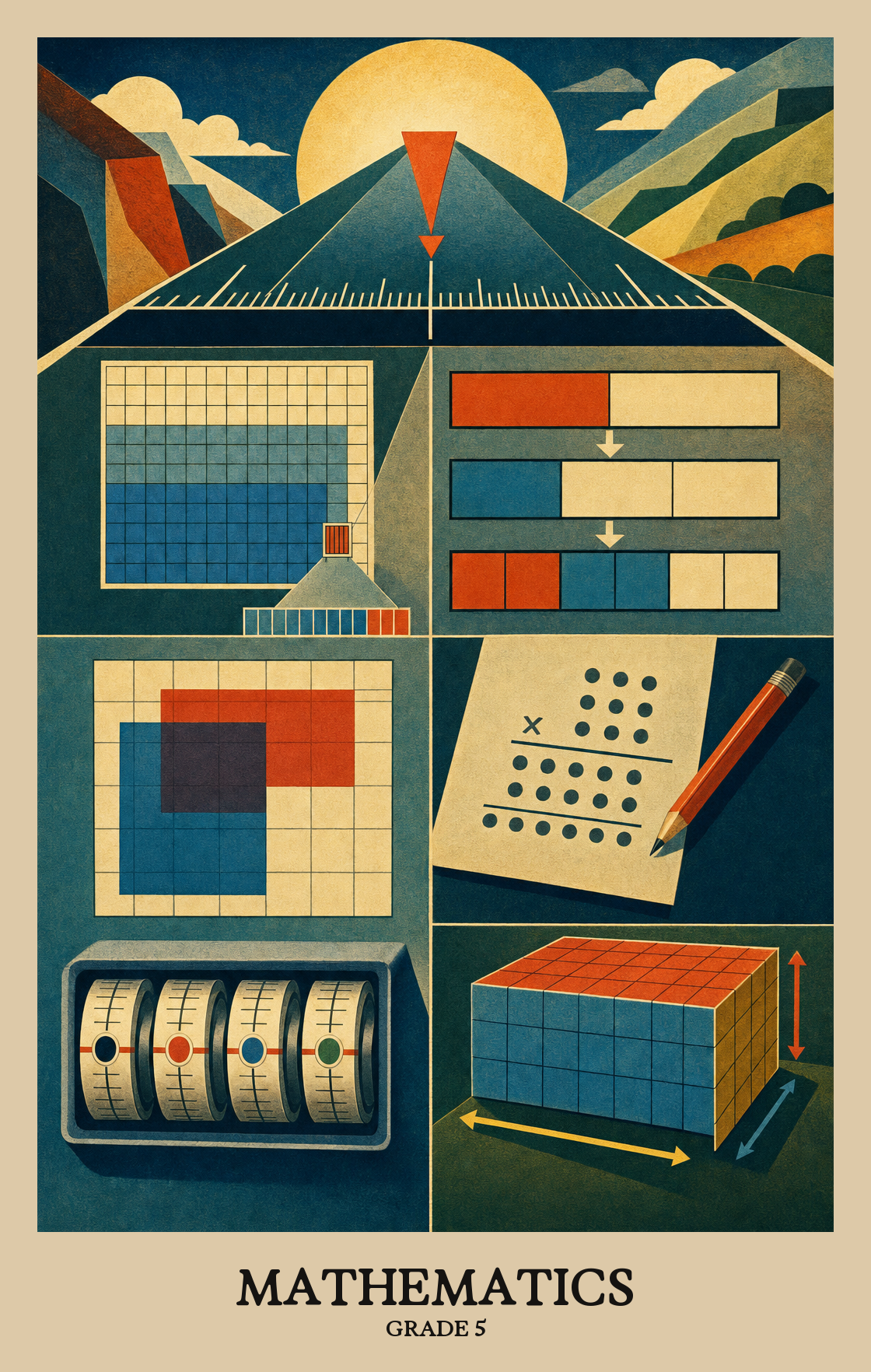
This is the year math stretches past whole numbers into decimals and fractions that don't share the same bottom number. Students read and compare decimals to the thousandths place, then add, subtract, and multiply them. They add and subtract fractions with unlike denominators, like one half plus one third, and start multiplying fractions too. By spring, students can multiply a three-digit number by a two-digit number on paper and find the volume of a box by multiplying its length, width, and height.

Illustration of what students learn in Grade 5 Mathematics
  • Decimals
  • Fractions with unlike denominators
  • Multiplying fractions
  • Long multiplication
  • Volume
  • Coordinate graphing
  • Order of operations
Source: North Carolina NC Standard Course of Study
Year at a glance
How the year usually goes. Every school and district set their own curriculum, so treat this as a guide, not official pacing.
  1. 1

    Place value to the thousandths

    Students dig into how digits change value as they move across a number, from millions down to thousandths. They read, write, and compare decimals, and see what happens when a number is multiplied or divided by 10, 100, or 1,000.

  2. 2

    Multi-digit multiplication and division

    Students lock in the standard method for multiplying larger numbers and learn several ways to divide with two-digit divisors. Expect homework with bigger numbers and more steps than last year.

  3. 3

    Decimal operations and expressions

    Students add, subtract, and multiply decimals, and divide with decimals in simple cases. They also write and solve number sentences that use parentheses and the order of operations.

  4. 4

    Fractions with unlike denominators

    Students add and subtract fractions like 1/3 and 1/4 by finding a common size for the pieces. They multiply fractions, divide with unit fractions, and use fractions to share things equally.

  5. 5

    Volume, measurement, and data

    Students measure how much space a box holds by packing it with unit cubes, then connect that to length times width times height. They also convert units with a chart and read line graphs that show change over time.

  6. 6

    Coordinate plane and shapes

    Students plot points on a grid using x and y coordinates and use those points to solve problems. They also sort quadrilaterals by their properties, seeing how a square fits inside the family of rectangles.

Mastery Learning Standards
The required skills a student should display by the end of Grade 5.
Operations and Algebraic Thinking
  • Write, explain, and evaluate numerical expressions involving the four…

    NC.5.OA.2

    Students write math expressions using addition, subtraction, multiplication, and division, then explain what each expression means and solve it. They use parentheses and number properties to work through two-step problems in the right order.

  • Generate two numerical patterns using two given rules.<ul><li>Identify apparent…

    NC.5.OA.3

    Students follow two different counting rules to build two number sequences, then pair up matching terms and plot those pairs as points on a grid.

Number and Operations in Base Ten
  • Explain the patterns in the place value system from one million to the…

    NC.5.NBT.1

    Each position in a number is worth ten times more than the spot to its right. Students explain why multiplying by 10 or 100 shifts digits left, and dividing shifts them right.

  • Read, write, and compare decimals to thousandths.<ul><li>Write decimals using…

    NC.5.NBT.3

    Students read, write, and compare decimal numbers down to the thousandths place. They write numbers like 3.047 in words and expanded form, then use >, =, and < to show which of two decimals is larger or smaller.

  • Demonstrate fluency with the multiplication of two whole numbers up to a…

    NC.5.NBT.5

    Multiply large numbers by hand using the standard step-by-step method. Students work up to a three-digit number times a two-digit number, like 347 times 23, without a calculator.

  • Find quotients with remainders when dividing whole numbers with up to…

    NC.5.NBT.6

    Students divide large numbers (up to four digits) by a two-digit number and find the leftover amount. They use drawings, area models, or partial quotients to work toward the standard long-division steps.

  • Compute and solve real-world problems with multi-digit whole numbers and…

    NC.5.NBT.7

    Students add, subtract, multiply, and divide decimal numbers, like $1.25 or $3.50, using place value and visual models. They also check whether answers make sense by estimating before or after they calculate.

Measurement and Data
  • Represent and interpret data.<ul><li>Collect data by asking a question that…

    NC.5.MD.2

    Students gather information that changes over time, then plot it on a line graph and read what the graph shows. They also decide whether a survey question will collect yes/no-style answers, numbers, or data that shifts across days or weeks.

  • Given a conversion chart, use multiplicative reasoning to solve one-step…

    NC.5.MD.1

    Students use a conversion chart to change one unit of measurement into another, like turning inches into feet or minutes into hours. They multiply or divide to find the answer, not just count up by ones.

  • Recognize volume as an attribute of solid figures and measure volume by…

    NC.5.MD.4

    Students learn that volume measures how much space a solid shape takes up. They find volume by counting how many small cubes fit inside a box or other 3D shape, using standard cubes measured in inches, centimeters, or feet.

  • Relate volume to the operations of multiplication and addition.<ul><li>Find the…

    NC.5.MD.5

    Students find the volume of box-shaped objects by counting unit cubes, then confirm the total matches what they get by multiplying the side lengths. They also find the volume of more complex shapes by splitting them into two separate boxes and adding the results.

Geometry
  • Graph points in the first quadrant of a coordinate plane

    NC.5.G.1

    Students plot points on a grid using two numbers: one that counts steps right and one that counts steps up. They use those coordinates to find locations and solve problems.

  • Classify quadrilaterals into categories based on their…

    NC.5.G.3

    Students sort four-sided shapes like squares, rectangles, and rhombuses by their properties, such as equal sides or right angles. They also learn that a square is always a rectangle, because it has every property a rectangle has.

Number and Operations – Fractions
  • Add and subtract fractions, including mixed numbers, with unlike denominators…

    NC.5.NF.1

    Students add and subtract fractions with different denominators, like 1/3 + 1/6, by finding a common denominator first. They check whether their answer makes sense and solve word problems using diagrams or equations.

  • Use fractions to model and solve division problems.<ul><li>Interpret a fraction…

    NC.5.NF.3

    Students learn that a fraction is just division written differently: 3/4 means 3 divided by 4. They solve word problems where splitting whole numbers into equal groups gives an answer like 1/2 or 2 3/4 instead of a whole number.

  • Apply and extend previous understandings of multiplication to multiply a…

    NC.5.NF.4

    Students multiply fractions by fractions and whole numbers, using area models to see why the answer gets smaller when you multiply by a fraction less than 1. They apply this to one-step word problems.

  • Solve one-step word problems involving division of unit fractions by non-zero…

    NC.5.NF.7

    Students divide fractions by whole numbers and whole numbers by fractions to solve word problems. They draw area and length diagrams to show what the division means before writing it as an equation.

Assessments
The state tests students at this grade and subject take.
State Summative

North Carolina EOG: Mathematics

End-of-grade mathematics assessment for grades 3 through 8, aligned to the North Carolina Standard Course of Study.

When given:
end of school year
Frequency:
annual
Official source
Alternate assessment

NCEXTEND1 Alternate Assessments

Alternate assessment for eligible students with significant cognitive disabilities, covering state-tested grades and subjects.

When given:
state testing window
Frequency:
annual
Official source
Common Questions
  • What math will students work on this year?

    Students multiply and divide larger numbers, add and subtract fractions with different bottom numbers, and start working with decimals out to the thousandths place. They also find the volume of boxes, plot points on a grid, and sort shapes by their properties.

  • How can families help with fractions at home?

    Cooking is the easiest way in. Halving a recipe, doubling it, or adding a half cup plus a third cup gives real practice with fractions that have different bottom numbers. Ask what the answer should be close to before doing the math.

  • What should decimal work look like by spring?

    Students should read a number like 2.045 out loud, say which digit is in the thousandths place, and compare two decimals to decide which is bigger. They should also add and subtract decimals with money and measurements without losing track of the decimal point.

  • How should multiplication and division be sequenced across the year?

    Build whole-number fluency early so students can lean on it when decimals and fractions arrive. Introduce the standard multiplication algorithm alongside area models, then move into division with two-digit divisors using partial quotients before pushing toward efficiency.

  • Which skills usually need the most reteaching?

    Adding and subtracting fractions with unlike bottom numbers, dividing by a two-digit number, and keeping place value straight when multiplying decimals. Plan extra practice and small-group time for these three.

  • How can families practice math in 10 minutes a day?

    Use real numbers from real life. Ask how much change is left after a purchase, how many minutes until dinner, or how to split six cookies among four people. A short conversation about how the answer was figured out matters more than worksheets.

  • What does volume work look like in fifth grade?

    Students count unit cubes inside a box, then connect that count to length times width times height. By the end of the year they should find the volume of a shape made of two boxes pushed together.

  • How do I know students are ready for sixth grade math?

    They can multiply a three-digit number by a two-digit number using the standard algorithm, divide with two-digit divisors, add and subtract fractions with unlike bottom numbers, and compute with decimals to hundredths. They can also plot points in the first quadrant and explain why a square is also a rectangle.