What makes America American
Students start the year looking at the people, traditions, and beliefs that shaped the country. They notice how different groups, from Native nations to recent newcomers, added to a shared identity.
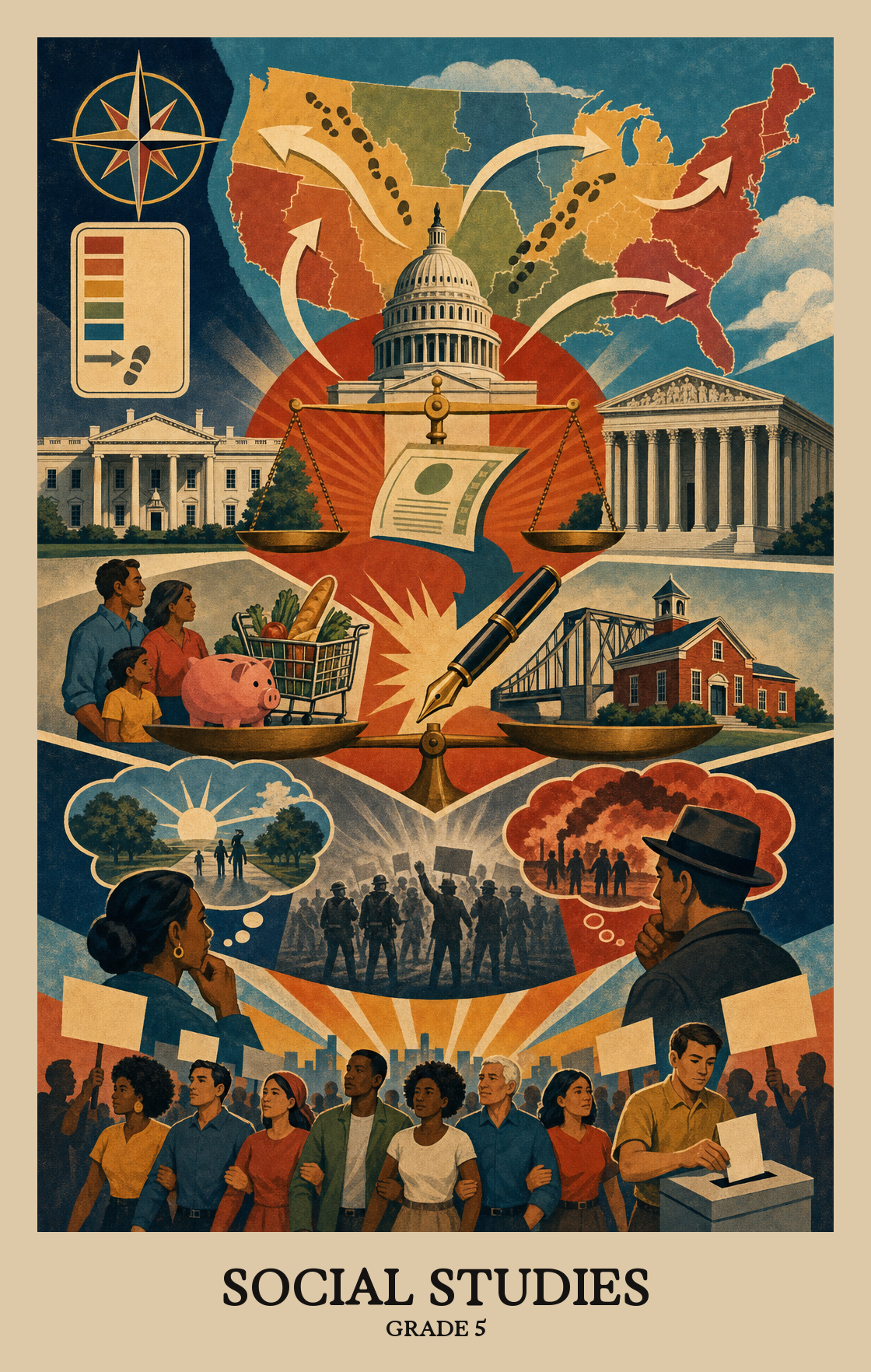
This is the year social studies zooms out to the whole United States story. Students look at how different groups of people shaped the country, why the three branches of government share power, and how money decisions affect both families and the nation. They read maps to see how migration changed the land, and compare different points of view on the same event. By spring, students can explain how a law gets made and name groups whose work changed American life.
Students start the year looking at the people, traditions, and beliefs that shaped the country. They notice how different groups, from Native nations to recent newcomers, added to a shared identity.
Students study how rivers, mountains, and coasts shaped where people settled and how they lived. They use maps to track migration, including the forced movement of enslaved people and families seeking a new home.
Students learn what the three branches of government do and how they check each other. They look at the Constitution and how it protects rights like speech, religion, and a fair trial.
Students follow how women, Black Americans, Native nations, and other groups pushed the country to live up to its promises. They see how protests, court cases, and new laws changed daily life.
Students explore why the country's economy grew at some moments and slowed at others. They look at jobs, factories, new technology, and trade with other countries.
Students practice thinking like a budgeter. They sort wants from needs, plan simple spending and saving, and notice how small money choices add up for a family and for the country.
Personal values and religious beliefs have shaped major decisions in American history, from which laws got passed to how communities formed. Students examine how what people believed changed the country over time.
Traditions, social structure, and art shape what makes the United States distinct. Students explain how shared customs, how society is organized, and creative expression have built a national identity over time.
Different groups, including Native peoples and immigrants of many faiths and backgrounds, have shaped what it means to be American. Students explain how the values and traditions of those groups left a lasting mark on the country's culture and identity.
| Standard | Definition | Code |
|---|---|---|
| Understand ways in which values and beliefs have influenced the development of… | Personal values and religious beliefs have shaped major decisions in American history, from which laws got passed to how communities formed. Students examine how what people believed changed the country over time. | 5.B.1 |
| Explain how traditions, social structure | Traditions, social structure, and art shape what makes the United States distinct. Students explain how shared customs, how society is organized, and creative expression have built a national identity over time. | 5.B1.1 |
| Explain how the values and beliefs of various indigenous, religious | Different groups, including Native peoples and immigrants of many faiths and backgrounds, have shaped what it means to be American. Students explain how the values and traditions of those groups left a lasting mark on the country's culture and identity. | 5.B.1.2 |
The three branches of government (Congress, the President, and the courts) each have different jobs. Students learn how those branches work together instead of one branch holding all the power.
The three branches of government (Congress, the President, and the courts) each hold different powers so no single branch gets too much control. Students learn how they check each other's decisions to keep rights and fairness in place.
Students learn how the federal government has stepped in over time to protect individual rights, from freedom of speech to equal treatment under the law. Real laws and court decisions show how those protections work in practice.
Students learn how women, Native Americans, religious minorities, and racial groups have pushed the government to protect their rights through voting, protests, petitions, and other civic action.
The Constitution lists rights the government cannot take away, like free speech or a fair trial. Students learn specific examples of those protections and how they apply to real situations.
| Standard | Definition | Code |
|---|---|---|
| Distinguish the roles and responsibilities of the three branches of government… | The three branches of government (Congress, the President, and the courts) each have different jobs. Students learn how those branches work together instead of one branch holding all the power. | 5.C&G.1.1 |
| Explain how the three branches of government work together to protect freedom… | The three branches of government (Congress, the President, and the courts) each hold different powers so no single branch gets too much control. Students learn how they check each other's decisions to keep rights and fairness in place. | 5.C&G.1.2 |
| Understand the ways in which the federal government has protected individual… | Students learn how the federal government has stepped in over time to protect individual rights, from freedom of speech to equal treatment under the law. Real laws and court decisions show how those protections work in practice. | 5.C&G.2 |
| Summarize the ways in which women, indigenous, religious | Students learn how women, Native Americans, religious minorities, and racial groups have pushed the government to protect their rights through voting, protests, petitions, and other civic action. | 5.C&G.2.1 |
| Exemplify ways in which rights are protected under the United States… | The Constitution lists rights the government cannot take away, like free speech or a fair trial. Students learn specific examples of those protections and how they apply to real situations. | 5.C&G.2.2 |
Economic decisions, like taxing goods or opening trade with other countries, shape how the U.S. grows and what it buys and sells. Students look at real examples to see what those choices gained, cost, and changed.
Students learn why the U.S. economy boomed or struggled at different points in history, looking at what drove growth, like new industries or trade, and what caused downturns, like war or falling prices.
Students look at a real economic choice, like building a factory or raising a price, and weigh what was gained against what was lost. The goal is to see that every decision has a tradeoff.
Students learn how factories, machines, and workers splitting up jobs helped the U.S. economy grow. They explain why producing more goods more efficiently led to more trade and a higher standard of living.
Trade means buying and selling goods with other countries. Students learn why the U.S. imports products it doesn't make enough of and exports products other countries want, and how those exchanges shape prices and jobs at home.
Personal financial choices, like saving instead of spending, have real consequences. Students explore how decisions about money, credit, and budgeting shape what people can afford now and later.
Personal spending and saving choices shape what families can afford day to day. Students learn how decisions like budgeting, borrowing, or setting money aside lead to real trade-offs at home.
A budget is a simple plan for how to spend and save money. Students learn why tracking what comes in and what goes out helps people avoid running short and build savings over time.
Students learn how choices like saving money, spending locally, or taking on debt ripple outward to affect jobs and businesses across the country. A single household decision, multiplied by millions of families, can speed up or slow down the whole economy.
| Standard | Definition | Code |
|---|---|---|
| Understand how economic decisions have impacted the United States in terms… | Economic decisions, like taxing goods or opening trade with other countries, shape how the U.S. grows and what it buys and sells. Students look at real examples to see what those choices gained, cost, and changed. | 5.E.1 |
| Explain factors that led to economic growth and decline within the United… | Students learn why the U.S. economy boomed or struggled at different points in history, looking at what drove growth, like new industries or trade, and what caused downturns, like war or falling prices. | 5.E.1.1 |
| Compare economic decisions in terms of benefits and consequences | Students look at a real economic choice, like building a factory or raising a price, and weigh what was gained against what was lost. The goal is to see that every decision has a tradeoff. | 5.E.1.2 |
| Explain the impact of production, specialization, technology | Students learn how factories, machines, and workers splitting up jobs helped the U.S. economy grow. They explain why producing more goods more efficiently led to more trade and a higher standard of living. | 5.E.1.3 |
| Summarize the role of trade between the United States and other countries | Trade means buying and selling goods with other countries. Students learn why the U.S. imports products it doesn't make enough of and exports products other countries want, and how those exchanges shape prices and jobs at home. | 5.E.1.4 |
| Understand the impact of personal financial decisions | Personal financial choices, like saving instead of spending, have real consequences. Students explore how decisions about money, credit, and budgeting shape what people can afford now and later. | 5.E.2 |
| Explain how personal financial decisions affect everyday life | Personal spending and saving choices shape what families can afford day to day. Students learn how decisions like budgeting, borrowing, or setting money aside lead to real trade-offs at home. | 5.E.2.1 |
| Explain the importance of developing a basic budget for spending and saving | A budget is a simple plan for how to spend and save money. Students learn why tracking what comes in and what goes out helps people avoid running short and build savings over time. | 5.E.2.2 |
| Explain how personal financial decisions impact economic growth and decline in… | Students learn how choices like saving money, spending locally, or taking on debt ripple outward to affect jobs and businesses across the country. A single household decision, multiplied by millions of families, can speed up or slow down the whole economy. | 5.E.2.3 |
Geographic features like rivers, mountains, and coastlines shaped where American cities grew, how trade routes formed, and why some regions developed differently than others. Students learn to connect physical geography to the choices people made over time.
Where people settled, what they built, and how they live are shaped by the land and climate around them. Students explain how rivers, mountains, and weather patterns influenced where American cities grew and how communities developed.
Maps show how people moving by choice, people forced to relocate, and enslaved people brought across the Atlantic each reshaped where communities formed and how the country grew. Students use maps to trace those patterns.
Technology changed how Americans use the land. Students explain how inventions like railroads, irrigation systems, and highways shaped where cities grew, how farms spread, and how people moved across the country.
Students learn why people moved to, stayed in, or left different parts of the country, including moves people chose and moves they were forced to make, such as the relocation of Native Americans or the transatlantic slave trade.
| Standard | Definition | Code |
|---|---|---|
| Understand the ways in which geographic factors and features have influenced… | Geographic features like rivers, mountains, and coastlines shaped where American cities grew, how trade routes formed, and why some regions developed differently than others. Students learn to connect physical geography to the choices people made over time. | 5.G.1 |
| Explain the relationship between location, physical environment | Where people settled, what they built, and how they live are shaped by the land and climate around them. Students explain how rivers, mountains, and weather patterns influenced where American cities grew and how communities developed. | 5.G.1.1 |
| Explain ways in which voluntary and forced migration and slavery led to changes… | Maps show how people moving by choice, people forced to relocate, and enslaved people brought across the Atlantic each reshaped where communities formed and how the country grew. Students use maps to trace those patterns. | 5.G.1.2 |
| Explain how technological innovation has impacted the geography of the United… | Technology changed how Americans use the land. Students explain how inventions like railroads, irrigation systems, and highways shaped where cities grew, how farms spread, and how people moved across the country. | G.G.1.3 |
| Explain the reasons for forced and voluntary migration to, from | Students learn why people moved to, stayed in, or left different parts of the country, including moves people chose and moves they were forced to make, such as the relocation of Native Americans or the transatlantic slave trade. | 5 G 1.4 |
Students examine how different people, events, and ideas changed what the United States looked like and how it worked. They connect specific moments in history to the country students live in today.
Students study how women, Indigenous peoples, and marginalized groups shaped American history through their actions and ideas, not just how they were affected by it.
Students trace how the roles of women, Native Americans, and other minority groups shifted over time in American history, from who held power to who fought for it.
Revolution, reform, and resistance each pushed the United States to change over time. Students learn how protests, laws, and uprisings shifted who held power and whose rights were recognized.
Major wars and turning points (like the Revolution or the Civil War) changed how the country was governed, who had rights, and how Americans lived. Students explain what shifted and why it mattered.
Students read firsthand accounts and history books side by side to see how different people experienced the same event, then explain how those views differ.
Students study flags, monuments, and national holidays to understand what those symbols mean to different groups of Americans, and why the same symbol can carry different meanings depending on who is looking at it.
| Standard | Definition | Code |
|---|---|---|
| Understand the role of various people, events, and ideas in shaping the United… | Students examine how different people, events, and ideas changed what the United States looked like and how it worked. They connect specific moments in history to the country students live in today. | 5.H.1 |
| Explain how the experiences and achievements of women, minorities, indigenous… | Students study how women, Indigenous peoples, and marginalized groups shaped American history through their actions and ideas, not just how they were affected by it. | 5.H.1.1 |
| Summarize the changing roles of women, indigenous, racial and other minority… | Students trace how the roles of women, Native Americans, and other minority groups shifted over time in American history, from who held power to who fought for it. | 5.H.1.2 |
| Explain the ways in which revolution, reform | Revolution, reform, and resistance each pushed the United States to change over time. Students learn how protests, laws, and uprisings shifted who held power and whose rights were recognized. | 5.H.1.3 |
| Explain the impact of major conflicts and events on the development of the… | Major wars and turning points (like the Revolution or the Civil War) changed how the country was governed, who had rights, and how Americans lived. Students explain what shifted and why it mattered. | 5.H.1.4 |
| Compare multiple perspectives of various historical events using primary and… | Students read firsthand accounts and history books side by side to see how different people experienced the same event, then explain how those views differ. | 5.H.1.5 |
| Explain the significance of national symbols and traditions from various… | Students study flags, monuments, and national holidays to understand what those symbols mean to different groups of Americans, and why the same symbol can carry different meanings depending on who is looking at it. | 5.H.1.6 |
Federally administered sample-based assessment in reading, mathematics, science, writing, and other subjects. NAEP results inform state-by-state comparisons rather than individual student or school accountability.
Students study the United States: how it was shaped by different groups of people, how the three branches of government work, why people moved across the country, and how money and trade affect everyday life. It is a big sweep of American history, geography, government, and economics.
Talk about the news at dinner and ask who is making the decision and who it affects. Visit a historic site, museum, or even a local monument and ask what story it tells and whose story might be missing. Ten minutes of real conversation goes a long way.
Try one good biography, picture book, or short documentary about a person students are curious about, such as an inventor, athlete, or activist. Stories about real people stick better than dates and facts. Let students pick who to learn about.
Most fifth grade teachers move roughly in chronological order, from early peoples and colonization through revolution, expansion, conflict, and modern times. Weave geography, economics, and government into each era instead of saving them for separate units. That way students see cause and effect, not isolated topics.
Anchor it in a real question students care about, such as how a law gets made or how a court case gets decided. Use a current event and trace which branch is doing what. Vocabulary sticks once students see the branches in action.
Let students help plan a small purchase or a grocery trip with a set amount of money. Talk through wants, needs, and trade-offs out loud. A simple weekly allowance with a save jar and a spend jar teaches budgeting better than any worksheet.
The three branches of government and how they check each other, the difference between forced and voluntary migration, and basic economic ideas like specialization and trade. Plan to circle back to these across units rather than teaching them once and moving on.
Use short, accessible sources: a photograph, a letter, a poster, a song, a map. Ask students what they notice, what they wonder, and whose perspective is shown. Pair two sources on the same event so students see that history depends on who is telling it.
By spring, students should be able to explain how an event changed the country, name contributions from a range of groups, read a basic map, and describe how the branches of government share power. Strong readiness shows up in writing and discussion, not just on a quiz.