Matter and how it changes
Students mix, heat, and cool everyday materials to see what changes and what stays the same. They weigh things before and after to check whether new substances formed or the original ingredients are still there.
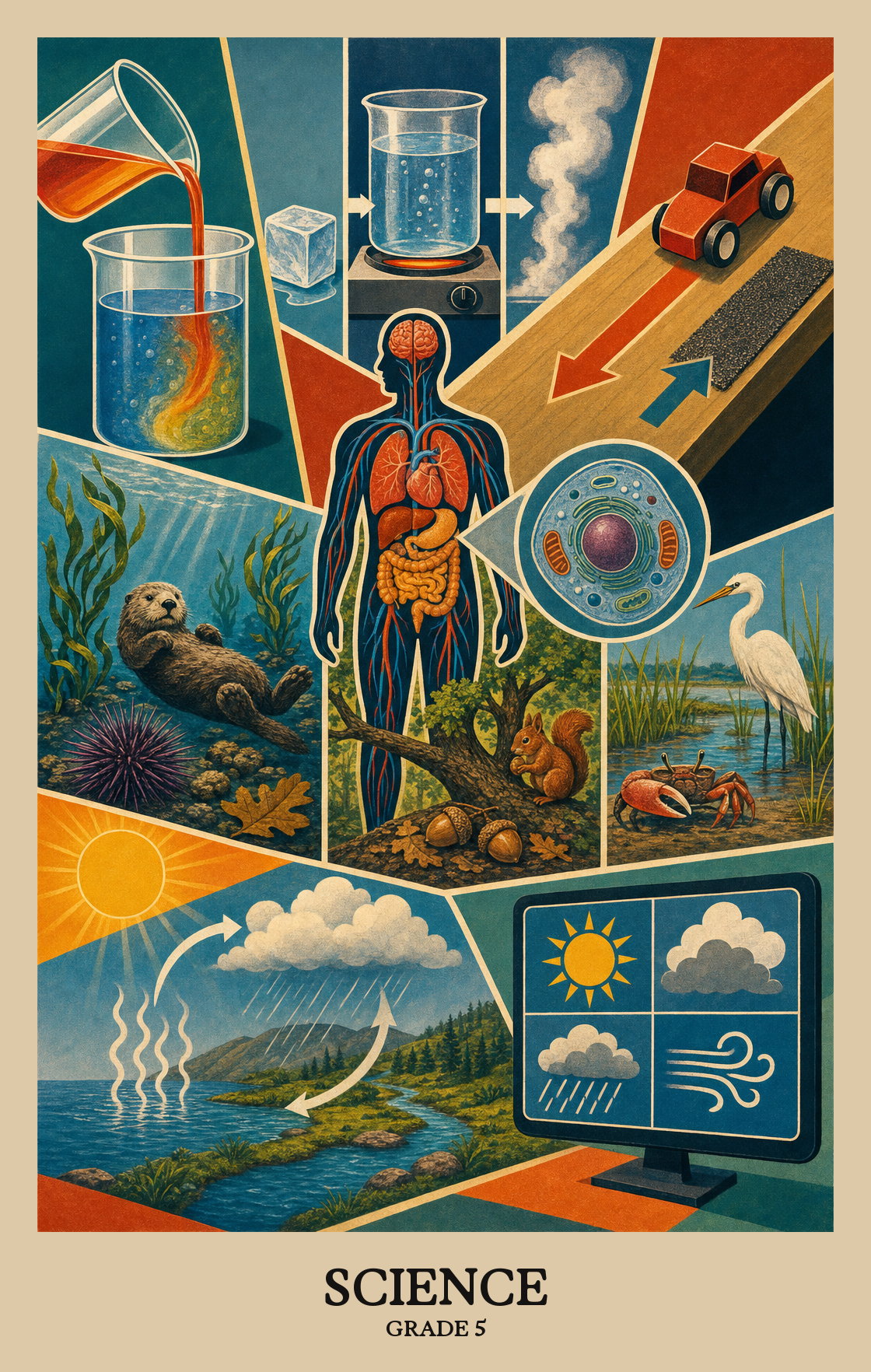
This is the year science gets hands-on and investigative. Students run experiments to see how mixing, heating, and cooling change materials, and they test how gravity and friction push objects around. They learn how the human body fits together from cells up to whole systems, and how plants and animals depend on each other in oceans, forests, and salt marshes. By spring, students can read a weather forecast and explain how the sun drives the water cycle.
Students mix, heat, and cool everyday materials to see what changes and what stays the same. They weigh things before and after to check whether new substances formed or the original ingredients are still there.
Students push, pull, roll, and drop objects to see how gravity, friction, and weight change the way things move. They start using simple math to describe where something is going and how fast.
Students zoom in from cells to tissues to organs to whole body systems. They build models to see how the digestive, respiratory, circulatory, muscular, skeletal, and nervous systems each keep a person alive.
Students look at forests, ponds, oceans, and salt marshes to see which plants and animals each place can support. They sort living things into producers, consumers, and decomposers, and trace how one change ripples through the whole system.
Students ask why a puppy looks like its parents but had to be taught to sit. They compare traits passed down at birth with skills and habits picked up over time, and instincts with learned behavior.
Students track temperature, wind, and rain to spot daily and seasonal patterns and to predict what is coming, including hurricanes and tornadoes. They model the water cycle and look at how the ocean shapes weather in North Carolina.
Students learn how matter and energy work together to cause changes, like heat melting ice or electricity lighting a bulb. The focus is on what happens to materials when energy acts on them.
Students weigh objects before and after mixing, burning, or breaking them apart to see whether the total weight changes. This builds the idea that matter doesn't just disappear when it changes form.
Students mix substances together, like vinegar and baking soda, and record what happens. They look for signs that a new substance formed, such as a color change, gas bubbles, or heat.
Students heat and cool different materials to see how each one changes, then connect those changes to why the material is used that way in real life.
| Standard | Definition | Code |
|---|---|---|
| Understand the interactions of matter and energy and the changes that occur | Students learn how matter and energy work together to cause changes, like heat melting ice or electricity lighting a bulb. The focus is on what happens to materials when energy acts on them. | PS.5.1 |
| Carry out investigations to compare the weight of objects before and after an… | Students weigh objects before and after mixing, burning, or breaking them apart to see whether the total weight changes. This builds the idea that matter doesn't just disappear when it changes form. | PS.5.1.1 |
| Carry out investigations to explain whether the mixing of two or… | Students mix substances together, like vinegar and baking soda, and record what happens. They look for signs that a new substance formed, such as a color change, gas bubbles, or heat. | PS.5.1.2 |
| Carry out investigations to compare how heating and cooling affect… | Students heat and cool different materials to see how each one changes, then connect those changes to why the material is used that way in real life. | PS.5.1.3 |
Pushing, pulling, and gravity are forces that make objects start, stop, or change direction. Students learn how the size and direction of a force change the way something moves.
Students test how gravity, friction, and heavier or lighter objects change the way things move. They run hands-on investigations and use what they find to explain why objects speed up, slow down, or change direction.
Students use numbers and calculations to figure out where a moving object is, which way it's heading, and how fast it's going.
| Standard | Definition | Code |
|---|---|---|
| Understand force, motion, and the relationship between them | Pushing, pulling, and gravity are forces that make objects start, stop, or change direction. Students learn how the size and direction of a force change the way something moves. | PS.5.2 |
| Carry out investigations to explain how factors such as gravity, friction | Students test how gravity, friction, and heavier or lighter objects change the way things move. They run hands-on investigations and use what they find to explain why objects speed up, slow down, or change direction. | PS.5.2.1 |
| Use mathematics and computational thinking to infer the motion of an object | Students use numbers and calculations to figure out where a moving object is, which way it's heading, and how fast it's going. | PS.5.2.2 |
Students learn how the body's major systems, like the heart, lungs, and digestive tract, each handle a specific job and work together to keep a person alive.
Students learn that the human body is built in layers: cells group into tissues, tissues form organs, organs work together as systems, and systems make up the whole body.
Students use diagrams and models to compare the major systems inside the human body, such as the digestive and circulatory systems, and explain what each one does to keep the body alive.
| Standard | Definition | Code |
|---|---|---|
| Understand how structures and systems of the human body perform functions… | Students learn how the body's major systems, like the heart, lungs, and digestive tract, each handle a specific job and work together to keep a person alive. | LS.5.1 |
| Use models to recognize the organizational structure of humans as… | Students learn that the human body is built in layers: cells group into tissues, tissues form organs, organs work together as systems, and systems make up the whole body. | LS.5.1.1 |
| Use models to compare the major systems of the human body | Students use diagrams and models to compare the major systems inside the human body, such as the digestive and circulatory systems, and explain what each one does to keep the body alive. | LS.5.1.2 |
Plants and animals in an ecosystem depend on each other to survive. Students learn how removing one species, like a plant or predator, can change the whole community around it.
Students compare ecosystems like oceans, forests, and lakes to explain which conditions help more plants and animals survive. They use evidence to argue why some ecosystems support a wider variety of living things than others.
Students sort living things into three roles: plants that make their own food, animals that eat other organisms, and decomposers like fungi that break down dead matter. They use diagrams or models to show how each role keeps the ecosystem running.
Students use food web diagrams to figure out what happens when one plant or animal in an ecosystem disappears. They trace how that change ripples through other living things that depend on it.
| Standard | Definition | Code |
|---|---|---|
| Understand the interdependence of plants and animals within their ecosystem | Plants and animals in an ecosystem depend on each other to survive. Students learn how removing one species, like a plant or predator, can change the whole community around it. | LS.5.2 |
| Engage in argument from evidence to compare the characteristics of several… | Students compare ecosystems like oceans, forests, and lakes to explain which conditions help more plants and animals survive. They use evidence to argue why some ecosystems support a wider variety of living things than others. | LS.5.2.1 |
| Use models to classify organisms within an ecosystem according to the function… | Students sort living things into three roles: plants that make their own food, animals that eat other organisms, and decomposers like fungi that break down dead matter. They use diagrams or models to show how each role keeps the ecosystem running. | LS.5.2.2 |
| Use models to infer the effects that may result from the… | Students use food web diagrams to figure out what happens when one plant or animal in an ecosystem disappears. They trace how that change ripples through other living things that depend on it. | LS.5.2.3 |
Some traits, like eye color or fur pattern, are passed down from parents. Others, like a scar or a learned skill, come from what happens during an organism's life.
Students compare two kinds of behavior: what an animal is born knowing how to do, like a spider spinning a web, and what it picks up from experience, like a dog learning to sit.
Students compare traits they are born with (like eye color or hair texture) to traits they develop over time (like a scar or a learned skill). They practice asking questions to tell the difference between the two.
| Standard | Definition | Code |
|---|---|---|
| Understand some characteristics of an organism are inherited and other… | Some traits, like eye color or fur pattern, are passed down from parents. Others, like a scar or a learned skill, come from what happens during an organism's life. | LS.5.3 |
| Ask questions to compare instincts and learned behaviors | Students compare two kinds of behavior: what an animal is born knowing how to do, like a spider spinning a web, and what it picks up from experience, like a dog learning to sit. | LS.5.3.1 |
| Ask questions to compare inherited and acquired traits | Students compare traits they are born with (like eye color or hair texture) to traits they develop over time (like a scar or a learned skill). They practice asking questions to tell the difference between the two. | LS.5.3.2 |
Students learn how the ocean and the air work together to create weather patterns and shape the climate of different regions.
Students read weather data across days and seasons to spot patterns, like why winter mornings are colder or why spring brings more rain. They look at temperature, wind, and precipitation records to explain how weather shifts over time.
Students read real weather data, like temperature readings and wind speeds, to explain what the weather is doing now and predict what's coming next, including storms like hurricanes and tornadoes.
Students explain how the ocean shapes North Carolina's weather and climate. They look at how water temperature, currents, and moisture from the sea affect rainfall and seasonal patterns along the coast and inland.
Students use diagrams or models to show how heat from the sun moves water from the ground and plants into the air, then back down as rain or snow.
| Standard | Definition | Code |
|---|---|---|
| Understand how Earth systems (hydrosphere and atmosphere) impact patterns of… | Students learn how the ocean and the air work together to create weather patterns and shape the climate of different regions. | ESS.5.1 |
| Analyze and interpret data to compare daily and seasonal changes in weather… | Students read weather data across days and seasons to spot patterns, like why winter mornings are colder or why spring brings more rain. They look at temperature, wind, and precipitation records to explain how weather shifts over time. | ESS.5.1.1 |
| Analyze and interpret weather data to explain current and upcoming weather… | Students read real weather data, like temperature readings and wind speeds, to explain what the weather is doing now and predict what's coming next, including storms like hurricanes and tornadoes. | ESS.5.1.2 |
| Construct an explanation to summarize the ocean's influences on weather and… | Students explain how the ocean shapes North Carolina's weather and climate. They look at how water temperature, currents, and moisture from the sea affect rainfall and seasonal patterns along the coast and inland. | ESS.5.1.3 |
| Use models to explain how the sun’s energy drives the processes of the water… | Students use diagrams or models to show how heat from the sun moves water from the ground and plants into the air, then back down as rain or snow. | ESS.5.1.4 |
End-of-grade science assessment in grades 5 and 8, aligned to North Carolina science standards.
Alternate assessment for eligible students with significant cognitive disabilities, covering state-tested grades and subjects.
Students study matter and how it changes when heated, cooled, or mixed. They learn about forces like gravity and friction, the major systems of the human body, and how plants and animals depend on each other in places like forests and salt marshes. They also study weather, the water cycle, and how the ocean shapes conditions along the coast.
Cook together and talk about what changes when something melts, freezes, or mixes. Check the weather forecast in the morning and guess what the afternoon will bring. Walk outside and name what eats what, and which living things break down leaves and other waste.
Students can run a simple experiment, record what they see, and explain what it shows. They can name the major body systems and what each one does, sort living things into producers, consumers, and decomposers, and read a weather chart well enough to predict what comes next.
Many teachers start with matter and forces in the fall, since the hands-on investigations build lab habits early. Body systems and ecosystems fit well in the middle of the year. Weather and the water cycle land nicely in spring, when students can track real seasonal changes outside.
Not this year. Students are expected to investigate, gather evidence, and explain their thinking. Asking questions like why do you think that happened or what could we try next matters more than memorising vocabulary.
Forces and motion often need a second pass, especially the idea that mass and friction change how things move. Producers, consumers, and decomposers also tend to blur together. Short sorting tasks and quick check-ins work better than long review lessons.
A ready student can plan a simple test, measure carefully, and write a short explanation of what happened and why. They can read a basic chart or model and pull information from it. If those habits are in place, the jump to middle school science goes smoothly.