Listening and telling stories
Students settle into reading and listening to short stories. They find the main lesson, talk about what characters do, and pick out words that show feelings or what something looks, sounds, or smells like.
This is the year reading and writing stretch beyond single sentences. Students pull the main idea and key details out of stories and short nonfiction, and they start telling their own stories with a clear beginning, middle, and end. They also write short pieces that introduce a topic and add a few facts about it. By spring, students can retell a story with characters and events and write a few connected sentences about something they learned.
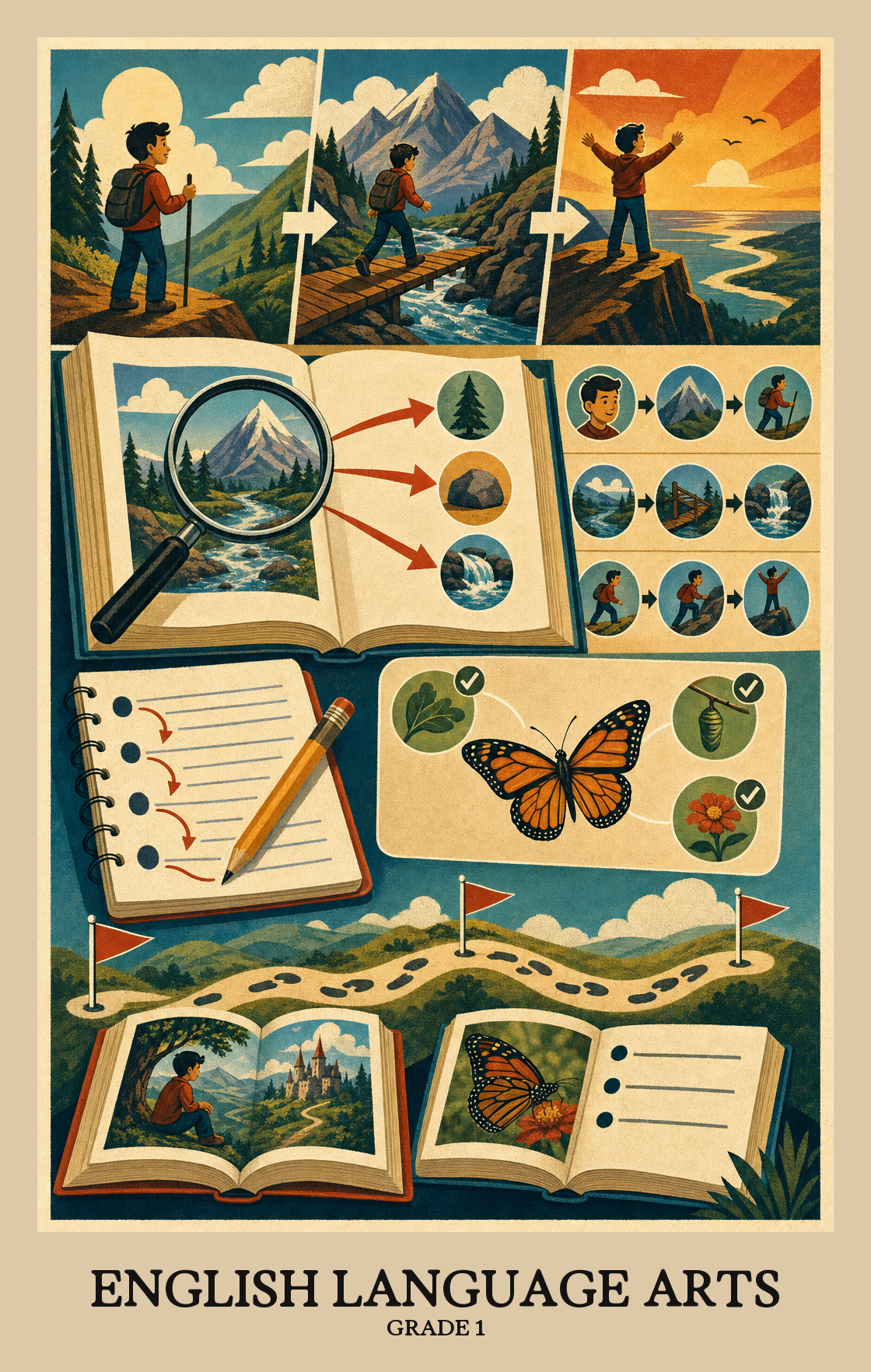
Students settle into reading and listening to short stories. They find the main lesson, talk about what characters do, and pick out words that show feelings or what something looks, sounds, or smells like.
Students start telling stories of their own, on paper and out loud. They set the scene for a listener, walk through what happened in order, and adjust how they tell it depending on who is listening.
Students move into books that teach about real things, like animals, weather, or community helpers. They find the topic, pick out key facts, and ask questions about what something is like.
Students write short pieces that explain a real topic to a reader. They name the topic, say what it is, and add facts and details so a reader learns something new.
Students look closely at how things happen in the world, like how a plant grows or why ice melts. They describe what they notice, tell what caused what, and compare different ways to solve a problem.
Students start sharing opinions backed by reasons. They pick a topic, find facts from a book or picture, sort facts from opinions, and tie their reasons back to what they are trying to say.
Reading or listening to a story, then explaining what it means, how it feels, or what the characters are really doing beneath the surface.
Students read a short story and figure out the big idea or lesson it teaches, using details from the story as clues.
Students look at a character in a story and explain how that character's personality or choices helped cause something to happen. The focus is on connecting who a character is to what occurs in the plot.
Students pick out words and phrases that describe how something looks, sounds, smells, or feels, or that show a character's emotions. These sensory and feeling words help readers picture the story.
Students write or tell a simple story with a beginning, middle, and end. This standard covers how well students put ideas into sentences that follow a clear order.
Students start a story by telling readers who is in it and where it takes place, so the audience knows the setting and characters before the action begins.
Students write out what happens in a story, step by step. They show how one event leads to the next so the story moves forward.
Students learn to think about who will read or hear their writing and make small changes so it is clear and interesting for that person.
Reading nonfiction passages and explaining what they learned, using details from the text to back up their thinking.
Students find the big idea of a passage and point to the most important details that support it. This is the foundation for understanding any nonfiction they read.
Students read a short informational passage and practice asking and answering questions about how something looks, feels, or works. The focus is on noticing the details an author uses to describe a person, place, animal, or object.
Students point to specific words an author chose and explain how those words connect to what the text is about.
Students write sentences that explain or describe something real, like an animal, a place, or how something works. The goal is to share facts, not tell a story.
Students write an opening sentence that names what their piece is about and tells the reader one key fact or detail about it.
Students pick a topic and write sentences that describe what it looks, sounds, or acts like, using real facts and specific details rather than opinions.
| Standard | Definition | Code |
|---|---|---|
| Narrate.Interpretive | Reading or listening to a story, then explaining what it means, how it feels, or what the characters are really doing beneath the surface. | ELD-LA.1.1 |
| Identifying a central message from key details | Students read a short story and figure out the big idea or lesson it teaches, using details from the story as clues. | ELD-LA.1.1.1 |
| Identifying how character attributes and actions contribute to an event | Students look at a character in a story and explain how that character's personality or choices helped cause something to happen. The focus is on connecting who a character is to what occurs in the plot. | ELD-LA.1.1.2 |
| Identifying words and phrases that suggest feelings or appeal to the senses | Students pick out words and phrases that describe how something looks, sounds, smells, or feels, or that show a character's emotions. These sensory and feeling words help readers picture the story. | ELD-LA.1.1.3 |
| Narrate.Expressive: Construct language arts narratives that | Students write or tell a simple story with a beginning, middle, and end. This standard covers how well students put ideas into sentences that follow a clear order. | ELD-LA.1.2 |
| Orient audience to story | Students start a story by telling readers who is in it and where it takes place, so the audience knows the setting and characters before the action begins. | ELD-LA.1.2.1 |
| Develop story events | Students write out what happens in a story, step by step. They show how one event leads to the next so the story moves forward. | ELD-LA.1.2.2 |
| Engage and adjust for audience | Students learn to think about who will read or hear their writing and make small changes so it is clear and interesting for that person. | ELD-LA.1.2.3 |
| Inform.Interpretive: Interpret informational texts in language arts by | Reading nonfiction passages and explaining what they learned, using details from the text to back up their thinking. | ELD-LA.1.3 |
| Identifying main topic and/or entity and key details | Students find the big idea of a passage and point to the most important details that support it. This is the foundation for understanding any nonfiction they read. | ELD-LA.1.3.1 |
| Asking and answering questions about descriptions of attributes and… | Students read a short informational passage and practice asking and answering questions about how something looks, feels, or works. The focus is on noticing the details an author uses to describe a person, place, animal, or object. | ELD-LA.1.3.2 |
| Identifying word choices in relation to topic or content area | Students point to specific words an author chose and explain how those words connect to what the text is about. | ELD-LA.1.3.3 |
| Inform.Expressive: Construct informational texts in language arts that | Students write sentences that explain or describe something real, like an animal, a place, or how something works. The goal is to share facts, not tell a story. | ELD-LA.1.4 |
| Introduce and define topic and/or entity for audience | Students write an opening sentence that names what their piece is about and tells the reader one key fact or detail about it. | ELD-LA.1.4.1 |
| Describe attributes and characteristics with facts, definitions | Students pick a topic and write sentences that describe what it looks, sounds, or acts like, using real facts and specific details rather than opinions. | ELD-LA.1.4.2 |
Reading a chart, graph, or number sentence and explaining what it means. Students practice turning math information on a page into words they can say out loud or write down.
Reading a math book or word problem, students point to the main idea or object being described, such as a shape, a number, or a counting rule.
Students look at a number, shape, or object in a math text and put what they notice into words. They might describe how many sides a shape has or whether a number is big or small.
Students write sentences or short paragraphs that explain math ideas, like how they solved a problem or what a shape looks like. The writing helps them put math thinking into words.
Students explain what something is or sort it into a group. For example, they might write that a triangle has three sides or that a dog is an animal.
Students pick a math idea, like addition or a shape, and write or talk about what it is and how it works. The goal is to explain it clearly enough that someone else could understand it.
Students pick two things they have learned about, say how those things are alike, and say how they are different. This is often the first time kids practice writing to explain an idea, not just tell a story.
| Standard | Definition | Code |
|---|---|---|
| Inform.Interpretive: Interpret mathematical informational texts by | Reading a chart, graph, or number sentence and explaining what it means. Students practice turning math information on a page into words they can say out loud or write down. | ELD-MA.1.1 |
| Identifying concept or entity | Reading a math book or word problem, students point to the main idea or object being described, such as a shape, a number, or a counting rule. | ELD-MA.1.1.1 |
| Describing attributes and characteristics | Students look at a number, shape, or object in a math text and put what they notice into words. They might describe how many sides a shape has or whether a number is big or small. | ELD-MA.1.1.2 |
| Inform.Expressive: Construct mathematical informational texts that | Students write sentences or short paragraphs that explain math ideas, like how they solved a problem or what a shape looks like. The writing helps them put math thinking into words. | ELD-MA.1.2 |
| Define or classify concept or entity | Students explain what something is or sort it into a group. For example, they might write that a triangle has three sides or that a dog is an animal. | ELD-MA.1.2.1 |
| Describe a concept or entity | Students pick a math idea, like addition or a shape, and write or talk about what it is and how it works. The goal is to explain it clearly enough that someone else could understand it. | ELD-MA.1.2.2 |
| Compare/contrast concepts or entities | Students pick two things they have learned about, say how those things are alike, and say how they are different. This is often the first time kids practice writing to explain an idea, not just tell a story. | ELD-MA.1.2.3 |
Reading short science books or articles and explaining what they learned, using details from the text to back up their answers.
Reading a short science passage and figuring out the main topic. Students identify what the text is mostly about, whether it covers animals, weather, plants, or another science subject.
Students read a short science passage and explain what a word or idea means, or sort it into a group with similar things, like deciding whether something is a plant, an animal, or neither.
Students build simple science writing by drawing pictures and writing sentences to explain what they observed or learned. The focus is on getting ideas onto the page in a clear, organized way.
Students write a sentence or two that names and introduces a science topic, like what a cloud is or what a frog does. The writing gives a reader enough to understand what the topic is about.
Students write sentences that name what something is, describe how it looks or works, and sort it into a group with similar things.
Students take what they observed or learned about a topic and write a short summary in their own words. This is an early step in science writing, where students practice turning facts and observations into clear sentences.
Reading or listening to a science explanation, then putting it into their own words to show they understood what happened and why.
Students look at what they noticed or measured and ask a question worth testing. They turn an observation into a starting point for a simple science investigation.
Students look at a handful of observations or events and use them together to explain why something happened. Think of it as connecting the dots between clues to build a simple scientific explanation.
Students pick out details from what they saw or noticed that back up a scientific explanation. For example, after watching a plant grow, they point to specific observations that support why it happened.
Students build a simple scientific explanation in their own words, connecting what they observed to a reason why it happened. This is the foundation for all science writing they will do as they get older.
Students put their observations into words, describing what they saw, heard, or measured to explain what happened in a science activity.
Students explain how one thing leads to another, like why a plant grows after you water it. They describe a chain of events, showing what happens first and what happens because of it.
Students look at two or more ways to solve a problem and explain which one works better and why.
| Standard | Definition | Code |
|---|---|---|
| Inform.Interpretive: Interpret scientific informational texts by | Reading short science books or articles and explaining what they learned, using details from the text to back up their answers. | ELD-SC.1.1 |
| Determining what text is about | Reading a short science passage and figuring out the main topic. Students identify what the text is mostly about, whether it covers animals, weather, plants, or another science subject. | ELD-SC.1.1.1 |
| Defining or classifying concept or entity | Students read a short science passage and explain what a word or idea means, or sort it into a group with similar things, like deciding whether something is a plant, an animal, or neither. | ELD-SC.1.1.2 |
| Inform.Expressive: Construct scientific informational texts that | Students build simple science writing by drawing pictures and writing sentences to explain what they observed or learned. The focus is on getting ideas onto the page in a clear, organized way. | ELD-SC.1.2 |
| Introduce others to topic or entity | Students write a sentence or two that names and introduces a science topic, like what a cloud is or what a frog does. The writing gives a reader enough to understand what the topic is about. | ELD-SC.1.2.1 |
| Define, describe, and classify concept, topic | Students write sentences that name what something is, describe how it looks or works, and sort it into a group with similar things. | ELD-SC.1.2.2 |
| Summarize observations or factual information | Students take what they observed or learned about a topic and write a short summary in their own words. This is an early step in science writing, where students practice turning facts and observations into clear sentences. | ELD-SC.1.2.3 |
| Explain.Interpretive | Reading or listening to a science explanation, then putting it into their own words to show they understood what happened and why. | ELD-SC.1.3 |
| Defining investigable questions or simple design problems based on observations… | Students look at what they noticed or measured and ask a question worth testing. They turn an observation into a starting point for a simple science investigation. | ELD-SC.1.3.1 |
| Analyzing several events and observations to help explain how or why a… | Students look at a handful of observations or events and use them together to explain why something happened. Think of it as connecting the dots between clues to build a simple scientific explanation. | ELD-SC.1.3.2 |
| Identifying information from observations | Students pick out details from what they saw or noticed that back up a scientific explanation. For example, after watching a plant grow, they point to specific observations that support why it happened. | ELD-SC.1.3.3 |
| Explain.Expressive: Construct scientific explanations that | Students build a simple scientific explanation in their own words, connecting what they observed to a reason why it happened. This is the foundation for all science writing they will do as they get older. | ELD-SC.1.4 |
| Describe observations and/or data about a phenomenon | Students put their observations into words, describing what they saw, heard, or measured to explain what happened in a science activity. | ELD-SC.1.4.1 |
| Relate how a series of events causes something to happen | Students explain how one thing leads to another, like why a plant grows after you water it. They describe a chain of events, showing what happens first and what happens because of it. | ELD-SC.1.4.2 |
| Compare multiple solutions to a problem | Students look at two or more ways to solve a problem and explain which one works better and why. | ELD-SC.1.4.3 |
Reading maps, photographs, and short passages about people, places, and events. Students explain what they learned from those sources in their own words.
Students figure out what a passage or book is mainly about, then connect that topic to a question the class is exploring, like why people live near rivers or how communities stay safe.
Students sort facts and details into groups to make sense of what they read. They notice what things have in common and use those patterns to explain what the information means.
Students write short sentences or a paragraph to share what they've learned about a social studies topic, like community helpers or maps. The writing explains facts, not opinions.
Students write an opening sentence or two that names the main topic of a social studies piece. That first line tells the reader what the writing is about before any details come in.
Students write sentences that give specific details about a social studies topic, like why people live in communities or how goods get from farms to stores.
Reading a social studies passage and figuring out what point the author is trying to make. Students identify the author's argument and find the details in the text that support it.
Students read or listen to a short piece about history, community, or another social studies topic and point to what it is mainly about.
Students read a source (a photo, a short text, or a map) and look for clues that support or challenge a social studies idea. They explain what that evidence actually shows.
Students look at a source and decide which statements are facts that can be checked and which are opinions that reflect what someone thinks or believes.
Students practice making simple arguments about social studies topics, backing up what they say with a reason. They learn that a good argument needs a claim and at least one piece of support.
Students write a sentence or two that names the topic they are arguing about before giving any reasons. It is the opening move in a short persuasive piece.
Students pick facts or details from what they read or learned to back up a point they want to make. The evidence has to connect to the claim, not just be something interesting.
Students write a sentence that makes a point, then back it up with a fact and explain why that fact matters. It's basic argument-building: here's what I think, here's my proof, here's why it counts.
| Standard | Definition | Code |
|---|---|---|
| Inform.Interpretive Interpret informational texts in social studies by | Reading maps, photographs, and short passages about people, places, and events. Students explain what they learned from those sources in their own words. | ELD-SS.1.1 |
| Determining topic associated with compelling or supporting questions | Students figure out what a passage or book is mainly about, then connect that topic to a question the class is exploring, like why people live near rivers or how communities stay safe. | ELD-SS.1.1.1 |
| Defining and classifying attributes, characteristics | Students sort facts and details into groups to make sense of what they read. They notice what things have in common and use those patterns to explain what the information means. | ELD-SS.1.1.2 |
| Inform.Expressive Construct informational texts in social studies that | Students write short sentences or a paragraph to share what they've learned about a social studies topic, like community helpers or maps. The writing explains facts, not opinions. | ELD-SS.1.2 |
| Introduce topic associated with compelling or supporting questions | Students write an opening sentence or two that names the main topic of a social studies piece. That first line tells the reader what the writing is about before any details come in. | ELD-SS.1.2.1 |
| Provide details about disciplinary ideas | Students write sentences that give specific details about a social studies topic, like why people live in communities or how goods get from farms to stores. | ELD-SS.1.2.2 |
| Argue.Interpretive: Interpret social studies arguments by | Reading a social studies passage and figuring out what point the author is trying to make. Students identify the author's argument and find the details in the text that support it. | ELD-SS.1.3 |
| Identifying topic | Students read or listen to a short piece about history, community, or another social studies topic and point to what it is mainly about. | ELD-SS.1.3.1 |
| Analyzing evidence gathered from source | Students read a source (a photo, a short text, or a map) and look for clues that support or challenge a social studies idea. They explain what that evidence actually shows. | ELD-SS.1.3.2 |
| Evaluating source based on distinctions between fact and opinion | Students look at a source and decide which statements are facts that can be checked and which are opinions that reflect what someone thinks or believes. | ELD-SS.1.3.3 |
| Argue.Expressive Construct social studies arguments that | Students practice making simple arguments about social studies topics, backing up what they say with a reason. They learn that a good argument needs a claim and at least one piece of support. | ELD-SS.1.4 |
| Introduce topic | Students write a sentence or two that names the topic they are arguing about before giving any reasons. It is the opening move in a short persuasive piece. | ELD-SS.1.4.1 |
| Select relevant information to support claim with evidence | Students pick facts or details from what they read or learned to back up a point they want to make. The evidence has to connect to the claim, not just be something interesting. | ELD-SS.1.4.2 |
| Show relationship between claim, evidence and reasoning | Students write a sentence that makes a point, then back it up with a fact and explain why that fact matters. It's basic argument-building: here's what I think, here's my proof, here's why it counts. | ELD-SS.1.4.3 |
End-of-grade reading assessment for grades 3 through 8, aligned to the North Carolina Standard Course of Study.
Alternate assessment for eligible students with significant cognitive disabilities, covering state-tested grades and subjects.
Students learn to retell a story with a beginning, middle, and end, and to pick out the lesson the story is teaching. They also start reading short true-fact books and writing a few sentences about what they learned.
Read a short book together, then ask two questions: what happened, and what was the author trying to teach. Let students point to the words or pictures that gave them the answer. That habit builds the exact skill teachers are looking for.
No. Students are expected to grow in both at once, and talking about books at home in any language helps. Describing what is happening in a picture, naming feelings, and retelling a story all build the same thinking that shows up in class.
A common path is to start with story retell and character feelings in the fall, move into main topic and key details with simple nonfiction by winter, and bring in basic opinion writing in the spring. Cycle back through each one so retell and main idea stay sharp.
Naming the central message of a story is the big one. Students often retell events well but struggle to say what the story is teaching. Telling a fact from an opinion in a simple sentence is the other skill that needs steady practice.
Short pieces with a clear beginning. A story should introduce the characters and setting before the action starts. A fact piece should name the topic in the first sentence and add two or three details that fit.
Ask them to look at the first letter and the picture, then guess a word that fits the sentence. If it still feels hard, say the word and keep reading so the story does not fall apart. Come back to the tricky word at the end.
By June, a student should be able to read a short story, retell it in order, and say what lesson it teaches. With a fact book, they should name the topic and two details, and ask a question about something they want to know more about.