Pushes, pulls, and motion
Students start the year experimenting with how things move. They push and pull objects, then watch what happens when they change how hard they push or what gets in the way.
This is the year science moves from noticing the world to testing it. Students push and pull objects to see how motion changes, and they compare what plants and animals need to live in different places. They watch the sky and track how the moon looks different from one night to the next. By spring, students can name a few natural resources, like water and soil, and explain one way people can protect them.
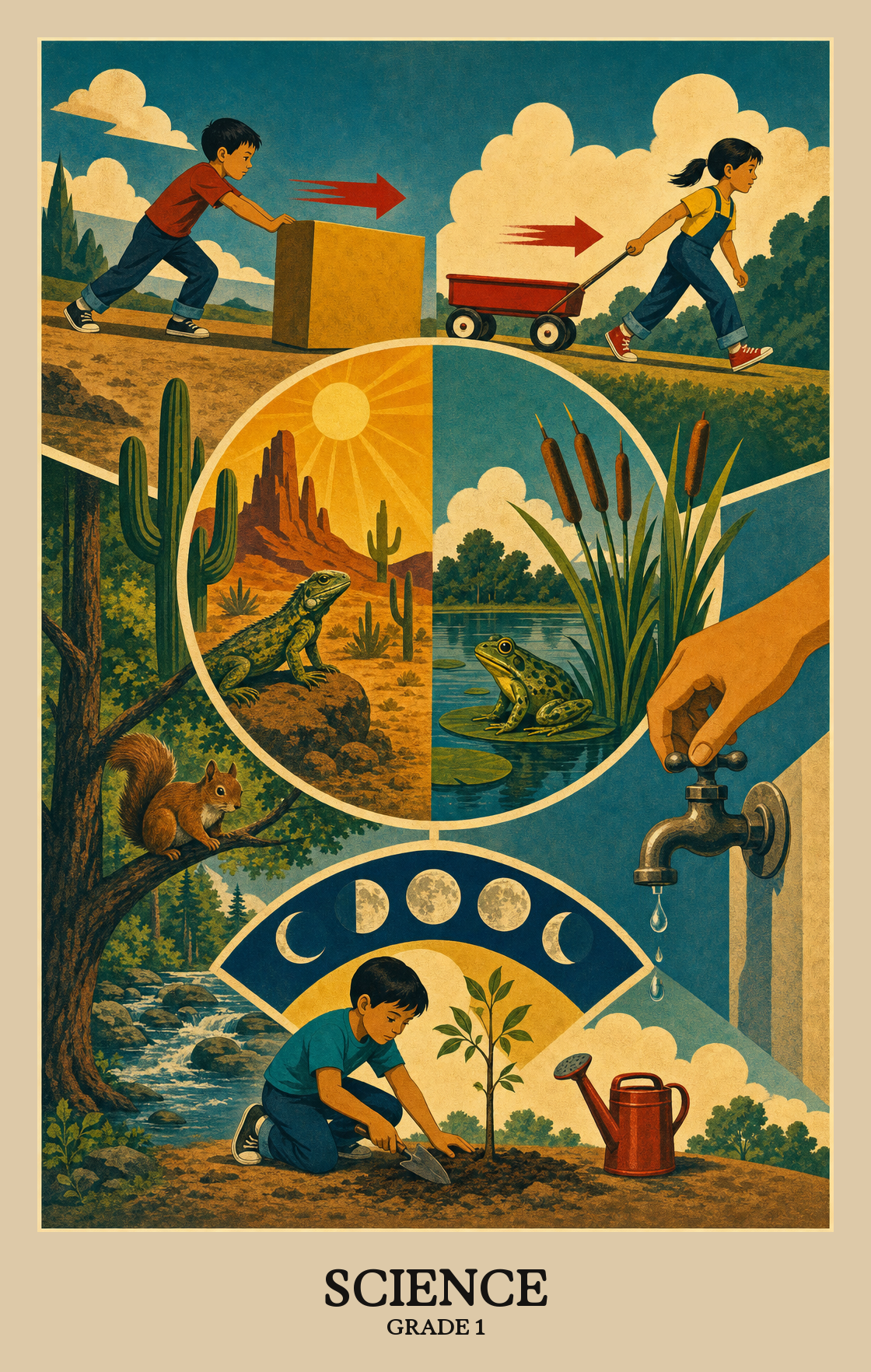
Students start the year experimenting with how things move. They push and pull objects, then watch what happens when they change how hard they push or what gets in the way.
Students look at how living things stay alive. They compare what a fish needs versus a rabbit, and notice how the same animal might find food and shelter in different places.
Students watch the sky and track what changes. They notice what shows up during the day, what shows up at night, and how the moon looks different from one week to the next.
Students dig into the ground beneath them. They sort rocks, feel different soils, and test which kinds of dirt hold water best and grow plants best.
Students close the year thinking about how people use water, trees, and land every day. They talk through small ways to use less and protect what we have.
Pushing or pulling an object changes how it moves. Students learn that a harder push makes something move faster or farther, and that a pull can change direction too.
A push or pull can make an object start moving, stop, or change direction. Students use simple models to show how a force affects movement, even when nothing is touching the object directly.
Students test how a harder push or a lighter push changes the way an object moves. A stronger force makes it go faster or farther; a weaker force keeps it slower or closer.
| Standard | Definition | Code |
|---|---|---|
| Understand how forces | Pushing or pulling an object changes how it moves. Students learn that a harder push makes something move faster or farther, and that a pull can change direction too. | PS.1.1 |
| Use models to explain the effect of a push or pull on the motion of an object… | A push or pull can make an object start moving, stop, or change direction. Students use simple models to show how a force affects movement, even when nothing is touching the object directly. | PS.1.1.1 |
| Carry out investigations to compare the effects of a given force on the motion… | Students test how a harder push or a lighter push changes the way an object moves. A stronger force makes it go faster or farther; a weaker force keeps it slower or closer. | PS.1.1.2 |
Plants and animals need certain things to stay alive. Students learn what those things are, like water, food, and sunlight, and how different living things get what they need in different places.
Plants and animals need certain things to survive. Students learn what those things are (like water, food, and sunlight) and how different living things meet those needs in different places.
Plants and animals need food, water, and shelter to survive. Students look at simple information to see how those needs get met in different places, like a forest, a desert, or a pond.
| Standard | Definition | Code |
|---|---|---|
| Understand the basic needs of a variety of plants and animals in… | Plants and animals need certain things to stay alive. Students learn what those things are, like water, food, and sunlight, and how different living things get what they need in different places. | LS.1.1 |
| Obtain, evaluate and communicate information to summarize the needs… | Plants and animals need certain things to survive. Students learn what those things are (like water, food, and sunlight) and how different living things meet those needs in different places. | LS.1.1.1 |
| Analyze and interpret data to compare how the needs of plants and animals can… | Plants and animals need food, water, and shelter to survive. Students look at simple information to see how those needs get met in different places, like a forest, a desert, or a pond. | LS.1.1.2 |
Students learn to spot patterns in the sky, like why the moon looks different each night and why the sun rises and sets. They observe how the Earth, moon, and sun move in ways that repeat.
Students look at the daytime sky and the nighttime sky and describe what they notice, like where the sun appears in the morning compared to the afternoon, or which stars show up after dark.
Students track how the moon's shape seems to change a little each night, from a thin crescent to a full circle and back again. They look at pictures or records of the moon to spot that pattern.
| Standard | Definition | Code |
|---|---|---|
| Recognize the features and patterns of the earth/moon/sun system as observed… | Students learn to spot patterns in the sky, like why the moon looks different each night and why the sun rises and sets. They observe how the Earth, moon, and sun move in ways that repeat. | ESS.1.1 |
| Use models to recognize differences in the features of the day and night sky… | Students look at the daytime sky and the nighttime sky and describe what they notice, like where the sun appears in the morning compared to the afternoon, or which stars show up after dark. | ESS.1.1.1 |
| Analyze and interpret data to recognize patterns of observable changes in the… | Students track how the moon's shape seems to change a little each night, from a thin crescent to a full circle and back again. They look at pictures or records of the moon to spot that pattern. | ESS.1.1.2 |
Students learn to describe rocks, soil, and water by their physical properties, such as color, texture, and hardness. These are the materials that make up the ground and land around us.
Students sort and describe rocks, soil, and water by what they can see and feel: color, texture, and weight. They share what they find out and compare what others noticed too.
Students dig up or collect soil from different spots nearby, then test how well each sample holds water and helps plants grow. They compare what they find to see which soils work better for growing things.
| Standard | Definition | Code |
|---|---|---|
| Understand the physical properties of Earth materials | Students learn to describe rocks, soil, and water by their physical properties, such as color, texture, and hardness. These are the materials that make up the ground and land around us. | ESS.1.2 |
| Obtain, evaluate and communicate information to summarize the… | Students sort and describe rocks, soil, and water by what they can see and feel: color, texture, and weight. They share what they find out and compare what others noticed too. | ESS.1.2.1 |
| Carry out investigations to compare the properties of different soil… | Students dig up or collect soil from different spots nearby, then test how well each sample holds water and helps plants grow. They compare what they find to see which soils work better for growing things. | ESS.1.2.2 |
Natural resources are things found in nature, like water, soil, and trees, that people use every day. Students learn why these resources matter and what happens when they run low.
Students learn what natural resources are (water, wood, soil, sunlight) and how people use them in everyday life. They read, discuss, and share what they find.
Students look at examples like saving water or planting trees and practice making a case for why those actions help protect the earth's resources.
| Standard | Definition | Code |
|---|---|---|
| Understand that natural resources are important to humans | Natural resources are things found in nature, like water, soil, and trees, that people use every day. Students learn why these resources matter and what happens when they run low. | ESS.1.3 |
| Obtain, evaluate and communicate information to summarize ways in which humans… | Students learn what natural resources are (water, wood, soil, sunlight) and how people use them in everyday life. They read, discuss, and share what they find. | ESS.1.3.1 |
| Engage in argument from evidence to explain ways that humans can protect… | Students look at examples like saving water or planting trees and practice making a case for why those actions help protect the earth's resources. | ESS.1.3.2 |
Alternate assessment for eligible students with significant cognitive disabilities, covering state-tested grades and subjects.
Students explore four big areas: how pushes and pulls move things, what plants and animals need to live, patterns in the sun and moon, and Earth materials like rocks, soil, and water. The focus is on noticing, testing, and explaining, not memorizing long lists of terms.
Go outside and look closely. Watch the moon over a few nights and sketch what changes. Roll a ball on carpet and on a smooth floor and talk about why one stops faster. Plant a bean in a cup and notice what it needs to grow.
Students should be able to show that a push or pull starts, stops, or changes the direction of an object. They should also see that a bigger push moves something farther or faster, and that magnets can pull without touching.
Many teachers start with forces and motion because it is hands-on and hooks students quickly. Living things fit well in spring when plants grow and animals are active outside. Moon patterns work any time, but a full month of observations is needed, so start that unit early.
Moon patterns trip up a lot of students because the changes happen slowly and at night. The idea that a magnet pulls without touching also takes time. Plan extra observation days and use models students can hold and move.
Not really. Students should describe what a rock or soil feels like, looks like, and how it behaves with water. Digging in the yard, rinsing a handful of dirt, and watching what settles teaches more than a vocabulary list.
Students look at how people use water, trees, and soil, then talk about simple ways to protect them. At home, sorting recycling, turning off the tap while brushing teeth, or refilling a water bottle all count as real examples to discuss.
By spring, students should explain how a push or pull changed something they tested, list what a plant or animal needs to survive, describe a pattern they saw in the moon or sky, and give one way people can protect a natural resource.