Our community and its people
Students start the year close to home. They look at who lives in their community, what traditions families share, and how people from different backgrounds shape the place they live.
This is the year students step outside their own block and start seeing how communities work. Students compare traditions and daily life in places near and far, and they look at how rules get made and why people trade for things they need. They use maps and globes to spot rivers, mountains, and other features. By spring, students can read a simple map, explain why a community has rules, and describe how a person from the past changed the place they lived.
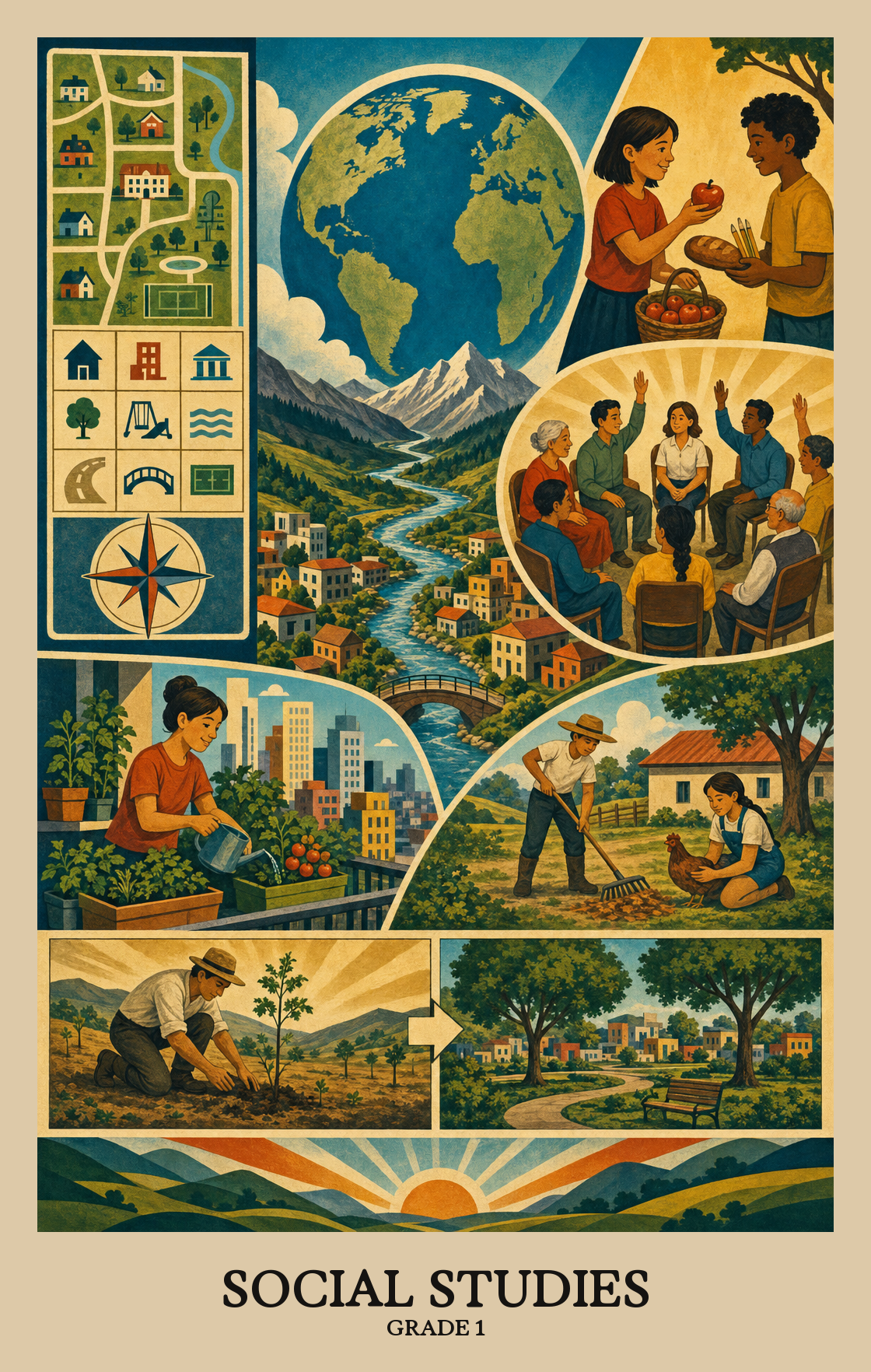
Students start the year close to home. They look at who lives in their community, what traditions families share, and how people from different backgrounds shape the place they live.
Students learn why classrooms and neighborhoods have rules and who helps make them. They practice the difference between what they get to do and what they are expected to do, and how to work out disagreements.
Students use maps and globes to find mountains, rivers, oceans, and other landforms. They learn that little pictures on a map stand for real places, and they start to see where their community sits in the wider world.
Students look at how weather, land, and water shape the way people live, eat, and build. They also see how people change the land around them, from planting gardens to clearing roads.
Students explore why there is not always enough of what people want. They learn how prices and choices shift when something is hard to find, and why people in different places trade with each other.
Students look at people from the past whose work and ideas changed their community and the world. They compare stories and pictures from different times to see how the same event can look different to different people.
Culture is the mix of traditions, values, and beliefs a group shares. Students learn how those shared ideas shape the way people live, build communities, and treat the world around them.
Students look at holidays, foods, languages, and customs from their own neighborhood and from communities across the world, then name what makes each place's way of life distinct.
People from different backgrounds bring their own traditions, foods, languages, and ideas to a community. Students learn how that mix of cultures shapes the neighborhood everyone shares.
Art, music, stories, and dance reflect where people come from and what they believe. Students learn how creative traditions from different cultures make communities richer and more interesting.
Students learn that different families and communities have their own ways of working out disagreements, and that those habits come from what people believe and value. What feels fair in one place may look different somewhere else.
| Standard | Definition | Code |
|---|---|---|
| Understand how culture, values | Culture is the mix of traditions, values, and beliefs a group shares. Students learn how those shared ideas shape the way people live, build communities, and treat the world around them. | 1.B.1 |
| Identify cultural practices and traditions in local communities and places… | Students look at holidays, foods, languages, and customs from their own neighborhood and from communities across the world, then name what makes each place's way of life distinct. | 1. B.1.1 |
| Summarize ways that culturally, racially | People from different backgrounds bring their own traditions, foods, languages, and ideas to a community. Students learn how that mix of cultures shapes the neighborhood everyone shares. | 1 B.1.2 |
| Explain how the artistic expressions of diverse people and cultures contribute… | Art, music, stories, and dance reflect where people come from and what they believe. Students learn how creative traditions from different cultures make communities richer and more interesting. | 1. B.1.3 |
| Explain how culture, values | Students learn that different families and communities have their own ways of working out disagreements, and that those habits come from what people believe and value. What feels fair in one place may look different somewhere else. | 1. B.1.4 |
Students learn what it means to be part of a community, from following rules to helping neighbors. They practice the small actions that make a group work.
People in a community make decisions together, follow shared rules, and take action to solve problems. Students explore how one person or a group can change a neighborhood, school, or town.
Students practice how rules get made, not just what the rules say. They look at examples of people working together to set rules for a classroom, a neighborhood, or a town.
Students learn the difference between what they are allowed to do (rights) and what they are expected to do (responsibilities) as members of a school, neighborhood, or country.
Students look at different ways people work to make their neighborhood better, like volunteering, solving problems together, or asking leaders for change. They compare those approaches to see what works.
| Standard | Definition | Code |
|---|---|---|
| Understand how people engage with and participate in the community | Students learn what it means to be part of a community, from following rules to helping neighbors. They practice the small actions that make a group work. | 1.C&G.1 |
| Exemplify ways individuals and groups play a role in shaping communities | People in a community make decisions together, follow shared rules, and take action to solve problems. Students explore how one person or a group can change a neighborhood, school, or town. | 1.C&G.1.1 |
| Exemplify ways individuals and groups contribute to the making of rules and… | Students practice how rules get made, not just what the rules say. They look at examples of people working together to set rules for a classroom, a neighborhood, or a town. | 1.C&G.2 |
| Identify the differences between rights and responsibilities of citizens in… | Students learn the difference between what they are allowed to do (rights) and what they are expected to do (responsibilities) as members of a school, neighborhood, or country. | 1.C&G.1.3 |
| Compare various processes or strategies people can use to improve communities | Students look at different ways people work to make their neighborhood better, like volunteering, solving problems together, or asking leaders for change. They compare those approaches to see what works. | 1.C&G.1.4 |
Students learn why people choose one thing over another when they can't have everything. They practice recognizing needs, wants, and trade-offs in everyday decisions like spending money or sharing resources.
Scarcity means there is not enough of something for everyone who wants it. Students learn why people have to make choices about how to use limited things like money, food, or time.
Students learn why prices rise when a toy is popular but hard to find, and drop when there are plenty to go around. It's the push and pull between how much of something exists and how many people want it.
When there are not enough of something people want, prices go up and people have to choose carefully. Students learn how having too much or too little of a good changes what people decide to buy.
People trade because no one can make everything they need. Students learn why a town, region, or country swaps what it produces well for things others make better.
| Standard | Definition | Code |
|---|---|---|
| Understand the role of basic economic concepts in the decisions people make | Students learn why people choose one thing over another when they can't have everything. They practice recognizing needs, wants, and trade-offs in everyday decisions like spending money or sharing resources. | 1.E.1 |
| Distinguish the relationship between scarcity and limited resources | Scarcity means there is not enough of something for everyone who wants it. Students learn why people have to make choices about how to use limited things like money, food, or time. | 1.E.1.1 |
| Recognize the relationship between supply and demand | Students learn why prices rise when a toy is popular but hard to find, and drop when there are plenty to go around. It's the push and pull between how much of something exists and how many people want it. | 1.E.1.2 |
| Exemplify how supply and demand affect the choices people make | When there are not enough of something people want, prices go up and people have to choose carefully. Students learn how having too much or too little of a good changes what people decide to buy. | 1.E.1.3 |
| Summarize reasons why people and countries trade goods and services | People trade because no one can make everything they need. Students learn why a town, region, or country swaps what it produces well for things others make better. | 1.E.1.4 |
Students use maps, globes, and simple directions like "north" or "near the river" to describe the neighborhood, school, or world around them.
Students look at maps, globes, and photos to find and name landforms like mountains, islands, and rivers in different parts of the world.
Students learn that maps use small pictures or symbols to stand for real things, like a blue line for a river or a tree shape for a forest. They practice reading those symbols to figure out what a place looks like.
Students learn how people change the land around them and how the land shapes the way people live, in places that look very different from one another.
Students look at how land, weather, and water shape the way people live. A child near the ocean fishes for food; a child near mountains dresses for cold. Place affects daily life.
Students learn how people change the land, water, and air around them. A farmer clearing a field, a city paving a road, or a village fishing a river all count as examples.
| Standard | Definition | Code |
|---|---|---|
| Apply geographic representations, tools, and terms to describe surroundings | Students use maps, globes, and simple directions like "north" or "near the river" to describe the neighborhood, school, or world around them. | 1.G.1 |
| Use maps, globes, and/or digital representations to identify various types of… | Students look at maps, globes, and photos to find and name landforms like mountains, islands, and rivers in different parts of the world. | 1.G.1.1 |
| Exemplify how geographic features are represented by symbols on maps or… | Students learn that maps use small pictures or symbols to stand for real things, like a blue line for a river or a tree shape for a forest. They practice reading those symbols to figure out what a place looks like. | 1.G.1.2 |
| Understand interactions between humans and the environment in different places… | Students learn how people change the land around them and how the land shapes the way people live, in places that look very different from one another. | 1.G.2 |
| Explain the various ways the physical environment impacts people in different… | Students look at how land, weather, and water shape the way people live. A child near the ocean fishes for food; a child near mountains dresses for cold. Place affects daily life. | 1.G.2.1 |
| Explain the various ways people impact the physical environment in different… | Students learn how people change the land, water, and air around them. A farmer clearing a field, a city paving a road, or a village fishing a river all count as examples. | 1.G.2.2 |
People and events shape the world students live in now. Students look at how life in the past was different and what changed it.
People in history made choices and created things that changed the way communities look and work today. Students learn how those actions, big and small, shaped the towns and places we live in now.
Students look at photos, letters, or stories from different people to see how the same historical event can look different depending on who lived through it.
| Standard | Definition | Code |
|---|---|---|
| Understand how people and events have changed society over time | People and events shape the world students live in now. Students look at how life in the past was different and what changed it. | 1.H.1 |
| Explain how the experiences and achievements of people throughout history have… | People in history made choices and created things that changed the way communities look and work today. Students learn how those actions, big and small, shaped the towns and places we live in now. | 1.H.1.1 |
| Use primary and secondary sources to compare multiple perspectives of various… | Students look at photos, letters, or stories from different people to see how the same historical event can look different depending on who lived through it. | 1.H.1.2 |
Federally administered sample-based assessment in reading, mathematics, science, writing, and other subjects. NAEP results inform state-by-state comparisons rather than individual student or school accountability.
Students learn how communities work. They study rules and rights, basic money ideas like wanting more than is available, maps and landforms, and how people and traditions have changed places over time. The focus is the local community and a few examples from around the world.
Talk about the community students live in. Point out rules at the store, look at a map before a trip, name the landforms around town, and share family traditions. Ten minutes of real conversation about a sign, a coin, or a holiday goes a long way.
A primary source is something from the time an event happened, like a photo, a letter, or an object. Students compare these with books written later to see that people can tell the same story in different ways. At home, old family photos make a great primary source.
A common path is geography first to build map skills, then history to show change over time, then civics and economics once students can talk about groups and choices. Behavioral sciences threads through the whole year as students compare traditions and resolve classroom disagreements.
Scarcity and supply and demand are the hardest. Six-year-olds need many concrete examples, like one cookie and four hands, before the words make sense. The difference between a right and a responsibility also takes repeated practice with classroom examples.
Students name traditions in their own families and classrooms first, then look at a few examples from other parts of the world. Art, music, food, and stories are the main entry points. The goal is respect and curiosity, not memorising facts about other countries.
Students should read a simple map key, point to land and water on a globe, and name landforms like mountains, rivers, and islands. They should also understand that a symbol on a map stands for something real, like a tree shape meaning a forest.
By June, students can describe their community, name a few rules and why they exist, give an example of scarcity, read a basic map, and explain one way a person from history changed a place. They can also compare two sources that tell the same story differently.
Make it local and physical. Walk to a park and find it on a map. Ask who makes the rules at school and why. Look at an old family photo and ask what has changed. Students remember the conversation, not the worksheet.