Skip to content

What does a student learn in ?

This is the year science moves from watching the world to testing it on purpose. Students melt and freeze water to see how solids and liquids switch back and forth, pluck rubber bands to learn that sound comes from things that wiggle, and track the weather day after day. They also study how baby animals grow up and why kittens from the same litter can look so different. By spring, they can read a thermometer, chart a week of weather, and explain why an ice cube turns into a puddle.

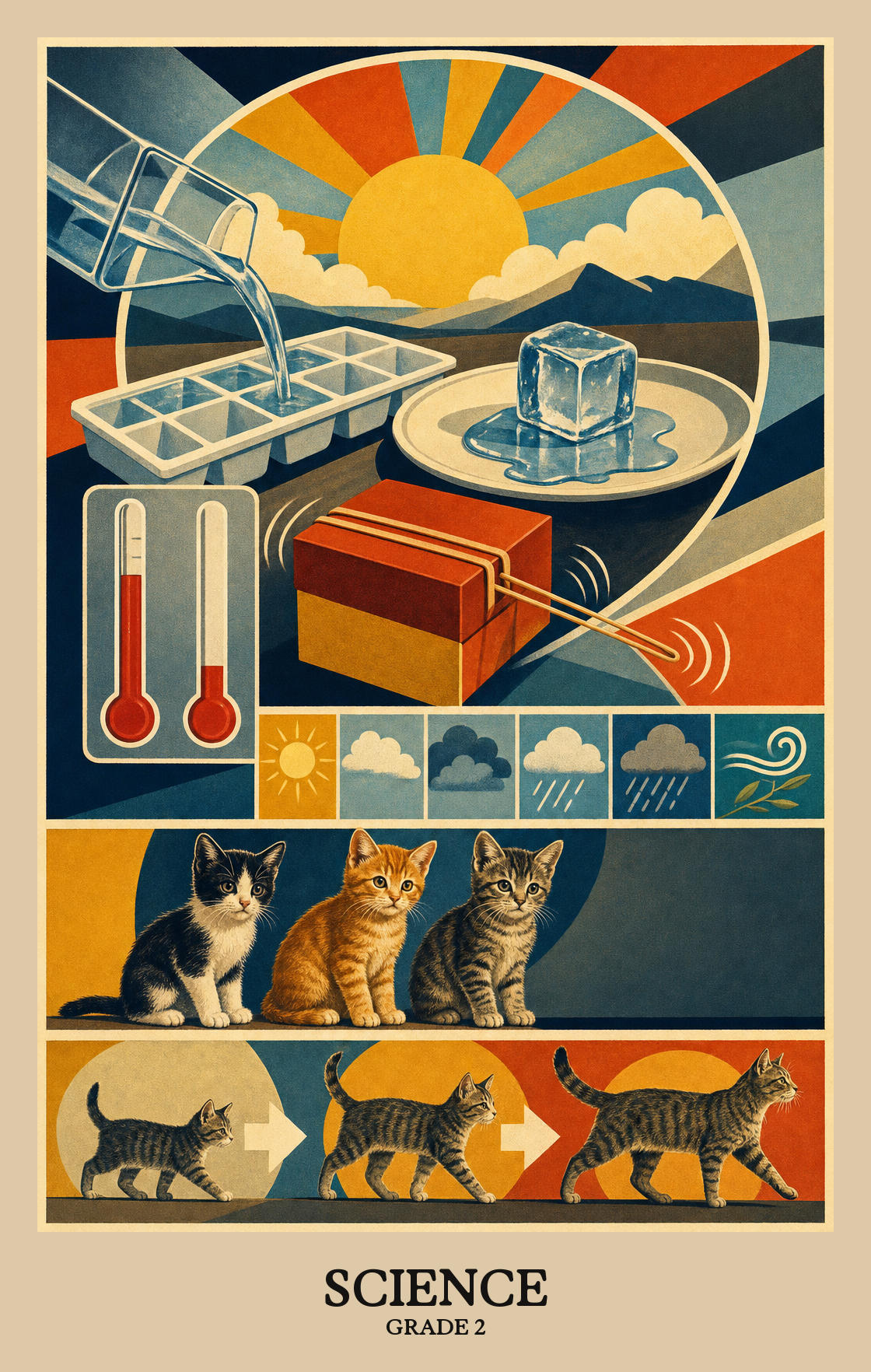
Illustration of what students learn in Grade 2 Science
  • Solids and liquids
  • Sound and vibration
  • Animal life cycles
  • Weather patterns
  • Traits from parents
Source: North Carolina NC Standard Course of Study
Year at a glance
How the year usually goes. Every school and district set their own curriculum, so treat this as a guide, not official pacing.
  1. 1

    Solids, liquids, and changes

    Students melt and freeze water and other materials to see how heating and cooling change them. They weigh and measure water before and after freezing, and watch what happens to water left out in an open cup versus a closed one.

  2. 2

    Sound and vibration

    Students pluck, tap, and strum objects to feel how sound comes from things that shake back and forth. They also learn how their ears pick up those vibrations so they can hear.

  3. 3

    Animal life cycles

    Students follow animals from birth to adulthood to old age. They compare how a butterfly, a frog, and a chicken grow up in very different ways.

  4. 4

    Parents and offspring

    Students look at why baby animals look a lot like their parents but not exactly the same. They compare puppies from one litter or chicks from one hen to spot small differences.

  5. 5

    Weather and the sun

    Students track temperature, wind, and rain across days and seasons. They learn that the sun warms the land, air, and water, and they try out the tools weather forecasters use.

Mastery Learning Standards
The required skills a student should display by the end of Grade 2.
Matter and its Interactions
  • Understand properties of solids and liquids and the changes they undergo

    PS.2.1

    Solids keep their shape on their own; liquids take the shape of whatever holds them. Students learn to spot the difference and describe what happens when matter heats up, cools down, or mixes with something else.

  • Carry out investigations to illustrate examples of matter that can change from…

    PS.2.1.1

    Students heat and cool everyday materials like ice and butter to watch them melt into liquid or freeze back into solid, learning that temperature drives this change.

  • Analyze and interpret data to compare the amount

    PS.2.1.2

    Students measure water in a container, then freeze it and measure again. They compare the weight and the amount of space the ice takes up to see what changed.

  • Analyze and interpret data to compare the amount

    PS.2.1.3

    Students measure how much water stays in an open cup versus a sealed one over several days. They record what happens and explain why the amounts change differently.

Waves and Their Applications in Technologies for Information Transfer
  • Understand the relationship between sound and vibrating objects

    PS.2.2

    Sound comes from objects that vibrate. Students learn that when something shakes or moves back and forth quickly, it makes a sound, and when the vibrating stops, the sound stops too.

  • Carry out investigations to illustrate how sound is produced by…

    PS.2.2.1

    Pluck a rubber band or tap a drum and students notice the object shakes quickly back and forth. They investigate how that shaking movement is what makes sound.

  • Use models to summarize the relationship between sound and how sounds are…

    PS.2.2.2

    Students build or draw a model showing how sound is made when something vibrates and how the ear picks it up. The focus is on connecting the vibration you can sometimes feel to the sound you hear.

From Molecules to Organisms- Structures and Processes
  • Understand animal life cycles

    LS.2.1

    Animals grow, change, and reproduce in patterns called life cycles. Students learn how a frog, butterfly, or dog moves through stages like birth, growth, and reproduction.

  • Use models to summarize the life cycle of animals including

    LS.2.1.1

    Animals are born, grow into adults, have offspring, grow old, and die. Students use drawings or diagrams to show how this cycle repeats for different animals.

  • Obtain, evaluate and communicate information to compare life cycles…

    LS.2.1.2

    Animals are born, grow, reproduce, and die, but the path looks different for each species. Students compare how a frog's life cycle differs from a butterfly's or a dog's, using books, videos, and other sources.

Heredity- Inheritance and Variation of Traits
  • Understand that organisms differ from or are similar to their parents and other…

    LS.2.2

    Young animals and plants share traits with their parents but are not exact copies. Students look at features like color, shape, and size to explain how offspring can resemble a parent in some ways and differ in others.

  • Obtain, evaluate, and communicate information to summarize ways in…

    LS.2.2.1

    Young animals look like their parents in many ways but not exactly. Students gather facts and pictures to explain which traits, like fur color or body shape, match the parents and which ones differ.

  • Analyze and interpret data to illustrate variations among offspring of the…

    LS.2.2.2

    Students look at data about siblings or baby animals from the same parents to see how offspring can look similar in some ways and different in others.

Earth’s Systems
  • Understand patterns of weather and factors that affect weather

    ESS2.1

    Students learn to recognize weather patterns, like why some days are cloudy or windy, and what factors shape the weather outside their window.

  • Obtain, evaluate, and communicate information to summarize how energy from the…

    ESS2.1.1

    Energy from the sun heats the ground, the air, and water on Earth. Students learn how sunlight is the main reason temperatures change and things feel warm.

  • Use mathematics and computational thinking to summarize weather conditions…

    ESS2.1.2

    Students collect and record daily weather data, such as temperature and wind speed, then use simple numbers and charts to spot patterns over time.

  • Carry out investigations to collect data and compare weather patterns…

    ESS2.1.3

    Students collect weather data over days and seasons, then look for patterns. They connect what they find to time of day and time of year, like why mornings feel cooler or why summer days last longer.

  • Obtain, evaluate and communicate information to recognize the tools scientists…

    ESS2.1.4

    Students learn which tools scientists use to watch and record the weather, like thermometers, rain gauges, and wind vanes, and how those tools help predict what tomorrow's weather might look like.

No state assessments at this grade
Students take their next one in Grade 3.
Alternate assessment

NCEXTEND1 Alternate Assessments

Alternate assessment for eligible students with significant cognitive disabilities, covering state-tested grades and subjects.

When given:
state testing window
Frequency:
annual
Official source
Common Questions
  • What science topics will students learn this year?

    Students study solids and liquids, sound and vibration, animal life cycles, how baby animals resemble their parents, and weather. Most of the year involves hands-on investigations where students observe something, collect data, and explain what they noticed.

  • How can I help with science at home?

    Freeze water in a cup and check the line before and after. Tap a stretched rubber band and feel it buzz. Watch the clouds each morning for a week. Short, repeated noticing at home matters more than fancy projects.

  • What does mastery look like by the end of the year?

    Students should describe how ice melts and water freezes, explain that sound comes from things that wiggle back and forth, name the stages of an animal life cycle, and read a thermometer to record daily weather.

  • My child says sound comes from vibrations. Is that right?

    Yes. Anything making sound is shaking quickly, even if it is too fast to see. Pressing fingers gently on the throat while humming is a clear way to feel it. Tapping a ruler off the edge of a table shows it too.

  • How should I sequence the units across the year?

    A common order is weather first, since students can collect data daily all year, then matter in the cooler months when freezing is easy to observe. Sound and life cycles fit well in spring when butterfly or mealworm kits are available.

  • Which ideas usually need the most reteaching?

    Volume versus weight after freezing trips students up, since the water level rises but the weight stays the same. Many also think loud sounds and quiet sounds work differently, rather than both coming from vibration.

  • How do I help if my child gets stuck on a science question?

    Ask what they noticed and what they think will happen next. Two-year-olds and second graders both learn science by predicting and checking. Avoid giving the answer right away, since the thinking matters more than the term.

  • How do I know students are ready for next year?

    They should be able to run a simple investigation, record numbers or observations in a chart, and explain a pattern they saw. Comfort with measuring temperature and describing changes over time is the strongest signal.