People who shaped America
Students learn about people from many backgrounds who helped build the country. They look at women, Native groups, and others whose stories often get left out of the usual telling.
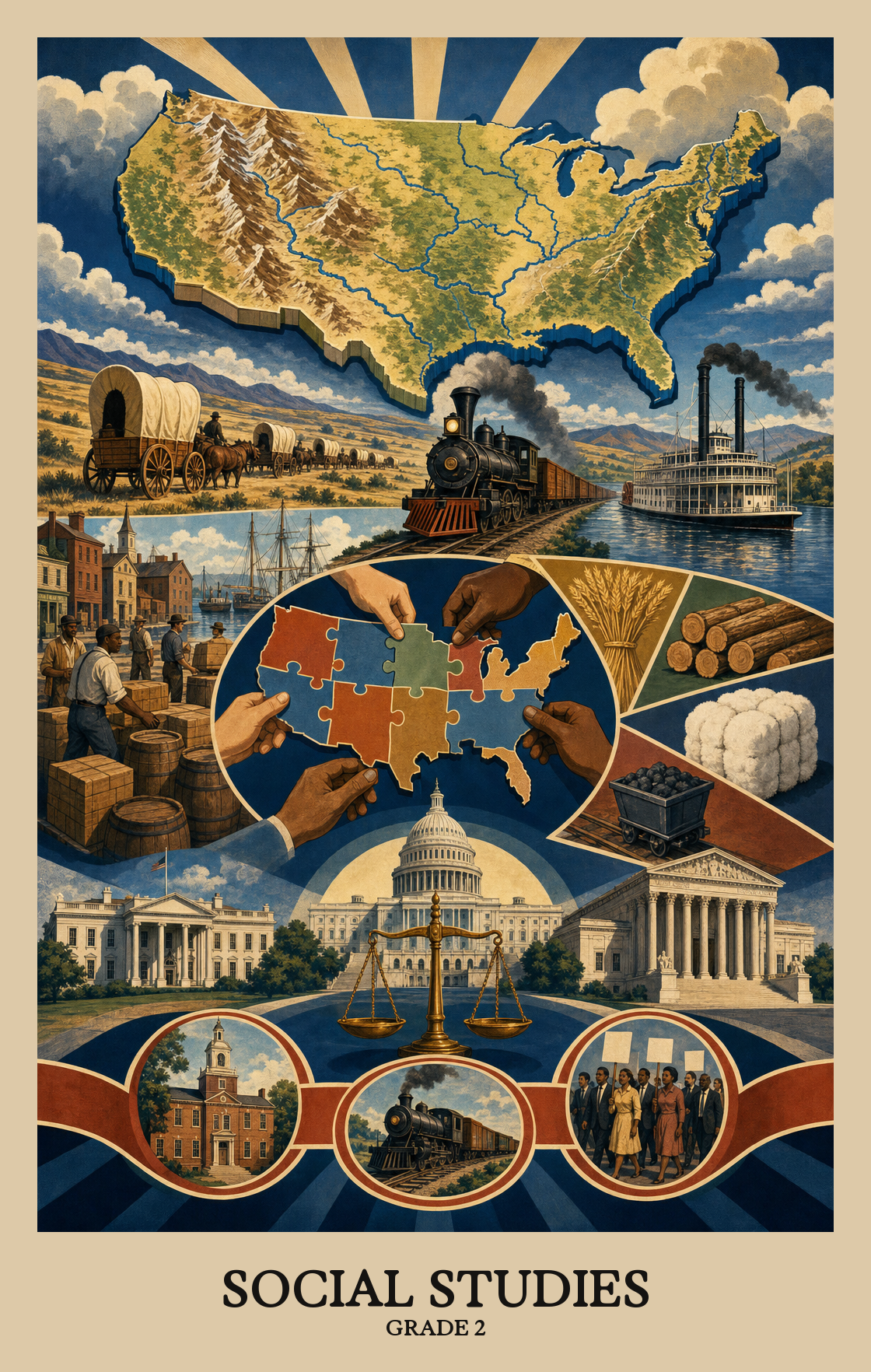
This is the year social studies zooms out from the local community to the whole country. Students start to see America as a place built by many different people, with shared ideas like freedom and fair government. They learn how land, rivers, and resources shaped where people settled and what they made or traded. By spring, students can name a few people or events that changed America and explain why the country has three branches of government.
Students learn about people from many backgrounds who helped build the country. They look at women, Native groups, and others whose stories often get left out of the usual telling.
Students explore how different groups of people brought their own traditions and ideas to America. They start to see how a country can hold many cultures at once.
Students learn what freedom, equality, and democracy mean in everyday words. They look at the three branches of government and what each one does.
Students use maps to find where settlements grew and why people chose those spots. They talk about how rivers, mountains, and weather shaped where people lived and traveled.
Students learn that there is not always enough of everything to go around. They see how people decide what to make, what to buy, and what to trade when resources are limited.
Students look at everyday traditions, holidays, and family customs to see how shared values shape what American life looks and feels like.
Students learn what words like freedom and equality actually mean, then connect those ideas to how the American government makes decisions and treats people.
Students learn why people can't always buy everything they want. When something is hard to find or costs more, people make different choices about how to spend their money.
Students learn how where people choose to live shapes the land around them, and how rivers, mountains, and other natural features affect where communities grow and how people travel between them.
Students learn how real people and key moments in history helped shape the country America became today.
| Standard | Definition | Code |
|---|---|---|
| Understand how values and beliefs shape culture in America | Students look at everyday traditions, holidays, and family customs to see how shared values shape what American life looks and feels like. | 2.B.1 |
| Understand how freedom, equality, and democracy contribute to the government of… | Students learn what words like freedom and equality actually mean, then connect those ideas to how the American government makes decisions and treats people. | 2.C&G.1 |
| Understand how the availability of resources impacts economic decisions | Students learn why people can't always buy everything they want. When something is hard to find or costs more, people make different choices about how to spend their money. | 2.E.1 |
| Understand how interaction between humans and the physical environment is… | Students learn how where people choose to live shapes the land around them, and how rivers, mountains, and other natural features affect where communities grow and how people travel between them. | 2.G.1 |
| Understand how various people and events have shaped America | Students learn how real people and key moments in history helped shape the country America became today. | 2.H.1 |
Students look at traditions, holidays, and customs from different cultures and explain how those ideas helped shape what it means to be American.
Students learn how the beliefs of Native American tribes, religious communities, and different racial groups have shaped American traditions, holidays, and daily life. The goal is to see how each group's values left a mark on the shared culture around them.
| Standard | Definition | Code |
|---|---|---|
| Identify the various values and beliefs of diverse cultures that have shaped… | Students look at traditions, holidays, and customs from different cultures and explain how those ideas helped shape what it means to be American. | 2.B.1.1 |
| Explain how belief systems of various indigenous, religious | Students learn how the beliefs of Native American tribes, religious communities, and different racial groups have shaped American traditions, holidays, and daily life. The goal is to see how each group's values left a mark on the shared culture around them. | 2.B.1.2 |
Students learn what democracy means and how its core ideas, like voting and equal say, shaped the rules and leaders of American government.
Students learn what the government's job is: protecting people's rights and making sure everyone is treated fairly. They practice putting that idea into their own words.
Students learn what the President, Congress, and the Supreme Court each do, and why the country has three separate groups running the government instead of one.
| Standard | Definition | Code |
|---|---|---|
| Explain how principles of democracy have shaped the government of America | Students learn what democracy means and how its core ideas, like voting and equal say, shaped the rules and leaders of American government. | 2.C&G.1.1 |
| Summarize the role of government in protecting freedom and equality of… | Students learn what the government's job is: protecting people's rights and making sure everyone is treated fairly. They practice putting that idea into their own words. | 2.C&G.121 |
| Compare the structure and function of the three branches of government at the… | Students learn what the President, Congress, and the Supreme Court each do, and why the country has three separate groups running the government instead of one. | 2.C&G.1.3 |
Scarcity means there isn't enough of something for everyone who wants it. Students learn how that shortage pushes people to make choices about what to buy, save, or give up.
When a factory or farm runs short of something it needs, like wood, water, or workers, it makes fewer goods. Students learn why the things we can make depend on what supplies are available.
| Standard | Definition | Code |
|---|---|---|
| Explain how scarcity affects economic decisions | Scarcity means there isn't enough of something for everyone who wants it. Students learn how that shortage pushes people to make choices about what to buy, save, or give up. | 2.E.1.1 |
| Explain how the availability of resources impacts the production of goods | When a factory or farm runs short of something it needs, like wood, water, or workers, it makes fewer goods. Students learn why the things we can make depend on what supplies are available. | 2.E.1.2 |
Students learn to find places on a map two ways: by exact address or coordinates, and by describing where something sits relative to nearby landmarks, rivers, or borders. This builds the map-reading foundation for studying how the United States took shape.
Students learn why early communities were built near rivers, forests, or flat land. Geography shaped where people settled and how they lived.
Students look at how people moving to new places, trading goods, and sharing ideas shaped different regions of the United States. A new settlement, a trade route, or a shared belief can change what a region looks like and how people live there.
| Standard | Definition | Code |
|---|---|---|
| Recognize absolute and relative location of various settlements, territories | Students learn to find places on a map two ways: by exact address or coordinates, and by describing where something sits relative to nearby landmarks, rivers, or borders. This builds the map-reading foundation for studying how the United States took shape. | 2.G.1.1 |
| Explain how the environment has impacted settlement across America | Students learn why early communities were built near rivers, forests, or flat land. Geography shaped where people settled and how they lived. | 2.G.1.2 |
| Interpret how the movement of people, goods | Students look at how people moving to new places, trading goods, and sharing ideas shaped different regions of the United States. A new settlement, a trade route, or a shared belief can change what a region looks like and how people live there. | 2.G.1.3 |
Students learn about real people from many different backgrounds whose actions changed American history. They practice putting those contributions into their own words.
Students learn how past events, like wars, discoveries, and the work of leaders, changed the way America grew and the way people live today.
Students look at the same moment in history through more than one set of eyes. They compare what a person from that time wrote or drew with what a historian wrote later, noticing where the accounts agree and where they differ.
| Standard | Definition | Code |
|---|---|---|
| Summarize contributions of various women, indigenous, religious, racial | Students learn about real people from many different backgrounds whose actions changed American history. They practice putting those contributions into their own words. | 2.H.1.1 |
| Explain ways in which various historical events have shaped American history | Students learn how past events, like wars, discoveries, and the work of leaders, changed the way America grew and the way people live today. | 2.H.1.2 |
| Compare various perspectives of the same time period using primary and… | Students look at the same moment in history through more than one set of eyes. They compare what a person from that time wrote or drew with what a historian wrote later, noticing where the accounts agree and where they differ. | 2.H.1.3 |
Federally administered sample-based assessment in reading, mathematics, science, writing, and other subjects. NAEP results inform state-by-state comparisons rather than individual student or school accountability.
Students learn about America by looking at five things: culture, government, money choices, geography, and history. They start to see how different groups of people, places, and events shaped the country. Most of the learning happens through stories, maps, and pictures rather than textbook reading.
Talk about family traditions, where relatives came from, and why they settled where they did. Look at a map of the United States together and find places students have heard about. Short conversations at dinner do more than worksheets at this age.
Students should be able to name the three branches of the national government in simple terms: one makes laws, one carries them out, and one decides what the laws mean. They should also know that government is supposed to protect fairness and freedom for everyone.
A common path is geography first, then history, then culture, then government, with economics woven in. Starting with maps and settlement gives students a place to anchor the people and events that come later. Save the three branches for spring once students have more background.
Scarcity means there is not enough of something for everyone who wants it. A good way to show this at home is with a snack: if there are four cookies and six people, someone has to make a choice. That choice is economics.
Telling absolute location from relative location trips students up, as does keeping the three branches straight. Plan to revisit both several times in short bursts rather than teaching each once. Anchor charts that stay on the wall all year help more than a single unit test.
Students look at photographs, old letters, paintings, and short quotes, then compare them with a modern book or article about the same event. The goal is noticing that two people can describe the same moment in different ways. Deep analysis comes in later grades.
By spring, students should be able to point to America on a map, name a few historical figures and explain why they matter, and describe one way the environment shaped where people settled. They should also be able to give a simple example of a good or service and why it costs what it does.
Tie it to real places and real people. Visit a local historical marker, watch a short video about a national park, or read a picture book about someone like Harriet Tubman or Sequoyah. Stories about actual people land better than lists of facts.