Counting and sorting to start
Students count small groups of objects and match each one to a number as they go. They sort buttons, blocks, and toys into groups by color, size, or shape and talk about what each group has in common.
This is the year math starts with counting and grows into real number sense. Students count to 100, recognize and write numbers up to 30, and figure out which group has more or fewer. They add and subtract small amounts using fingers, blocks, and pictures, and they start naming shapes like circles, triangles, and squares. By spring, students can count a pile of 30 objects and tell you how many are in each group on a simple picture graph.
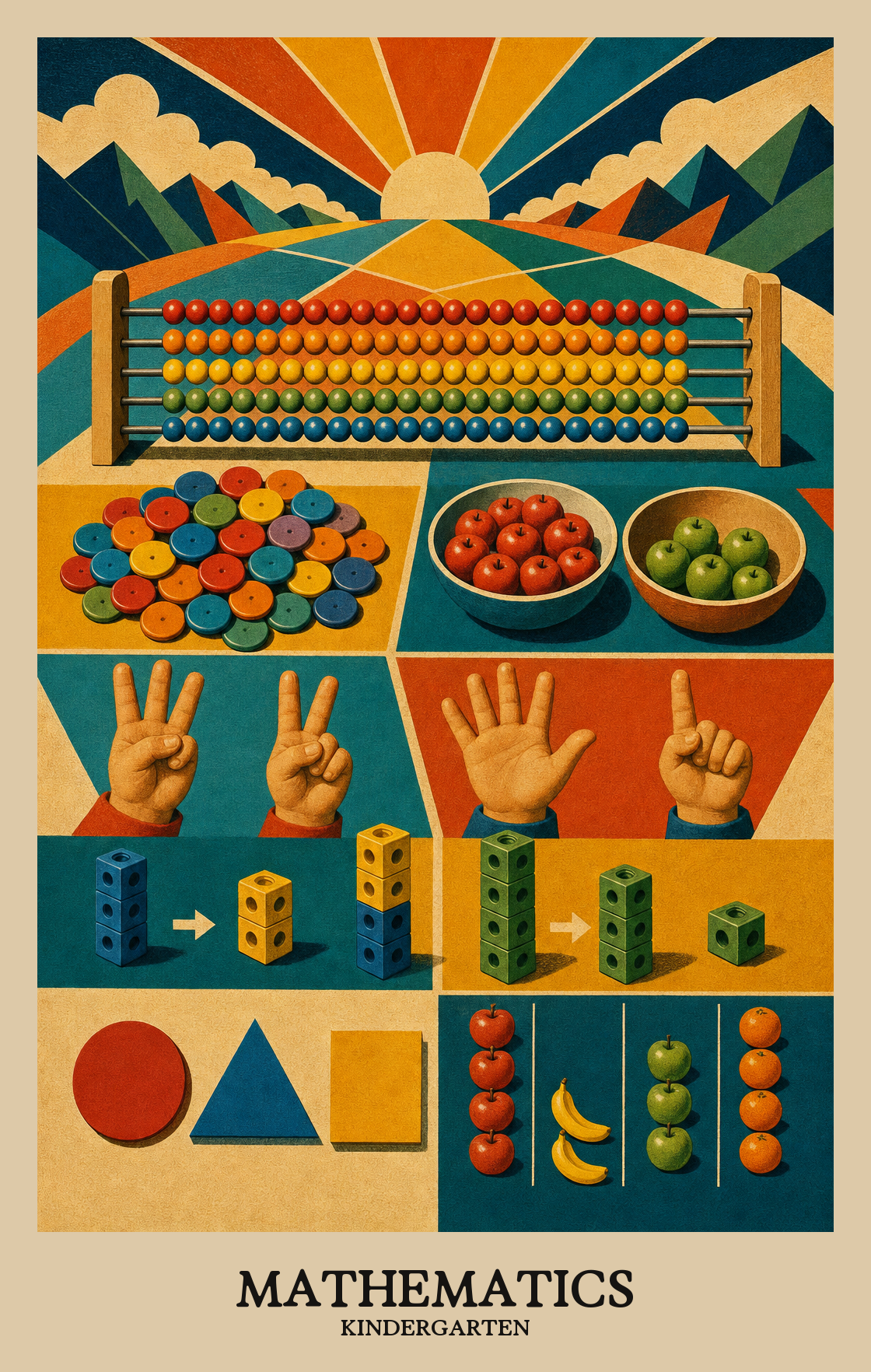
Students count small groups of objects and match each one to a number as they go. They sort buttons, blocks, and toys into groups by color, size, or shape and talk about what each group has in common.
Students read and write the numbers 0 to 30 and build sets that match each one. They compare two groups and decide which has more, fewer, or the same, using fingers, ten-frames, and pictures.
Students take numbers up to 10 apart and put them back together in different ways. They use cubes and drawings to solve simple story problems about joining groups or taking some away.
Students name circles, triangles, squares, and rectangles and build them from straws or sticks. They compare two objects to see which is longer, taller, heavier, or holds more, and they learn the days of the week and months of the year.
Students find the repeating part of a pattern and keep it going with colors, sounds, or movements. They ask a question, collect answers from classmates, and show what they found in a simple picture graph.
Students count all the way to 100 by ones and start counting by tens using groups of cubes or pennies. They take numbers like 14 or 18 apart into a ten and some ones, which sets them up for first grade.
Students count, compare, and name amounts. This is the foundation for every math skill that comes after it.
Students count small groups of objects, add by putting groups together, and take away to find what's left. The work is hands-on: blocks, fingers, drawings.
Students learn to measure length and size by comparing everyday objects, and to name and sort shapes like circles, squares, and triangles.
Students sort objects into groups and count how many are in each group. That's the start of reading a simple chart or graph.
Students sort objects by shape, color, or size and find simple repeating patterns, like red-blue-red-blue. Recognizing what comes next builds the foundation for math rules they will use for years.
| Standard | Definition | Code |
|---|---|---|
| Number and Number Sense | Students count, compare, and name amounts. This is the foundation for every math skill that comes after it. | K.NS |
| Computation and Estimation | Students count small groups of objects, add by putting groups together, and take away to find what's left. The work is hands-on: blocks, fingers, drawings. | K.CE |
| Measurement and Geometry | Students learn to measure length and size by comparing everyday objects, and to name and sort shapes like circles, squares, and triangles. | K.MG |
| Probability and Statistics | Students sort objects into groups and count how many are in each group. That's the start of reading a simple chart or graph. | K.PS |
| Patterns, Functions, and Algebra | Students sort objects by shape, color, or size and find simple repeating patterns, like red-blue-red-blue. Recognizing what comes next builds the foundation for math rules they will use for years. | K.PFA |
Students count objects, pictures, and groups of things up to 100, using whatever counting method makes sense for the situation, such as starting from a different number or counting in groups.
Counting objects one by one, students touch or point to each item in a group of up to 30 things and say a number for each one. The last number they say tells them how many are in the group.
Counting ten toys in a line gives the same answer as counting the same ten toys in a circle. Students learn that rearranging objects doesn't change how many there are.
Counting forward means saying numbers in order: 1, 2, 3. Students practice this by filling in grids and paths that show each number as its own step, building a picture of how numbers grow.
Counting out loud from 0 to 100, one number at a time, in order. Students practice saying each number in the right sequence without skipping or repeating.
Starting from any number, students count forward out loud to 100. This builds the mental number line they will use for adding and subtracting later.
Students start at any number between 1 and 20 and count down out loud. It is the same idea as a rocket launch countdown, practiced until it feels as automatic as counting forward.
Given any number up to 30, students say the next number right away without counting up from the start. This builds number fluency so students stop relying on finger-counting for every problem.
Given a number between 1 and 20, students say the number that comes just before it without counting up from one. For example, if given 14, students say 13 right away.
Breaking apart numbers 11 through 19, students show that each one is made of a ten and some leftover ones. They use blocks, drawings, or written numbers to do it.
Students sort a pile of small objects into groups of ten, then count by tens to find the total. A pile of 36 pennies becomes 3 groups of ten with 6 left over.
Students count objects, draw groups, and figure out which pile has more or fewer. They work with quantities up to 30.
Students read and write every number from 0 to 30 and match each written numeral to the right amount.
Given a number, students build a matching group of objects. If the number is zero, they show an empty set with nothing in it.
Students count a group of up to 30 objects and write the number that shows how many there are.
Students look at a group of objects and build a new group that has more, fewer, or the same amount. This works with up to 30 objects, using real items or pictures.
Given a number like 14, students build a group of objects that has more, fewer, or the same count. They show they understand what that number means by physically making a matching set.
Students look at two groups of objects and decide which group has more, which has fewer, or whether both groups have the same amount. Groups can have up to 30 objects each.
Students look at two numbers and say which is bigger, smaller, or the same, using tools like a ten-frame or their fingers as a reference point.
| Standard | Definition | Code |
|---|---|---|
| The student will utilize flexible counting strategies to determine and describe… | Students count objects, pictures, and groups of things up to 100, using whatever counting method makes sense for the situation, such as starting from a different number or counting in groups. | K.NS.1 |
| Use one-to-one correspondence to determine how many are in a given set… | Counting objects one by one, students touch or point to each item in a group of up to 30 things and say a number for each one. The last number they say tells them how many are in the group. | K.NS.1.a |
| Recognize and explain that the number of objects remains the same regardless of… | Counting ten toys in a line gives the same answer as counting the same ten toys in a circle. Students learn that rearranging objects doesn't change how many there are. | K.NS.1.b |
| Represent forward counting by ones using a variety of tools, including… | Counting forward means saying numbers in order: 1, 2, 3. Students practice this by filling in grids and paths that show each number as its own step, building a picture of how numbers grow. | K.NS.1.c |
| Count forward orally by ones from 0 to 100 | Counting out loud from 0 to 100, one number at a time, in order. Students practice saying each number in the right sequence without skipping or repeating. | K.NS.1.d |
| Count forward orally by ones, within 100, starting at any given number | Starting from any number, students count forward out loud to 100. This builds the mental number line they will use for adding and subtracting later. | K.NS.1.e |
| Count backward orally by ones when given any number between 1 and 20 | Students start at any number between 1 and 20 and count down out loud. It is the same idea as a rocket launch countdown, practiced until it feels as automatic as counting forward. | K.NS.1.f |
| State the number after, without counting, when given any number between 0 and… | Given any number up to 30, students say the next number right away without counting up from the start. This builds number fluency so students stop relying on finger-counting for every problem. | K.NS.1.g |
| State the number before, without counting, when given any number between 1 and… | Given a number between 1 and 20, students say the number that comes just before it without counting up from one. For example, if given 14, students say 13 right away. | K.NS.1.h |
| Use objects, drawings, words | Breaking apart numbers 11 through 19, students show that each one is made of a ten and some leftover ones. They use blocks, drawings, or written numbers to do it. | K.NS.1.i |
| Group a collection of up to 100 objects | Students sort a pile of small objects into groups of ten, then count by tens to find the total. A pile of 36 pennies becomes 3 groups of ten with 6 left over. | K.NS.1.j |
| The student will identify, represent | Students count objects, draw groups, and figure out which pile has more or fewer. They work with quantities up to 30. | K.NS.2 |
| Read, write, and identify the numerals 0 through 30 | Students read and write every number from 0 to 30 and match each written numeral to the right amount. | K.NS.2.a |
| Construct a set of objects that corresponds to a given numeral within 30… | Given a number, students build a matching group of objects. If the number is zero, they show an empty set with nothing in it. | K.NS.2.b |
| Determine and write the numeral that corresponds to the total number of objects… | Students count a group of up to 30 objects and write the number that shows how many there are. | K.NS.2.c |
| Given a set of up to 30 objects, construct another set which has more, fewer | Students look at a group of objects and build a new group that has more, fewer, or the same amount. This works with up to 30 objects, using real items or pictures. | K.NS.2.d |
| Given a numeral up to 30, construct a set which has more, fewer | Given a number like 14, students build a group of objects that has more, fewer, or the same count. They show they understand what that number means by physically making a matching set. | K.NS.2.e |
| Compare two sets containing up to 30 concrete objects or pictorial models… | Students look at two groups of objects and decide which group has more, which has fewer, or whether both groups have the same amount. Groups can have up to 30 objects each. | K.NS.2.f |
| Compare numbers up to 30, to the benchmarks of 5 and 10 using various models | Students look at two numbers and say which is bigger, smaller, or the same, using tools like a ten-frame or their fingers as a reference point. | K.NS.2.g |
Students solve simple addition and subtraction story problems using numbers up to 10. Think combining a few apples or taking some away.
Students use blocks, drawings, or fingers to break a number like 4 into smaller parts and put it back together again. They practice finding more than one way to do it.
Breaking a small number into two parts and putting them back together. Students practice this with numbers up to 5, using objects, pictures, or drawings until it feels natural and quick.
Students figure out what number, when added to another small number, equals exactly 5. For example, if you have 3, students find that 2 more makes 5.
Students use blocks, drawings, or fingers to show how a number like 7 can be split into different pairs, such as 3 and 4 or 2 and 5. Breaking one number apart in several ways builds the number sense students need before adding and subtracting.
Students find the missing piece that completes a group of 10. Given a number like 6, students figure out that 4 more makes 10.
Students solve simple add-and-subtract word problems using small groups of objects they can hold and count, like blocks or coins. The total never goes above 10.
| Standard | Definition | Code |
|---|---|---|
| The student will model and solve single-step contextual problems using addition… | Students solve simple addition and subtraction story problems using numbers up to 10. Think combining a few apples or taking some away. | K.CE.1 |
| Use objects, drawings, words | Students use blocks, drawings, or fingers to break a number like 4 into smaller parts and put it back together again. They practice finding more than one way to do it. | K.CE.1.a |
| Recognize and describe with fluency part-part-whole relationships for numbers… | Breaking a small number into two parts and putting them back together. Students practice this with numbers up to 5, using objects, pictures, or drawings until it feels natural and quick. | K.CE.1.b |
| Model and identify the number that makes 5 when added to a given number less… | Students figure out what number, when added to another small number, equals exactly 5. For example, if you have 3, students find that 2 more makes 5. | K.CE.1.c |
| Use objects, drawings, words | Students use blocks, drawings, or fingers to show how a number like 7 can be split into different pairs, such as 3 and 4 or 2 and 5. Breaking one number apart in several ways builds the number sense students need before adding and subtracting. | K.CE.1.d |
| Model and identify the number that makes 10 when added to a given number less… | Students find the missing piece that completes a group of 10. Given a number like 6, students figure out that 4 more makes 10. | K.CE.1.e |
| Model and solve single-step contextual problems | Students solve simple add-and-subtract word problems using small groups of objects they can hold and count, like blocks or coins. The total never goes above 10. | K.CE.1.f |
Students pick up two objects and compare them directly, deciding which is longer, heavier, or holds more. No rulers or scales needed, just the two objects side by side.
Students pick up two objects and decide which one is longer, heavier, or holds more. They explain how they know, using words like "longer than" or "heavier than."
Students place two objects side by side and say which one is longer and which is shorter. They are comparing real things, like a crayon and a pencil, not measuring with numbers yet.
Students line up two objects side by side and decide which one is taller and which one is shorter.
Students pick up two objects and decide which one is heavier and which is lighter. They use those words to describe what they feel, not numbers.
Students fill two containers with water or sand and say which one holds more and which holds less.
Students compare how long two activities take and say which one took longer or shorter. For example, they might decide that eating lunch takes longer than tying a shoe.
Students learn to recognize and name basic shapes like circles, triangles, squares, and rectangles. They compare how shapes look and draw them on their own.
Students learn to name circles, triangles, squares, and rectangles by their shape, whether the shape is drawn on paper, made from blocks, or turned sideways.
Students count and name the sides and corners of triangles, squares, and rectangles. A triangle has three of each, a square four equal sides and four corners, and a rectangle four sides and four corners with opposite sides the same length.
Students describe a circle out loud, using words like "round" and "curved" to explain what makes it different from shapes with straight edges.
Students look at a mix of shapes and decide which ones are actually circles, triangles, squares, or rectangles, and which ones just look similar but don't quite fit.
Students look at two shapes side by side and explain what makes them alike and what makes them different, using features like the number of sides or corners.
Students build shapes like circles, triangles, squares, and rectangles using everyday materials such as straws or pipe cleaners. Making the shapes by hand helps students understand what makes each one different.
Students learn to read a calendar and name its parts. They identify days, weeks, and months and explain what each one means.
Students learn that a calendar is a tool for measuring time, the same way a ruler measures length. They practice reading days, weeks, and months on a real calendar.
Students name the seven days of the week in order and learn that those seven days make up one full week.
Students look at a calendar and figure out which day comes before and which day comes after a given day. They practice naming yesterday, today, and tomorrow by pointing to real dates on the calendar.
Students learn the names of all twelve months, in order, and understand that those twelve months make up one full year.
Students learn which words name days of the week and which name months of the year. They can tell you that Monday is a day and March is a month.
| Standard | Definition | Code |
|---|---|---|
| The student will reason mathematically by making direct comparisons between… | Students pick up two objects and compare them directly, deciding which is longer, heavier, or holds more. No rulers or scales needed, just the two objects side by side. | K.MG.1 |
| Use direct comparisons to compare, describe | Students pick up two objects and decide which one is longer, heavier, or holds more. They explain how they know, using words like "longer than" or "heavier than." | K.MG.1.a |
| lengths of two objects using the terms longer or shorter | Students place two objects side by side and say which one is longer and which is shorter. They are comparing real things, like a crayon and a pencil, not measuring with numbers yet. | K.MG.1.a.1 |
| heights of two objects using the terms taller or shorter | Students line up two objects side by side and decide which one is taller and which one is shorter. | K.MG.1.a.2 |
| weights of two objects using the terms heavier or lighter | Students pick up two objects and decide which one is heavier and which is lighter. They use those words to describe what they feel, not numbers. | K.MG.1.a.3 |
| volumes of two containers using the terms more or less | Students fill two containers with water or sand and say which one holds more and which holds less. | K.MG.1.a.4 |
| amount of time spent on two events using the terms longer or shorter | Students compare how long two activities take and say which one took longer or shorter. For example, they might decide that eating lunch takes longer than tying a shoe. | K.MG.1.a.5 |
| The student will identify, describe, name, compare | Students learn to recognize and name basic shapes like circles, triangles, squares, and rectangles. They compare how shapes look and draw them on their own. | K.MG.2 |
| Identify and name concrete and pictorial representations of circles, triangles… | Students learn to name circles, triangles, squares, and rectangles by their shape, whether the shape is drawn on paper, made from blocks, or turned sideways. | K.MG.2.a |
| Describe triangles, squares | Students count and name the sides and corners of triangles, squares, and rectangles. A triangle has three of each, a square four equal sides and four corners, and a rectangle four sides and four corners with opposite sides the same length. | K.MG.2.b |
| Describe a circle using terms such as round and curved | Students describe a circle out loud, using words like "round" and "curved" to explain what makes it different from shapes with straight edges. | K.MG.2.c |
| Distinguish between examples and nonexamples of identified plane figures | Students look at a mix of shapes and decide which ones are actually circles, triangles, squares, or rectangles, and which ones just look similar but don't quite fit. | K.MG.2.d |
| Compare and contrast two plane figures using characteristics to describe… | Students look at two shapes side by side and explain what makes them alike and what makes them different, using features like the number of sides or corners. | K.MG.2.e |
| Construct plane figures | Students build shapes like circles, triangles, squares, and rectangles using everyday materials such as straws or pipe cleaners. Making the shapes by hand helps students understand what makes each one different. | K.MG.2.f |
| The student will describe the units of time represented in a calendar | Students learn to read a calendar and name its parts. They identify days, weeks, and months and explain what each one means. | K.MG.3 |
| Identify a calendar as a tool used to measure time | Students learn that a calendar is a tool for measuring time, the same way a ruler measures length. They practice reading days, weeks, and months on a real calendar. | K.MG.3.a |
| Name the days of the week and state that there are seven days in one week | Students name the seven days of the week in order and learn that those seven days make up one full week. | K.MG.3.b |
| Determine the day before and after a given day | Students look at a calendar and figure out which day comes before and which day comes after a given day. They practice naming yesterday, today, and tomorrow by pointing to real dates on the calendar. | K.MG.3.c |
| Name the twelve months of the year and state that there are twelve months in… | Students learn the names of all twelve months, in order, and understand that those twelve months make up one full year. | K.MG.3.d |
| Distinguish between days of the week and months of the year | Students learn which words name days of the week and which name months of the year. They can tell you that Monday is a day and March is a month. | K.MG.3.e |
Students gather information by counting real objects or pictures, then arrange the results in a simple graph. They practice asking a question, collecting answers, and explaining what the graph shows.
Students sort real objects into groups based on one shared trait, like putting all red blocks together or grouping shapes by size. This is the first step in reading and making graphs.
Students look at a sorted group of objects, like buttons or coins, and put a name to what makes each group alike: its color, size, or shape.
Students come up with simple questions that can be answered by collecting information, like "What is your favorite color?" with no more than four answer choices and 25 or fewer total responses.
Students figure out what to count or draw to answer a simple question, then gather that information by counting real objects or making pictures of what they find.
Students sort real objects into groups and arrange them in rows or columns to make a graph. For example, they might line up blocks by color to show which group has more.
Students arrange pictures of real objects into rows or columns to make a simple graph that shows how many of each kind there are.
Students look at a finished graph and answer questions about it, such as which group has the most, which has the least, and how many are in each group.
Students look at a simple graph made of pictures or real objects and answer questions about it, like which group has the most and which has the fewest.
Students look at a finished graph and answer questions about what it shows, then guess what might happen next based on what the data shows.
| Standard | Definition | Code |
|---|---|---|
| The student will apply the data cycle | Students gather information by counting real objects or pictures, then arrange the results in a simple graph. They practice asking a question, collecting answers, and explaining what the graph shows. | K.PS.1 |
| Sort and classify concrete objects into appropriate subsets | Students sort real objects into groups based on one shared trait, like putting all red blocks together or grouping shapes by size. This is the first step in reading and making graphs. | K.PS.1.a |
| Describe and label attributes | Students look at a sorted group of objects, like buttons or coins, and put a name to what makes each group alike: its color, size, or shape. | K.PS.1.b |
| Pose questions, given a predetermined context, that require the collection of… | Students come up with simple questions that can be answered by collecting information, like "What is your favorite color?" with no more than four answer choices and 25 or fewer total responses. | K.PS.1.c |
| Determine the data needed to answer a posed question | Students figure out what to count or draw to answer a simple question, then gather that information by counting real objects or making pictures of what they find. | K.PS.1.d |
| Organize and represent a data set | Students sort real objects into groups and arrange them in rows or columns to make a graph. For example, they might line up blocks by color to show which group has more. | K.PS.1.e |
| Organize and represent a data set | Students arrange pictures of real objects into rows or columns to make a simple graph that shows how many of each kind there are. | K.PS.1.f |
| Analyze data represented in object graphs and picture graphs and communicate… | Students look at a finished graph and answer questions about it, such as which group has the most, which has the least, and how many are in each group. | K.PS.1.g |
| ask and answer questions about the data represented in object graphs and… | Students look at a simple graph made of pictures or real objects and answer questions about it, like which group has the most and which has the fewest. | K.PS.1.g.1 |
| draw conclusions about the data and make predictions based on the data | Students look at a finished graph and answer questions about what it shows, then guess what might happen next based on what the data shows. | K.PS.1.g.2 |
Students spot a repeating pattern, say what comes next, and make one of their own. The pattern might use colors, shapes, sounds, or movements.
Students look at a repeating pattern, like red-blue-red-blue, and name the smallest chunk that repeats. That repeating chunk is called the core.
Students see a repeating pattern (like red, blue, red, blue) and keep it going by adding at least two full rounds of that pattern. The focus is on recognizing what repeats and copying it correctly.
Students make their own repeating pattern, such as red-blue-red-blue, using objects, colors, sounds, or movements, then explain what the pattern is doing.
| Standard | Definition | Code |
|---|---|---|
| The student will identify, describe, extend | Students spot a repeating pattern, say what comes next, and make one of their own. The pattern might use colors, shapes, sounds, or movements. | K.PFA.1 |
| Identify and describe the core found in repeating patterns | Students look at a repeating pattern, like red-blue-red-blue, and name the smallest chunk that repeats. That repeating chunk is called the core. | K.PFA.1.a |
| Extend a repeating pattern by adding at least two complete repetitions of the… | Students see a repeating pattern (like red, blue, red, blue) and keep it going by adding at least two full rounds of that pattern. The focus is on recognizing what repeats and copying it correctly. | K.PFA.1.b |
| Create and describe a repeating pattern using objects, colors, sounds, movements | Students make their own repeating pattern, such as red-blue-red-blue, using objects, colors, sounds, or movements, then explain what the pattern is doing. | K.PFA.1.c |
Standards of Learning mathematics assessment for grades 3 through 8.
Shorter computer-adaptive mathematics growth assessments for grades 3 through 8, administered during the school year in addition to spring SOL tests.
Alternate assessment program for eligible students with significant cognitive disabilities, covering state-tested grades and subjects.
Students count to 100, read and write numbers up to 30, and compare small groups using words like more, fewer, and the same. They add and subtract with objects up to 10, name basic shapes, and sort things into groups.
Count real things together. Stairs going up, grapes on a plate, pennies in a jar. Ask how many, then mix the objects up and count again so students see the total stays the same.
The jump from 29 to 30, 39 to 40, and so on is the tricky part. Practice those bridges out loud during car rides or walks. Start counting from a number other than one, like 17, so students get used to picking up anywhere.
Build counting and one-to-one matching first, then numerals to 30, then comparing sets. Bring in part-part-whole work to 5, then to 10, before tackling teen numbers as a ten and some ones. Shapes, measurement, patterns, and graphs can run alongside.
Teen numbers and counting backward from 20 are the common sticking points. Many students also confuse fewer and less, or count the same object twice when sets get above 20. Five-frames and ten-frames help anchor these ideas.
Not yet. The goal is to see numbers as parts that make a whole. Students should know pairs that make 5 quickly and be working on pairs that make 10, using fingers, dots, or counters.
Point out circles, triangles, squares, and rectangles on signs, food, and toys. Compare two shoes for longer or shorter, two cups for more or less, and two bags for heavier or lighter. A few questions at dinner is plenty.
Students can spot the repeating part of a pattern like red, blue, red, blue and keep it going. They can sort a pile of objects by one feature, build a simple picture graph, and answer which group has the most or the fewest.
They count to 100 without help, write numbers to 30, and compare two groups up to 30. They solve small story problems with objects within 10 and can break teen numbers into a ten and some ones.