Being part of the classroom
Students learn what it means to share a room with other people. They practice taking turns, telling the truth, following rules, and taking care of their own things and other kids' things.
This is the year school itself becomes the first lesson in being part of a community. Students learn the rules of the classroom, how to take turns, and why it matters to be kind and honest. They meet the flag, the Pledge, the president, and the holidays the country celebrates together. By spring, they can point to land and water on a map, name a few local helpers like firefighters and teachers, and explain that people work to earn money for the things they need.
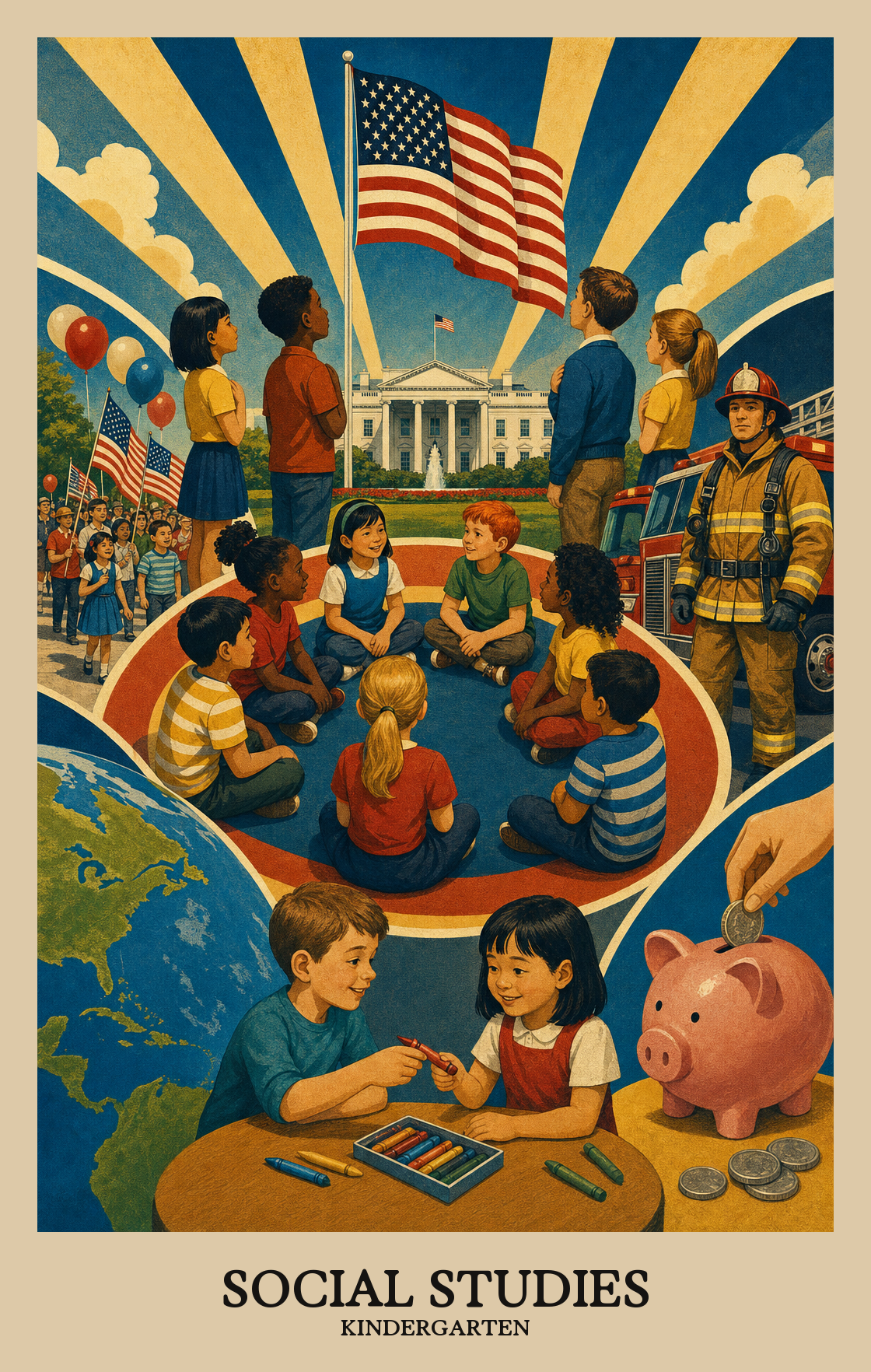
Students learn what it means to share a room with other people. They practice taking turns, telling the truth, following rules, and taking care of their own things and other kids' things.
Students meet the flag, the bald eagle, and the Pledge of Allegiance, and learn why people mark days like Thanksgiving, Memorial Day, and Juneteenth. They also learn that the president is chosen by voters.
Students hear stories about the people who lived in Virginia long ago, including Indigenous tribes, early settlers, and local leaders. They also learn about the doctors, teachers, and first responders who keep the community running today.
Students use words like near, far, above, and below to describe where things sit. They compare a map to a globe, spot land and water, and find Virginia and the United States.
Students learn that people work to earn money and save up for what they need. They start to see the difference between needs and wants, and that no one can buy everything.
Students use maps, pictures, and simple timelines to ask questions about people and places. These thinking skills run through every social studies lesson in kindergarten.
Students look at real objects, old photographs, maps, charts, and other sources to find information and answer questions about the world around them.
Students learn to read simple maps and spot basic features like land, water, and roads. They practice pointing to where things are and describing what the land around them looks like.
Students ask questions about what they see, hear, and wonder about. Asking "why" and "how" is how social studies thinking starts.
Students put events or ideas in order, from first to last. They practice sorting and arranging information so it tells a clear story or shows how things happened.
Students look at two things side by side and explain what matches and what doesn't. That comparison helps them make sense of what they're learning.
Students learn to notice what makes something happen and what happens because of it. A rainy day causes people to grab an umbrella. A forgotten lunch causes a hungry afternoon.
Students pick between two choices (like saving money or spending it) and explain why one option makes more sense. It's early practice in thinking through trade-offs before deciding.
Students practice being kind, taking turns, working hard, and doing their part as a member of their class and community.
Students learn and use the key words from social studies lessons, like "community," "map," or "leader," to show they understand what those words mean.
| Standard | Definition | Code |
|---|---|---|
| The student will apply history and social science skills to the content by | Students use maps, pictures, and simple timelines to ask questions about people and places. These thinking skills run through every social studies lesson in kindergarten. | S.K |
| viewing and exploring information sources, including | Students look at real objects, old photographs, maps, charts, and other sources to find information and answer questions about the world around them. | S.K.a |
| applying geographic skills to identify and understand geographic features | Students learn to read simple maps and spot basic features like land, water, and roads. They practice pointing to where things are and describing what the land around them looks like. | S.K.b |
| demonstrating curiosity and critical thinking through questioning | Students ask questions about what they see, hear, and wonder about. Asking "why" and "how" is how social studies thinking starts. | S.K.c |
| sequencing and organizing information | Students put events or ideas in order, from first to last. They practice sorting and arranging information so it tells a clear story or shows how things happened. | S.K.d |
| identifying similarities and differences to explain content | Students look at two things side by side and explain what matches and what doesn't. That comparison helps them make sense of what they're learning. | S.K.e |
| recognizing cause-and-effect relationships | Students learn to notice what makes something happen and what happens because of it. A rainy day causes people to grab an umbrella. A forgotten lunch causes a hungry afternoon. | S.K.f |
| using economic decision-making models to make informed economic decisions | Students pick between two choices (like saving money or spending it) and explain why one option makes more sense. It's early practice in thinking through trade-offs before deciding. | S.K.g |
| practicing civility, respect, hard work | Students practice being kind, taking turns, working hard, and doing their part as a member of their class and community. | S.K.h |
| using content vocabulary to demonstrate comprehension | Students learn and use the key words from social studies lessons, like "community," "map," or "leader," to show they understand what those words mean. | S.K.i |
Students practice being good citizens right in the classroom. They take turns, follow rules, listen to others, and learn what it means to be part of a group.
Students practice owning what they do, good or bad, instead of blaming others. That means saying sorry when something goes wrong and trying to fix it.
Students practice being honest and kind at school, telling the truth in class and treating classmates the way they want to be treated.
Rules explain what behavior is expected and why. Students practice following them on their own, without being reminded every time.
Students learn to take care of their own belongings and leave other people's things alone.
Students practice taking turns and sharing with classmates. These habits help the whole group get along and get things done together.
Students learn why communities celebrate shared holidays and traditions. They recognize Virginia holidays and national ones, and talk about what those days mean.
Labor Day is a fall holiday when Americans pause to recognize the work people do every day. Students learn why this day matters and what it tells us about how communities say thank you.
Students learn that Columbus Day marks the anniversary of Christopher Columbus arriving in the Americas, and that Virginia also celebrates it as Yorktown Victory Day to honor the 1781 battle that helped end the Revolutionary War.
Election Day is when citizens vote to choose their leaders. Students learn why voting matters and how communities come together to pick the people who make decisions for everyone.
Veterans Day is a holiday when communities thank people who have served in the military. Students learn why this day matters and how Virginia communities mark it each year.
Students learn why Thanksgiving is a national holiday and what it marks in American history. They talk about how communities across the country observe it each year.
Students learn that Christmas Day on December 25 is one of Virginia's official holidays, a day many families celebrate with traditions passed down over generations.
New Year's Day (January 1) marks the start of a fresh calendar year. Students learn why communities celebrate this holiday and how it became an official Virginia day of recognition.
Students learn why the country sets aside a day to honor Martin Luther King, Jr. and what he did to make equal treatment under the law a reality for more Americans.
Students learn why Virginia sets aside a day to honor George Washington, the first U.S. president, who was born in Virginia and helped shape the country's early government.
Memorial Day is a national holiday when Americans pause to remember soldiers who died serving the country. Students learn why communities hold parades and ceremonies on this day each May.
Juneteenth (June 19) marks the day in 1865 when enslaved people in Texas learned they were free. Students learn why this day matters and how communities across the country honor it each year.
Independence Day is a national holiday on July 4th. Students learn why Americans celebrate the day the United States declared independence from Britain in 1776.
Patriotism means loving and feeling proud of your country. Students learn what that word means and look at ways communities show it, like flying flags, singing national songs, or honoring people who served.
Students learn to recognize the American flag and the Virginia state flag and say what each one stands for.
Students learn to recognize symbols that stand for Virginia and the United States, like the bald eagle, the state bird, and the state flower.
Students learn what the Pledge of Allegiance and the National Anthem are and why Americans say or sing them together. These are two of the most common ways people show love for their country.
Students learn the name of the current U.S. president and what that job means. They also learn that voters choose the president through an election.
| Standard | Definition | Code |
|---|---|---|
| The student will apply history and social science skills to practice… | Students practice being good citizens right in the classroom. They take turns, follow rules, listen to others, and learn what it means to be part of a group. | K.1 |
| taking responsibility for one’s actions | Students practice owning what they do, good or bad, instead of blaming others. That means saying sorry when something goes wrong and trying to fix it. | K.1.a |
| practicing honesty and showing kindness to oneself and others | Students practice being honest and kind at school, telling the truth in class and treating classmates the way they want to be treated. | K.1.b |
| recognizing the purpose of rules and practicing self-control | Rules explain what behavior is expected and why. Students practice following them on their own, without being reminded every time. | K.1.c |
| caring for one’s personal property and respecting other students’ property | Students learn to take care of their own belongings and leave other people's things alone. | K.1.d |
| taking turns, sharing | Students practice taking turns and sharing with classmates. These habits help the whole group get along and get things done together. | K.1.e |
| The student will apply history and social science skills to explain how… | Students learn why communities celebrate shared holidays and traditions. They recognize Virginia holidays and national ones, and talk about what those days mean. | K.2 |
| Labor Day | Labor Day is a fall holiday when Americans pause to recognize the work people do every day. Students learn why this day matters and what it tells us about how communities say thank you. | K.2.a |
| Columbus Day (Yorktown Victory Day) | Students learn that Columbus Day marks the anniversary of Christopher Columbus arriving in the Americas, and that Virginia also celebrates it as Yorktown Victory Day to honor the 1781 battle that helped end the Revolutionary War. | K.2.b |
| Election Day | Election Day is when citizens vote to choose their leaders. Students learn why voting matters and how communities come together to pick the people who make decisions for everyone. | K.2.c |
| Veterans Day | Veterans Day is a holiday when communities thank people who have served in the military. Students learn why this day matters and how Virginia communities mark it each year. | K.2.d |
| Thanksgiving Day | Students learn why Thanksgiving is a national holiday and what it marks in American history. They talk about how communities across the country observe it each year. | K.2.e |
| Christmas Day | Students learn that Christmas Day on December 25 is one of Virginia's official holidays, a day many families celebrate with traditions passed down over generations. | K.2.f |
| New Year’s Day | New Year's Day (January 1) marks the start of a fresh calendar year. Students learn why communities celebrate this holiday and how it became an official Virginia day of recognition. | K.2.g |
| Martin Luther King, Jr | Students learn why the country sets aside a day to honor Martin Luther King, Jr. and what he did to make equal treatment under the law a reality for more Americans. | K.2.h |
| George Washington Day | Students learn why Virginia sets aside a day to honor George Washington, the first U.S. president, who was born in Virginia and helped shape the country's early government. | K.2.i |
| Memorial Day | Memorial Day is a national holiday when Americans pause to remember soldiers who died serving the country. Students learn why communities hold parades and ceremonies on this day each May. | K.2.j |
| Juneteenth | Juneteenth (June 19) marks the day in 1865 when enslaved people in Texas learned they were free. Students learn why this day matters and how communities across the country honor it each year. | K.2.k |
| Independence Day | Independence Day is a national holiday on July 4th. Students learn why Americans celebrate the day the United States declared independence from Britain in 1776. | K.2.l |
| The student will apply history and social science skills to define patriotism… | Patriotism means loving and feeling proud of your country. Students learn what that word means and look at ways communities show it, like flying flags, singing national songs, or honoring people who served. | K.3 |
| identifying the American and Virginia flags | Students learn to recognize the American flag and the Virginia state flag and say what each one stands for. | K.3.a |
| identifying national and state symbols, including | Students learn to recognize symbols that stand for Virginia and the United States, like the bald eagle, the state bird, and the state flower. | K.3.b |
| recognizing the Pledge of Allegiance and the National Anthem | Students learn what the Pledge of Allegiance and the National Anthem are and why Americans say or sing them together. These are two of the most common ways people show love for their country. | K.3.c |
| identifying the current president and explaining that the president is the… | Students learn the name of the current U.S. president and what that job means. They also learn that voters choose the president through an election. | K.3.d |
Students learn who first lived in Virginia long before it became a state. They look at early Native American communities and how those people lived, worked, and settled the land.
Students look at old stories and events from long ago to learn how Virginia's earliest people lived. They recognize the difference between things that really happened and tales that have been passed down over time.
Students look at early groups who helped build Virginia, such as Indigenous tribes, farmers, and settlers. They learn what each group did and how those contributions shaped the communities that came after them.
Places look different today than they did long ago. Students look at pictures or simple maps to notice how a neighborhood, town, or landmark has changed over time.
Students learn about real people from the past who helped build and shape their town or city. Think founders, early leaders, or community members whose decisions still affect the neighborhood today.
Communities have their own foods, traditions, and celebrations that set them apart. Students learn to notice what makes a neighborhood, town, or culture distinct from others nearby.
Students learn who helps keep their neighborhood running. They can name jobs like doctors, firefighters, and teachers and explain what each person actually does for the community.
Students look at pictures or hear stories about things that happened long ago in their community and learn to recognize those moments as history.
Students learn the real stories of the people who built their town or neighborhood and share those stories out loud or in pictures.
| Standard | Definition | Code |
|---|---|---|
| The student will apply history and social science skills to recognize… | Students learn who first lived in Virginia long before it became a state. They look at early Native American communities and how those people lived, worked, and settled the land. | K.4 |
| identifying examples of historic events, stories | Students look at old stories and events from long ago to learn how Virginia's earliest people lived. They recognize the difference between things that really happened and tales that have been passed down over time. | K.4.a |
| identifying early communities, changemakers | Students look at early groups who helped build Virginia, such as Indigenous tribes, farmers, and settlers. They learn what each group did and how those contributions shaped the communities that came after them. | K.4.b |
| recognizing that places change over time | Places look different today than they did long ago. Students look at pictures or simple maps to notice how a neighborhood, town, or landmark has changed over time. | K.4.c |
| identifying people who helped establish and lead the local community over time | Students learn about real people from the past who helped build and shape their town or city. Think founders, early leaders, or community members whose decisions still affect the neighborhood today. | K.4.d |
| The student will apply history and social science skills to understand and… | Communities have their own foods, traditions, and celebrations that set them apart. Students learn to notice what makes a neighborhood, town, or culture distinct from others nearby. | K.5 |
| explaining the roles of important local community members, such as | Students learn who helps keep their neighborhood running. They can name jobs like doctors, firefighters, and teachers and explain what each person actually does for the community. | K.5.a |
| identifying historic events | Students look at pictures or hear stories about things that happened long ago in their community and learn to recognize those moments as history. | K.5.b |
| telling the stories of the people that developed their local communities | Students learn the real stories of the people who built their town or neighborhood and share those stories out loud or in pictures. | K.5.c |
Students use words like near, far, left, right, and in between to describe where things are. They might explain that the school is near their house or that the tree is in front of the fence.
Reading a map or globe is a core geography skill in kindergarten. Students learn what maps and globes show, how to find places on them, and what basic symbols like compass roses and keys mean.
Maps and globes both show where places are in the world. Students learn what makes them alike and what sets them apart, such as how a globe is a sphere and a map is flat.
Maps use symbols as picture shortcuts. Students learn what common symbols stand for, like a blue line for a river or a star for a capital city.
Students look at a map of their neighborhood and point out where the land is and where water like a river, lake, or pond shows up.
Students point to where the United States and Virginia sit on a map and globe. They practice finding their country and state by location, not just by label.
| Standard | Definition | Code |
|---|---|---|
| The student will apply history and social science skills to describe the… | Students use words like near, far, left, right, and in between to describe where things are. They might explain that the school is near their house or that the tree is in front of the fence. | K.6 |
| The student will apply history and social science skills to demonstrate an… | Reading a map or globe is a core geography skill in kindergarten. Students learn what maps and globes show, how to find places on them, and what basic symbols like compass roses and keys mean. | K.7 |
| identifying the similarities and differences between a map and a globe | Maps and globes both show where places are in the world. Students learn what makes them alike and what sets them apart, such as how a globe is a sphere and a map is flat. | K.7.a |
| identifying basic map symbols | Maps use symbols as picture shortcuts. Students learn what common symbols stand for, like a blue line for a river or a star for a capital city. | K.7.b |
| identifying land and bodies of water in the local community | Students look at a map of their neighborhood and point out where the land is and where water like a river, lake, or pond shows up. | K.7.c |
| identifying the geographic location of the United States and Virginia on a map… | Students point to where the United States and Virginia sit on a map and globe. They practice finding their country and state by location, not just by label. | K.7.d |
Students learn what it means to make a choice when they can't have everything they want. They practice deciding between needs and wants, and see why spending or saving money involves a trade-off.
Students learn why people work for money and how families save up to buy things they need, like food, and things they want, like toys.
Buying something means choosing not to buy something else. Students learn that people can buy what they want in America, but no one can have everything, so choosing one thing means giving up another.
| Standard | Definition | Code |
|---|---|---|
| The student will apply history and social science skills to demonstrate an… | Students learn what it means to make a choice when they can't have everything they want. They practice deciding between needs and wants, and see why spending or saving money involves a trade-off. | K.8 |
| describing ways people work to earn and save money to buy the things they need… | Students learn why people work for money and how families save up to buy things they need, like food, and things they want, like toys. | K.8.a |
| recognizing that Americans are free to make choices about what to buy and that… | Buying something means choosing not to buy something else. Students learn that people can buy what they want in America, but no one can have everything, so choosing one thing means giving up another. | K.8.b |
Alternate assessment program for eligible students with significant cognitive disabilities, covering state-tested grades and subjects.
Students learn how to be a good classmate, how their community works, and a little about the country and state they live in. They meet holidays, flags, and symbols like the bald eagle. They also start using maps and globes and talking about where things are.
Talk about holidays when they come up on the calendar and say a sentence about why people celebrate. Point out community helpers like firefighters, nurses, and store workers when running errands. Read picture books about leaders and history at bedtime.
Students should know the difference between a map and a globe, and find land and water on both. They should also point out the United States and Virginia. At home, spin a globe and find where you live, then find the ocean.
A big part of the year is practicing citizenship in the classroom: telling the truth, sharing, cleaning up, and being kind. These habits are the foundation for every other social studies topic, so they get real teaching time, not just reminders.
Most teachers start with classroom citizenship in the first weeks, then weave holidays in as they fall on the calendar. Maps, globes, and positional words fit well in the middle of the year. Save community helpers and Virginia's early communities for longer stretches in winter and spring.
Positional words like left, right, between, and behind trip up a lot of students, especially left and right. The difference between a map and a globe also needs several passes. Plan to revisit both across the year instead of teaching them once.
Students should recognize the Pledge of Allegiance and the National Anthem and know roughly what each holiday honors. Word-for-word memorizing of every holiday is not the goal. Short, repeated exposure across the year works better than a single unit.
Words like near, far, above, below, and between are how young students start describing location before they can read a map. Practice them with real objects: put the book under the chair, stand next to the door, point to what is behind you.
By spring, students should follow classroom rules without constant reminders, name a few community helpers, point to the United States and Virginia on a map, and describe where something is using words like next to or between. They should also recognize the American flag and the president.