Looking closely and asking questions
Students start the year by noticing the world around them. They ask questions, describe what they see, and sort small objects by color, shape, size, and weight.
This is the year students start noticing the world like scientists. They watch what happens when they push a ball, feel the difference between a rough rock and a smooth leaf, and sort things into living and nonliving. Students track the weather, follow shadows across the day, and learn that plants and animals need food, water, and shelter. By spring, they can ask a question about something they noticed and draw or describe what they found out.
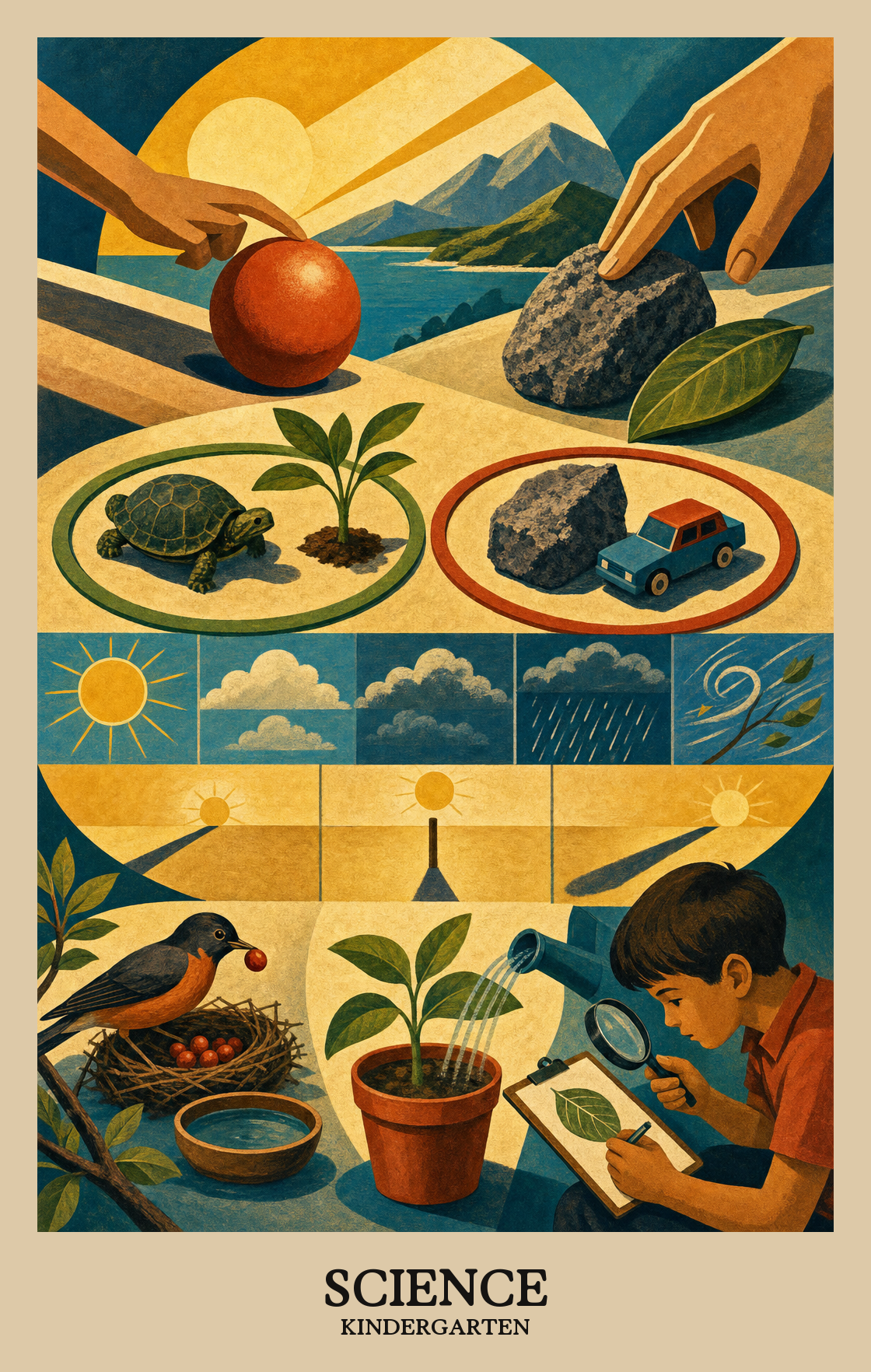
Students start the year by noticing the world around them. They ask questions, describe what they see, and sort small objects by color, shape, size, and weight.
Students play with how things move. They learn that a gentle push or pull moves an object a little, a harder one moves it more, and the direction can change.
Students use eyes, ears, nose, tongue, and skin to explore. They figure out what counts as living, what plants and animals need to grow, and how babies look like their parents.
Students explore water in puddles, ice, and steam, and notice it always flows downhill. They also see how the sun warms the ground and how a blocked light makes a shadow.
Students watch daily weather, the seasons, and day turning into night. They notice that some changes happen fast, like ice melting, and some happen slowly, like a seed growing.
Students wrap up the year by thinking about how people use water, air, land, and materials. They learn which things can be reused or recycled and how everyday choices help plants, animals, and people.
Students ask questions, make observations, and test simple ideas about the world around them. This is the foundation of how scientists and engineers think and work.
Students ask questions about things they notice and put into words what problem they want to solve. This is how science and engineering work begins.
Students notice something and ask "why" or "how" questions about it. That curiosity is where science starts.
Students spot something that isn't working or is missing, then name it as a problem worth solving. This is the first step in figuring out how to make things better.
Students look at something closely, then guess what might happen next. This is one of the first steps scientists use when they investigate the world around them.
Students plan a simple test or experiment to answer a question, then actually do it. They might check which object sinks, which crayon melts faster, or how a plant changes over time.
Students look closely at something (a plant, a bug, the sky) and write down or draw what they notice. That recorded information is called data.
Students look closely at everyday objects and describe what they notice: color, shape, size, texture, and how the object feels in their hands.
Students pick up two objects and figure out which one is longer or heavier. They use simple tools like a ruler or a balance scale to compare, then describe what they found.
Students draw pictures or make marks on paper to save what they noticed during a science activity. This is how scientists remember what happened.
Students look at information collected during an activity and explain what they notice. They practice deciding whether the results make sense.
Students notice what repeats or stays the same in what they observe, like colors following a pattern or objects that are always the same shape, and put those observations into words.
Students sort objects into groups based on one shared trait, like color, size, or texture. Sequencing means putting objects in order by that same trait, from smallest to largest, for example.
Students sort and display what they observed, putting data into a simple picture, chart, or group so patterns are easier to see.
Students look at simple charts and picture graphs, then answer questions about what the data shows. They practice reading information that has been organized visually rather than written out in words.
Students look at what they found out and decide if it makes sense. They practice saying why they think something is true, and they listen to other students' ideas to see if they agree.
Students look at what they noticed or measured and say what they think it means. For example, after watching ice melt, they might say "the ice turned to water because it got warm."
Students draw pictures or build simple objects to show how something works or what it looks like. A diagram of the sun, a clay animal, or a drawing of rain clouds all count as models.
A model is a copy or stand-in for a real thing. Students learn to tell the difference between, say, a toy globe and the actual Earth, or a drawing of a frog and a living frog.
Students gather information from books, pictures, and conversations, then share what they learned with others. This is how scientists collect facts and explain what they found.
Students use words like heavier, longer, or hotter to describe how two objects compare. Instead of saying "a lot," they say which one is more, less, bigger, or smaller.
Students share what they notice by drawing pictures or talking about what they saw. This is how scientists record and describe the world around them.
| Standard | Definition | Code |
|---|---|---|
| The student will demonstrate an understanding of scientific and engineering… | Students ask questions, make observations, and test simple ideas about the world around them. This is the foundation of how scientists and engineers think and work. | K.1 |
| asking questions and defining problems | Students ask questions about things they notice and put into words what problem they want to solve. This is how science and engineering work begins. | K.1.a |
| ask questions based on observations | Students notice something and ask "why" or "how" questions about it. That curiosity is where science starts. | K.1.a.i |
| identify a problem based on need | Students spot something that isn't working or is missing, then name it as a problem worth solving. This is the first step in figuring out how to make things better. | K.1.a.ii |
| make predictions based on observations | Students look at something closely, then guess what might happen next. This is one of the first steps scientists use when they investigate the world around them. | K.1.a.iii |
| planning and carrying out investigations | Students plan a simple test or experiment to answer a question, then actually do it. They might check which object sinks, which crayon melts faster, or how a plant changes over time. | K.1.b |
| make observations to collect data | Students look closely at something (a plant, a bug, the sky) and write down or draw what they notice. That recorded information is called data. | K.1.b.i |
| identify characteristics and properties of objects through observations | Students look closely at everyday objects and describe what they notice: color, shape, size, texture, and how the object feels in their hands. | K.1.b.ii |
| measure the relative length and weight of common objects | Students pick up two objects and figure out which one is longer or heavier. They use simple tools like a ruler or a balance scale to compare, then describe what they found. | K.1.b.iii |
| record information from investigations | Students draw pictures or make marks on paper to save what they noticed during a science activity. This is how scientists remember what happened. | K.1.b.iv |
| interpreting, analyzing | Students look at information collected during an activity and explain what they notice. They practice deciding whether the results make sense. | K.1.c |
| describe patterns | Students notice what repeats or stays the same in what they observe, like colors following a pattern or objects that are always the same shape, and put those observations into words. | K.1.c.i |
| classify and/or sequence objects based on a single physical characteristic or… | Students sort objects into groups based on one shared trait, like color, size, or texture. Sequencing means putting objects in order by that same trait, from smallest to largest, for example. | K.1.c.ii |
| organize and represent data | Students sort and display what they observed, putting data into a simple picture, chart, or group so patterns are easier to see. | K.1.c.iii |
| read and interpret data in object graphs, picture graphs | Students look at simple charts and picture graphs, then answer questions about what the data shows. They practice reading information that has been organized visually rather than written out in words. | K.1.c.iv |
| constructing and critiquing conclusions and explanations | Students look at what they found out and decide if it makes sense. They practice saying why they think something is true, and they listen to other students' ideas to see if they agree. | K.1.d |
| make simple conclusions based on data or observations | Students look at what they noticed or measured and say what they think it means. For example, after watching ice melt, they might say "the ice turned to water because it got warm." | K.1.d.i |
| developing and using models | Students draw pictures or build simple objects to show how something works or what it looks like. A diagram of the sun, a clay animal, or a drawing of rain clouds all count as models. | K.1.e |
| distinguish between a model and an actual object | A model is a copy or stand-in for a real thing. Students learn to tell the difference between, say, a toy globe and the actual Earth, or a drawing of a frog and a living frog. | K.1.e.i |
| obtaining, evaluating | Students gather information from books, pictures, and conversations, then share what they learned with others. This is how scientists collect facts and explain what they found. | K.1.f |
| communicate comparative measures | Students use words like heavier, longer, or hotter to describe how two objects compare. Instead of saying "a lot," they say which one is more, less, bigger, or smaller. | K.1.f.i |
| communicate observations using pictures, drawings, and/or speech | Students share what they notice by drawing pictures or talking about what they saw. This is how scientists record and describe the world around them. | K.1.f.ii |
Pushing or pulling an object makes it move, stop, or change direction. Students test this by rolling, sliding, and tossing everyday objects to see what happens when force changes.
Pushing or pulling an object makes it move. Students explore how hard you push or pull changes how far or fast something goes.
Pushing or pulling a moving toy can change which way it goes. A ball rolling left can be sent rolling right with one push.
A harder push makes something move faster or farther. Students learn that how hard they push or pull an object changes how much it moves.
| Standard | Definition | Code |
|---|---|---|
| The student will investigate and understand that pushes and pulls affect the… | Pushing or pulling an object makes it move, stop, or change direction. Students test this by rolling, sliding, and tossing everyday objects to see what happens when force changes. | K.2 |
| pushes and pulls can cause an object to move | Pushing or pulling an object makes it move. Students explore how hard you push or pull changes how far or fast something goes. | K.2.a |
| pushes and pulls can change the direction of an object | Pushing or pulling a moving toy can change which way it goes. A ball rolling left can be sent rolling right with one push. | K.2.b |
| changes in motion are related to the strength of the push or pull | A harder push makes something move faster or farther. Students learn that how hard they push or pull an object changes how much it moves. | K.2.c |
Students look at everyday objects and describe what they notice: color, shape, size, and how something feels to the touch. They learn that every object can be described in more than one way.
Students sort and describe objects by color, noticing how color is one way to tell things apart.
Students sort and describe everyday objects by their shape, such as round, flat, or curved, and notice how the same material can take different forms.
Students touch and describe materials by how they feel: rough, smooth, bumpy, or soft. Sorting objects by texture is one way to tell different materials apart.
Students sort everyday objects by size and weight, deciding which is bigger or heavier and which is smaller or lighter.
Water can be a liquid you drink, a solid ice cube, or steam from a hot pot. Students observe how water looks, feels, and moves, and talk about why people, animals, and plants need it every day.
Water shows up in everyday life in many forms and places. Students explore how people use water for drinking, cleaning, cooking, and growing food.
Water shows up in rivers, puddles, clouds, and even inside fruits and vegetables. Students learn to recognize water as the same substance whether it is in a lake, a glass, or the air.
Water shows up as a liquid you can pour, a solid you can hold (like ice), or a gas that disappears into the air. Students learn to recognize all three forms.
Students observe that water always moves downhill, not up. Pour water on a slope and it runs to the lowest point every time.
| Standard | Definition | Code |
|---|---|---|
| The student will investigate and understand that physical properties of an… | Students look at everyday objects and describe what they notice: color, shape, size, and how something feels to the touch. They learn that every object can be described in more than one way. | K.3 |
| colors | Students sort and describe objects by color, noticing how color is one way to tell things apart. | K.3.a |
| shapes and forms | Students sort and describe everyday objects by their shape, such as round, flat, or curved, and notice how the same material can take different forms. | K.3.b |
| textures and feel; and | Students touch and describe materials by how they feel: rough, smooth, bumpy, or soft. Sorting objects by texture is one way to tell different materials apart. | K.3.c |
| relative sizes and weights of objects | Students sort everyday objects by size and weight, deciding which is bigger or heavier and which is smaller or lighter. | K.3.d |
| The student will investigate and understand that water is important in our… | Water can be a liquid you drink, a solid ice cube, or steam from a hot pot. Students observe how water looks, feels, and moves, and talk about why people, animals, and plants need it every day. | K.4 |
| water has many uses | Water shows up in everyday life in many forms and places. Students explore how people use water for drinking, cleaning, cooking, and growing food. | K.4.a |
| water can be found in many places | Water shows up in rivers, puddles, clouds, and even inside fruits and vegetables. Students learn to recognize water as the same substance whether it is in a lake, a glass, or the air. | K.4.b |
| water occurs in different phases | Water shows up as a liquid you can pour, a solid you can hold (like ice), or a gas that disappears into the air. Students learn to recognize all three forms. | K.4.c |
| water flows downhill | Students observe that water always moves downhill, not up. Pour water on a slope and it runs to the lowest point every time. | K.4.d |
Sight, hearing, touch, taste, and smell are the five senses. Students learn how each sense gives the body information about the world and how people use that information to react.
Students learn that each sense comes from a specific body part: eyes see, ears hear, the nose smells, the tongue tastes, and skin feels touch.
Students practice using sight, hearing, smell, taste, and touch to notice things around them, the same way they use those senses to get dressed, eat breakfast, and move through every part of their day.
Living things grow, eat, and respond to the world around them. Students sort animals and plants from rocks, water, and other nonliving objects by looking for those signs of life.
Students sort the world into two groups: things that are alive (like plants and animals) and things that are not (like rocks and water). They practice explaining what makes something living or nonliving.
Living things breathe, grow, and respond to the world around them. Students learn to sort creatures like bugs and plants away from objects like rocks and chairs by looking for those signs of life.
Plants and animals need food, water, and air to stay alive. Students explore what living things do to grow, move, and reproduce.
Living things need food, water, air, shelter, and space to stay alive. Students look at plants and animals to see what happens when any of those needs go unmet.
Plants and animals are born, grow, and eventually die. Students learn that this pattern repeats with every living thing, from a seed becoming a flower to a kitten growing into a cat.
Baby plants and animals look like their parents, but not exactly. Students learn why siblings and parent plants or animals share some features while each one still looks a little different.
| Standard | Definition | Code |
|---|---|---|
| The students will investigate and understand that senses allow humans to seek… | Sight, hearing, touch, taste, and smell are the five senses. Students learn how each sense gives the body information about the world and how people use that information to react. | K.5 |
| the five basic senses correspond to specific human body structures | Students learn that each sense comes from a specific body part: eyes see, ears hear, the nose smells, the tongue tastes, and skin feels touch. | K.5.a |
| senses are used in our daily lives | Students practice using sight, hearing, smell, taste, and touch to notice things around them, the same way they use those senses to get dressed, eat breakfast, and move through every part of their day. | K.5.b |
| The student will investigate and understand that there are differences between… | Living things grow, eat, and respond to the world around them. Students sort animals and plants from rocks, water, and other nonliving objects by looking for those signs of life. | K.6 |
| all things can be classified as living or nonliving | Students sort the world into two groups: things that are alive (like plants and animals) and things that are not (like rocks and water). They practice explaining what makes something living or nonliving. | K.6.a |
| living organisms have certain characteristics that distinguish them from… | Living things breathe, grow, and respond to the world around them. Students learn to sort creatures like bugs and plants away from objects like rocks and chairs by looking for those signs of life. | K.6.b |
| The student will investigate and understand that plants and animals have basic… | Plants and animals need food, water, and air to stay alive. Students explore what living things do to grow, move, and reproduce. | K.7 |
| living things need adequate food, water, shelter, air | Living things need food, water, air, shelter, and space to stay alive. Students look at plants and animals to see what happens when any of those needs go unmet. | K.7.a |
| plants and animals have life cycles | Plants and animals are born, grow, and eventually die. Students learn that this pattern repeats with every living thing, from a seed becoming a flower to a kitten growing into a cat. | K.7.b |
| offspring of plants and animals are similar but not identical to their parents… | Baby plants and animals look like their parents, but not exactly. Students learn why siblings and parent plants or animals share some features while each one still looks a little different. | K.7.c |
Light from the sun warms surfaces like pavement and soil, and can cast shadows when objects block it. Students explore how sunlight changes temperature and why shadows form.
Students learn that sunlight does two things: it lights up the world around us and warms the ground, water, and air.
Blocking light makes a shadow. Students learn that a shadow forms when something solid, like a toy or a hand, gets in the way of sunlight or a lamp and stops the light from passing through.
Objects left in sunlight feel warmer than objects sitting in the shade. Students learn why the sun is the source of that heat.
Patterns in nature repeat in predictable ways. Students look for these repeating designs in things like seasons, day and night, animal markings, and plant shapes.
Students observe and describe what the weather is doing each day: sunny or cloudy, warm or cold, calm or windy, dry or rainy.
Students notice how weather and nature shift across the four seasons, from leaves changing color in fall to snow in winter to flowers blooming in spring.
Students learn why the sky looks different during the day (bright, with the sun) and at night (dark, with stars or the moon). They practice sorting pictures and observations into daytime and nighttime.
Seasons shift, weather changes day to day, and plants grow taller over weeks. Students observe how things in the natural world look different across days, months, and years.
Students sort things into what nature made and what people built, then explain how both can change over time. A tree grows and a road cracks; neither stays the same forever.
Students notice that living things like plants and animals grow and change, while nonliving things like rocks and puddles can change too, just differently. Change happens to everything over time.
Students watch how things in nature change over time, like puddles drying up or leaves changing color, and practice describing those changes in words or simple measurements.
Some changes in nature happen quickly, like a thunderstorm rolling in. Others take much longer, like a rock slowly wearing down from rain and wind.
| Standard | Definition | Code |
|---|---|---|
| The student will investigate and understand that light influences temperature… | Light from the sun warms surfaces like pavement and soil, and can cast shadows when objects block it. Students explore how sunlight changes temperature and why shadows form. | K.8 |
| the sun provides light and warms Earth's surface | Students learn that sunlight does two things: it lights up the world around us and warms the ground, water, and air. | K.8.a |
| shadows can be produced when sunlight or artificial light is blocked by an… | Blocking light makes a shadow. Students learn that a shadow forms when something solid, like a toy or a hand, gets in the way of sunlight or a lamp and stops the light from passing through. | K.8.b |
| objects in shadows and objects in sunlight have different temperatures | Objects left in sunlight feel warmer than objects sitting in the shade. Students learn why the sun is the source of that heat. | K.8.c |
| The student will investigate and understand that there are patterns in nature | Patterns in nature repeat in predictable ways. Students look for these repeating designs in things like seasons, day and night, animal markings, and plant shapes. | K.9 |
| daily weather | Students observe and describe what the weather is doing each day: sunny or cloudy, warm or cold, calm or windy, dry or rainy. | K.9.a |
| seasonal changes; and | Students notice how weather and nature shift across the four seasons, from leaves changing color in fall to snow in winter to flowers blooming in spring. | K.9.b |
| day and night | Students learn why the sky looks different during the day (bright, with the sun) and at night (dark, with stars or the moon). They practice sorting pictures and observations into daytime and nighttime. | K.9.c |
| The student will investigate and understand that change occurs over time | Seasons shift, weather changes day to day, and plants grow taller over weeks. Students observe how things in the natural world look different across days, months, and years. | K.10 |
| natural and human-made things change over time | Students sort things into what nature made and what people built, then explain how both can change over time. A tree grows and a road cracks; neither stays the same forever. | K.10.a |
| living and nonliving things change over time | Students notice that living things like plants and animals grow and change, while nonliving things like rocks and puddles can change too, just differently. Change happens to everything over time. | K.10.b |
| changes can be observed and measured | Students watch how things in nature change over time, like puddles drying up or leaves changing color, and practice describing those changes in words or simple measurements. | K.10.c |
| changes may be fast or slow | Some changes in nature happen quickly, like a thunderstorm rolling in. Others take much longer, like a rock slowly wearing down from rain and wind. | K.10.d |
Students learn where everyday materials come from, like wood, water, and rock, and practice explaining how people use those materials in daily life.
Students learn that some things, like glass bottles or cardboard boxes, can be cleaned and used again instead of thrown away.
Recycling means turning old materials into something new instead of throwing them away. Students learn which everyday items, like paper, plastic, and cans, can go through that process.
Students learn that everyday choices, like throwing trash in the bin or leaving the water running, affect the air, land, water, and living things around them.
| Standard | Definition | Code |
|---|---|---|
| The student will investigate and understand that humans use resources | Students learn where everyday materials come from, like wood, water, and rock, and practice explaining how people use those materials in daily life. | K.11 |
| some materials and objects can be used over and over again | Students learn that some things, like glass bottles or cardboard boxes, can be cleaned and used again instead of thrown away. | K.11.a |
| materials can be recycled | Recycling means turning old materials into something new instead of throwing them away. Students learn which everyday items, like paper, plastic, and cans, can go through that process. | K.11.b |
| choices we make impact the air, water, land and living things | Students learn that everyday choices, like throwing trash in the bin or leaving the water running, affect the air, land, water, and living things around them. | K.11.c |
Alternate assessment program for eligible students with significant cognitive disabilities, covering state-tested grades and subjects.
Students explore the world by watching, touching, and asking questions. They learn about pushes and pulls, water, plants and animals, the sun and shadows, and the weather. Most of the work happens through hands-on play and simple conversations about what students notice.
Go outside and ask what students see, hear, and smell. Sort rocks, leaves, or toys by color, size, or weight. Watch the weather each morning and talk about what changed since yesterday. Five to ten minutes of noticing counts.
Students should be able to tell living things from nonliving things and name what plants and animals need to survive: food, water, air, shelter, and space. They should also know that baby animals and plants look like their parents but are not exactly the same.
Most teachers start with the five senses and observation skills, since those tools support every other unit. Weather and seasons run all year as a daily routine. Pushes and pulls, water, and shadows fit well as short hands-on units once students can describe what they see.
Comparing weight and length trips students up, since heavier and bigger get mixed up. Reading picture graphs and recording observations also need repeated practice. Build in short sorting and measuring tasks across units so these skills get reinforced all year.
Yes. Asking questions is the first practice students work on this year. When a question comes up, try answering with another question: What do you think? How could we find out? Then test it together if you can.
Patterns show up everywhere. Track the weather on a calendar for a week. Watch shadows shrink and grow during the day. Notice which trees lose leaves and which stay green. Talk about what comes next based on what already happened.
Students can describe an object by color, shape, texture, and size. They can sort things into groups, compare two objects by weight or length, and explain a simple cause like a push making a ball roll. They can also read a basic picture graph.
No. Kindergarten science is about noticing and describing, not memorizing terms. Words like heavier, lighter, longer, and shorter matter more than textbook labels. Talking through what students see at home builds the language naturally.