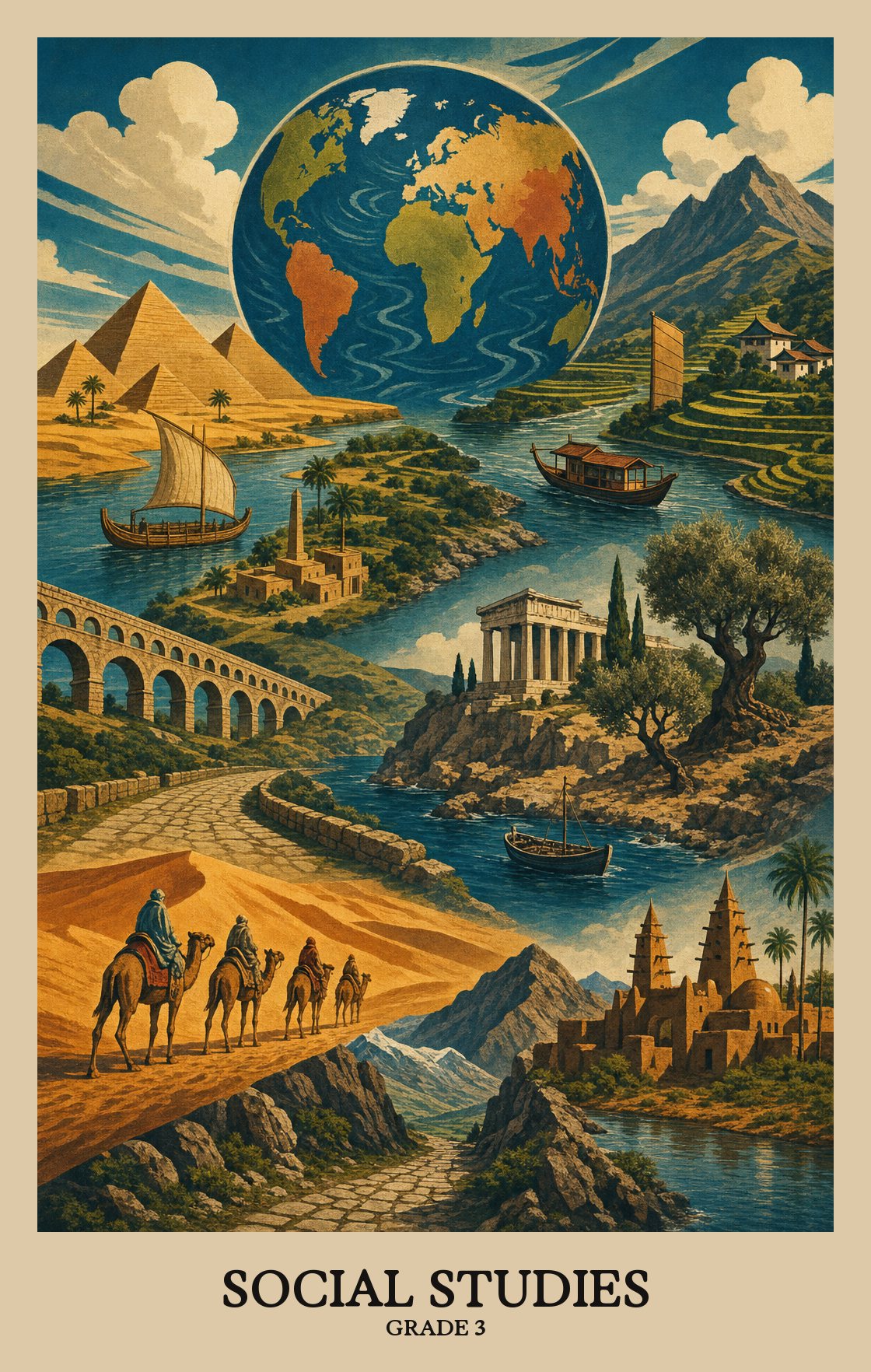
The student will apply history and social science skills to describe the… | Ancient Egypt is one of the oldest civilizations students study in third grade. Students explore how Egyptians organized their government, built their economy, shaped their society, and created lasting inventions along the Nile River. | 3.4 |
locating ancient Egypt on a map of the world | Students find Egypt on a world map and identify it as a civilization that grew along the Nile River in northeastern Africa. | 3.4.a |
connecting the geography of ancient Egypt and its economy | Students connect the Nile River's floods and farmland to how ancient Egyptians grew food, traded goods, and built their civilization. Geography shaped what Egypt could produce and sell. | 3.4.b |
identifying and explaining the government | Students learn how ancient Egypt was ruled by a pharaoh, a king with total power over the land and its people. They look at how that one ruler made laws, led armies, and controlled resources across the kingdom. | 3.4.c |
describing the arts and innovations | Students study Egyptian inventions and creative works, from hieroglyphics and papyrus scrolls to monuments and sculptures, to understand how ancient Egyptians solved problems and recorded their world. | 3.4.d |
identifying and explaining the architecture and its influence in the world today | Students learn how ancient Egyptians built massive pyramids and temples, then trace how those construction ideas still show up in buildings and monuments around the world today. | 3.4.e |
The student will apply history and social science skills to describe the… | Students study how people in ancient China lived, governed themselves, traded goods, and built new inventions. They look at how geography shaped where communities grew and how those choices still echo in the world today. | 3.5 |
locating ancient China on a map of the world | Students find ancient China on a world map and identify where it sits relative to other continents and oceans. | 3.5.a |
connecting the geography of ancient China and its economy | Students learn how rivers, mountains, and deserts shaped what ancient Chinese people could grow, trade, and build. Geography determined where farming and early trade routes took hold. | 3.5.b |
identifying and explaining the government | Students learn how ancient China was ruled, including who held power, how laws were made, and how emperors governed the people. | 3.5.c |
describing the arts and innovations | Students learn what ancient Chinese people invented and created, from paper and silk to early writing. They look at how these ideas changed daily life and spread beyond China's borders. | 3.5.d |
identifying and explaining the architecture and its influence in the world today | Students learn about structures built in ancient China, like the Great Wall, and explain how those building ideas still show up in architecture around the world today. | 3.5.e |
The student will apply history and social science skills to describe the… | Ancient Greece gets credit for ideas that still shape how we govern, compete, and think today. Students learn how the Greeks lived, how their city-states were ruled, and what they invented in art, science, and democracy. | 3.6 |
locating ancient Greece on a map of the world | Students find ancient Greece on a world map and explain where it sits in relation to the continents and bodies of water around it. | 3.6.a |
describing the unique geography of ancient Greece | Students look at how mountains, islands, and seas shaped daily life in ancient Greece, including why Greeks became skilled sailors and traders instead of farming large stretches of land. | 3.6.b |
identifying and explaining direct democracy | Direct democracy is a system where citizens vote on laws themselves instead of choosing representatives to decide for them. Students learn how ancient Athens used this idea and why it shaped how many governments work today. | 3.6.c |
describing the arts and innovations | Students learn how ancient Greeks shaped art, architecture, and ideas that still show up in buildings, stories, and science today. | 3.6.d |
identifying and explaining the architecture and its influence in the world today | Students look at buildings from ancient Greece, such as columns and temple-style fronts, and explain how that style shows up in courthouses, museums, and other buildings around the world today. | 3.6.e |
The student will apply history and social science skills to describe the… | Ancient Rome built one of history's most powerful civilizations. Students study how Romans governed themselves, traded goods, built roads and aqueducts, and organized daily life across a vast empire. | 3.7 |
locating ancient Rome on a map of the world | Students find ancient Rome on a world map and explain where it sits relative to other continents, oceans, and civilizations they already know. | 3.7.a |
connecting the geography of ancient Rome and its economy | Students study how Rome's location near rivers, mountains, and the Mediterranean Sea shaped what Romans farmed, traded, and built. Geography wasn't just background; it drove how Rome grew into a powerful civilization. | 3.7.b |
identifying and explaining representative democracy | Students learn how ancient Romans created a system where citizens vote for leaders to make decisions on their behalf, rather than everyone voting on every law directly. | 3.7.c |
describing the arts and innovations | Students learn how Romans built arches, aqueducts, and roads that influenced cities long after Rome fell. They also look at Roman art, writing, and public buildings to see how those ideas still show up in the world today. | 3.7.d |
identifying and explaining the architecture and its influence in the world today | Students learn how Roman builders designed arches, domes, and concrete structures, then trace how those same ideas show up in courthouses, stadiums, and government buildings today. | 3.7.e |
The student will apply history and social science skills to describe the… | Students learn how the Mali Empire grew powerful through trade, geography, and strong leadership. They look at how Mali's people lived, how its rulers governed, and what made it one of the most influential civilizations in the ancient world. | 3.8 |
locating ancient empire of Mali on a map of the world | Students find the Mali Empire on a world map, placing it in West Africa. This builds the habit of connecting historical events to actual places on the globe. | 3.8.a |
connecting the geography of ancient empire of Mali and its economy | Mali sat along major trade routes in West Africa, where gold and salt were plentiful. Students explain how that location shaped what Mali traded and how its economy grew. | 3.8.b |
identifying and explaining the government | Students learn how Mali was ruled, including who held power and how decisions were made across the empire. | 3.8.c |
describing the arts and innovations | Mali's artists and builders left behind music, storytelling, and architecture that shaped West African culture. Students learn what people in ancient Mali created and invented, and why those contributions mattered beyond Mali's borders. | 3.8.d |
identifying and explaining the architecture and its influence in the world | Mali's builders shaped cities with mud-brick mosques and walled markets. Students learn how that style of construction spread beyond West Africa and still influences architecture today. | 3.8.e |
The student will apply history and social science skills to explain the basic… | Students learn how the U.S. government is divided into three branches, what each branch does, and why the country is set up that way. They practice explaining it in their own words. | 3.9 |
explaining the purpose of governments and understanding that other countries… | Governments make rules and provide services that keep people safe and society running. Students learn why every country has some form of government and how governments around the world are alike or different from the one in the United States. | 3.9.a |
explaining how the Constitution supports the structure of the United States… | The Constitution is the written rulebook for how the U.S. government works. Students learn how it divides power into three branches and why those rules still guide decisions made in Washington today. | 3.9.b |
identifying and describing the three branches of government | Students learn the three branches of the federal government: Congress makes the laws, the President carries them out, and the Supreme Court decides if they hold up. | 3.9.c |
explaining what governments do at the national, state | Students sort out which level of government handles which jobs: Congress makes laws for the whole country, the state sets school rules, and the town fixes local roads. | 3.9.d |
explaining how local, state | Students sort governments into three levels: neighborhood and city, state, and national. They explain what each level is in charge of and how each one is set up to do that work. | 3.9.e |