Letters, sounds, and book basics
Students learn the names and sounds of every letter, upper and lower case. They figure out how a book works: front cover, title, and reading left to right across the page.
This is the year letters start turning into words. Students learn the names and sounds of every letter, then blend simple sounds together to read short words like cat and sit. They listen to stories and answer questions about the characters and what happened. By spring, students can read easy words on a page and use drawings and letters to write about a favorite book or a real event.
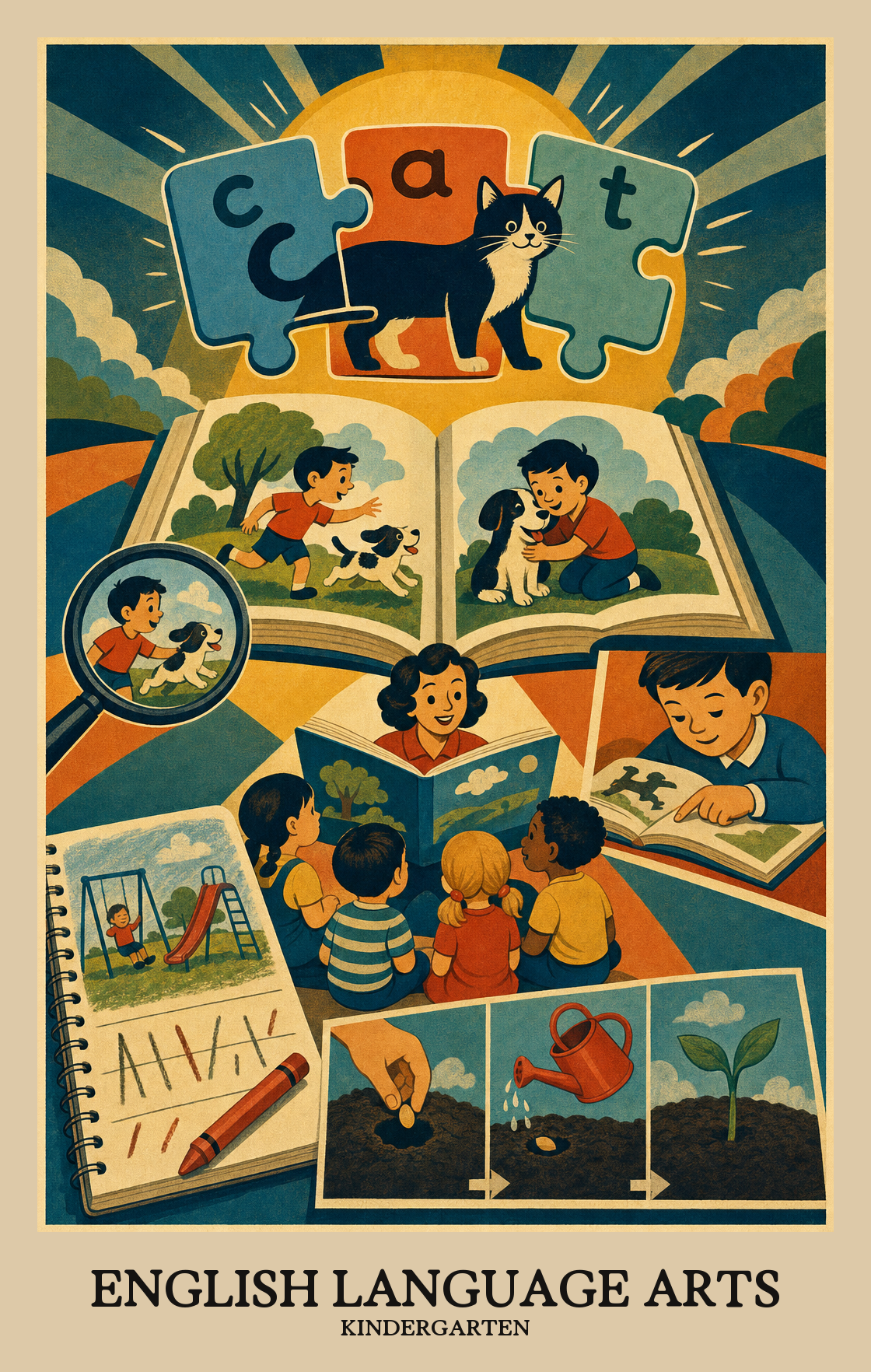
Students learn the names and sounds of every letter, upper and lower case. They figure out how a book works: front cover, title, and reading left to right across the page.
Students start pulling words apart by ear. They clap syllables, hear the first and last sound in a short word, and blend sounds together to say a whole word like cat or sun.
Students sound out short words and learn to read common words on sight, like the, is, and my. They read simple books and notice when two words look almost the same, like bat and bad.
Students listen to stories and talk about who is in them, where they happen, and what happens. They ask questions when a word is new and compare two stories they know well.
Students read books about real things, like animals, weather, or community helpers. They pick out the main topic, point to pictures that show the idea, and ask questions to learn more.
Students mix drawing with writing to tell a story, share an opinion about a book, or explain something they know. They write letters for the sounds they hear and start using capitals and end punctuation.
Books have a front and back, words run left to right, and spaces sit between words. Students learn how a printed page works before they start reading on their own.
Reading starts at the top-left corner of the page and moves right, then down, one line at a time. Students learn that books follow this same order from the first page to the last.
Students learn that every spoken word has a matching written form made of letters in a specific order. The word they say out loud becomes the letters they see on the page.
Students learn that each spoken word matches one printed word on the page. They practice pointing to each word as it's read aloud, moving left to right across the line.
Students name every letter of the alphabet, both capital and lowercase, when they see it on a page.
Students learn that spoken words are made of individual sounds. They practice breaking words apart by sound, blending sounds together, and swapping one sound for another.
Students listen to a spoken word and swap, split, or blend its sounds. They might change the first sound in "cat" to make "bat," or separate "dog" into its three sounds and push them back together.
Students listen to a short word like "cat" and say each sound separately: the first sound, the middle vowel, and the last sound. This is an early building block for reading and spelling.
Students clap out or count the beats in spoken words, then pull those beats apart and push them back together. "Dinosaur" has three beats; "cat" has one.
Students take a word apart and put it back together by splitting the starting sound from the rest. For "cat," that means breaking it into "c" and "at," then blending them back into one word.
Students learn the sounds that letters make, then use those sounds to read simple words. This is the foundation of sounding out any word they will encounter in books.
Students learn which letter makes which sound for common consonants like the letters B, M, and S. Knowing that each letter has a predictable sound helps students start sounding out words on their own.
Students learn that each vowel (a, e, i, o, u) can make two different sounds. The short "a" in "cat" sounds different from the long "a" in "cake," and students practice connecting those sounds to the letters they see.
Students recognize short words that show up constantly in books, like "the," "is," "you," and "are," reading them on sight without sounding them out.
Students look at two words that are almost identical and figure out which letter sounds are different. A pair like "bat" and "cat" sounds alike except for that first letter.
Students practice reading short books made up of words they already know how to sound out. The goal is to build confidence and speed with the letter-sound patterns they've learned so far.
| Standard | Definition | Code |
|---|---|---|
| Demonstrate understanding of the organization and basic features of print | Books have a front and back, words run left to right, and spaces sit between words. Students learn how a printed page works before they start reading on their own. | RF.K.1 |
| Follow words from left to right, top to bottom and page by page | Reading starts at the top-left corner of the page and moves right, then down, one line at a time. Students learn that books follow this same order from the first page to the last. | RF.K.1.a |
| Recognize that spoken words are represented in written language by specific… | Students learn that every spoken word has a matching written form made of letters in a specific order. The word they say out loud becomes the letters they see on the page. | RF.K.1.b |
| Understand that words are separated by spaces in print and can point with one-… | Students learn that each spoken word matches one printed word on the page. They practice pointing to each word as it's read aloud, moving left to right across the line. | RF.K.1.c |
| Recognize and name all upper- and lowercase letters of the alphabet | Students name every letter of the alphabet, both capital and lowercase, when they see it on a page. | RF.K.1.d |
| Demonstrate understanding of phonemes | Students learn that spoken words are made of individual sounds. They practice breaking words apart by sound, blending sounds together, and swapping one sound for another. | RF.K.2 |
| Manipulate (segment, blend or substitute) sounds in the initial, final and… | Students listen to a spoken word and swap, split, or blend its sounds. They might change the first sound in "cat" to make "bat," or separate "dog" into its three sounds and push them back together. | RF.K.2.a |
| Isolate and pronounce the initial, medial vowel | Students listen to a short word like "cat" and say each sound separately: the first sound, the middle vowel, and the last sound. This is an early building block for reading and spelling. | RF.K.2.b |
| Count, produce, blend | Students clap out or count the beats in spoken words, then pull those beats apart and push them back together. "Dinosaur" has three beats; "cat" has one. | RF.K.2.c |
| Blend and segment onsets and rimes | Students take a word apart and put it back together by splitting the starting sound from the rest. For "cat," that means breaking it into "c" and "at," then blending them back into one word. | RF.K.2.d |
| Know and apply grade-level phonics and word analysis skills in decoding words | Students learn the sounds that letters make, then use those sounds to read simple words. This is the foundation of sounding out any word they will encounter in books. | RF.K.3 |
| Demonstrate basic knowledge of phoneme-grapheme correspondences of predictable… | Students learn which letter makes which sound for common consonants like the letters B, M, and S. Knowing that each letter has a predictable sound helps students start sounding out words on their own. | RF.K.3.a |
| Associate the long and short sounds with common spellings | Students learn that each vowel (a, e, i, o, u) can make two different sounds. The short "a" in "cat" sounds different from the long "a" in "cake," and students practice connecting those sounds to the letters they see. | RF.K.3.b |
| Read common high-frequency words | Students recognize short words that show up constantly in books, like "the," "is," "you," and "are," reading them on sight without sounding them out. | RF.K.3.c |
| Distinguish between similarly spelled words by identifying the sounds of the… | Students look at two words that are almost identical and figure out which letter sounds are different. A pair like "bat" and "cat" sounds alike except for that first letter. | RF.K.3.d |
| Read decodable texts that support instruction | Students practice reading short books made up of words they already know how to sound out. The goal is to build confidence and speed with the letter-sound patterns they've learned so far. | RF.K.4 |
After hearing or reading a story, students answer questions about what happened and ask their own questions about parts they want to understand better.
Retelling a story means saying what happened in order. Students listen to a book and then explain the main events back in their own words, with a little help from the teacher.
With a little help, students name who is in a story, where it takes place, and what happens. It is the beginning of understanding how a story is built.
Students stop at unfamiliar words in a story and ask what they mean. They look for clues in the pictures or nearby sentences to figure them out.
Students learn that not all books work the same way. A poem looks and sounds different from a storybook, and knowing the difference helps students understand what they're reading before they get past the first page.
Students learn who wrote a story and who drew the pictures, then explain what each person's job was in making the book.
Students look at the pictures in a book and explain what part of the story each picture shows. A teacher or adult helps them connect what they see in the drawing to what is happening in the words.
This standard does not apply to literary reading. For kindergarten literature, look to the other Reading standards covering story details, characters, and retelling.
Students look at two familiar stories side by side and talk about how the characters' adventures are alike and how they're different. A teacher helps guide the conversation.
This standard starts in second grade. Nothing is assessed here in kindergarten.
Students figure out what an unfamiliar word means using the words and pictures around it. This builds the vocabulary they need to understand what they read and hear.
Words can mean more than one thing. Students learn that a word like "duck" names a bird and also means to bend down fast, then practice using both meanings correctly.
Students use word endings and beginnings as clues to figure out words they don't know. Seeing "-ed" or "un-" at the start or end of a word helps students take a guess at what it means.
Students learn that words can be related or have shades of meaning, like the difference between "big" and "enormous." A teacher guides the conversation, helping students notice how word choice changes what a sentence feels like.
Students group familiar things by what they have in common, like sorting toy shapes into a pile of circles and a pile of squares. Sorting helps students see what makes a group a group.
Students learn pairs of opposite words like hot and cold, fast and slow, or happy and sad. They practice matching a word to its opposite to show they understand what each word means.
Students match new vocabulary words to real things they already know. A word like "colorful" gets connected to something they can actually see, touch, or find in the classroom.
Students sort out how words like walk, march, strut, and prance each describe a slightly different way of moving. They act out each word to feel the difference in their body.
Students hear stories, plays, and poems read aloud to build vocabulary and understand how written language works.
| Standard | Definition | Code |
|---|---|---|
| With prompting and support, ask and answer questions about key details in a… | After hearing or reading a story, students answer questions about what happened and ask their own questions about parts they want to understand better. | RL.K.1 |
| With prompting and support, retell familiar stories, including key events | Retelling a story means saying what happened in order. Students listen to a book and then explain the main events back in their own words, with a little help from the teacher. | RL.K.2 |
| With prompting and support, identify characters, settings and major events in a… | With a little help, students name who is in a story, where it takes place, and what happens. It is the beginning of understanding how a story is built. | RL.K.3 |
| Ask and answer questions about unknown words in a text | Students stop at unfamiliar words in a story and ask what they mean. They look for clues in the pictures or nearby sentences to figure them out. | RL.K.4 |
| Recognize common types of texts | Students learn that not all books work the same way. A poem looks and sounds different from a storybook, and knowing the difference helps students understand what they're reading before they get past the first page. | RL.K.5 |
| With prompting and support, name the author and illustrator of a story and… | Students learn who wrote a story and who drew the pictures, then explain what each person's job was in making the book. | RL.K.6 |
| With prompting and support, describe the relationship between illustrations and… | Students look at the pictures in a book and explain what part of the story each picture shows. A teacher or adult helps them connect what they see in the drawing to what is happening in the words. | RL.K.7 |
| Not applicable for literature | This standard does not apply to literary reading. For kindergarten literature, look to the other Reading standards covering story details, characters, and retelling. | RL.K.8 |
| With prompting and support, compare and contrast the adventures and experiences… | Students look at two familiar stories side by side and talk about how the characters' adventures are alike and how they're different. A teacher helps guide the conversation. | RL.K.9 |
| Begins in second grade | This standard starts in second grade. Nothing is assessed here in kindergarten. | RL.K.10 |
| Determine or clarify the meaning of unknown and multiple-meaning words and… | Students figure out what an unfamiliar word means using the words and pictures around it. This builds the vocabulary they need to understand what they read and hear. | RL.K.11 |
| Identify new meanings for familiar words and apply them accurately | Words can mean more than one thing. Students learn that a word like "duck" names a bird and also means to bend down fast, then practice using both meanings correctly. | RL.K.11.a |
| Use the most frequently occurring inflectional endings and affixes | Students use word endings and beginnings as clues to figure out words they don't know. Seeing "-ed" or "un-" at the start or end of a word helps students take a guess at what it means. | RL.K.11.b |
| With guidance and support from adults, explore word relationships and nuances… | Students learn that words can be related or have shades of meaning, like the difference between "big" and "enormous." A teacher guides the conversation, helping students notice how word choice changes what a sentence feels like. | RL.K.12 |
| Sort common objects into categories | Students group familiar things by what they have in common, like sorting toy shapes into a pile of circles and a pile of squares. Sorting helps students see what makes a group a group. | RL.K.12.a |
| Demonstrate understanding of frequently occurring verbs and adjectives by… | Students learn pairs of opposite words like hot and cold, fast and slow, or happy and sad. They practice matching a word to its opposite to show they understand what each word means. | RL.K.12.b |
| Identify real-life connections between words and their use | Students match new vocabulary words to real things they already know. A word like "colorful" gets connected to something they can actually see, touch, or find in the classroom. | RL.K.12.c |
| Distinguish shades of meaning among verbs describing the same general action | Students sort out how words like walk, march, strut, and prance each describe a slightly different way of moving. They act out each word to feel the difference in their body. | RL.K.12.d |
| Listen to high quality drama, prose | Students hear stories, plays, and poems read aloud to build vocabulary and understand how written language works. | RL.K.13 |
Reading a simple book out loud, students answer questions like "who" and "what" with a teacher's help. They also learn to ask their own questions about what they just heard.
Reading a short nonfiction book, students point to what the whole book is about and then share two or three facts they learned from it. A teacher or adult may help by asking guiding questions.
With a teacher's help, students find how two things in a book connect. They might explain why one event caused another, or how two people in the same story are related.
Students ask what an unfamiliar word means and look for clues in the text to figure it out. A teacher or adult helps them work through it.
Students point to the front cover, back cover, and title page of a nonfiction book. These three parts tell readers what the book is about before they read a single page.
Students learn that a book has two key people behind it: the author writes the words and the illustrator draws the pictures. Both choices shape what readers learn and notice.
Students look at the pictures in a nonfiction book and explain how each one connects to the words on the page, like pointing out that a photo of a dog matches what the sentence is describing.
Students look at a nonfiction book or passage and find the reasons the author gives to back up a main idea. A teacher or adult helps them spot those reasons in the text.
Two books can cover the same topic but show or explain it differently. Students look at both and spot what matches and what doesn't, like how two books about frogs might use different pictures or describe frog behavior in different ways.
This standard doesn't apply to kindergarten. It starts in second grade, so no kindergarten work is tied to this code.
When students run into a word they don't know in a book or article, they figure out what it means using clues from the surrounding sentences. This builds the vocabulary they need to understand what they read.
A word can have more than one meaning. Students learn that a word they already know, like "duck," can also mean something completely different, and practice using both meanings correctly.
Word endings and prefixes change what a word means. Students use clues like -ed, -s, un-, or -ful to figure out unfamiliar words while reading.
Students learn that words are related and that small differences in meaning matter. With a teacher's help, they explore how words like "hot," "warm," and "cold" connect to each other and to the world around them.
Students group familiar objects by what they have in common, such as putting all the circles in one pile and all the squares in another. Sorting this way builds the idea that a category is a collection of things that share a key trait.
Students practice pairing opposite words, like hot and cold or fast and slow, when reading informational books. This builds the word knowledge students need to understand what they read.
Students connect new words to things they can actually see or touch. For example, after learning the word "colorful," they look around the classroom and point to things that match.
Students sort out the difference between words that describe similar actions, like how "march" feels stiffer than "walk." They act out each word to feel what sets it apart.
Students listen to or read nonfiction books and passages with a clear reason in mind, such as finding out how something works or why something happens. They stay focused and show they understood what they heard or read.
| Standard | Definition | Code |
|---|---|---|
| With prompting and support, ask and answer questions about key details in a… | Reading a simple book out loud, students answer questions like "who" and "what" with a teacher's help. They also learn to ask their own questions about what they just heard. | RI.K.1 |
| With prompting and support, identify the main topic and retell key details of a… | Reading a short nonfiction book, students point to what the whole book is about and then share two or three facts they learned from it. A teacher or adult may help by asking guiding questions. | RI.K.2 |
| With prompting and support, describe the connection between two individuals… | With a teacher's help, students find how two things in a book connect. They might explain why one event caused another, or how two people in the same story are related. | RI.K.3 |
| With prompting and support, ask and answer questions about unknown words in a… | Students ask what an unfamiliar word means and look for clues in the text to figure it out. A teacher or adult helps them work through it. | RI.K.4 |
| Identify the front cover, back cover and title page of a book | Students point to the front cover, back cover, and title page of a nonfiction book. These three parts tell readers what the book is about before they read a single page. | RI.K.5 |
| Name the author and illustrator of a text and define the role of each in… | Students learn that a book has two key people behind it: the author writes the words and the illustrator draws the pictures. Both choices shape what readers learn and notice. | RI.K.6 |
| With prompting and support, describe the relationship between illustrations and… | Students look at the pictures in a nonfiction book and explain how each one connects to the words on the page, like pointing out that a photo of a dog matches what the sentence is describing. | RI.K.7 |
| With prompting and support, identify the reasons an author gives to support… | Students look at a nonfiction book or passage and find the reasons the author gives to back up a main idea. A teacher or adult helps them spot those reasons in the text. | RI.K.8 |
| With prompting and support, identify basic similarities in and differences… | Two books can cover the same topic but show or explain it differently. Students look at both and spot what matches and what doesn't, like how two books about frogs might use different pictures or describe frog behavior in different ways. | RI.K.9 |
| Begins in second grade | This standard doesn't apply to kindergarten. It starts in second grade, so no kindergarten work is tied to this code. | RI.K.10 |
| Determine or clarify the meaning of unknown and multiple-meaning words and… | When students run into a word they don't know in a book or article, they figure out what it means using clues from the surrounding sentences. This builds the vocabulary they need to understand what they read. | RI.K.11 |
| Identify new meanings for familiar words and apply them accurately | A word can have more than one meaning. Students learn that a word they already know, like "duck," can also mean something completely different, and practice using both meanings correctly. | RI.K.11.a |
| Use the most frequently occurring inflectional endings and affixes | Word endings and prefixes change what a word means. Students use clues like -ed, -s, un-, or -ful to figure out unfamiliar words while reading. | RI.K.11.b |
| With guidance and support from adults, explore word relationships and nuances… | Students learn that words are related and that small differences in meaning matter. With a teacher's help, they explore how words like "hot," "warm," and "cold" connect to each other and to the world around them. | RI.K.12 |
| Sort common objects into categories | Students group familiar objects by what they have in common, such as putting all the circles in one pile and all the squares in another. Sorting this way builds the idea that a category is a collection of things that share a key trait. | RI.K.12.a |
| Demonstrate understanding of frequently occurring verbs and adjectives by… | Students practice pairing opposite words, like hot and cold or fast and slow, when reading informational books. This builds the word knowledge students need to understand what they read. | RI.K.12.b |
| Identify real-life connections between words and their use | Students connect new words to things they can actually see or touch. For example, after learning the word "colorful," they look around the classroom and point to things that match. | RI.K.12.c |
| Distinguish shades of meaning among verbs describing the same general action | Students sort out the difference between words that describe similar actions, like how "march" feels stiffer than "walk." They act out each word to feel what sets it apart. | RI.K.12.d |
| Actively engage in individual or group readings of informational text with… | Students listen to or read nonfiction books and passages with a clear reason in mind, such as finding out how something works or why something happens. They stay focused and show they understood what they heard or read. | RI.K.13 |
Students pick something they like, a book or a topic, draw a picture, and write or dictate a sentence saying why they like it.
Students pick a topic and share facts about it by drawing a picture, telling the idea out loud, or writing a few words. The goal is to inform, not to tell a story.
Students draw pictures and write or dictate words to tell a short story about something that happened. They put the events in order and share how they felt about it.
This standard doesn't start until third grade. No writing production skills are tracked here for Kindergarten.
Students revise their writing by listening to a classmate's question or suggestion, then adding a detail that makes the piece clearer. A teacher or adult helps guide the process.
With a teacher's help, students use a computer or tablet to write and share their work. They might type words, add pictures, or work with a classmate to create something together.
The class picks a topic together, reads about it, and writes something based on what they found. Students share what they noticed and what they think.
Students answer a simple question by drawing on something they remember or by looking at a book or picture a teacher provides. The focus is on finding and using real information, not making something up.
This standard doesn't apply in Kindergarten. Writing research skills are introduced in fourth grade, when students are ready to draw on texts as sources.
Students use correct words and sentences when they write. This means putting the right words in the right order, not mixing up words like "he" and "she," and writing in a way that makes sense to the reader.
Students practice writing capital and lowercase letters, keeping them sitting on the line instead of floating above or dipping below it.
Students practice writing common everyday words like names for things (dog, ball, school) and action words (run, eat, go). This builds basic vocabulary use on the page.
Students learn to use question words like who, what, where, when, why, and how in their own writing and speech. These words help them ask real questions and get specific information.
Students practice using everyday direction and location words in their writing. Words like "in," "on," "by," and "with" help sentences make sense and show how things relate to each other.
Students practice saying and building complete sentences out loud, often with the whole class. They learn what makes a sentence feel finished before they write one on their own.
Students practice the basic rules of written English: starting sentences with a capital letter, ending them with a period or question mark, and spelling common words correctly.
Students learn to start every sentence with a capital letter and to always capitalize the word I. It is one of the first punctuation rules students practice in writing.
Students learn the marks that end a sentence: a period, a question mark, or an exclamation point. They practice naming each one and spotting it at the end of written sentences.
Students match spoken sounds to letters on the page. For most consonants and short vowel sounds, like the "a" in "cat" or the "b" in "ball," students write a real letter instead of guessing or drawing.
Students sound out simple words and write the letters they hear. This is early spelling: not memorizing words yet, just matching letters to the sounds in them.
This standard doesn't apply in Kindergarten. Writing range expectations start in third grade.
| Standard | Definition | Code |
|---|---|---|
| Use a combination of drawing, dictating and writing to compose opinion pieces… | Students pick something they like, a book or a topic, draw a picture, and write or dictate a sentence saying why they like it. | W.K.1 |
| Use a combination of drawing, dictating and writing to compose… | Students pick a topic and share facts about it by drawing a picture, telling the idea out loud, or writing a few words. The goal is to inform, not to tell a story. | W.K.2 |
| Use a combination of drawing, dictating and writing to narrate a single event… | Students draw pictures and write or dictate words to tell a short story about something that happened. They put the events in order and share how they felt about it. | W.K.3 |
| Begins in third grade | This standard doesn't start until third grade. No writing production skills are tracked here for Kindergarten. | W.K.4 |
| With guidance and support from adults, respond to questions and suggestions… | Students revise their writing by listening to a classmate's question or suggestion, then adding a detail that makes the piece clearer. A teacher or adult helps guide the process. | W.K.5 |
| With guidance and support from adults, explore a variety of digital tools to… | With a teacher's help, students use a computer or tablet to write and share their work. They might type words, add pictures, or work with a classmate to create something together. | W.K.6 |
| Participate in shared research and writing projects | The class picks a topic together, reads about it, and writes something based on what they found. Students share what they noticed and what they think. | W.K.7 |
| With guidance and support from adults, recall information from experiences or… | Students answer a simple question by drawing on something they remember or by looking at a book or picture a teacher provides. The focus is on finding and using real information, not making something up. | W.K.8 |
| Begins in fourth grade | This standard doesn't apply in Kindergarten. Writing research skills are introduced in fourth grade, when students are ready to draw on texts as sources. | W.K.9 |
| Demonstrate command of the conventions of standards English grammar and usage… | Students use correct words and sentences when they write. This means putting the right words in the right order, not mixing up words like "he" and "she," and writing in a way that makes sense to the reader. | W.K.10 |
| Correctly form upper and lowercase letters with line awareness | Students practice writing capital and lowercase letters, keeping them sitting on the line instead of floating above or dipping below it. | W.K.10.a |
| Use frequently occurring nouns and verbs in writing | Students practice writing common everyday words like names for things (dog, ball, school) and action words (run, eat, go). This builds basic vocabulary use on the page. | W.K.10.b |
| Understand and use question words | Students learn to use question words like who, what, where, when, why, and how in their own writing and speech. These words help them ask real questions and get specific information. | W.K.10.c |
| Use the most frequently occurring prepositions in written work | Students practice using everyday direction and location words in their writing. Words like "in," "on," "by," and "with" help sentences make sense and show how things relate to each other. | W.K.10.d |
| Produce and expand complete sentences in shared language activities | Students practice saying and building complete sentences out loud, often with the whole class. They learn what makes a sentence feel finished before they write one on their own. | W.K.10.e |
| Demonstrate command of the conventions of standard English capitalization… | Students practice the basic rules of written English: starting sentences with a capital letter, ending them with a period or question mark, and spelling common words correctly. | W.K.11 |
| Capitalize the first word in a sentence and the pronoun I | Students learn to start every sentence with a capital letter and to always capitalize the word I. It is one of the first punctuation rules students practice in writing. | W.K.11.a |
| Recognize and name end punctuation | Students learn the marks that end a sentence: a period, a question mark, or an exclamation point. They practice naming each one and spotting it at the end of written sentences. | W.K.11.b |
| Write a letter or letters for most consonant and short vowel sounds | Students match spoken sounds to letters on the page. For most consonants and short vowel sounds, like the "a" in "cat" or the "b" in "ball," students write a real letter instead of guessing or drawing. | W.K.11.c |
| Spell simple words phonetically, drawing on knowledge of letter-sound… | Students sound out simple words and write the letters they hear. This is early spelling: not memorizing words yet, just matching letters to the sounds in them. | W.K.11.d |
| Begins in third grade | This standard doesn't apply in Kindergarten. Writing range expectations start in third grade. | W.K.12 |
Students take turns talking and listening in small groups and class discussions about books and topics. They practice sharing ideas with other students and adults.
Students listen while others talk and wait their turn to speak during group conversations.
Students take turns talking with a partner, keeping the conversation going by listening and responding more than once. They practice staying on topic instead of giving one answer and stopping.
After listening to a story or video, students ask and answer questions about what happened and when. They speak up when something is unclear.
Students ask questions when something is confusing and answer questions when someone else needs help. This is how they start figuring out what they don't understand yet.
With a little help from a teacher, students describe someone they know, a place they've been, or something that happened, using specific details instead of just saying "it was fun" or "it was big."
Students pair a drawing or picture with what they say or write to give their audience more detail. A labeled sketch, a diagram, or a simple illustration counts.
Students practice speaking at a volume others can hear, saying words clearly, and not rushing. The goal is for listeners to understand what students mean.
Students speak in complete sentences and use words like "he," "she," and "they" correctly. They practice the same grammar rules in conversation that they use in writing.
Students use common, everyday words like names for people, places, and things, along with action words, when they talk and share ideas.
Students practice turning one thing into many by saying words out loud: one dog becomes two dogs, one wish becomes two wishes. They learn that adding the sound "s" or "ez" to the end of a word makes it plural.
Students learn to ask and answer questions using words like who, what, where, when, why, and how. These small words help them get information and make sense of what they hear and read.
Students practice placing small words like "on," "in," "by," and "with" into their own writing to show where things are or how they relate.
Students practice saying complete sentences out loud, then build on them by adding details. Think "The dog ran" becoming "The big dog ran fast."
Students practice using new words from books, class discussions, and read-alouds in their own sentences and conversations.
| Standard | Definition | Code |
|---|---|---|
| Participate in collaborative conversations with diverse partners about topics… | Students take turns talking and listening in small groups and class discussions about books and topics. They practice sharing ideas with other students and adults. | SL.K.1 |
| Follow agreed-upon rules for discussions | Students listen while others talk and wait their turn to speak during group conversations. | SL.K.1.a |
| Extend a conversation through multiple exchanges | Students take turns talking with a partner, keeping the conversation going by listening and responding more than once. They practice staying on topic instead of giving one answer and stopping. | SL.K.1.b |
| Confirm sequence of events of a read aloud or media presentation by asking and… | After listening to a story or video, students ask and answer questions about what happened and when. They speak up when something is unclear. | SL.K.2 |
| Ask and answer questions to seek help, get information or clarify what is not… | Students ask questions when something is confusing and answer questions when someone else needs help. This is how they start figuring out what they don't understand yet. | SL.K.3 |
| Use details to describe familiar people, places, things or events with… | With a little help from a teacher, students describe someone they know, a place they've been, or something that happened, using specific details instead of just saying "it was fun" or "it was big." | SL.K.4 |
| Add drawings or other visual displays to supply additional detail to… | Students pair a drawing or picture with what they say or write to give their audience more detail. A labeled sketch, a diagram, or a simple illustration counts. | SL.K.5 |
| Speak with appropriate volume, enunciation | Students practice speaking at a volume others can hear, saying words clearly, and not rushing. The goal is for listeners to understand what students mean. | SL.K.6 |
| Demonstrate command of the conventions of standards English grammar and usage… | Students speak in complete sentences and use words like "he," "she," and "they" correctly. They practice the same grammar rules in conversation that they use in writing. | SL.K.7 |
| Use frequently occurring nouns and verbs in speech | Students use common, everyday words like names for people, places, and things, along with action words, when they talk and share ideas. | SL.K.7.a |
| Form regular plural nouns orally by adding /s/ or /es/ | Students practice turning one thing into many by saying words out loud: one dog becomes two dogs, one wish becomes two wishes. They learn that adding the sound "s" or "ez" to the end of a word makes it plural. | SL.K.7.b |
| Understand and use question words | Students learn to ask and answer questions using words like who, what, where, when, why, and how. These small words help them get information and make sense of what they hear and read. | SL.K.7.c |
| Use the most frequently occurring prepositions in written work | Students practice placing small words like "on," "in," "by," and "with" into their own writing to show where things are or how they relate. | SL.K.7.d |
| Produce and expand complete sentences in shared language activities | Students practice saying complete sentences out loud, then build on them by adding details. Think "The dog ran" becoming "The big dog ran fast." | SL.K.7.e |
| Use words and phrases acquired through conversations, reading | Students practice using new words from books, class discussions, and read-alouds in their own sentences and conversations. | SL.K.8 |
KAP English language arts assessment for grades 3 through 8 and grade 10, aligned to the Kansas English Language Arts Standards.
Students should name every letter and the sound it makes, blend simple sounds into words like cat or sit, and read a small set of everyday words by sight. In writing, they should be able to draw a picture and add a sentence or two using letters that match the sounds they hear.
Read aloud every day and run a finger under the words so students see that print goes left to right. After the story, ask who was in it, where it happened, and what happened first and last. Five to ten minutes is plenty.
Yes, this is common at this age. Practice a few letters at a time by hunting for them on cereal boxes, signs, or in a favorite book. Say the sound the letter makes, not just the name, so the two stick together.
Start with letter names and the most common consonant sounds, then short vowels, then blending those sounds into three-sound words like mat or pin. Bring in high-frequency words like the, is, and my alongside the sounds so students can read short sentences early.
Writing is a mix of drawing, talking, and putting letters on the page. Students might draw a picture of a trip to the park and write a few words underneath using the sounds they hear. Invented spelling like luv for love is expected and shows real progress.
Short vowel sounds and blending three sounds into a word are the two spots where students often stall. Build short daily routines for sound work so students get many quick reps across the week instead of one long lesson.
A ready student can read short words like sat, pen, or hop without much help, knows about 25 to 50 common words by sight, and can retell a story with a beginning, middle, and end. They should also write a short sentence that another adult can read.
Not really. The goal is to spell short words by stretching out the sounds and writing a letter for each one. A handful of common words like the, is, and my are worth learning by sight because they show up everywhere.
Have real back-and-forth conversations at dinner or in the car. Ask open questions like why or how, then wait for a full answer. Taking turns and finishing a thought is exactly the skill students are building in class.