Watching weather and the sky
Students notice what the weather is doing each day and start tracking what they see, like sunny days, rainy days, and windy days. Patterns over weeks help them describe what a typical day looks like.
This is the year science becomes about watching the world closely and noticing patterns. Students push and pull objects to see what makes them speed up, slow down, or change direction. They track sunlight, weather, and what plants and animals need to live. By spring, students can describe how the weather has changed over weeks and explain what a plant or animal needs from the place it lives.
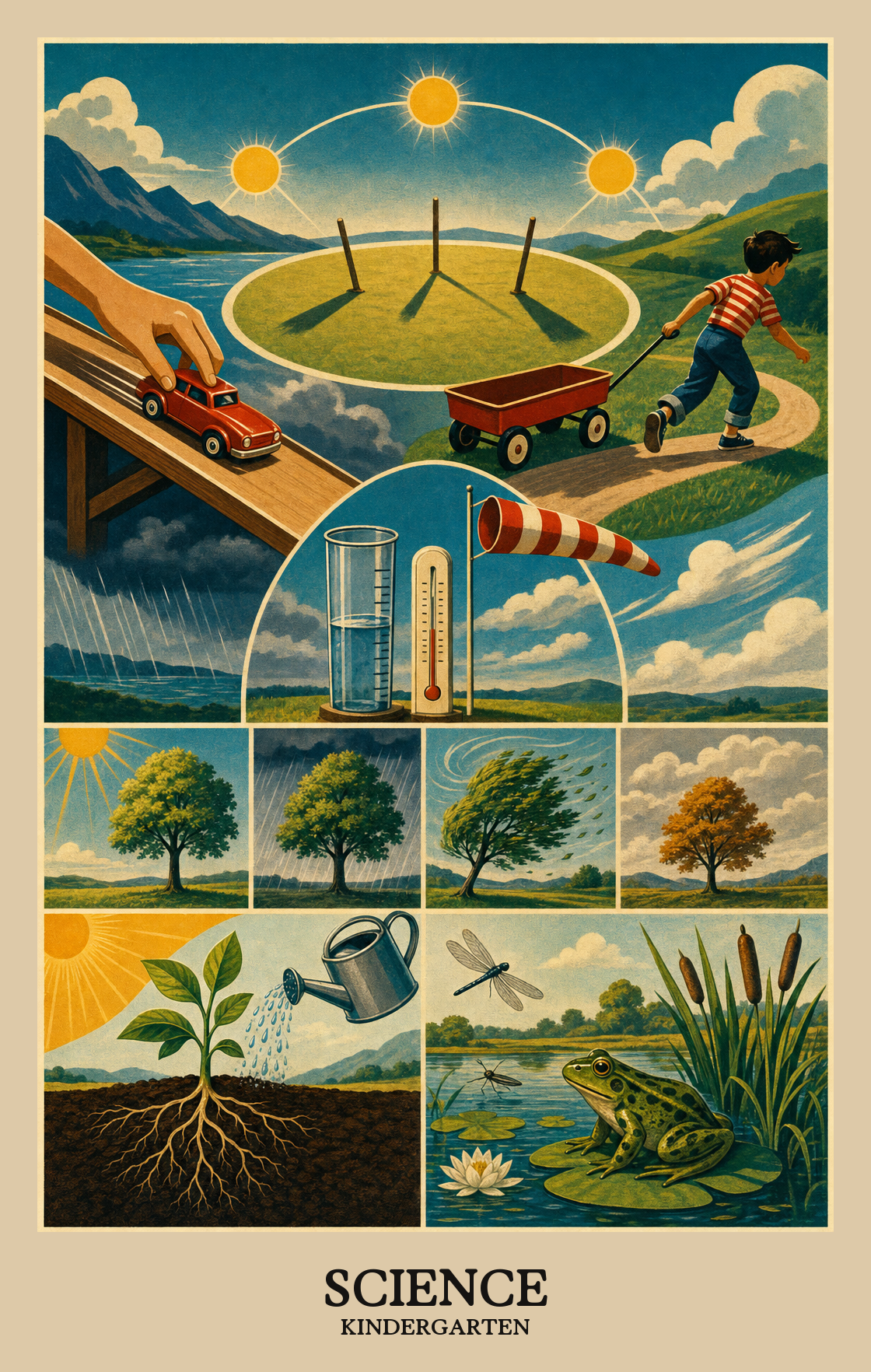
Students notice what the weather is doing each day and start tracking what they see, like sunny days, rainy days, and windy days. Patterns over weeks help them describe what a typical day looks like.
Students feel how the sun warms sidewalks, sand, and playground equipment. They try out simple shade structures, like a paper tent over a rock, to see what keeps a spot cooler.
Students roll, push, and pull objects to see how a harder push sends something farther or how a tap can change its direction. They test simple setups, like a ramp or a ball, to make something speed up, slow down, or turn.
Students look at plants, pets, and the animals near school to figure out what every living thing needs to stay alive. They notice that water, food, air, and a safe place to live keep showing up on the list.
Students see how people, animals, and plants change the spaces around them, from a garden bed to a beaver's dam. They talk about small steps, like picking up trash or saving water, that help the local area.
Students ask questions about storms, snow, and other rough weather, and learn why grown-ups check the forecast. They talk through what to do when severe weather is on the way.
Students push, pull, and roll objects to see how forces change the way things move. They learn that a bigger push or pull makes something move faster or farther.
Students explore how sunlight warms surfaces and how shade keeps things cool. They notice that light and heat come from sources like the sun and a light bulb.
Students learn what living things need to survive. They compare plants and animals to figure out what each one needs, like food, water, and sunlight.
Students observe and describe what happens outside: weather, water, land, and living things. They notice patterns, like why puddles disappear or why leaves fall.
Students learn how humans use natural resources like water, land, and plants, and how those choices affect the world around them.
| Standard | Definition | Code |
|---|---|---|
| Motion and Stability | Students push, pull, and roll objects to see how forces change the way things move. They learn that a bigger push or pull makes something move faster or farther. | K-PS2 |
| Energy | Students explore how sunlight warms surfaces and how shade keeps things cool. They notice that light and heat come from sources like the sun and a light bulb. | K-PS3 |
| From Molecules to Organisms | Students learn what living things need to survive. They compare plants and animals to figure out what each one needs, like food, water, and sunlight. | K-LS1 |
| Earth's Systems | Students observe and describe what happens outside: weather, water, land, and living things. They notice patterns, like why puddles disappear or why leaves fall. | K-ESS2 |
| Earth and Human Activity | Students learn how humans use natural resources like water, land, and plants, and how those choices affect the world around them. | K-ESS3 |
Students push and pull objects to see how the strength and direction of each push or pull changes how the object moves. A harder push sends something farther; a gentle one keeps it close.
Students test whether pushing or pulling a toy made it move faster, slower, or in a different direction, then look at what happened to decide if their idea worked.
| Standard | Definition | Code |
|---|---|---|
| Plan and conduct an investigation to compare the effects of different strengths… | Students push and pull objects to see how the strength and direction of each push or pull changes how the object moves. A harder push sends something farther; a gentle one keeps it close. | K-PS2-1 |
| Analyze data to determine if a design solution works as intended to change the… | Students test whether pushing or pulling a toy made it move faster, slower, or in a different direction, then look at what happened to decide if their idea worked. | K-PS2-2 |
Students go outside and notice what sunlight warms up, like soil, sand, and pavement, then compare those surfaces to spots that stayed in the shade.
Students build a small structure (like a shade or cover) that keeps a spot cooler by blocking sunlight. The goal is to test whether their design actually reduces how much heat the sun creates in that area.
| Standard | Definition | Code |
|---|---|---|
| Make observations to determine the effect of sunlight on Earth's surface | Students go outside and notice what sunlight warms up, like soil, sand, and pavement, then compare those surfaces to spots that stayed in the shade. | K-PS3-1 |
| Use tools and materials to design and build a structure that will reduce the… | Students build a small structure (like a shade or cover) that keeps a spot cooler by blocking sunlight. The goal is to test whether their design actually reduces how much heat the sun creates in that area. | K-PS3-2 |
Students observe real plants and animals to figure out what living things need to survive, like food, water, and light. They look for patterns in what those needs have in common.
| Standard | Definition | Code |
|---|---|---|
| Use observations to describe patterns of what plants and animals | Students observe real plants and animals to figure out what living things need to survive, like food, water, and light. They look for patterns in what those needs have in common. | K-LS1-1 |
Students watch the weather outside and keep track of what they notice, sunny, rainy, windy, over days and weeks to find patterns like "it rains more in spring."
Plants and animals change their surroundings to survive. Students look at real examples, like a bird building a nest or a person clearing land, and explain why those changes happen.
| Standard | Definition | Code |
|---|---|---|
| Use and share observations of local weather conditions to describe patterns… | Students watch the weather outside and keep track of what they notice, sunny, rainy, windy, over days and weeks to find patterns like "it rains more in spring." | K-ESS2-1 |
| Construct an argument supported by evidence for how plants and animals | Plants and animals change their surroundings to survive. Students look at real examples, like a bird building a nest or a person clearing land, and explain why those changes happen. | K-ESS2-2 |
Students match animals and plants to the places where they live, like a fish in water or a cactus in the desert, and explain why that place gives the creature what it needs to survive.
Students learn why weather forecasts matter by asking questions about storms, floods, and other severe weather. They explore how knowing a storm is coming helps people stay safe and make smart decisions ahead of time.
Students think of ways people can help take care of their neighborhood, like picking up trash or saving water, and share their ideas with the class.
| Standard | Definition | Code |
|---|---|---|
| Use a model to represent the relationship between the needs of different plants… | Students match animals and plants to the places where they live, like a fish in water or a cactus in the desert, and explain why that place gives the creature what it needs to survive. | K-ESS3-1 |
| Ask questions to obtain information about the purpose of weather forecasting to… | Students learn why weather forecasts matter by asking questions about storms, floods, and other severe weather. They explore how knowing a storm is coming helps people stay safe and make smart decisions ahead of time. | K-ESS3-2 |
| Communicate solutions that will reduce the impact of humans on the land, water… | Students think of ways people can help take care of their neighborhood, like picking up trash or saving water, and share their ideas with the class. | K-ESS3-3 |
Federally administered sample-based assessment in reading, mathematics, science, writing, and other subjects. NAEP results inform state-by-state comparisons rather than individual student or school accountability.
Students spend the year noticing the world and asking questions about it. They push and pull objects to see how they move, watch the weather, track how the sun warms the ground, and figure out what plants and animals need to live. Most learning happens through hands-on play, not worksheets.
Go outside and talk about what you see. Notice the weather each morning, watch ants on the sidewalk, or see how a shadow moves across the yard. Ask questions like "why do you think that happened?" and let students guess before you answer.
Not really. The focus is on observing, asking questions, and explaining what they notice. Knowing the names of a few animals, plants, and weather words helps, but careful looking matters more than memorizing vocabulary.
Roll a ball gently, then hard, and talk about the difference. Push a toy car into a pillow and see what happens. Try pulling a wagon with one toy inside, then with five, and ask why it feels different.
Weather observation works well as a year-long routine since patterns only show up over time. Pair forces and motion with outdoor play in fall, sunlight and shade investigations in late spring, and plant and animal needs whenever a garden or class pet gives a natural hook.
Two trip students up most often. First, that the sun warms surfaces, not just the air, which becomes clear once they touch pavement and grass on a sunny day. Second, that a stronger push makes something go faster or farther, which gets mixed up with simply pushing more times.
Something simple with a clear question and a fair comparison. Two ramps at different heights, two cups in sun and shade, or two seeds with and without water. Students should predict, try it, and talk about what they noticed.
By spring, students should describe weather using words like sunny, windy, rainy, and cold, explain that living things need food, water, air, and shelter, and predict how a bigger push will change how an object moves. They should also ask their own questions about what they see outside.