Counting and number names
Students count out loud to 100 and learn to read and write numbers from 0 to 20. They practice starting a count from any number, not always from 1.
This is the year numbers click as real amounts, not just words in a song. Students count to 100, write the numbers 0 to 20, and learn that the last number they say is how many things are in the pile. They start adding and taking away small groups using fingers, drawings, and simple problems. By spring, they can count out 15 buttons, tell which group has more, and add and subtract within 5 without much thinking.
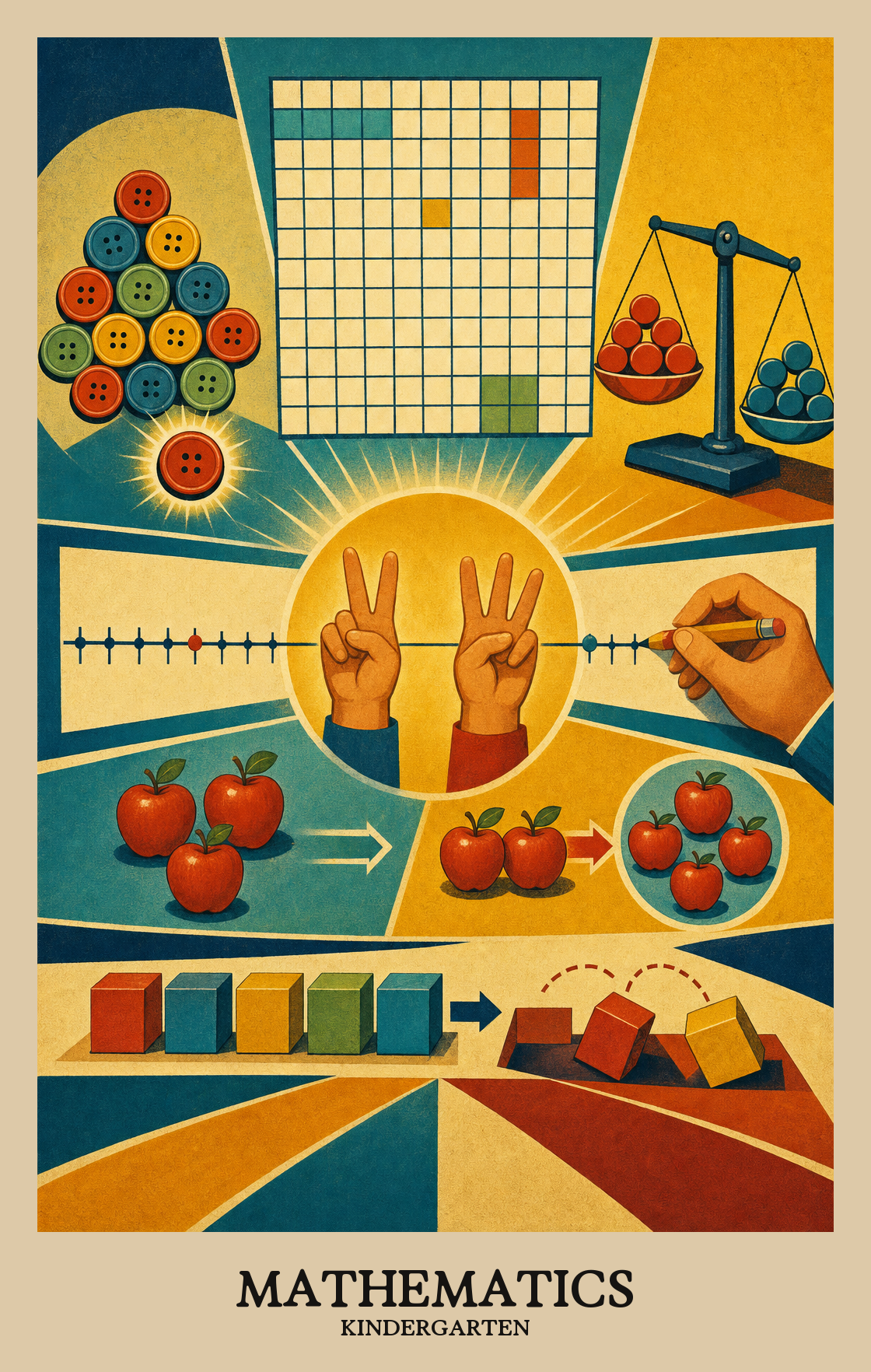
Students count out loud to 100 and learn to read and write numbers from 0 to 20. They practice starting a count from any number, not always from 1.
Students count objects to answer how many, pointing to each one as they say a number. They learn that the last number said tells the size of the group, no matter how the objects are arranged.
Students decide which group has more, less, or the same, and compare written numbers up to 10. They also sort objects into categories and count how many are in each pile.
Students act out addition and subtraction stories using fingers, drawings, and small objects. They break numbers up to 10 into pairs and get quick and steady with sums and differences within 5.
Students see that numbers from 11 to 19 are a group of ten with some extra ones. They show this with drawings or equations like 10 + 4 = 14.
Students name flat and solid shapes, describe where things sit using words like above and beside, and build new shapes from smaller ones. They also compare two objects to see which is longer, shorter, or heavier.
Students count from 1 to 100 out loud, one number at a time, then practice counting by tens: 10, 20, 30, and so on. Both patterns keep growing by the same amount each time.
Students practice counting up from any number, not just from 1. If a teacher says "start at 6," students count 6, 7, 8, 9 from there.
Students read and write the numbers 0 through 20. That means recognizing each number on paper and writing it correctly by hand.
Counting isn't just reciting numbers. Students match each object to exactly one number as they count, and understand that the last number they say tells how many objects there are in all.
Counting means saying "one, two, three" while touching each object exactly once. Students match one number word to one object, so nothing gets counted twice or skipped.
When students count a group of objects, the last number they say is how many there are total. It doesn't matter how the objects are arranged or which one they count first, the answer stays the same.
Counting up always means one more. Students learn that saying the next number in a sequence means there is exactly one more object in the group, so 6 is one more than 5, and 7 is one more than 6.
Students count a small group of objects and write the matching number. They also learn that 0 means nothing is there.
Students count a group of objects and say how many are in it, up to 20. They also do the reverse: hear a number and count out exactly that many blocks, toys, or pictures.
Students look at two groups of objects and decide which group has more, which has fewer, or whether both groups have the same amount. Groups have up to ten objects.
Students look at two written numbers, both between 1 and 10, and decide which is greater, which is less, or whether they are equal.
| Standard | Definition | Code |
|---|---|---|
| Count to 100 by ones and by tens and identify as a growth pattern | Students count from 1 to 100 out loud, one number at a time, then practice counting by tens: 10, 20, 30, and so on. Both patterns keep growing by the same amount each time. | K.CC.1 |
| Count forward beginning from a given number within the known sequence | Students practice counting up from any number, not just from 1. If a teacher says "start at 6," students count 6, 7, 8, 9 from there. | K.CC.2 |
| Read and write numerals from 0 to 20 | Students read and write the numbers 0 through 20. That means recognizing each number on paper and writing it correctly by hand. | K.CC.3 |
| Understand the relationship between numbers and quantities | Counting isn't just reciting numbers. Students match each object to exactly one number as they count, and understand that the last number they say tells how many objects there are in all. | K.CC.4 |
| When counting objects, say each number's name in sequential order, pairing each… | Counting means saying "one, two, three" while touching each object exactly once. Students match one number word to one object, so nothing gets counted twice or skipped. | K.CC.4.a |
| Understand that the last number name said tells the number of objects counted | When students count a group of objects, the last number they say is how many there are total. It doesn't matter how the objects are arranged or which one they count first, the answer stays the same. | K.CC.4.b |
| Understand that each successive number name refers to a quantity that is one… | Counting up always means one more. Students learn that saying the next number in a sequence means there is exactly one more object in the group, so 6 is one more than 5, and 7 is one more than 6. | K.CC.4.c |
| Represent a number of objects with a written numeral 0-20 | Students count a small group of objects and write the matching number. They also learn that 0 means nothing is there. | K.CC.4.d |
| Count to answer "how many?" up to20 concrete or pictorial objects arranged in a… | Students count a group of objects and say how many are in it, up to 20. They also do the reverse: hear a number and count out exactly that many blocks, toys, or pictures. | K.CC.5 |
| Identify whether the number of objects in one group is greater than, less than | Students look at two groups of objects and decide which group has more, which has fewer, or whether both groups have the same amount. Groups have up to ten objects. | K.CC.6 |
| Compare two numbers between 1 and 10 presented as written numerals | Students look at two written numbers, both between 1 and 10, and decide which is greater, which is less, or whether they are equal. | K.CC.7 |
Students show adding and taking away using whatever makes sense to them: fingers, drawings, claps, or just acting it out. The idea is to connect the math to something real before numbers and symbols enter the picture.
Students solve simple adding and subtracting stories using numbers up to 10. They might use blocks or drawings to figure out how many are left or how many there are altogether.
Students break a number like 7 into two smaller numbers, then find a different way to split the same number. They record each split as a drawing or simple equation, like 7 = 5 + 2 and 7 = 6 + 1.
Students figure out what number is missing when two groups need to add up to 10. For example, if there are 6 blocks, students find that 4 more make 10.
Students quickly solve any addition or subtraction problem where the answer is 5 or under. They can work these out from memory, with fingers, or with objects, without stopping to figure it out step by step.
| Standard | Definition | Code |
|---|---|---|
| Represent addition and subtraction with objects, fingers, mental images… | Students show adding and taking away using whatever makes sense to them: fingers, drawings, claps, or just acting it out. The idea is to connect the math to something real before numbers and symbols enter the picture. | K.OA.1 |
| Solve addition and subtraction word problems | Students solve simple adding and subtracting stories using numbers up to 10. They might use blocks or drawings to figure out how many are left or how many there are altogether. | K.OA.2 |
| Decompose numbers less than or equal to 10 into pairs in more than one way | Students break a number like 7 into two smaller numbers, then find a different way to split the same number. They record each split as a drawing or simple equation, like 7 = 5 + 2 and 7 = 6 + 1. | K.OA.3 |
| For any number from 1 to 9, find the number that makes 10 when added to the… | Students figure out what number is missing when two groups need to add up to 10. For example, if there are 6 blocks, students find that 4 more make 10. | K.OA.4 |
| Fluently (efficiently, accurately | Students quickly solve any addition or subtraction problem where the answer is 5 or under. They can work these out from memory, with fingers, or with objects, without stopping to figure it out step by step. | K.OA.5 |
Students break apart numbers like 13 or 17 into a group of ten and some leftover ones. They show this with drawings or simple math sentences like 10 + 3 = 13.
| Standard | Definition | Code |
|---|---|---|
| Compose and decompose numbers from 11 to 19 into ten ones and some further ones | Students break apart numbers like 13 or 17 into a group of ten and some leftover ones. They show this with drawings or simple math sentences like 10 + 3 = 13. | K.NBT.1 |
Students pick up an everyday object and describe what can be measured about it. A crayon, for example, has a length, a weight, and a width. Students practice noticing more than one measurable attribute at a time.
Two objects sit side by side, and students say which one is taller, heavier, or longer. They also explain the difference: "the red block is shorter than the blue one."
Students sort everyday objects into groups, count how many are in each group, and then order the groups from smallest to largest. No group has more than 10 items.
| Standard | Definition | Code |
|---|---|---|
| Describe measurable attributes of objects, such as length or weight | Students pick up an everyday object and describe what can be measured about it. A crayon, for example, has a length, a weight, and a width. Students practice noticing more than one measurable attribute at a time. | K.MD.1 |
| Directly compare two objects, with a measureable attribute in common, to see… | Two objects sit side by side, and students say which one is taller, heavier, or longer. They also explain the difference: "the red block is shorter than the blue one." | K.MD.2 |
| Classify objects into given categories | Students sort everyday objects into groups, count how many are in each group, and then order the groups from smallest to largest. No group has more than 10 items. | K.MD.3 |
Students name the shapes they see in everyday objects, like a window being a rectangle or a ball being a sphere, and say where things are by using words like above, below, beside, and next to.
Students name shapes correctly whether the shape is tiny or large, upright or tilted. A triangle is still a triangle even when it's flipped on its side.
Students sort shapes into two groups: flat shapes like a square drawn on paper, and solid shapes like a block or ball you can pick up.
Students look at flat and solid shapes of different sizes and figure out what makes them alike or different, naming things like how many sides or corners each one has.
Students build and draw basic shapes like squares, triangles, and circles using materials or pencil and paper. They connect the shapes they see in the real world to the ones they can make with their own hands.
Students put smaller shapes together to build a bigger one, like joining two triangles side by side to make a rectangle.
| Standard | Definition | Code |
|---|---|---|
| Describe objects in the environment using names of shapes | Students name the shapes they see in everyday objects, like a window being a rectangle or a ball being a sphere, and say where things are by using words like above, below, beside, and next to. | K.G.1 |
| Correctly gives most precise name of shapes regardless of their orientations | Students name shapes correctly whether the shape is tiny or large, upright or tilted. A triangle is still a triangle even when it's flipped on its side. | K.G.2 |
| Identify shapes as two-dimensional | Students sort shapes into two groups: flat shapes like a square drawn on paper, and solid shapes like a block or ball you can pick up. | K.G.3 |
| Analyze and compare two- and three-dimensional shapes, in different sizes and… | Students look at flat and solid shapes of different sizes and figure out what makes them alike or different, naming things like how many sides or corners each one has. | K.G.4 |
| Model shapes in the world by building shapes from components | Students build and draw basic shapes like squares, triangles, and circles using materials or pencil and paper. They connect the shapes they see in the real world to the ones they can make with their own hands. | K.G.5 |
| Compose simple shapes to form larger shapes | Students put smaller shapes together to build a bigger one, like joining two triangles side by side to make a rectangle. | K.G.6 |
KAP mathematics assessment for grades 3 through 8 and grade 10, aligned to the Kansas Mathematics Standards.
Students count to 100 by ones and tens, write numbers from 0 to 20, and add and subtract small numbers up to 10. They also name shapes, compare sizes, and sort objects into groups.
Count real things together: stairs, grapes, socks, steps to the car. Once counting to 20 feels easy, start at a number other than one, like counting from seven. Five minutes a day adds up fast.
Saying numbers in order is different from counting things. Practice pointing to each object once while saying one number, then asking how many there are in total. Moving objects into a line as they count usually fixes double-counting.
Start with rote counting and one-to-one matching with small groups, then move to writing numerals and answering how many. Push comparing groups and counting on from a given number in the second half of the year, once cardinality is solid.
Students answer sums and differences within 5 without counting on fingers every time. They know pairs like 2 and 3 make 5, and that 4 minus 1 is 3. Speed matters less than recognizing the pairs.
Not really. The goal is to know small sums and differences up to 5 from seeing them often, not from flashcards. Games with dice, dominoes, and playing cards build this without drills.
Writing numerals 0 to 20 with correct formation, making ten from a smaller number, and decomposing teen numbers into ten and some ones. Build these into daily warm-ups rather than saving them for a single unit.
Ready students count past 20 confidently, read and write numbers to 20, and solve small addition and subtraction word problems with objects or drawings. They can also see a teen number as ten and some extras.
Point out circles, squares, triangles, and rectangles on signs, food, and toys. Ask what is the same and different about two shapes, or have them build a bigger shape from smaller ones with blocks or paper scraps.