Settling into longer texts
Students start the year reading longer chapters and articles on their own. They practice pointing back to a sentence or paragraph in the book to explain what a character did or what an author said.
This is the year reading shifts from following a story to backing up ideas with proof from the page. Students point to specific lines that show why a character changed or why an author's argument holds up. In writing, they pull facts from more than one source and put them into their own words instead of copying. By spring, they can write a multi-paragraph opinion piece that uses evidence from what they read.
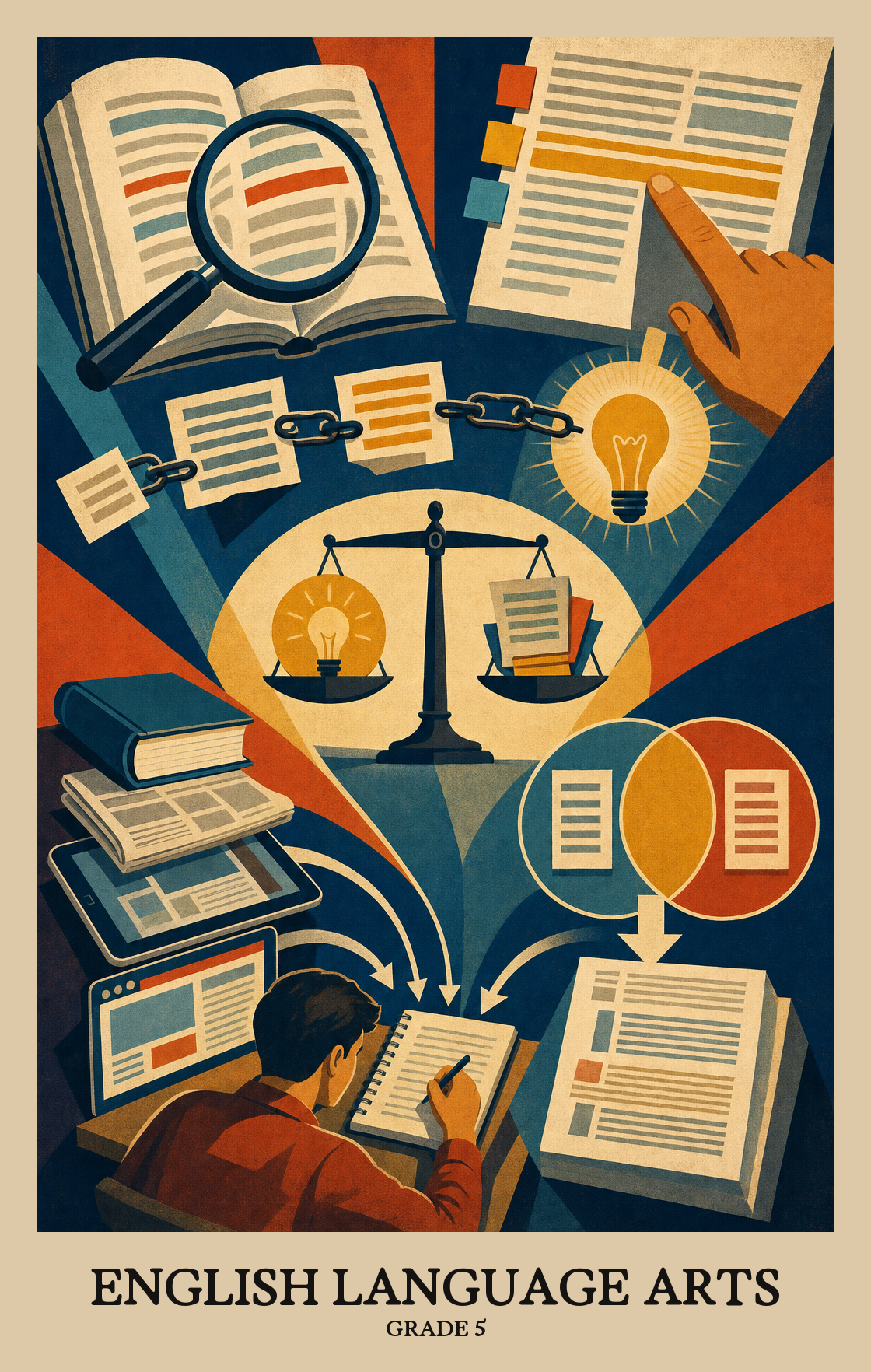
Students start the year reading longer chapters and articles on their own. They practice pointing back to a sentence or paragraph in the book to explain what a character did or what an author said.
Students compare characters across different stories and figure out the lesson an author is trying to teach. They also notice how the narrator's view shapes what readers learn.
Students use headings, captions, and charts to find information fast. They weigh whether an author makes a strong point and pull facts from more than one article to talk about a topic.
Students break apart longer words using roots, prefixes, and suffixes from Latin and Greek. They also figure out what sayings like raining cats and dogs actually mean in a sentence.
Students plan, draft, and revise opinion pieces, explanations, and stories. They learn the difference between using their own words and copying, and they pick sources that actually fit the topic.
Students build longer sentences with commas in the right spots and use apostrophes to show who owns what. In class talks, they ask follow-up questions and sum up what a speaker said.
Reading skills students use to understand what a text says, figure out what it means, and explain how they know. This standard covers the close-reading work students do across stories, articles, and other texts in fifth grade.
Students read a passage and explain what the text says outright, then go further and figure out what the author implies but never states directly. Both conclusions need words or sentences from the text as backup.
Students read a passage and back up their conclusions with two kinds of proof: words the author actually wrote and reasonable guesses the evidence supports.
Students figure out the meaning of unfamiliar words by using context clues, word roots, and other strategies. The goal is reading without stopping to look everything up.
Students use prefixes, suffixes, and root words from Latin and Greek to figure out what an unfamiliar word means. Reading the surrounding sentences helps them check their guess.
Students use the words and sentences around an unfamiliar word to figure out what it means. This skill also applies when a word has more than one meaning and students have to pick the right one.
Students figure out what phrases like "it's raining cats and dogs" or "the tip of the iceberg" actually mean when they show up in a story or article. The phrase isn't literal; students explain what the writer really meant.
Students practice using three kinds of words: everyday words they already know, general school words that show up across subjects, and topic-specific vocabulary tied to what they're reading or studying.
Students read on their own for stretches of time, choosing books or articles for different reasons: to learn something, to enjoy a story, or to answer a question they have.
Reading fiction, poetry, and plays, students go beyond the words on the page to figure out what the author means, why characters act as they do, and what the story adds up to.
Students look at two or more characters across stories and explain how their roles, relationships, and conflicts are alike or different. The focus is on why each character matters to the plot, not just what they do.
Reading a story closely enough to name what lesson it teaches, what problem the main character faces, and how that problem gets resolved by the end.
The narrator telling a story shapes how readers feel about the characters and events. Students figure out whose perspective is driving the story and how that viewpoint colors what gets shared and what gets left out.
Students read nonfiction and use its headings, charts, captions, and other features to figure out information the main text doesn't spell out directly.
Students use headings, captions, charts, and images together to find information in a nonfiction text and get a quick sense of what the whole piece covers.
Students read nonfiction passages and figure out what the author means beyond the literal words. They notice techniques like comparison, repetition, or word choice and use those clues to draw their own conclusions.
Students read a nonfiction text, decide whether the author actually accomplished what they set out to do, and back up that opinion with specific details from the text.
Students read a nonfiction author's conclusion and decide whether the reasoning behind it actually holds up. They point to specific details from the text to explain why the argument makes sense or falls short.
Students read nonfiction passages and figure out how the author organized the information, such as by cause and effect or problem and solution. That structure helps students understand and explain what the text is saying.
Nonfiction writers organize information in patterns, such as cause and effect or problem and solution. Students figure out which pattern a text uses and explain how that structure shapes the way ideas connect.
Students read multiple articles or books on the same topic, then pull the most useful facts together to write or talk about that subject with confidence.
| Standard | Definition | Code |
|---|---|---|
| Develop and demonstrate comprehension-reading skills in response to texts | Reading skills students use to understand what a text says, figure out what it means, and explain how they know. This standard covers the close-reading work students do across stories, articles, and other texts in fifth grade. | 5.R.1.A |
| Drawing conclusions and inferring by referencing textual evidence to support… | Students read a passage and explain what the text says outright, then go further and figure out what the author implies but never states directly. Both conclusions need words or sentences from the text as backup. | 5.R.1.A.a |
| Drawing conclusions by providing textual evidence of what the text says… | Students read a passage and back up their conclusions with two kinds of proof: words the author actually wrote and reasonable guesses the evidence supports. | 5.R.1.A.b |
| Develop an understanding of vocabulary | Students figure out the meaning of unfamiliar words by using context clues, word roots, and other strategies. The goal is reading without stopping to look everything up. | 5.R.1.B |
| Determining the meaning of academic English words derived from Latin, Greek, or… | Students use prefixes, suffixes, and root words from Latin and Greek to figure out what an unfamiliar word means. Reading the surrounding sentences helps them check their guess. | 5.R.1.B.a |
| Using context to determine meaning of unfamiliar or multiple-meaning words | Students use the words and sentences around an unfamiliar word to figure out what it means. This skill also applies when a word has more than one meaning and students have to pick the right one. | 5.R.1.B.b |
| Explaining the meaning of common idioms, adages, similes, metaphors… | Students figure out what phrases like "it's raining cats and dogs" or "the tip of the iceberg" actually mean when they show up in a story or article. The phrase isn't literal; students explain what the writer really meant. | 5.R.1.B.d |
| Using conversational, general academic | Students practice using three kinds of words: everyday words they already know, general school words that show up across subjects, and topic-specific vocabulary tied to what they're reading or studying. | 5.R.1.B.g |
| Read independently for multiple purposes over sustained periods of time | Students read on their own for stretches of time, choosing books or articles for different reasons: to learn something, to enjoy a story, or to answer a question they have. | 5.R.1.D |
| Read, infer, analyze and draw conclusions using fiction texts including poetry… | Reading fiction, poetry, and plays, students go beyond the words on the page to figure out what the author means, why characters act as they do, and what the story adds up to. | 5.R.2.A |
| Compare and contrast the roles and functions of characters in various plots… | Students look at two or more characters across stories and explain how their roles, relationships, and conflicts are alike or different. The focus is on why each character matters to the plot, not just what they do. | 5.R.2.A.a |
| Explain the theme or moral lesson, conflict | Reading a story closely enough to name what lesson it teaches, what problem the main character faces, and how that problem gets resolved by the end. | 5.R.2.A.b |
| Describe how a narrator’s or speaker’s point of view influences others | The narrator telling a story shapes how readers feel about the characters and events. Students figure out whose perspective is driving the story and how that viewpoint colors what gets shared and what gets left out. | 5.R.2.A.c |
| Read, infer and draw conclusions using text features in nonfiction texts | Students read nonfiction and use its headings, charts, captions, and other features to figure out information the main text doesn't spell out directly. | 5.R.3.A |
| Use multiple text features and graphics to locate information and gain an… | Students use headings, captions, charts, and images together to find information in a nonfiction text and get a quick sense of what the whole piece covers. | 5.R.3.A.a |
| Read, infer and draw conclusions using literary techniques in nonfiction texts | Students read nonfiction passages and figure out what the author means beyond the literal words. They notice techniques like comparison, repetition, or word choice and use those clues to draw their own conclusions. | 5.R.3.B |
| Evaluate if the author’s purpose was achieved, identify reasons for the… | Students read a nonfiction text, decide whether the author actually accomplished what they set out to do, and back up that opinion with specific details from the text. | 5.R.3.B.a |
| Use reasoning to determine the logic of an author’s conclusion and provide… | Students read a nonfiction author's conclusion and decide whether the reasoning behind it actually holds up. They point to specific details from the text to explain why the argument makes sense or falls short. | 5.R.3.B.g |
| Read, infer and draw conclusions using text structures in nonfiction texts | Students read nonfiction passages and figure out how the author organized the information, such as by cause and effect or problem and solution. That structure helps students understand and explain what the text is saying. | 5.R.3.C |
| Analyze how the pattern of organization of a text influences the relationships | Nonfiction writers organize information in patterns, such as cause and effect or problem and solution. Students figure out which pattern a text uses and explain how that structure shapes the way ideas connect. | 5.R.3.C.c |
| Integrate information from several texts on the same topic in order to write or… | Students read multiple articles or books on the same topic, then pull the most useful facts together to write or talk about that subject with confidence. | 5.R.3.C.e |
Reading longer words gets easier when students recognize familiar patterns, like prefixes, suffixes, and roots. Students use those word parts to sound out and make sense of new words on the page.
Students break apart long, unfamiliar words by using letter sounds, syllable patterns, and word parts like prefixes and suffixes. The goal is to read those words correctly when they appear in a sentence or passage.
Students read words built from roots, prefixes, and suffixes, and learn the key vocabulary that shows up across subjects like science and social studies.
| Standard | Definition | Code |
|---|---|---|
| Develop phonics in the reading process | Reading longer words gets easier when students recognize familiar patterns, like prefixes, suffixes, and roots. Students use those word parts to sound out and make sense of new words on the page. | 5.RF.3.A |
| Decoding words using knowledge of all letter-sound correspondences… | Students break apart long, unfamiliar words by using letter sounds, syllable patterns, and word parts like prefixes and suffixes. The goal is to read those words correctly when they appear in a sentence or passage. | 5.RF.3.A.a |
| Reading root words, prefixes, suffixes | Students read words built from roots, prefixes, and suffixes, and learn the key vocabulary that shows up across subjects like science and social studies. | 5.RF.3.A.b |
Students take their prewriting notes or outline and turn them into a full draft, following the shape and style that fits the type of writing they chose.
Students reread their writing, make improvements to what they say, and fix errors in grammar and spelling, with a teacher or peer helping them spot what to change.
Students state a clear opinion and back it up with reasons and evidence from what they've read or learned. The goal is to persuade a reader, not just share a feeling.
Students explain a topic clearly in writing, using facts, definitions, and details to help the reader understand. This standard covers the whole process: choosing what to include, organizing it, and wrapping it up.
Students write their own stories, poems, or personal narratives. The work can be made-up fiction or drawn from real events.
Students gather information from multiple sources (books, websites, interviews) and organize what they find to support a piece of writing. The goal is to use research as a tool, not just copy facts.
Students practice choosing which sources actually help answer their question, whether that source is a story, a book, a website, or an article.
Students learn the difference between putting an idea in their own words and copying someone else's words without credit. Paraphrasing is allowed; passing off another person's exact words as your own is not.
| Standard | Definition | Code |
|---|---|---|
| Appropriate to genre, type develop a draft from prewriting | Students take their prewriting notes or outline and turn them into a full draft, following the shape and style that fits the type of writing they chose. | 5.W.1.B |
| Reread, revise and edit drafts with assistance | Students reread their writing, make improvements to what they say, and fix errors in grammar and spelling, with a teacher or peer helping them spot what to change. | 5.W.1.C |
| Write opinion texts | Students state a clear opinion and back it up with reasons and evidence from what they've read or learned. The goal is to persuade a reader, not just share a feeling. | 5.W.2.A |
| Write informative/explanatory texts | Students explain a topic clearly in writing, using facts, definitions, and details to help the reader understand. This standard covers the whole process: choosing what to include, organizing it, and wrapping it up. | 5.W.2.B |
| Write fiction or nonfiction narratives and poems | Students write their own stories, poems, or personal narratives. The work can be made-up fiction or drawn from real events. | 5.W.2.C |
| Apply a research process to use information from a variety of sources | Students gather information from multiple sources (books, websites, interviews) and organize what they find to support a piece of writing. The goal is to use research as a tool, not just copy facts. | 5.W.3.A |
| Select relevant sources, literary and informational | Students practice choosing which sources actually help answer their question, whether that source is a story, a book, a website, or an article. | 5.W.3.A.d |
| Differentiate between paraphrasing and plagiarism when using ideas of others | Students learn the difference between putting an idea in their own words and copying someone else's words without credit. Paraphrasing is allowed; passing off another person's exact words as your own is not. | 5.W.3.A.g |
Students use correct grammar in what they say and write. That means choosing the right verb forms, keeping tenses consistent, and building sentences that follow standard English rules.
Students learn to name and use the eight parts of speech: nouns, verbs, adjectives, adverbs, pronouns, prepositions, conjunctions, and interjections. They practice spotting each one in sentences and using them correctly in their own writing and speech.
Students write sentences that contain more than one idea, connecting a main thought to a supporting clause. The goal is variety: not every sentence looks the same.
Students use correct punctuation, capitalization, and spelling in their own writing, not just on worksheets. This standard is about getting those details right in real sentences and paragraphs.
Students practice placing a comma after an opening clause before the main sentence begins. For example, "When the bell rang, everyone ran outside" needs that comma after the first part.
Students use apostrophes to show that something belongs to one person or thing, like "the dog's leash" or "Maria's backpack." This is different from a plural or a contraction.
Students add an apostrophe after the -s in words like "the dogs' leashes" or "the teachers' desks" to show that something belongs to more than one person or thing.
| Standard | Definition | Code |
|---|---|---|
| In speech and written form, apply standard English grammar | Students use correct grammar in what they say and write. That means choosing the right verb forms, keeping tenses consistent, and building sentences that follow standard English rules. | 5.L.1.A |
| Explain and use the eight parts of speech | Students learn to name and use the eight parts of speech: nouns, verbs, adjectives, adverbs, pronouns, prepositions, conjunctions, and interjections. They practice spotting each one in sentences and using them correctly in their own writing and speech. | 5.L.1.A.a |
| Produce a variety of complex sentences in writing | Students write sentences that contain more than one idea, connecting a main thought to a supporting clause. The goal is variety: not every sentence looks the same. | 5.L.1.A.e |
| In written text, apply punctuation, capitalization and spelling | Students use correct punctuation, capitalization, and spelling in their own writing, not just on worksheets. This standard is about getting those details right in real sentences and paragraphs. | 5.L.1.B |
| Use a comma to separate an introductory clause in a complex sentence | Students practice placing a comma after an opening clause before the main sentence begins. For example, "When the bell rang, everyone ran outside" needs that comma after the first part. | 5.L.1.B.c |
| Use apostrophes in singular nouns to show possession | Students use apostrophes to show that something belongs to one person or thing, like "the dog's leash" or "Maria's backpack." This is different from a plural or a contraction. | 5.L.1.B.h |
| Write apostrophes in regular plural nouns to show possession | Students add an apostrophe after the -s in words like "the dogs' leashes" or "the teachers' desks" to show that something belongs to more than one person or thing. | 5.L.1.B.i |
Students practice listening carefully in class discussions, group work, and presentations. They focus on what the speaker is actually saying before they respond.
Students ask follow-up questions when something is unclear and connect their own comments to what a classmate just said, keeping a class discussion moving forward.
Students listen to a speaker, then sum up the main point in their own words, pointing to specific details from what was said to back up their summary.
| Standard | Definition | Code |
|---|---|---|
| Develop and apply effective listening skills and strategies in formal and… | Students practice listening carefully in class discussions, group work, and presentations. They focus on what the speaker is actually saying before they respond. | 5.SL.1.A |
| Posing and responding to specific questions to clarify or following up on… | Students ask follow-up questions when something is unclear and connect their own comments to what a classmate just said, keeping a class discussion moving forward. | 5.SL.1.A.b |
| Listening for speaker’s message and summarizing main points based on evidence | Students listen to a speaker, then sum up the main point in their own words, pointing to specific details from what was said to back up their summary. | 5.SL.1.A.d |
Missouri Assessment Program grade-level English language arts assessment for grades 3 through 8.
Alternate assessment for eligible students with significant cognitive disabilities, covering the state-tested grade-level and end-of-course subjects.
Students read longer chapter books and articles, then back up what they say with lines from the text. They write longer pieces with a real opinion, a clear order, and paragraphs that hold together. Spelling, grammar, and punctuation start to matter more in the final draft.
Keep a steady reading habit of about 20 minutes a night, with a mix of stories and nonfiction. After reading, ask one question: what made you think that, and where in the book does it show? That small habit builds the evidence muscle teachers are looking for.
Cover part of the word and look for chunks that are familiar, like a root, prefix, or suffix. Then reread the whole sentence to see if the meaning fits. Words from Latin and Greek roots show up often this year, so noticing parts inside a word pays off.
A solid piece has a clear point at the start, paragraphs that each cover one idea, and specific details from a book or a source. Sentences vary in length and include some longer ones with commas in the right spots. Apostrophes for possession and basic spelling should be mostly correct by the final draft.
Start with shorter texts to lock in citing evidence and inferring, then move into longer fiction units that compare characters, theme, and point of view. Bring nonfiction in alongside, building up to units where students pull information from several articles on one topic. Save the heaviest cross-text work for the second half of the year.
Inference with real text evidence is the biggest one. Students often retell instead of analyzing, or quote without explaining. Plan to revisit it across genres all year, and expect to reteach paraphrasing versus copying once research writing starts.
Start with two or three vetted sources on a shared topic so the focus stays on reading and note-taking, not searching. Teach paraphrasing early by having students close the source before they write. Build up to students picking their own sources later in the year.
By spring, students should read a grade-level article or chapter and explain the main idea with two or three pieces of evidence in writing. They should draft an opinion or explanatory piece with paragraphs, revise it with feedback, and use commas and apostrophes correctly most of the time. Discussions should include real follow-up questions, not just turn-taking.