Matter and what it's made of
Students explore the idea that everything is built from particles too tiny to see. They weigh things before and after heating, cooling, or mixing to show the amount of matter stays the same.
This is the year science zooms out to the whole planet and beyond. Students learn that matter is made of tiny particles too small to see, and that the weight stays the same when things melt, mix, or dissolve. They trace how energy from the sun ends up in plants, then animals, then back into the soil. By spring, they can explain why we have seasons and why the sun looks brighter than other stars.
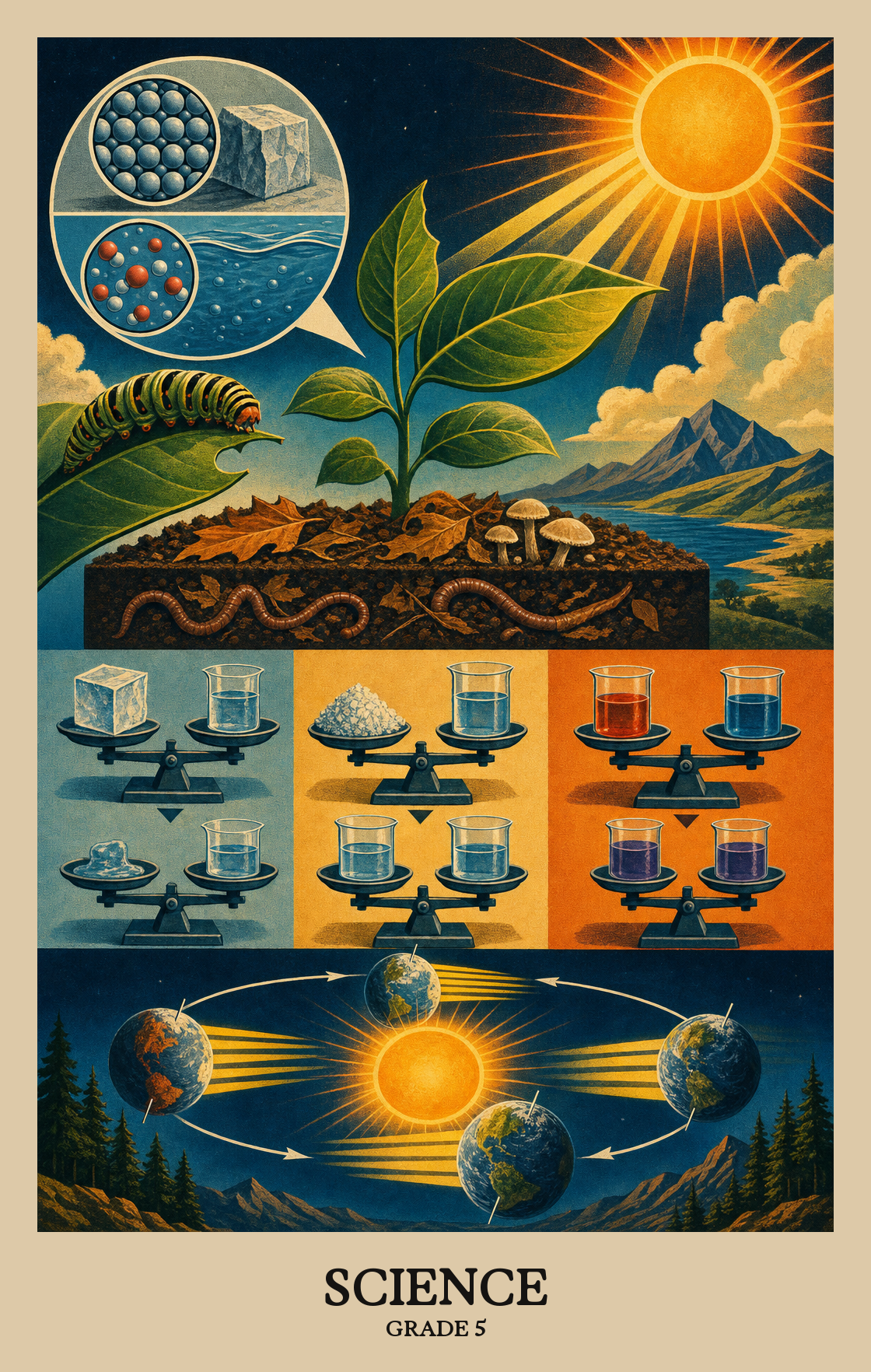
Students explore the idea that everything is built from particles too tiny to see. They weigh things before and after heating, cooling, or mixing to show the amount of matter stays the same.
Students separate mixtures using tools like filters, magnets, and screens. They also combine substances to see when something new forms, such as a color change or fizzing.
Students argue that gravity pulls objects toward the center of Earth and that we see things because light bounces off them. They trace the energy in food back to the sun.
Students compare body systems across animals and build the case that plants grow mostly from air and water, not soil. They map how matter moves between plants, animals, and decomposers.
Students track shadows, daylight, and stars across the seasons and explain why the sun looks brighter than other stars. They graph how much of Earth's water is fresh and where it sits.
Students study how communities protect land, air, and water, then take on a design problem of their own. They sketch solutions, run fair tests, and improve a prototype based on what fails.
Matter is made of tiny particles too small to see, even under a magnifying glass. Students build a model, like a drawing or diagram, to show how those invisible particles make up everyday objects like water, air, or a rock.
Students heat, cool, and mix materials, then weigh and graph the results to show that the total weight stays the same before and after, no matter what changes happened.
Students sort, filter, or use a magnet to pull apart mixed materials, like separating sand from water or iron filings from gravel. The goal is to split a mixture into its parts using physical tools, not chemicals.
Students mix substances together and observe whether the result is something new. They look for signs like color change, gas bubbles, or a solid forming to decide if a chemical reaction happened.
| Standard | Definition | Code |
|---|---|---|
| Develop a model to describe that matter is made of particles too small to be… | Matter is made of tiny particles too small to see, even under a magnifying glass. Students build a model, like a drawing or diagram, to show how those invisible particles make up everyday objects like water, air, or a rock. | 5.PS1.A.a |
| Measure and graph quantities to provide evidence that regardless of the type of… | Students heat, cool, and mix materials, then weigh and graph the results to show that the total weight stays the same before and after, no matter what changes happened. | 5.PS1.A.b |
| Plan and conduct investigations to separate the components of a… | Students sort, filter, or use a magnet to pull apart mixed materials, like separating sand from water or iron filings from gravel. The goal is to split a mixture into its parts using physical tools, not chemicals. | 5.PS1.B.a |
| Conduct an investigation to determine whether the combining of two or more… | Students mix substances together and observe whether the result is something new. They look for signs like color change, gas bubbles, or a solid forming to decide if a chemical reaction happened. | 5.PS1.B.b |
Students gather evidence to explain why objects fall straight down toward Earth rather than sideways or upward. The argument is that gravity always pulls toward Earth's center, no matter where on the planet an object is.
| Standard | Definition | Code |
|---|---|---|
| Support an argument that the gravitational force exerted by Earth on objects is… | Students gather evidence to explain why objects fall straight down toward Earth rather than sideways or upward. The argument is that gravity always pulls toward Earth's center, no matter where on the planet an object is. | 5.PS2.B |
Chemical reactions release or absorb energy. Students learn why burning wood gives off heat, why a battery powers a device, and how the food they eat fuels the body.
Food holds stored energy that originally came from the sun. Students trace that path, showing how sunlight becomes the energy your body uses to move, grow, heal, and stay warm.
| Standard | Definition | Code |
|---|---|---|
| Energy in Chemical Process and Everyday | Chemical reactions release or absorb energy. Students learn why burning wood gives off heat, why a battery powers a device, and how the food they eat fuels the body. | PS3.D |
| Use models to describe that energy stored in food | Food holds stored energy that originally came from the sun. Students trace that path, showing how sunlight becomes the energy your body uses to move, grow, heal, and stay warm. | 5.PS3.D |
Students learn why we can see objects at all. Some things give off their own light, like a lamp or a flame. Everything else is visible only because light bounces off it and reaches our eyes.
| Standard | Definition | Code |
|---|---|---|
| Develop a model to describe that objects can be seen only when light is… | Students learn why we can see objects at all. Some things give off their own light, like a lamp or a flame. Everything else is visible only because light bounces off it and reaches our eyes. | 5.PS4.A |
Students compare the organs that do the same job in different backboned animals, such as how a fish, a frog, and a human each digest food or move blood, and explain how those organs are alike and different.
Plants make their own food by capturing sunlight and turning it into sugar. Animals get energy by eating plants or other animals, and both release energy from food through a process that uses oxygen.
Plants don't grow mainly from soil. Students learn that plants pull carbon dioxide from the air and water from the ground, then use sunlight to turn those two ingredients into the food and matter they need to grow.
| Standard | Definition | Code |
|---|---|---|
| Compare and contrast the major organs/organ systems | Students compare the organs that do the same job in different backboned animals, such as how a fish, a frog, and a human each digest food or move blood, and explain how those organs are alike and different. | 5.LS1.A |
| Organization for Matter and Energy Flow in Organisms | Plants make their own food by capturing sunlight and turning it into sugar. Animals get energy by eating plants or other animals, and both release energy from food through a process that uses oxygen. | LS1.C |
| Support an argument that plants get the materials | Plants don't grow mainly from soil. Students learn that plants pull carbon dioxide from the air and water from the ground, then use sunlight to turn those two ingredients into the food and matter they need to grow. | 5.LS1.C |
Plants pull energy from sunlight and nutrients from soil, then pass that energy to animals that eat them. Matter keeps cycling through living things, while energy flows in one direction, from the sun outward through the food chain.
Matter cycles through living things and back into the environment. Students build a model showing how plants, animals, and decomposers pass materials among each other and into the soil, water, and air.
| Standard | Definition | Code |
|---|---|---|
| Cycles of matter and Energy Transfer in Ecosystems | Plants pull energy from sunlight and nutrients from soil, then pass that energy to animals that eat them. Matter keeps cycling through living things, while energy flows in one direction, from the sun outward through the food chain. | LS2.B |
| Develop a model to describe the movement of matter among plants, animals… | Matter cycles through living things and back into the environment. Students build a model showing how plants, animals, and decomposers pass materials among each other and into the soil, water, and air. | 5.LS2.B |
Stars look dimmer the farther away they are. Students learn why our sun looks so bright compared to other stars: it's much closer to Earth, not necessarily bigger or brighter than all of them.
The brightness of a star in the night sky depends on its size and how far away it is. Students learn why Earth's seasons change and how the predictable movements of Earth around the sun drive those patterns.
Students track how daylight hours change across the seasons and figure out why summer days are long and winter days are short.
Students graph real patterns in nature: how shadows grow and shrink through the day, why we have day and night, and why certain stars appear only in certain seasons.
| Standard | Definition | Code |
|---|---|---|
| Support an argument that relative distances from Earth affects the apparent… | Stars look dimmer the farther away they are. Students learn why our sun looks so bright compared to other stars: it's much closer to Earth, not necessarily bigger or brighter than all of them. | 5.ESS1.A |
| Earth and the Solar System | The brightness of a star in the night sky depends on its size and how far away it is. Students learn why Earth's seasons change and how the predictable movements of Earth around the sun drive those patterns. | ESS1.B |
| Make observations during different seasons to relate the amount of daylight to… | Students track how daylight hours change across the seasons and figure out why summer days are long and winter days are short. | 5.ESS1.B.a |
| Represent data in graphical displays to reveal patterns of daily changes in… | Students graph real patterns in nature: how shadows grow and shrink through the day, why we have day and night, and why certain stars appear only in certain seasons. | 5.ESS1.B.b |
Students build a model (a diagram, drawing, or physical build) showing how land, living things, water, and air affect each other. For example, rain soaks into soil, plants absorb it, and animals drink from the streams it feeds.
Most of Earth's water is salty ocean water. Students compare the amounts of fresh water and salt water found in oceans, glaciers, and rivers, then show those amounts on a graph.
| Standard | Definition | Code |
|---|---|---|
| Develop a model using an example to describe ways the geosphere, biosphere… | Students build a model (a diagram, drawing, or physical build) showing how land, living things, water, and air affect each other. For example, rain soaks into soil, plants absorb it, and animals drink from the streams it feeds. | 5.ESS2.A |
| Describe and graph the amounts and percentages of water and fresh water in… | Most of Earth's water is salty ocean water. Students compare the amounts of fresh water and salt water found in oceans, glaciers, and rivers, then show those amounts on a graph. | 5.ESS2.C |
Students study how human actions (like building roads, burning fuel, and cutting down trees) change the land, water, and air around them.
Students research how real communities use science to protect local water, land, and air. They combine what they find from multiple sources into a clear picture of what people are actually doing to help.
| Standard | Definition | Code |
|---|---|---|
| Human Impacts on Earth's Systems | Students study how human actions (like building roads, burning fuel, and cutting down trees) change the land, water, and air around them. | ESS3.C |
| Obtain and combine information about ways individual communities use science… | Students research how real communities use science to protect local water, land, and air. They combine what they find from multiple sources into a clear picture of what people are actually doing to help. | 5.ESS3.C |
Students identify a real problem they want to solve, then set rules for what a good solution looks like, including limits on what materials, time, or money can be used.
Students come up with more than one solution to an engineering problem, then compare their ideas to see which one best fits the requirements and limits they were given.
Students test a model or prototype by changing one thing at a time, watching for what breaks or falls short, and using those results to figure out what to fix.
| Standard | Definition | Code |
|---|---|---|
| Define a simple design problem reflecting a need or a want that includes… | Students identify a real problem they want to solve, then set rules for what a good solution looks like, including limits on what materials, time, or money can be used. | 5.ETS1.A |
| Generate and compare multiple possible solutions to a problem based on how well… | Students come up with more than one solution to an engineering problem, then compare their ideas to see which one best fits the requirements and limits they were given. | 5.ETS1.B |
| Plan and carry out fair tests in which variables are controlled and failure… | Students test a model or prototype by changing one thing at a time, watching for what breaks or falls short, and using those results to figure out what to fix. | 5.ETS1.C |
Missouri Assessment Program grade-level science assessment for grades 5 and 8.
Alternate assessment for eligible students with significant cognitive disabilities, covering the state-tested grade-level and end-of-course subjects.
Students study matter and how it changes, gravity, light, food energy from the sun, plant and animal body systems, water on Earth, the sun and stars, seasons and shadows, and how people protect natural resources. They also design and test solutions to simple problems.
Cook together and talk about how ingredients change when heated or mixed. Step outside at the same time each week and notice how the shadow length and sunset time shift with the seasons. Ten minutes of noticing and asking why goes a long way.
Students can explain that everything is made of tiny particles too small to see, that weight stays the same when substances are mixed or heated, and that plants build themselves from air and water using sunlight. They can also plan a fair test and revise it after it fails.
A common path starts with matter and mixtures, moves into energy from the sun through plants and food webs, then covers Earth systems, water distribution, and patterns in the sky. Engineering design works best woven through each unit rather than taught as a separate block.
Two ideas trip students up every year: weight is conserved when substances change form, and plants get most of their mass from air, not soil. Hands-on weighing before and after a change, and growing plants in different conditions, help these ideas stick.
Yes, and it is a very common idea. Plants actually build themselves mostly from air and water, using sunlight as the energy source. Soil mainly provides a few extra nutrients and a place for roots to hold on.
Most weeks should include at least one investigation where students collect data, graph it, or build a model. Plan for shorter, repeated investigations rather than one big project, so students get more chances to control variables and revise their thinking.
Look for students who can ask a testable question, plan a fair test, record data in a table or graph, and use that data to back up a claim. Comfort with models and diagrams matters as much as knowing the content.
When students build something at home, ask what the goal is, what counts as success, and what the limits are. After a first try, ask what failed and what one change might help. The thinking matters more than the final product.