Asking good questions
Students learn to ask real questions about people, places, and events from the past and present. They start to see that a strong question opens up a topic instead of having one quick answer.
This is the year students start acting like real researchers. Students ask their own questions about people and events, then hunt down books, articles, maps, and other sources to find answers. They learn to spot the difference between a fact and someone's opinion, and to notice when a source is one-sided. By spring, students can pick a question that matters to them, gather solid evidence, and present a clear position to the class.
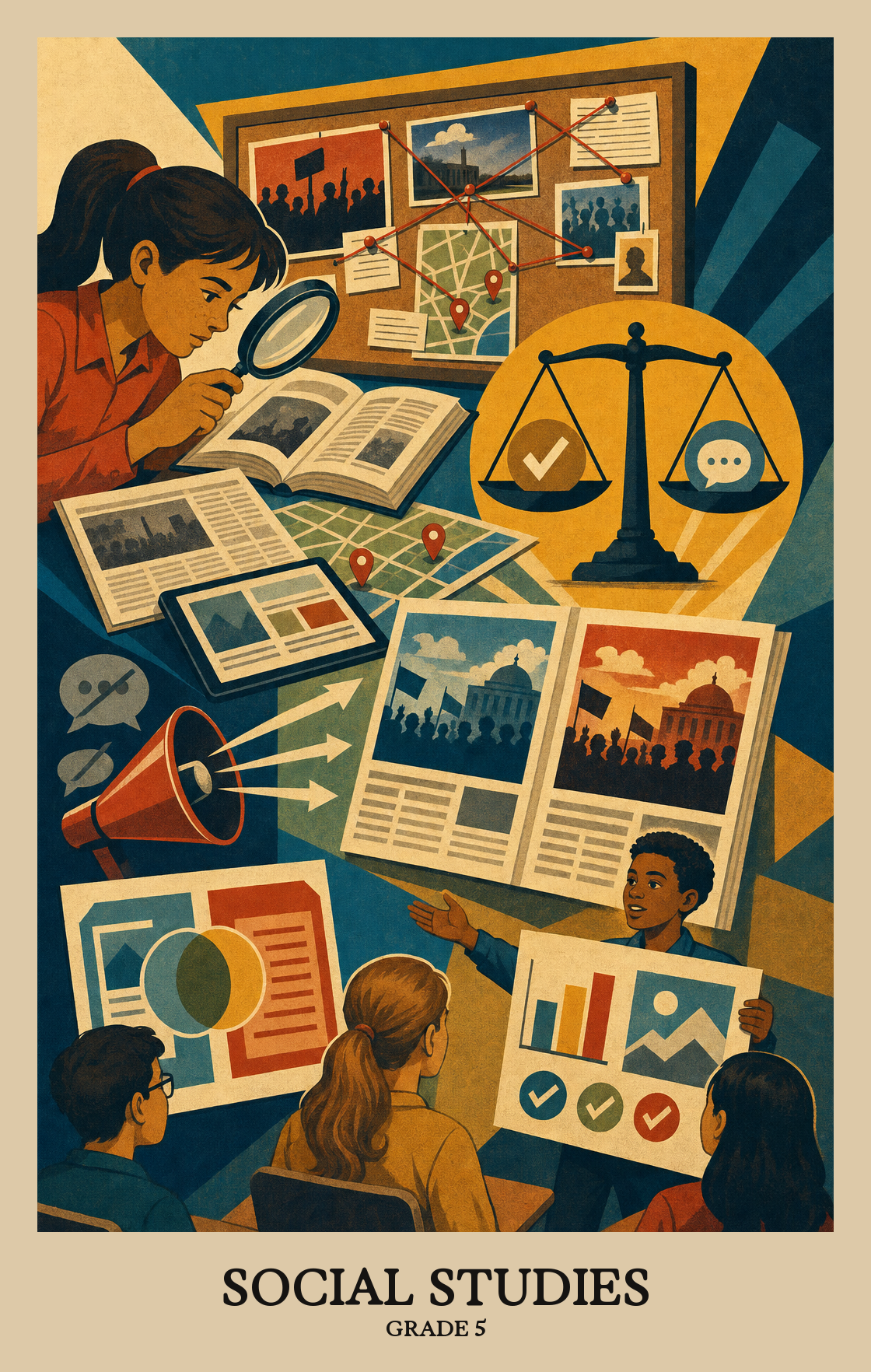
Students learn to ask real questions about people, places, and events from the past and present. They start to see that a strong question opens up a topic instead of having one quick answer.
Students gather books, articles, maps, and objects to learn about a topic. They practice deciding which sources are trustworthy and which ones leave important pieces out.
Students learn the difference between a fact and an opinion, and they notice how the writer or speaker shapes a story. They start spotting bias and thinking about who is telling it and why.
Students turn their research into maps, timelines, charts, and diagrams so others can follow the story. They read these visuals too, pulling ideas and predictions from what they see.
Students pick a side on a social studies question and back it up with evidence from their research. They present their case to classmates and answer questions about how they got there.
Students choose sources, check whether they can be trusted, and use what they find to build a research project, report, or presentation on a social studies topic.
Students examine real objects, photos, or documents from the past and use what they find to explain a social studies topic. The work is about reading physical evidence, not just a textbook.
| Standard | Definition | Code |
|---|---|---|
| Identify, select, analyze, evaluate | Students choose sources, check whether they can be trusted, and use what they find to build a research project, report, or presentation on a social studies topic. | 5.TS.7.A.a |
| Evaluate and use artifacts to share information on social studies' topics | Students examine real objects, photos, or documents from the past and use what they find to explain a social studies topic. The work is about reading physical evidence, not just a textbook. | 5.TS.7.A.b |
Students read maps, charts, and graphs to spot patterns and draw conclusions. They also create their own visuals to show what they've learned or predict what might happen next.
Students pick the right visual tool (a map, timeline, chart, or diagram) and build it themselves to show what they know about a history or geography topic.
| Standard | Definition | Code |
|---|---|---|
| Use visual tools to interpret, draw conclusions, make predictions | Students read maps, charts, and graphs to spot patterns and draw conclusions. They also create their own visuals to show what they've learned or predict what might happen next. | 5.TS.7.B.a |
| Create products such as maps, graphs, timelines, charts, models, diagrams, etc… | Students pick the right visual tool (a map, timeline, chart, or diagram) and build it themselves to show what they know about a history or geography topic. | 5.TS.7.B.b |
Students learn to spot the difference between facts and opinions in sources like articles, speeches, or maps, then explain how those choices shape what the author believes or leaves out.
Students pick a social studies topic, research it using multiple sources, and write or speak to defend their position. The goal is to back up an opinion with real evidence, not just state it.
| Standard | Definition | Code |
|---|---|---|
| Explain how facts and opinions affect point of view and/or bias in… | Students learn to spot the difference between facts and opinions in sources like articles, speeches, or maps, then explain how those choices shape what the author believes or leaves out. | 5.TS.7.C.a |
| Identify, research, and defend a point of view/position on a social… | Students pick a social studies topic, research it using multiple sources, and write or speak to defend their position. The goal is to back up an opinion with real evidence, not just state it. | 5.TS.7.C.b |
Students pick a social studies topic, find reliable sources, and present what they learned to an audience. The focus is on using real evidence to support what they say or write.
| Standard | Definition | Code |
|---|---|---|
| Conduct and present social studies’ research to an audience using appropriate… | Students pick a social studies topic, find reliable sources, and present what they learned to an audience. The focus is on using real evidence to support what they say or write. | 5.TS.7.D.a |
Students come up with a focused question worth investigating, not just a topic to look up. The question should be specific enough to guide real research.
Students pick a real social studies question, then follow a step-by-step plan to find and use sources that help answer it.
Students practice picking sources that actually answer a research question, not just the first result they find. They learn to judge whether a source is relevant and trustworthy before using it.
| Standard | Definition | Code |
|---|---|---|
| Generate compelling research questions about a social studies’ topic | Students come up with a focused question worth investigating, not just a topic to look up. The question should be specific enough to guide real research. | 5.TS.7.E.a |
| Create and apply a research process to investigate a compelling social studies’… | Students pick a real social studies question, then follow a step-by-step plan to find and use sources that help answer it. | 5.TS.7.E.b |
| Evaluate and use appropriate resources for investigating a compelling social… | Students practice picking sources that actually answer a research question, not just the first result they find. They learn to judge whether a source is relevant and trustworthy before using it. | 5.TS.7.E.c |
Students pick a social studies question, find sources that back up their answer, and present what they learned to an audience. The work covers choosing good sources, not just finding any source.
| Standard | Definition | Code |
|---|---|---|
| Conduct and present research on a social studies’ question to an… | Students pick a social studies question, find sources that back up their answer, and present what they learned to an audience. The work covers choosing good sources, not just finding any source. | 5.TS.7.F.a |
Students pick a social studies question, gather facts to support a position, and explain in writing or discussion why their answer holds up.
| Standard | Definition | Code |
|---|---|---|
| Research and defend a point of view/position on a social studies’ question | Students pick a social studies question, gather facts to support a position, and explain in writing or discussion why their answer holds up. | 5.TS.7.G.a |
Alternate assessment for eligible students with significant cognitive disabilities, covering the state-tested grade-level and end-of-course subjects.
Students learn how to investigate questions about people, places, and the past using real sources. They read books, look at maps and photos, ask questions, and share what they find through writing, posters, or short presentations.
Talk about the news, family history, or a trip to a museum. Ask students where they got their information and whether the source seems trustworthy. A short conversation at dinner builds the same thinking skills students practice in class.
A fact can be checked. An opinion is what someone thinks. Students learn to spot the difference and to notice when a writer is trying to convince them of something. Reading a short news article together and sorting facts from opinions is good practice.
Start with short, structured investigations where the question and sources are provided. Move toward students writing their own questions, picking sources, and defending a position by spring. Build one habit at a time so the final project pulls everything together.
Spotting bias and writing a strong research question are the two big ones. Students often pick questions that can be answered with a single word. Model open questions early and revisit them every time a new project starts.
Kid-friendly encyclopedias, library books, museum websites, and short news articles from trusted outlets work well. Teach students to check who wrote something and when it was published. Two sources that agree are stronger than one.
Students build maps, timelines, charts, diagrams, and short presentations. The format should match the question. A timeline fits a history question. A map fits a question about place. Mixing formats across the year keeps the work fresh.
By spring, students should be able to pick a question, find two or three solid sources, take notes, and present a clear point of view with evidence. They should also be able to explain why they trust the sources they used.
Pick a topic they care about, such as a sport, a country, or a person from history. Ask them to find one fact and one opinion about it online or in a book, then explain the difference. That short habit covers most of the year's research thinking.