Patterns and number rules
Students start the year spotting number patterns and writing the rule behind them. They generate two patterns from two rules and plot the matching points on a coordinate grid to see how the patterns connect.
This is the year fractions and decimals start working together as two ways to name the same number. Students add and subtract fractions with unlike bottoms, multiply and divide with fractions, and figure out why multiplying by a fraction less than one makes a number smaller. They also start plotting points on a grid and finding the volume of a box by counting unit cubes inside it. By spring, students can solve a multi-step word problem with fractions and explain their reasoning.
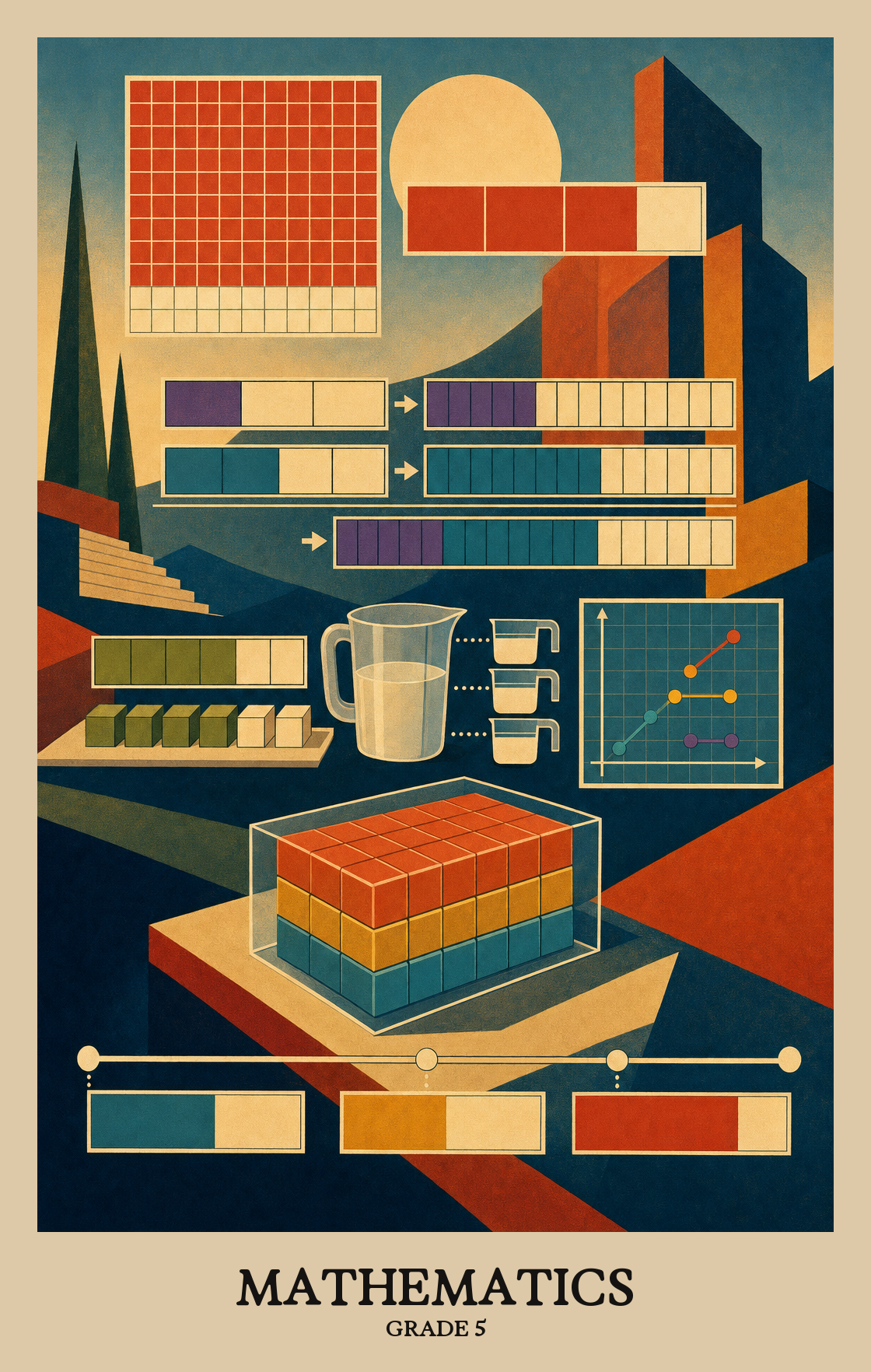
Students start the year spotting number patterns and writing the rule behind them. They generate two patterns from two rules and plot the matching points on a coordinate grid to see how the patterns connect.
Students see fractions and decimals as two ways to name the same amount, like 0.25 and one fourth. They convert between the two forms and compare values out to the thousandths place.
Students add and subtract fractions and mixed numbers when the bottom numbers are different, such as one half plus one third. They estimate first to check whether an answer makes sense.
Students multiply and divide with fractions and explain why multiplying by a number less than one makes the answer smaller. They connect fraction multiplication to the area of a rectangle with fractional sides.
Students sort two- and three-dimensional shapes by their properties and find the volume of boxes by stacking unit cubes. They also plot points on a coordinate grid to solve problems.
Students convert between units, like inches to feet or milliliters to liters, inside multi-step word problems. They build line plots from a set of measurements and find the median to answer questions about the data.
Fractions with denominators like 10 or 25 can be rewritten as decimals. Students convert between the two forms and explain why they name the same amount.
Fractions and decimals are two ways to write the same amount. Students learn that one-half and 0.5 mean the same thing, and practice switching between fraction and decimal form for numbers with denominators like 10 or 100.
Students switch between fraction and decimal form for the same number, like writing 0.25 as 1/4 or 3/4 as 0.75. Both forms name the same amount, just written differently.
Students compare fractions and decimals out to three places after the decimal point, then use >, =, or < to show which is larger, smaller, or equal. They also explain how they know.
Adding, subtracting, multiplying, and dividing fractions and decimals. Students work through problems that mix both, building the number sense they need before algebra.
Before adding, subtracting, or multiplying fractions and decimals, students predict roughly what the answer should be. That quick check helps them catch mistakes before they happen.
Before multiplying two fractions, students predict whether the answer will be bigger or smaller than the numbers they started with. They use what they know about the size of each fraction to make a reasonable guess before doing any math.
Multiplying by a fraction bigger than 1 (like 5/4) makes the answer larger than the number you started with. Students explain why that happens, not just calculate it.
Multiplying by a fraction smaller than 1 shrinks the number. Students explain why, using a picture or words to show that taking part of something gives you less than what you started with.
Multiplying the top and bottom of a fraction by the same number keeps its value the same. Students explain why this works, connecting it to the idea that any number divided by itself equals 1.
Adding and subtracting fractions gets harder when the bottom numbers don't match. Students find a common denominator, rewrite the fractions so they match, then add or subtract, including problems that mix whole numbers with fractions.
Students connect fraction multiplication to rectangle area by seeing that multiplying two fractions gives the same result as finding how much space a rectangle covers when its sides are measured in fractions of a foot, inch, or other unit.
Students multiply a fraction by a whole number and a whole number by a fraction, then explain what the answer means in context. For example, they work out what three-quarters of 12 looks like, or how many groups of 8 fit into a fraction problem.
Students multiply two fractions that are each smaller than 1 and explain what the answer means. For example, finding half of a quarter gives a smaller piece than either fraction started with.
Dividing a fraction by a whole number means splitting a fraction into even smaller pieces. Students find the answer and explain what it means, like figuring out how much of a pizza each person gets when half a pizza is shared among three people.
Students divide a whole number by a fraction like 1/2 or 1/4 and explain what the answer means. For example, how many quarter-cups fit in 3 cups? Students find that number and describe what it represents in the problem.
| Standard | Definition | Code |
|---|---|---|
| Understand the relationship between fractions and decimals | Fractions with denominators like 10 or 25 can be rewritten as decimals. Students convert between the two forms and explain why they name the same amount. | 5.NF.A |
| Understand that parts of a whole can be expressed as fractions and/or decimals | Fractions and decimals are two ways to write the same amount. Students learn that one-half and 0.5 mean the same thing, and practice switching between fraction and decimal form for numbers with denominators like 10 or 100. | 5.NF.A.1 |
| Convert decimals to fractions and fractions to decimals | Students switch between fraction and decimal form for the same number, like writing 0.25 as 1/4 or 3/4 as 0.75. Both forms name the same amount, just written differently. | 5.NF.A.2 |
| Compare and order fractions and/or decimals to the thousandths place using… | Students compare fractions and decimals out to three places after the decimal point, then use >, =, or < to show which is larger, smaller, or equal. They also explain how they know. | 5.NF.A.3 |
| Perform operations and solve problems with fractions and decimals | Adding, subtracting, multiplying, and dividing fractions and decimals. Students work through problems that mix both, building the number sense they need before algebra. | 5.NF.B |
| Estimate results of sums, differences and products with fractions and decimals… | Before adding, subtracting, or multiplying fractions and decimals, students predict roughly what the answer should be. That quick check helps them catch mistakes before they happen. | 5.NF.B.4 |
| Estimate the size of the product based on the size of the two factors | Before multiplying two fractions, students predict whether the answer will be bigger or smaller than the numbers they started with. They use what they know about the size of each fraction to make a reasonable guess before doing any math. | 5.NF.B.5a |
| Explain why multiplying a given number by a fraction greater than 1 results in… | Multiplying by a fraction bigger than 1 (like 5/4) makes the answer larger than the number you started with. Students explain why that happens, not just calculate it. | 5.NF.B.5b |
| Explain why multiplying a given number by a fraction less than 1 results in a… | Multiplying by a fraction smaller than 1 shrinks the number. Students explain why, using a picture or words to show that taking part of something gives you less than what you started with. | 5.NF.B.5c |
| Explain why multiplying the numerator and denominator by the same number… | Multiplying the top and bottom of a fraction by the same number keeps its value the same. Students explain why this works, connecting it to the idea that any number divided by itself equals 1. | 5.NF.B.5d |
| Solve problems involving addition and subtraction of fractions and mixed… | Adding and subtracting fractions gets harder when the bottom numbers don't match. Students find a common denominator, rewrite the fractions so they match, then add or subtract, including problems that mix whole numbers with fractions. | 5.NF.B.6 |
| Recognize the relationship between multiplying fractions and finding the areas… | Students connect fraction multiplication to rectangle area by seeing that multiplying two fractions gives the same result as finding how much space a rectangle covers when its sides are measured in fractions of a foot, inch, or other unit. | 5.NF.B.7a |
| Calculate and interpret the product of a fraction by a whole number and a… | Students multiply a fraction by a whole number and a whole number by a fraction, then explain what the answer means in context. For example, they work out what three-quarters of 12 looks like, or how many groups of 8 fit into a fraction problem. | 5.NF.B.7b |
| Calculate and interpret the product of two fractions less than one | Students multiply two fractions that are each smaller than 1 and explain what the answer means. For example, finding half of a quarter gives a smaller piece than either fraction started with. | 5.NF.B.7c |
| Calculate and interpret the quotient of a unit fraction by a non-zero whole… | Dividing a fraction by a whole number means splitting a fraction into even smaller pieces. Students find the answer and explain what it means, like figuring out how much of a pizza each person gets when half a pizza is shared among three people. | 5.NF.B.8a |
| Calculate and interpret the quotient of a whole number by a unit fraction | Students divide a whole number by a fraction like 1/2 or 1/4 and explain what the answer means. For example, how many quarter-cups fit in 3 cups? Students find that number and describe what it represents in the problem. | 5.NF.B.8b |
Students look at number patterns and figure out the rule behind them. Then they use that rule to predict what comes next or describe how two quantities change together.
Students follow two separate counting rules to build two number sequences, then look at how the sequences relate to each other. For example, one rule might say "add 3" and another "add 6."
Students take two number patterns and pair up their matching terms as coordinates, like (2, 6), ready to plot on a graph.
Students plot pairs of numbers from a pattern onto a grid with an x-axis and a y-axis, then look at the shape the points form to describe the relationship between the two values.
Students look at two number patterns side by side and describe how one relates to the other, such as noticing that one sequence is always double the other.
Students look at a sequence of numbers and write a rule that explains how it works, such as "multiply by 3 each time" or "add 5 to the previous number."
Students use addition, subtraction, multiplication, and division to set up and solve word problems. The focus is writing the math sentence that fits the situation, not just finding the answer.
Multi-step word problems ask students to use addition, subtraction, multiplication, or division across two or more steps, with some values replaced by a letter standing in for an unknown number. Students solve and explain how they got the answer.
| Standard | Definition | Code |
|---|---|---|
| Represent and analyze patterns and relationships | Students look at number patterns and figure out the rule behind them. Then they use that rule to predict what comes next or describe how two quantities change together. | 5.RA.A |
| Generate two numeric patterns given two rules | Students follow two separate counting rules to build two number sequences, then look at how the sequences relate to each other. For example, one rule might say "add 3" and another "add 6." | 5.RA.A.1a |
| Translate two numeric patterns into two sets of ordered pairs | Students take two number patterns and pair up their matching terms as coordinates, like (2, 6), ready to plot on a graph. | 5.RA.A.1b |
| Graph numeric patterns on the Cartesian coordinate plane | Students plot pairs of numbers from a pattern onto a grid with an x-axis and a y-axis, then look at the shape the points form to describe the relationship between the two values. | 5.RA.A.1c |
| Identify the relationship between two numeric patterns | Students look at two number patterns side by side and describe how one relates to the other, such as noticing that one sequence is always double the other. | 5.RA.A.1d |
| Write a rule to describe or explain a given numeric pattern | Students look at a sequence of numbers and write a rule that explains how it works, such as "multiply by 3 each time" or "add 5 to the previous number." | 5.RA.A.2 |
| Use the four operations to represent and solve problems | Students use addition, subtraction, multiplication, and division to set up and solve word problems. The focus is writing the math sentence that fits the situation, not just finding the answer. | 5.RA.C |
| Solve and justify multi-step problems involving variables, whole numbers… | Multi-step word problems ask students to use addition, subtraction, multiplication, or division across two or more steps, with some values replaced by a letter standing in for an unknown number. Students solve and explain how they got the answer. | 5.RA.C.5 |
Students sort flat shapes like squares and triangles, and solid shapes like cubes and cones, into groups based on their properties, such as the number of sides or whether faces are flat or curved.
Students sort shapes into groups and subgroups based on their properties. A square belongs under rectangles, which belongs under quadrilaterals, building a family tree of shapes from most specific to most general.
Students measure how much space a 3D shape takes up by counting unit cubes or using a formula. This is volume, and fifth graders apply it to rectangular boxes.
A unit cube is a perfect cube where every edge measures 1 unit. Students use it as the basic building block for measuring volume, the same way a square tile measures area.
Students figure out the volume of a box-shaped object by thinking about it as stacked layers. Multiply the area of the bottom face by the number of layers to get the total space inside.
Students plot points on a grid using two numbers, one for how far across and one for how far up, then use that grid to solve math problems.
Students plot points on a grid where two number lines cross at zero. Reading the grid means finding how far right and how far up a point sits from that corner.
Students read any dot on a grid by naming two numbers: how far it sits to the right and how far it sits up. Those two numbers, written as a pair, give the dot its exact address on the graph.
The first number in a coordinate pair tells how far to move right from the starting point (0,0) before moving up or down. Students use that number to place or read points on a grid.
The second number in an ordered pair tells how far up a point sits from the starting corner of the grid. Students use that count to plot or read any location on the coordinate plane.
Students convert between units in the same system, like inches to feet or grams to kilograms, and use those conversions to solve word problems.
Students convert between units like inches and feet, or ounces and pounds, to solve problems that take more than one step. The focus is on knowing when a conversion is needed and carrying it through the full problem.
| Standard | Definition | Code |
|---|---|---|
| Classify two- and three- dimensional geometric shapes | Students sort flat shapes like squares and triangles, and solid shapes like cubes and cones, into groups based on their properties, such as the number of sides or whether faces are flat or curved. | 5.GM.A |
| Classify figures in a hierarchy based on properties | Students sort shapes into groups and subgroups based on their properties. A square belongs under rectangles, which belongs under quadrilaterals, building a family tree of shapes from most specific to most general. | 5.GM.A.2 |
| Understand and compute volume | Students measure how much space a 3D shape takes up by counting unit cubes or using a formula. This is volume, and fifth graders apply it to rectangular boxes. | 5.GM.B |
| Describe a cube with edge length 1 unit as a “unit cube” and is said to have… | A unit cube is a perfect cube where every edge measures 1 unit. Students use it as the basic building block for measuring volume, the same way a square tile measures area. | 5.GM.B.4a |
| Understand that the volume of a right rectangular prism can be found by… | Students figure out the volume of a box-shaped object by thinking about it as stacked layers. Multiply the area of the bottom face by the number of layers to get the total space inside. | 5.GM.B.4b |
| Graph points on the Cartesian coordinate plane within the first quadrant to… | Students plot points on a grid using two numbers, one for how far across and one for how far up, then use that grid to solve math problems. | 5.GM.C |
| Represent the axes as scaled perpendicular number lines that both intersect at… | Students plot points on a grid where two number lines cross at zero. Reading the grid means finding how far right and how far up a point sits from that corner. | 5.GM.C.6a |
| Identify any point on the Cartesian coordinate plane by its ordered pair… | Students read any dot on a grid by naming two numbers: how far it sits to the right and how far it sits up. Those two numbers, written as a pair, give the dot its exact address on the graph. | 5.GM.C.6b |
| Define the first number in an ordered pair as the horizontal distance from the… | The first number in a coordinate pair tells how far to move right from the starting point (0,0) before moving up or down. Students use that number to place or read points on a grid. | 5.GM.C.6c |
| Define the second number in an ordered pair as the vertical distance from the… | The second number in an ordered pair tells how far up a point sits from the starting corner of the grid. Students use that count to plot or read any location on the coordinate plane. | 5.GM.C.6d |
| Solve problems involving measurement and conversions within a… | Students convert between units in the same system, like inches to feet or grams to kilograms, and use those conversions to solve word problems. | 5.GM.D |
| Solve multi-step problems that require measurement conversions | Students convert between units like inches and feet, or ounces and pounds, to solve problems that take more than one step. The focus is on knowing when a conversion is needed and carrying it through the full problem. | 5.GM.D.9 |
Students collect data, display it in graphs or tables, and draw conclusions from what the numbers show.
Students plot measurements on a number-line graph, then study the results to answer questions. They identify values that stand apart from the rest and find the middle value in the data set.
| Standard | Definition | Code |
|---|---|---|
| Represent and analyze data | Students collect data, display it in graphs or tables, and draw conclusions from what the numbers show. | 5.DS.A |
| Create a line plot to represent a given or generated data set | Students plot measurements on a number-line graph, then study the results to answer questions. They identify values that stand apart from the rest and find the middle value in the data set. | 5.DS.A.2 |
Missouri Assessment Program grade-level mathematics assessment for grades 3 through 8.
Alternate assessment for eligible students with significant cognitive disabilities, covering the state-tested grade-level and end-of-course subjects.
The biggest focus is fractions and decimals. Students add, subtract, multiply, and divide fractions, and they connect fractions to decimals like 0.25 and one-fourth. They also work with volume of boxes, plot points on a graph, and solve longer word problems with more than one step.
Cooking is the easiest way in. Cut a recipe in half, double it, or ask how much is left after using three-fourths of a cup. Measuring cups, rulers, and money are all fair game for quick five-minute conversations about halves, fourths, and tenths.
This trips students up because in earlier grades multiplying always made numbers bigger. Half of 10 is 5, so multiplying by one-half made it smaller. A good question to ask is whether the answer should be bigger or smaller than what they started with, and why.
Start with adding and subtracting fractions with unlike denominators, since that builds on fourth grade. Then move to multiplying fractions using area models before dividing whole numbers by unit fractions. Saving fraction-decimal conversion for after students are confident with both forms tends to reduce confusion.
Dividing with unit fractions and estimating products with fractions are the two that students often guess at. Volume by stacking layers also needs more time than the pacing guide suggests. Plan a built-in revisit week after the first fractions unit and after volume.
Volume is how much space something takes up, measured in unit cubes. Students figure out how many cubes fit inside a box by stacking layers. Building with sugar cubes or small blocks at home gives them a real feel for it.
Students plot points using ordered pairs like (3, 4) in the first quadrant only, so no negative numbers yet. They also graph number patterns to see how two rules relate. Battleship and connect-the-dots puzzles with coordinates are good practice.
Students convert within one system, such as feet to inches or liters to milliliters, inside word problems with more than one step. A measuring tape and a kitchen scale at home give plenty of natural practice. Ask how many inches are in four and a half feet.
By spring, students should add, subtract, and multiply fractions with unlike denominators without a model, and explain why the answer makes sense. They should also solve two-step word problems with decimals and read a point on a coordinate graph. Shaky fraction reasoning is the clearest signal more time is needed.