Reading longer texts with proof
Students start the year reading chapter books and articles that take more than one sitting. They learn to back up what they think with a specific line from the page instead of a guess.
This is the year reading and writing start asking students to back up what they say. When they read a story or an article, they point to the exact line that proves their answer and explain what the author is trying to do. Writing stretches from single paragraphs into longer pieces with a clear opinion, real reasons, and sources the student found. By spring, students can read a chapter on their own and write a few paragraphs that use evidence from the text.
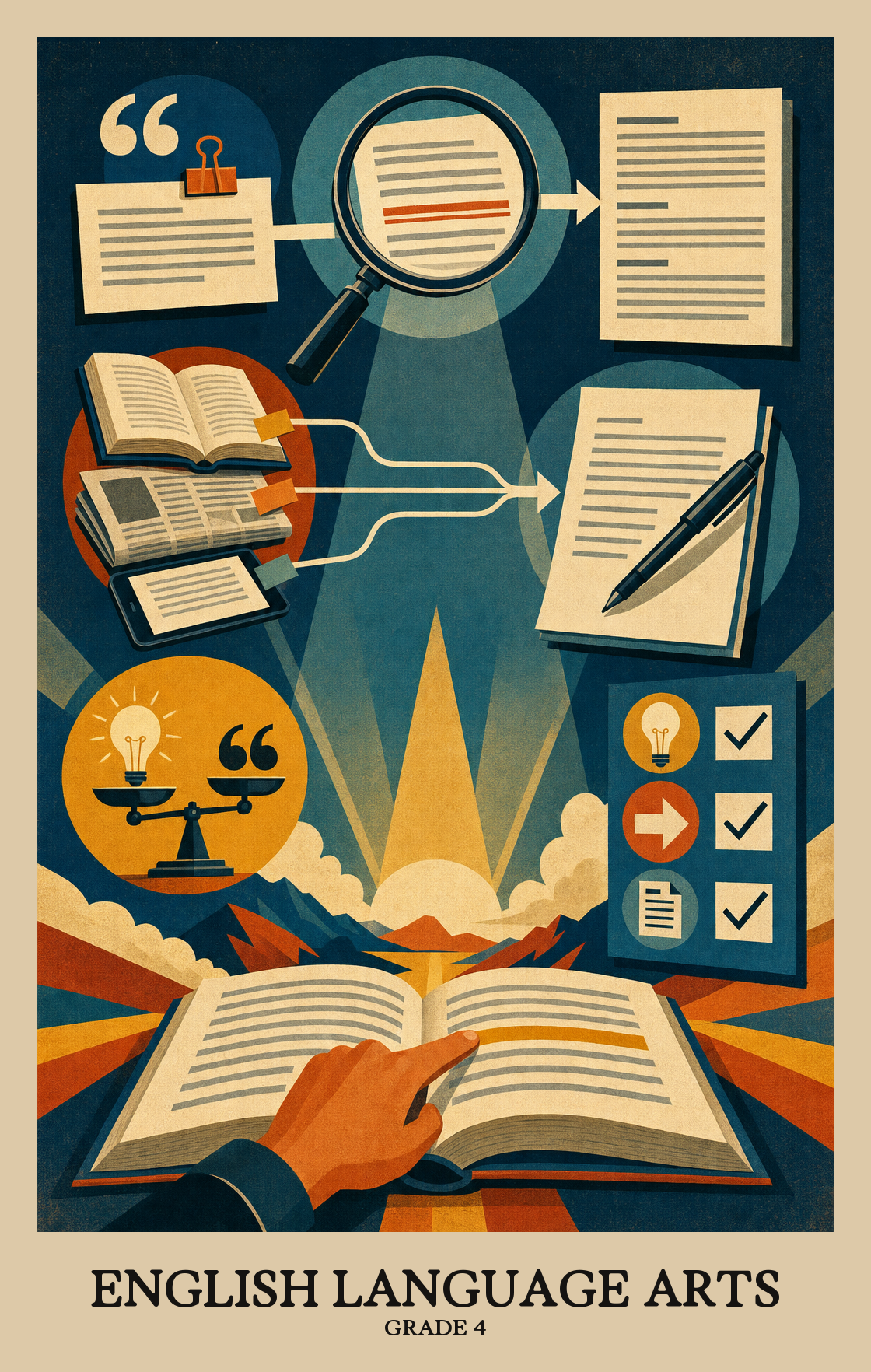
Students start the year reading chapter books and articles that take more than one sitting. They learn to back up what they think with a specific line from the page instead of a guess.
Students figure out new words by breaking them into roots, prefixes, and suffixes, and by checking the sentence around them. They also start to catch idioms and figures of speech that do not mean what they sound like.
Students dig into stories, plays, and poems. They track how characters change, how earlier events cause later ones, and whether the story is told by someone inside it or someone outside it.
Students use headings, captions, charts, and diagrams to find facts and get the gist of a text. They start noticing when a writer is trying to convince them of something and how word choices push the reader.
Students plan, draft, and revise opinion pieces, explanations, and stories. They pull facts from more than one source and learn the difference between putting an idea in their own words and copying it.
Students write all four sentence types, join ideas with a comma before words like and or but, and fix capitalization as they edit. In group talk, they ask follow-up questions and build on what classmates just said.
Reading closely enough to answer questions, explain what happened, and point to the part of the text that backs up the answer. Students practice this with both stories and nonfiction.
Students read a story or article, then explain their thinking using specific lines from the text. They do not just state what happened; they connect clues from the page to reach a conclusion the author never spelled out.
Students read a passage and back up their conclusions with specific lines or details from the text itself, not just a general feeling about what happened.
Students learn the meanings of new words they meet while reading, using context clues and word parts like prefixes and roots to figure out what unfamiliar words mean.
Students use Latin and Greek roots, prefixes, and suffixes as clues to figure out what an unfamiliar word means. A root like "rupt" or a prefix like "un-" can unlock the whole word without a dictionary.
Students use the surrounding words in a sentence to figure out what an unfamiliar word means, or what meaning a word like "bat" or "fair" carries in that particular sentence.
Students figure out what phrases like "it's raining cats and dogs" or "break a leg" actually mean, even though the words don't mean what they say.
Students sort words by how formal they are, from everyday talk to the precise vocabulary used in science, history, or other subjects.
Students read on their own for longer stretches, for different reasons: to enjoy a story, to learn something new, or to find an answer. The goal is building the habit of sitting with a book and reading it through.
Reading fiction, poetry, and plays closely enough to figure out ideas the author never states outright. Students go beyond what the text says to explain why characters act, how events connect, and what the writing really means.
Students read a story and put the key events in order, explain how earlier moments lead to later ones, and figure out the lesson the story is teaching.
Characters in a story rarely stay the same. Students read to find how two or more characters affect each other and how those relationships shift as the plot moves forward.
Students look at two stories and decide who is telling each one. They explain whether a character is speaking in their own voice ("I went to the store") or whether an outside narrator is describing the action.
Nonfiction texts use tools like headings, captions, and diagrams to organize information. Students read those features closely to figure out what the author means, even when it isn't stated directly.
Nonfiction books use tools like headings, indexes, and captions to help readers find information fast. Students practice using those tools together to understand what a text covers before reading every word.
Students read charts, graphs, maps, and diagrams in nonfiction texts and explain in their own words what the visual is showing.
Students read nonfiction passages and figure out ideas the author hints at but never states directly. They notice how word choice, structure, and detail shape the meaning beneath the surface.
Students read a persuasive article or speech and figure out what the author wants them to think or do. Then they point to specific sentences from the text that show why the author wrote it.
Students read a nonfiction passage and explain how the author's word choices are meant to shape what the reader thinks or believes. The focus is on noticing when language is doing more than just reporting facts.
Students read nonfiction passages and figure out how the author organized the information, such as cause and effect or problem and solution. Then they use that structure to draw conclusions the text doesn't spell out directly.
Students find the connections between ideas in a nonfiction text. Some connections are stated outright; others have to be pieced together from clues the author leaves behind.
| Standard | Definition | Code |
|---|---|---|
| Develop and demonstrate comprehension-reading skills in response to texts | Reading closely enough to answer questions, explain what happened, and point to the part of the text that backs up the answer. Students practice this with both stories and nonfiction. | 4.R.1.A |
| Drawing conclusions and inferring by referencing textual evidence of what the… | Students read a story or article, then explain their thinking using specific lines from the text. They do not just state what happened; they connect clues from the page to reach a conclusion the author never spelled out. | 4.R.1.A.a |
| Drawing conclusions by providing textual evidence of what the text says… | Students read a passage and back up their conclusions with specific lines or details from the text itself, not just a general feeling about what happened. | 4.R.1.A.b |
| Develop an understanding of vocabulary | Students learn the meanings of new words they meet while reading, using context clues and word parts like prefixes and roots to figure out what unfamiliar words mean. | 4.R.1.B |
| Determining the meaning of academic English words derived from Latin, Greek, or… | Students use Latin and Greek roots, prefixes, and suffixes as clues to figure out what an unfamiliar word means. A root like "rupt" or a prefix like "un-" can unlock the whole word without a dictionary. | 4.R.1.B.a |
| Using the context of the sentence to determine the meaning of unfamiliar words… | Students use the surrounding words in a sentence to figure out what an unfamiliar word means, or what meaning a word like "bat" or "fair" carries in that particular sentence. | 4.R.1.B.b |
| Identify the meaning of common idioms and figurative language | Students figure out what phrases like "it's raining cats and dogs" or "break a leg" actually mean, even though the words don't mean what they say. | 4.R.1.B.d |
| Using conversational, general academic | Students sort words by how formal they are, from everyday talk to the precise vocabulary used in science, history, or other subjects. | 4.R.1.B.f |
| Read independently for multiple purposes over sustained periods of time | Students read on their own for longer stretches, for different reasons: to enjoy a story, to learn something new, or to find an answer. The goal is building the habit of sitting with a book and reading it through. | 4.R.1.D |
| Read, infer, analyze and draw conclusions using fiction texts including poetry… | Reading fiction, poetry, and plays closely enough to figure out ideas the author never states outright. Students go beyond what the text says to explain why characters act, how events connect, and what the writing really means. | 4.R.2.A |
| Summarize and sequence the events/plot, explain how past events impact future… | Students read a story and put the key events in order, explain how earlier moments lead to later ones, and figure out the lesson the story is teaching. | 4.R.2.A.a |
| Describe the interaction of characters, including relationships and how they… | Characters in a story rarely stay the same. Students read to find how two or more characters affect each other and how those relationships shift as the plot moves forward. | 4.R.2.A.c |
| Compare and contrast the point of view from which stories are narrated; explain… | Students look at two stories and decide who is telling each one. They explain whether a character is speaking in their own voice ("I went to the store") or whether an outside narrator is describing the action. | 4.R.2.A.e |
| Read, infer and draw conclusions using text features in nonfiction texts | Nonfiction texts use tools like headings, captions, and diagrams to organize information. Students read those features closely to figure out what the author means, even when it isn't stated directly. | 4.R.3.A |
| Use multiple text features to locate information and gain an overview of the… | Nonfiction books use tools like headings, indexes, and captions to help readers find information fast. Students practice using those tools together to understand what a text covers before reading every word. | 4.R.3.A.a |
| Interpret and explain factual information presented graphically | Students read charts, graphs, maps, and diagrams in nonfiction texts and explain in their own words what the visual is showing. | 4.R.3.A.c |
| Read, infer and draw conclusions using literary techniques in nonfiction texts | Students read nonfiction passages and figure out ideas the author hints at but never states directly. They notice how word choice, structure, and detail shape the meaning beneath the surface. | 4.R.3.B |
| Analyze, make inferences | Students read a persuasive article or speech and figure out what the author wants them to think or do. Then they point to specific sentences from the text that show why the author wrote it. | 4.R.3.B.b |
| Explain how an author uses language to present information to influence what… | Students read a nonfiction passage and explain how the author's word choices are meant to shape what the reader thinks or believes. The focus is on noticing when language is doing more than just reporting facts. | 4.R.3.B.c |
| Read, infer and draw conclusions using text structures in nonfiction texts | Students read nonfiction passages and figure out how the author organized the information, such as cause and effect or problem and solution. Then they use that structure to draw conclusions the text doesn't spell out directly. | 4.R.3.C |
| Explain explicit and implicit relationships among ideas in texts | Students find the connections between ideas in a nonfiction text. Some connections are stated outright; others have to be pieced together from clues the author leaves behind. | 4.R.3.C.b |
Students apply what they know about letter patterns and word parts to decode unfamiliar words while reading. This is the mechanics work that keeps reading moving when a new or tricky word appears on the page.
Students break apart long, unfamiliar words by sounding out each part, splitting the word into syllables, and using prefixes or suffixes as clues. The goal is to read those words smoothly inside a sentence.
Students read words by breaking them into parts: a root word plus any prefix or suffix added to the front or back. They also practice key vocabulary words from subjects like science and social studies.
| Standard | Definition | Code |
|---|---|---|
| Develop phonics in the reading process | Students apply what they know about letter patterns and word parts to decode unfamiliar words while reading. This is the mechanics work that keeps reading moving when a new or tricky word appears on the page. | 4.RF.3.A |
| Decoding words using knowledge of all letter-sound… | Students break apart long, unfamiliar words by sounding out each part, splitting the word into syllables, and using prefixes or suffixes as clues. The goal is to read those words smoothly inside a sentence. | 4.RF.3.A.a |
| Reading root words, prefixes | Students read words by breaking them into parts: a root word plus any prefix or suffix added to the front or back. They also practice key vocabulary words from subjects like science and social studies. | 4.RF.3.A.b |
Students take their prewriting notes or outline and turn them into a full draft, using the shape and details that fit the type of writing they chose.
Students go back through a draft to fix unclear sentences, check spelling and punctuation, and make the writing stronger. A teacher or peer helps guide the changes.
Students pick a topic, state what they think about it, and back up that opinion with reasons and details from what they have read or know.
Students explain a topic clearly, grouping related facts and details into paragraphs with a strong opening and a closing that wraps up what they learned.
Students write their own stories, true or made-up, and poems. This standard covers the full range of creative and personal writing students do in fourth grade.
Students gather facts and details from more than one source, such as books, articles, or websites, then use that information in their writing.
Students learn to pull information from more than one kind of source, such as a book, an article, or a poem, and judge whether each one actually fits the topic they are researching.
Students learn the difference between putting someone else's idea into their own words and copying it without credit. Paraphrasing means restating the idea honestly; plagiarism means passing it off as your own.
| Standard | Definition | Code |
|---|---|---|
| Appropriate to genre type, develop a draft from prewriting | Students take their prewriting notes or outline and turn them into a full draft, using the shape and details that fit the type of writing they chose. | 4.W.1.B |
| Reread, revise and edit drafts with assistance | Students go back through a draft to fix unclear sentences, check spelling and punctuation, and make the writing stronger. A teacher or peer helps guide the changes. | 4.W.1.C |
| Write opinion texts | Students pick a topic, state what they think about it, and back up that opinion with reasons and details from what they have read or know. | 4.W.2.A |
| Write informative/explanatory texts | Students explain a topic clearly, grouping related facts and details into paragraphs with a strong opening and a closing that wraps up what they learned. | 4.W.2.B |
| Write fiction or nonfiction narratives and poems | Students write their own stories, true or made-up, and poems. This standard covers the full range of creative and personal writing students do in fourth grade. | 4.W.2.C |
| Apply research process to use information from a variety of sources | Students gather facts and details from more than one source, such as books, articles, or websites, then use that information in their writing. | 4.W.3.A |
| Identify a variety of relevant sources, literary and informational | Students learn to pull information from more than one kind of source, such as a book, an article, or a poem, and judge whether each one actually fits the topic they are researching. | 4.W.3.A.c |
| Differentiate between paraphrasing and plagiarism when using ideas of others | Students learn the difference between putting someone else's idea into their own words and copying it without credit. Paraphrasing means restating the idea honestly; plagiarism means passing it off as your own. | 4.W.3.A.g |
Students use correct grammar in sentences they write and say out loud. That means choosing the right verb forms, pronouns, and punctuation so their meaning comes through clearly.
Students write complete sentences, then practice stretching them with extra details. They work with all four sentence types (statements, questions, commands, and exclamations) in both simple and compound forms.
Students use correct capitalization, punctuation, and spelling in their own writing, not just in practice exercises.
Students learn when to put a comma before joining words like "and," "but," or "so" when connecting two complete sentences into one longer sentence.
Students practice capitalizing the right words in their writing: names, places, the start of a sentence, and titles like "Dr." or "President."
| Standard | Definition | Code |
|---|---|---|
| In speech and written form, apply standard English grammar | Students use correct grammar in sentences they write and say out loud. That means choosing the right verb forms, pronouns, and punctuation so their meaning comes through clearly. | 4.L.1.A |
| Produce and expand the complete simple and compound four types of sentences | Students write complete sentences, then practice stretching them with extra details. They work with all four sentence types (statements, questions, commands, and exclamations) in both simple and compound forms. | 4.L.1.A.h |
| In written text, apply punctuation, capitalization and spelling | Students use correct capitalization, punctuation, and spelling in their own writing, not just in practice exercises. | 4.L.1.B |
| Insert a comma before a coordinating conjunction in a compound sentence | Students learn when to put a comma before joining words like "and," "but," or "so" when connecting two complete sentences into one longer sentence. | 4.L.1.B.c |
| Use correct capitalization | Students practice capitalizing the right words in their writing: names, places, the start of a sentence, and titles like "Dr." or "President." | 4.L.1.B.e |
Students practice listening carefully in class discussions and presentations. They learn to track what a speaker is saying, ask relevant questions, and build on what they heard.
Students ask follow-up questions when something is unclear and build on what classmates say instead of just waiting for their turn to talk.
| Standard | Definition | Code |
|---|---|---|
| Develop and apply effective listening skills and strategies in formal… | Students practice listening carefully in class discussions and presentations. They learn to track what a speaker is saying, ask relevant questions, and build on what they heard. | 4.SL.1.A |
| Posing and responding to specific questions to clarify or follow up… | Students ask follow-up questions when something is unclear and build on what classmates say instead of just waiting for their turn to talk. | 4.SL.1.A.b |
Missouri Assessment Program grade-level English language arts assessment for grades 3 through 8.
Alternate assessment for eligible students with significant cognitive disabilities, covering the state-tested grade-level and end-of-course subjects.
Federally administered sample-based assessment in reading, mathematics, science, writing, and other subjects. NAEP results inform state-by-state comparisons rather than individual student or school accountability.
Students read longer stories and articles and back up their ideas with lines from the text. They also write opinion pieces, explanations, and stories with a real beginning, middle, and end. Expect more independent reading and longer paragraphs than last year.
Take turns reading a page aloud, then ask what just happened and how the character is feeling. When a word is tricky, look at the parts: a prefix like un-, a root, or an ending like -ly. Five to ten minutes a night beats one long session on the weekend.
Look for a clear main idea, a few sentences that back it up, and an ending that wraps it up. Sentences should mix short and longer ones, with commas before words like and or but in longer sentences. Spelling and capital letters should be mostly correct on a final draft.
Many teachers anchor each unit in a text type, then teach the matching writing genre alongside it. Fiction units pair well with narrative writing, nonfiction with informational, and persuasive articles with opinion writing. Grammar and vocabulary work best when tied to the texts students are already reading.
Citing evidence is the big one. Students often answer with a personal opinion instead of pointing back to a line in the text. Inferring author's purpose in persuasive writing and telling paraphrasing apart from copying also tend to need extra rounds.
Aim for about 20 minutes a day of reading they choose themselves. Chapter books, magazines, and nonfiction about a hobby all count. Ask one question after: what surprised them, or what they think happens next.
By spring, a student should read a new article or chapter, summarize it, and pull two or three pieces of evidence to support an idea. In writing, they should plan, draft, and revise a multi-paragraph piece with help. They should also use compound sentences with correct commas.
Paraphrasing means putting an author's idea into your own words and still saying where it came from. Copying word-for-word without credit is plagiarism. A good check at home: close the book, then say the idea out loud before writing it down.