Forces and motion
Students push, pull, and watch how objects move. They test what happens when a force gets bigger or when something heavier is in the way, and they look for patterns that predict what comes next.
This is the year science becomes something students test, not just read about. Students push and pull objects to see how force changes motion, and they connect a faster object to more energy. They study how rivers wear down rock, how fossils hint at older landscapes, and how animal senses send signals to the brain. By spring, students can run a fair test, record what happened, and explain the result in their own words.
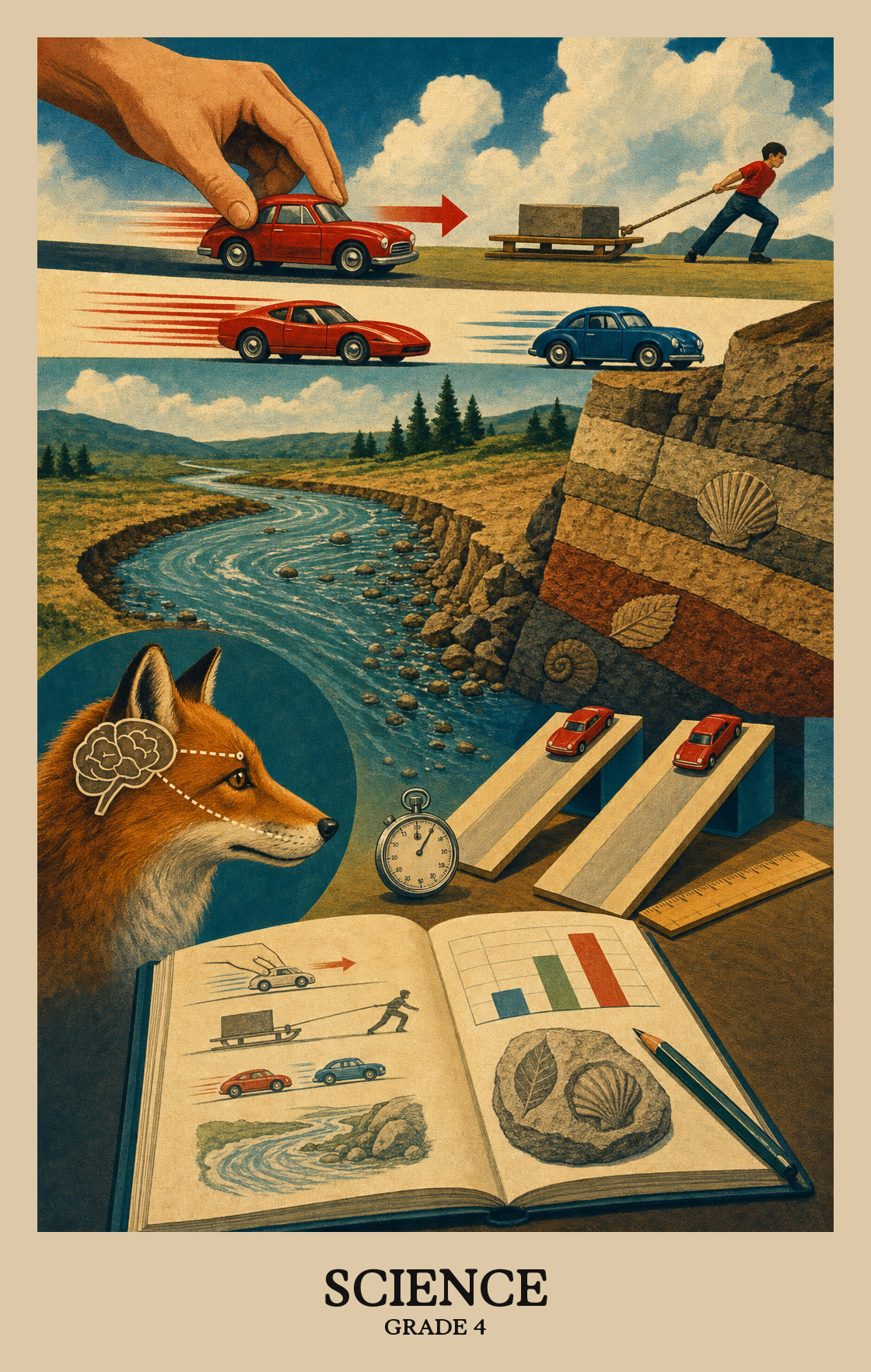
Students push, pull, and watch how objects move. They test what happens when a force gets bigger or when something heavier is in the way, and they look for patterns that predict what comes next.
Students connect speed to energy and watch energy change forms, like a battery powering a buzzer or motion warming up hands. They build small devices that move energy from one place to another.
Students model waves with ropes and water to see how they carry energy. They also study how eyes, ears, and noses send information to the brain so animals can react to the world around them.
Students look at the parts of plants and animals and what each part does, from roots that pull up water to claws that catch food. They build an argument for how these parts help living things survive.
Students study how wind, water, and ice slowly reshape the land. They read maps for mountains, rivers, and earthquake zones, and use fossils and rock layers as clues to what an area looked like long ago.
Students take on a real problem, like protecting a town from floods, and sketch more than one solution. They run fair tests, find the weak spots, and improve their design based on what the results show.
Students watch a moving object, such as a rolling ball or a swinging pendulum, and record what they notice. Then they use that pattern to predict where the object will be next.
Students set up a simple test, like pushing a toy car from both sides at once or from just one side, to see what happens when forces are equal versus unequal. Equal forces keep an object still; unequal forces make it move or change direction.
Pushing harder makes an object move faster; pushing on something heavier slows that change down. Students predict what happens to speed and direction when the force or the weight of an object changes.
Students design an experiment to find out how much force it takes to drag an object across surfaces like sandpaper or a smooth table. They measure that force with a spring scale and compare the results.
| Standard | Definition | Code |
|---|---|---|
| Make observations and/or measurements of an object's motion to provide evidence… | Students watch a moving object, such as a rolling ball or a swinging pendulum, and record what they notice. Then they use that pattern to predict where the object will be next. | 4.PS2.A.a |
| Plan and conduct an investigation to provide evidence of the effects of… | Students set up a simple test, like pushing a toy car from both sides at once or from just one side, to see what happens when forces are equal versus unequal. Equal forces keep an object still; unequal forces make it move or change direction. | 4.PS2.A.b |
| Predict how changes in either the amount of force applied to an object or the… | Pushing harder makes an object move faster; pushing on something heavier slows that change down. Students predict what happens to speed and direction when the force or the weight of an object changes. | 4.PS2.B.b |
| Plan and conduct a fair test to compare and contrast the forces | Students design an experiment to find out how much force it takes to drag an object across surfaces like sandpaper or a smooth table. They measure that force with a spring scale and compare the results. | 4.PS2.B.a |
Moving objects carry energy, and faster means more. Students look at real examples to explain how an object's speed connects to how much energy it has.
Stored energy can move from one object to another, but it doesn't disappear. Students learn how heat, light, and sound travel between objects and what happens to energy when it seems to vanish.
Students observe something change, such as a battery making a bulb glow or hands rubbing together getting warm, and explain in writing what form of energy went in and what came out.
Students design and test a simple device that changes one kind of energy into another, like turning motion into electricity or sunlight into heat, then use what they learn to improve the design.
Students learn how forces and energy are connected. When a stronger force acts on an object, more energy moves into or out of that object.
Simple machines like levers, ramps, and pulleys change how hard students have to push or pull to move something, or change the direction of that push. Students use models to show how each machine makes the job easier.
| Standard | Definition | Code |
|---|---|---|
| Use evidence to construct an explanation relating the speed of an object to the… | Moving objects carry energy, and faster means more. Students look at real examples to explain how an object's speed connects to how much energy it has. | 4.PS3.A |
| Conservation of Energy and Energy Transfer | Stored energy can move from one object to another, but it doesn't disappear. Students learn how heat, light, and sound travel between objects and what happens to energy when it seems to vanish. | PS3.B |
| Provide evidence to construct an explanation of an energy transformation | Students observe something change, such as a battery making a bulb glow or hands rubbing together getting warm, and explain in writing what form of energy went in and what came out. | 4.PS3.B.a |
| Apply scientific ideas to design, test | Students design and test a simple device that changes one kind of energy into another, like turning motion into electricity or sunlight into heat, then use what they learn to improve the design. | 4.PS3.B.b |
| Relationship Between Energy and Forces | Students learn how forces and energy are connected. When a stronger force acts on an object, more energy moves into or out of that object. | PS3.C |
| Use models to explain that simple machines change the amount of effort force… | Simple machines like levers, ramps, and pulleys change how hard students have to push or pull to move something, or change the direction of that push. Students use models to show how each machine makes the job easier. | 4.PS3.C |
Waves carry energy and can push objects up and down or back and forth. Students build a model showing how waves differ by height (amplitude) and length (wavelength) and use it to explain why a floating cork bobs when a wave passes.
| Standard | Definition | Code |
|---|---|---|
| Develop a model of waves to describe patterns in terms of amplitude or… | Waves carry energy and can push objects up and down or back and forth. Students build a model showing how waves differ by height (amplitude) and length (wavelength) and use it to explain why a floating cork bobs when a wave passes. | 4.PS4.A |
Plants and animals have body parts, inside and out, that each do a specific job. Students study how those structures help living things survive, grow, and reproduce.
Students learn how animals use their senses to gather information and how the brain turns that information into a response, like pulling your hand away from something hot.
Animals take in information through their senses, send it to the brain, and react. Students use a model to show how a dog hearing a sound, for example, leads to a response.
| Standard | Definition | Code |
|---|---|---|
| Construct an argument that plants and animals have internal and external… | Plants and animals have body parts, inside and out, that each do a specific job. Students study how those structures help living things survive, grow, and reproduce. | 4.LS1.A |
| Information Processing | Students learn how animals use their senses to gather information and how the brain turns that information into a response, like pulling your hand away from something hot. | LS1.D |
| Use a model to describe that animals receive different types of information… | Animals take in information through their senses, send it to the brain, and react. Students use a model to show how a dog hearing a sound, for example, leads to a response. | 4.LS1.D |
Rock layers act like a timeline. Students read patterns in stacked rock and fossils to explain how a landscape changed over millions of years.
| Standard | Definition | Code |
|---|---|---|
| Identify evidence from patterns in rock formations and fossils in rock layers… | Rock layers act like a timeline. Students read patterns in stacked rock and fossils to explain how a landscape changed over millions of years. | 4.ESS1.C |
Students plan and run investigations to find out how natural forces like wind, water, and ice wear down rocks and move soil to change the shape of the land over time.
Reading a map of mountains, ocean floors, and earthquake zones, students look for patterns in where those features appear and what that might mean about how Earth is shaped.
| Standard | Definition | Code |
|---|---|---|
| Plan and conduct scientific investigations or simulations to provide evidence… | Students plan and run investigations to find out how natural forces like wind, water, and ice wear down rocks and move soil to change the shape of the land over time. | 4.ESS2.A |
| Analyze and interpret data from maps to describe patterns of Earth's features | Reading a map of mountains, ocean floors, and earthquake zones, students look for patterns in where those features appear and what that might mean about how Earth is shaped. | 4.ESS2.B |
Rocks, water, soil, and sunlight are natural resources people use to build, grow food, and make energy. Students learn where these resources come from and why using them carefully matters.
Students look at problems like floods, earthquakes, or wildfires and compare different ways people could protect themselves. Then they decide which solution works best.
| Standard | Definition | Code |
|---|---|---|
| Natural Resources | Rocks, water, soil, and sunlight are natural resources people use to build, grow food, and make energy. Students learn where these resources come from and why using them carefully matters. | ESS3.A |
| Generate and compare multiple solutions to reduce the impacts of natural Earth… | Students look at problems like floods, earthquakes, or wildfires and compare different ways people could protect themselves. Then they decide which solution works best. | 4.ESS3.A |
Students identify a real problem worth solving, then set the rules for what counts as a solution, such as what materials they can use, how much it can cost, or how long it takes to build.
Students come up with more than one solution to an engineering problem, then compare each idea to decide which one best fits the rules and limits they were given.
Students run tests on a model or prototype, keeping one thing the same at a time so the results are fair. They look for what broke or fell short, then use that information to improve the design.
| Standard | Definition | Code |
|---|---|---|
| Define a simple design problem reflecting a need or a want that includes… | Students identify a real problem worth solving, then set the rules for what counts as a solution, such as what materials they can use, how much it can cost, or how long it takes to build. | 4.ETS1.A |
| Generate and compare multiple possible solutions to a problem based on how well… | Students come up with more than one solution to an engineering problem, then compare each idea to decide which one best fits the rules and limits they were given. | 4.ETS1.B |
| Plan and carry out fair tests in which variables are controlled and failure… | Students run tests on a model or prototype, keeping one thing the same at a time so the results are fair. They look for what broke or fell short, then use that information to improve the design. | 4.ETS1.C |
Alternate assessment for eligible students with significant cognitive disabilities, covering the state-tested grade-level and end-of-course subjects.
Federally administered sample-based assessment in reading, mathematics, science, writing, and other subjects. NAEP results inform state-by-state comparisons rather than individual student or school accountability.
Students study forces and motion, energy, waves, plants and animals, and how Earth changes over time. They also design and test simple devices to solve a problem. Most learning happens by doing investigations and explaining results with evidence.
Talk about why things move, stop, or change. Push a toy car on the rug and then on a wood floor and ask why it rolls farther on one. Watch how plants grow on a windowsill, or notice how rain wears down a dirt patch in the yard. Ten minutes of noticing goes a long way.
Students can plan a fair test, collect data, and explain what they saw using evidence. They can predict how a push or pull will change motion, describe how energy moves from one form to another, and point to clues in rocks or land that show change over time.
Not at this level. Most of the work is hands-on investigation and explaining what happened. Ask about the experiment of the week and what the results showed, rather than quizzing on vocabulary.
Many teachers start with motion and forces because the investigations are concrete and build measurement habits. Energy fits naturally after, since faster objects carry more energy. Earth science and life science can anchor the second half, with engineering design woven throughout.
Balanced versus unbalanced forces trips students up, since a still object still has forces acting on it. Energy transformation is also tricky because students confuse energy with the object itself. Plan extra time and a second round of hands-on work for both.
Ask what problem the project is trying to solve and what counts as success. Then ask what failed and what got changed. Resisting the urge to fix it for them is the real help. Building, breaking, and rebuilding is the point.
Students should change one variable, keep the others the same, and measure with a tool such as a spring scale or ruler. Build in time to repeat trials and discuss what made a test fair or unfair. The reasoning matters as much as the result.
They can ask a testable question, plan a fair test, record data, and explain results using what they observed. They can also read a simple map or diagram and describe a pattern. Comfort with being wrong and trying again is a strong sign.