Asking good questions
Students start the year by asking real questions about people, places, and the past. They learn that a strong question is one a book or expert can actually help answer.
This is the year students start acting like real researchers instead of just readers. Students learn to ask their own questions about people and places, then hunt for answers in old photos, artifacts, maps, and books. They practice spotting the difference between a fact and an opinion. By spring, students can pick a topic, gather information from a few trusted sources, and share what they found with the class through a poster, timeline, or short report.
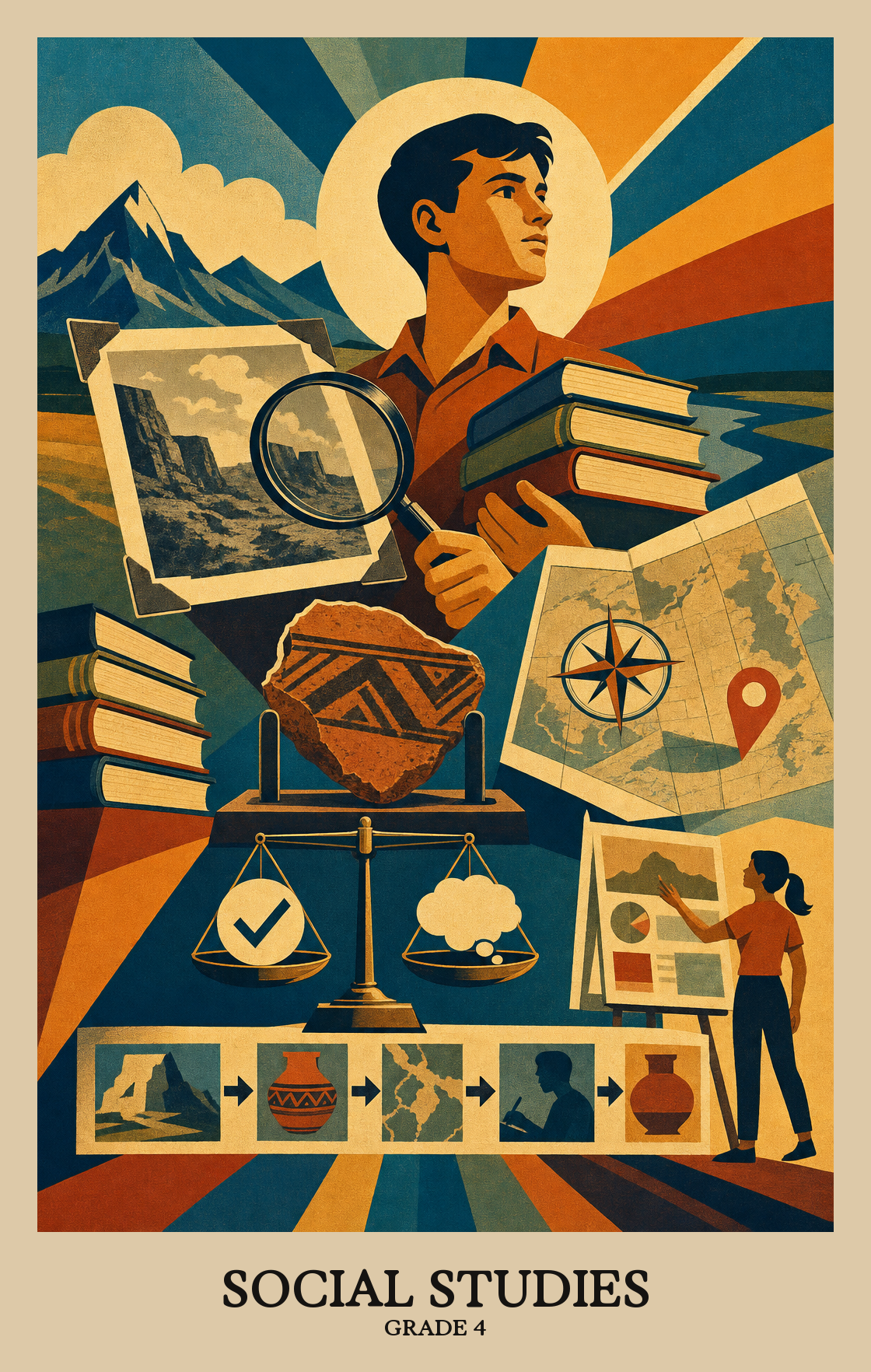
Students start the year by asking real questions about people, places, and the past. They learn that a strong question is one a book or expert can actually help answer.
Students look at letters, photos, articles, and old objects to figure out what they show. They learn to tell where information came from and whether it was made at the time or written later.
Students practice spotting the difference between something that can be proven and something a person believes. They notice how the writer's side of a story can shape what gets told.
Students turn their findings into maps, timelines, charts, and diagrams. The goal is to share an idea in a way another person can see at a glance.
Students pull it all together in a research project. They pick a question, gather sources, and share what they found with classmates or family.
With a teacher's help, students choose real historical documents, photos, or news articles, then decide which ones are trustworthy and useful for answering a research question.
Students study real objects from the past, like pottery, tools, or clothing, to figure out what life was like for people in another time or place. Then they use what those objects reveal to explain a social studies topic.
| Standard | Definition | Code |
|---|---|---|
| Select, analyze, and evaluate primary and secondary social studies’ sources… | With a teacher's help, students choose real historical documents, photos, or news articles, then decide which ones are trustworthy and useful for answering a research question. | 4.TS.7.A.a |
| Analyze and use artifacts to share information on social studies’ topics | Students study real objects from the past, like pottery, tools, or clothing, to figure out what life was like for people in another time or place. Then they use what those objects reveal to explain a social studies topic. | 4.TS.7.A.b |
Students read maps, charts, and diagrams to figure out what the information means, then draw conclusions or make predictions about it. A teacher is nearby to help when needed.
Students make maps, timelines, charts, or diagrams to show what they've learned. The goal is to present information clearly in a visual form rather than just writing it out.
| Standard | Definition | Code |
|---|---|---|
| Use visual tools and informational texts to interpret, draw conclusions, make… | Students read maps, charts, and diagrams to figure out what the information means, then draw conclusions or make predictions about it. A teacher is nearby to help when needed. | 4.TS.7.B.a |
| Create products such as maps, graphs, timelines, charts, models, diagrams, etc… | Students make maps, timelines, charts, or diagrams to show what they've learned. The goal is to present information clearly in a visual form rather than just writing it out. | 4.TS.7.B.b |
Students learn to tell the difference between a fact that can be checked and an opinion that reflects what someone believes. They also practice spotting when a source favors one side of a topic over another.
| Standard | Definition | Code |
|---|---|---|
| Distinguish between fact and opinion and recognize bias and point of view in… | Students learn to tell the difference between a fact that can be checked and an opinion that reflects what someone believes. They also practice spotting when a source favors one side of a topic over another. | 4.TS.7.C.a |
Students pick a social studies topic, gather information from real sources like books or maps, and share what they found with the class. A teacher helps guide the process.
| Standard | Definition | Code |
|---|---|---|
| With assistance, conduct and present social studies’ research to an audience… | Students pick a social studies topic, gather information from real sources like books or maps, and share what they found with the class. A teacher helps guide the process. | 4.TS.7.D.a |
Students come up with their own questions worth investigating about a history or civics topic, questions specific enough to actually research and answer.
Students follow a step-by-step process to research a real social studies question, from finding sources to drawing conclusions. The question drives the work, not a worksheet.
Students pick the right sources to answer a big social studies question, like choosing a history book over a random website. They practice matching the question to the source that actually answers it.
| Standard | Definition | Code |
|---|---|---|
| Generate compelling research questions about a social studies topic | Students come up with their own questions worth investigating about a history or civics topic, questions specific enough to actually research and answer. | 4.TS.7.E.a |
| Apply a research process to a compelling social studies’ question | Students follow a step-by-step process to research a real social studies question, from finding sources to drawing conclusions. The question drives the work, not a worksheet. | 4.TS.7.E.b |
| Identify and use appropriate resources for investigating a compelling social… | Students pick the right sources to answer a big social studies question, like choosing a history book over a random website. They practice matching the question to the source that actually answers it. | 4.TS.7.E.c |
Students pick a social studies question, dig into sources to find answers, and share what they learned with an audience. Think of it as a short research project that ends with students explaining their findings out loud or in writing.
| Standard | Definition | Code |
|---|---|---|
| Research an appropriate social studies’ question and share results with… | Students pick a social studies question, dig into sources to find answers, and share what they learned with an audience. Think of it as a short research project that ends with students explaining their findings out loud or in writing. | 4.TS.7.F.a |
Alternate assessment for eligible students with significant cognitive disabilities, covering the state-tested grade-level and end-of-course subjects.
Federally administered sample-based assessment in reading, mathematics, science, writing, and other subjects. NAEP results inform state-by-state comparisons rather than individual student or school accountability.
Students learn to ask real questions about people, places, and the past, then go find answers. They look at maps, old photos, objects like tools or pottery, and short articles. By the end of the year, students can share what they found with a small project or presentation.
Ask students where they got their information and whether it came from someone who was actually there. Looking at old family photos, museum websites, or a road map together counts. Five minutes of questions like that builds the same thinking the year is asking for.
A primary source is something from the time itself, like a letter, a photograph, a tool, or a song. Students compare those to books and websites written later. Pointing this out at a museum or while watching a documentary helps the idea stick.
By spring, students should be able to pick a question, find two or three sources that help answer it, and tell the difference between a fact and an opinion. They should also be able to make a simple map, timeline, or chart that shows what they learned.
Start with sorting fact from opinion using short articles and ads, since that skill shows up in every other task. Move into reading maps, timelines, and artifacts in the middle of the year. Save full research projects for the second half, once students can handle a question and two sources.
A good question has more than one possible answer and needs a source to settle it. Why did people settle near rivers is a strong question. What year did something happen is too small to research. Model the difference often and students will copy it.
Ask who made it and why. A company selling something, a kid on a video, and a museum site are all telling you different things for different reasons. Naming the source out loud, even with cereal boxes and ads, builds the habit fast.
Telling fact from opinion in a real article trips students up, especially when the opinion sounds confident. Reading a map legend and a timeline scale also need repeated practice. Build short warm-ups around these instead of saving them for a unit.
Students often build a timeline, a labeled map, a poster about an artifact, or a short presentation answering a question they chose. Ask what their question was and which sources helped most. That conversation matters more than how the poster looks.